If you’re comparing Apidog and Schemathesis, you’re probably trying to figure out which one to put in your CI pipeline. The honest answer is that they solve different problems, and the strongest teams run both. This guide breaks down what each tool does, where each one wins, and gives you a clean split so you stop treating them as either-or. For a broader grounding, the API testing ultimate guide covers the categories these tools sit in, and Schemathesis publishes its own open-source docs and source on GitHub.
The short version
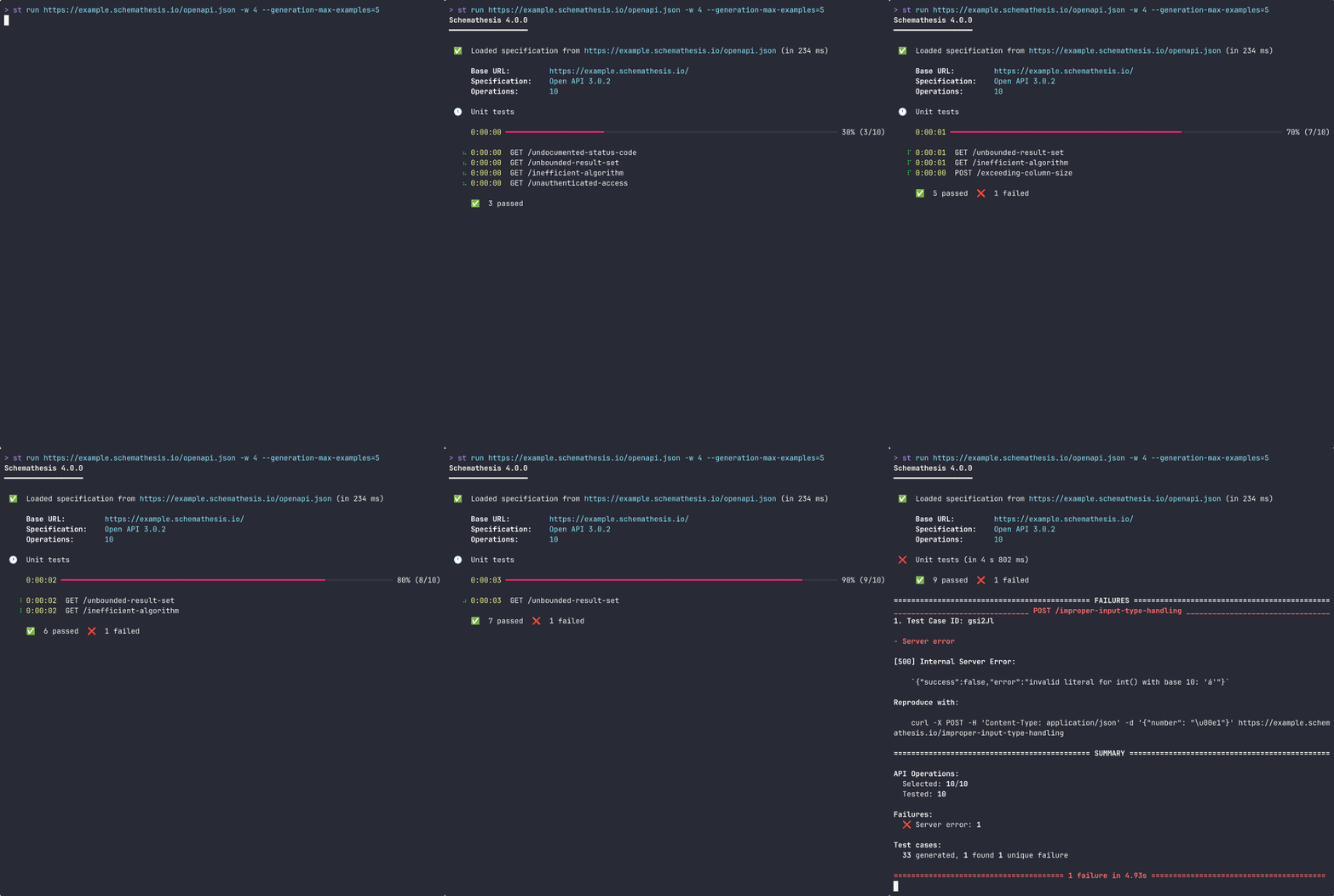
Schemathesis is a property-based fuzzer. You hand it an OpenAPI or GraphQL schema, and it generates a flood of inputs to find cases where your API crashes, returns undocumented data, or accepts values it shouldn’t. It’s built on Hypothesis, the Python property-based testing library, and it shines at catching the bugs you didn’t think to write a test for.
Apidog is an all-in-one API platform. You design APIs visually, write functional and contract tests with assertions, run them data-driven against CSV or JSON, mock endpoints, and wire the whole thing into CI/CD with the apidog run command. It covers REST, gRPC, WebSocket, SSE, SOAP, and GraphQL in one workspace.
So one tool hunts for unknown edge cases from your schema. The other builds the deliberate, repeatable test suite your team maintains by hand. Different jobs.
What Schemathesis is good at
Schemathesis reads your schema and treats it as a contract, then tries to break that contract. It generates inputs from your declared types and constraints, sends them, and checks the responses against what the spec promises. Out of the box it catches things like:
- 500 errors triggered by edge-case inputs you never tested manually.
- Responses that don’t match the documented schema (undocumented fields, wrong types, missing required fields).
- Validation gaps where invalid data slips through and gets a 2xx.
Because it’s property-based, you don’t write individual test cases. You write properties (or accept the built-in checks) and let the engine explore the input space. When it finds a failure, it shrinks the input down to a minimal reproducible example, which is genuinely useful when you’re debugging. Instead of staring at a 4 KB payload that triggered a crash, you get the smallest input that still reproduces it. It can also chain operations, using data from one response to drive the next request, so it tests realistic sequences and not just isolated calls.
It runs as a CLI, a Docker image, a GitHub Action, and inside pytest. It supports OpenAPI 2.0, 3.0, and 3.1 plus GraphQL. If your spec is accurate and you want machine-generated coverage of the messy inputs, Schemathesis earns its place. This is fuzzing driven by your schema, and it’s good at it.
Where it’s narrower: Schemathesis is a testing engine, not a design or collaboration platform. It assumes you already have a schema, it’s Python-centric, and it doesn’t mock, document, or give you a visual surface for non-engineers. It also isn’t built to express bespoke business-logic assertions the way a functional test suite is. That’s not a knock. It’s the scope.
What Apidog is good at
Apidog covers the parts of the lifecycle that sit around the fuzzing layer. You can:
- Design APIs visually with an OpenAPI-backed editor, then keep the spec as the source of truth.
- Build functional tests with visual assertions, no scripting required, then chain them into test scenarios that pass data between steps.
- Run contract testing to confirm the running API still matches the agreed spec.
- Drive tests data-driven from CSV or JSON with
apidog run -d, so one scenario runs across dozens of input rows. - Mock endpoints with realistic responses before the backend exists.
- Run everything in CI/CD through the apidog run command, with branches and an API-as-code workflow for review.
- Test across REST, gRPC, WebSocket, SSE, SOAP, and GraphQL from the same place.
The honest edge here isn’t that Apidog fuzzes better. It doesn’t fuzz at all in the property-based sense. Apidog’s edge is breadth and intent: deliberate, reviewable tests that your team owns, plus design, mocking, docs, and multi-protocol support in one tool instead of five.
One point worth clearing up, since it comes up a lot. Apidog supports monkey testing, which throws random inputs at an interface. That is not the same as property-based testing. Monkey testing is random and unstructured. Property-based testing, which is what Schemathesis does, generates inputs strategically from your schema’s types and constraints and checks declared properties. Don’t conflate the two. If you want true property-based fuzzing, that’s Schemathesis’s lane, not Apidog’s.
Head-to-head comparison
| Capability | Apidog | Schemathesis |
|---|---|---|
| Primary job | Functional + contract testing, design, mock, docs | Property-based fuzzing from a schema |
| Test authoring | Visual, no-code assertions + scenarios | Auto-generated from schema; properties in code |
| Input strategy | Deliberate cases + data-driven (CSV/JSON) | Generated inputs across the schema’s input space |
| Finds unknown edge cases | Limited (random monkey testing, not property-based) | Yes, this is its core strength |
| Schema/spec contract checks | Yes, contract testing | Yes, validates responses against the spec |
| Protocols | REST, gRPC, WebSocket, SSE, SOAP, GraphQL | OpenAPI (REST) + GraphQL |
| Mocking | Built-in smart mock | No |
| API design + docs | Visual designer + auto docs | No |
| CI/CD | apidog run in any pipeline |
CLI, Docker, GitHub Action, pytest |
| Interface | Desktop app + CLI | CLI / library (Python) |
| Audience | Devs, QA, tech leads, frontend, writers | Engineers comfortable in Python/CLI |
The table makes the split obvious. Apidog is wide and deliberate. Schemathesis is deep and generative within one specific category.
Use both: here’s the split
You don’t have to choose. Here’s a clean division of labor that gets you the coverage of both without redundant work.
Let Apidog own the deliberate layer
Use Apidog to design the API, mock it for the frontend, and write the functional and contract tests that encode your business rules. “Creating an order with a valid payload returns 201 and a sane order ID.” “An expired token returns 401.” “The checkout scenario passes the cart ID from step one into step three.” These are cases a human decides matter, and they belong in a maintained suite. Run them in CI with apidog run, data-driven from CSV when you need broad input coverage on known shapes.
Let Schemathesis own the generative layer
Point Schemathesis at the same OpenAPI or GraphQL schema and let it fuzz. It’ll surface the 500s and contract mismatches your hand-written tests miss, because it explores inputs nobody thought to type. Run it as a separate CI job or a nightly stage so a noisy fuzz run never blocks a clean functional gate.
Keep the schema as the shared contract
The glue is the schema. Apidog treats your OpenAPI spec as the source of truth for design, mocks, and contract tests. Schemathesis consumes that same spec to generate its inputs. Keep the spec accurate and both tools get sharper. A drifting spec weakens both, so spec quality is the one investment that pays off twice.
That’s the whole split. Deliberate suite plus design and mocks in Apidog, generative fuzzing in Schemathesis, one shared schema underneath.
Frequently asked questions
Is Apidog a Schemathesis alternative?
Only partway. If you specifically want property-based fuzzing generated from your schema, Apidog isn’t a drop-in replacement, because it doesn’t do that. If “alternative” means you want one tool for design, functional tests, contract testing, mocking, and CI, Apidog covers far more of the lifecycle. The realistic framing is complement, not replacement. For the functional side, see how contract testing works in Apidog.
Property-based vs functional API testing: what’s the difference?
Functional testing checks specific, known cases you wrote on purpose: this input should produce that output. Property-based testing checks general properties across many generated inputs: “the API should never return a 500” or “every response should match its declared schema.” Functional tests verify the behavior you designed. Property-based tests hunt for behavior you didn’t anticipate. You want both.
Does Apidog do fuzzing?
Apidog has monkey testing, which sends random inputs, but that’s not property-based fuzzing. Property-based testing generates inputs strategically from your schema’s types and constraints and shrinks failures to minimal cases. For that exact capability, Schemathesis is the right tool. Apidog’s strength is the deliberate, data-driven, multi-protocol test suite plus design and mocking.
Can I run both in the same CI pipeline?
Yes, and it’s a common setup. Run your Apidog functional and contract tests as a blocking gate with apidog run, since those are deterministic and should always pass. Run Schemathesis as a separate or nightly job, since fuzz runs can be longer and noisier. Both read the same schema, so there’s no duplicate maintenance of test definitions.
Bottom line
Schemathesis is a strong property-based fuzzer. It finds the edge-case bugs your hand-written tests miss, straight from your schema. Apidog is the platform around that: visual design, functional and contract tests, data-driven runs, mocking, CI/CD, and support for REST, gRPC, WebSocket, SSE, SOAP, and GraphQL. They don’t compete so much as cover different halves of a complete testing strategy.
If your current setup leans entirely on one side, add the other. Download Apidog to build the deliberate, maintained test suite and design layer, keep Schemathesis for generative fuzzing, and let your shared schema tie them together. You can try Apidog free, and once your functional tests live in Apidog, wiring them into CI takes one command.