
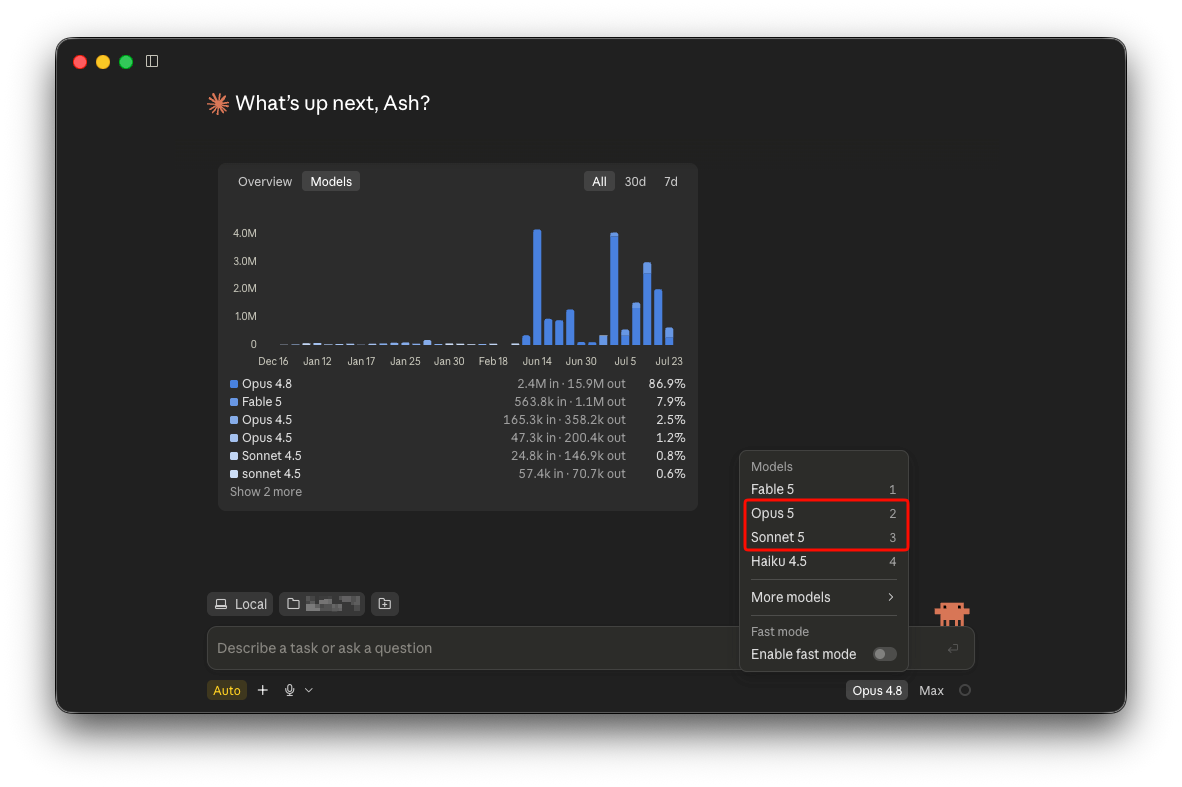
Anthropic shipped Claude Opus 5 on July 24, 2026, and Claude Sonnet 5 on June 30, 2026. Both are current-generation. Both carry a 1M context window and 128k max output. Both run adaptive thinking by default and expose an effort parameter. From the outside they look like the same model at two prices, which turns the choice into a pure spend question.
That question has a deadline attached. Sonnet 5 is still on its introductory rate of $2 per million input tokens and $10 per million output tokens. On September 1, 2026, it moves to the standard $3 / $15. Opus 5 sits at $5 / $25 and is not scheduled to move. So the gap between the tiers is 2.5x today and roughly 1.67x from September, and that shift is large enough to flip real decisions. If you are budgeting a workload that ships in Q4, budget it at the September numbers, not today’s.
This guide compares the two on specs, real cost per task (not cost per token, which misleads here), where Opus 5’s agentic-coding edge is worth paying for, and where Sonnet 5 is plainly enough. If you want to measure the difference yourself instead of trusting a table, you can run both models side by side in Apidog and read the usage fields back.
The pricing picture, and the date that changes it
Here are the published base rates from Anthropic’s pricing page.
| Model | Input / MTok | Output / MTok | Status |
|---|---|---|---|
| Claude Opus 5 | $5.00 | $25.00 | Standard |
| Claude Sonnet 5 (through Aug 31, 2026) | $2.00 | $10.00 | Introductory |
| Claude Sonnet 5 (from Sep 1, 2026) | $3.00 | $15.00 | Standard |
Opus 5 also carries rates worth knowing before you model anything: prompt caching at $6.25 per MTok for a 5-minute write, $10 for a 1-hour write, and $0.50 for cache hits; the Batch API at $2.50 / $12.50, a flat 50% discount; fast mode at $10 / $50 for 2.5x output speed (research preview, first-party API only, not combinable with batch); and a 1.1x multiplier on every token category when you set inference_geo: "us". The full breakdown with worked examples lives in the Opus 5 pricing guide, and the Sonnet side is covered in the Sonnet 5 pricing breakdown.
One detail that surprises people: Opus 5 costs exactly what Opus 4.8 cost. Anthropic did not raise the Opus price for a generation jump. So the Opus-versus-Sonnet decision you made in July 2026 is the same arithmetic you were doing in June, with a better Opus on one side of it.
Specs: nearly identical shells
| Spec | Claude Opus 5 | Claude Sonnet 5 |
|---|---|---|
| Model ID | claude-opus-5 |
claude-sonnet-5 |
| Context window | 1M tokens (default and max) | 1M tokens (default and max) |
| Max output | 128k (300k on Batch API with beta header) | 128k |
| Adaptive thinking | On by default | On by default |
| Effort levels | Five, up to max, default high |
low / medium / high / xhigh |
| Knowledge cutoff | May 2026 | January 2026 |
| Priority Tier | Not supported | Not available |
| Prompt caching, tool use, batch, vision | Supported | Supported |
| Tokenizer | 4.7-generation tokenizer | 4.7-generation tokenizer |
Three of those rows do real work.
The knowledge cutoff gap is four months. Opus 5 is trained through May 2026, the freshest cutoff of any current Claude model; Sonnet 5 stops at January 2026. If your workload touches library versions or API changes from spring 2026, Opus 5 knows about them. That is a recency argument rather than a capability one, and retrieval closes it for either model.
Neither tier gives you Priority Tier. This trips up teams migrating from Opus 4.8, which does support it. If you depend on Priority Tier for latency guarantees, neither current-generation model is a drop-in. The Opus 4.8 to Opus 5 migration guide covers the rest of the breaking changes.
The tokenizer row is a non-difference, and that is worth knowing. It is the row people expect to matter here, and it does not.
Why cost per token still misleads here
Start by clearing up a common mix-up. Anthropic documents that Claude 4.7 and later models use a newer tokenizer producing roughly 30% more tokens for the same text than the previous one. Both Opus 5 and Sonnet 5 are in that group. The 30% figure is measured against Sonnet 4.6 and earlier, not between these two.
So Opus 5 and Sonnet 5 count your text the same way. A 4,000-word document is the same number of billable input tokens on both, and the published per-token prices are directly comparable. If you are migrating from Sonnet 4.6, budget for the 30% jump; if you are choosing between these two, ignore it.
What does move cost per task is output volume. Anthropic’s own prompting guidance for Opus 5 says its default visible responses and written deliverables run longer than prior Opus models, and that lowering effort reduces thinking without reliably shortening the visible response. Output tokens cost five times what input tokens cost on both models. An Opus 5 request that writes 30% more prose than you asked for is a real line item, and the fix is prompt-side, not price-side. The Opus 5 prompting guide covers the conciseness instructions that bring it back down.
Anthropic’s token counting endpoint gives you exact input counts for both models on your own text in a couple of minutes. Measure output on a real sample of your workload rather than assuming.
Here is what the arithmetic looks like on a concrete daily workload: 500k input tokens and 40k output tokens.
| Scenario | Daily cost | Ratio vs Sonnet 5 |
|---|---|---|
| Opus 5 | $3.50 | baseline |
| Sonnet 5, introductory ($2/$10) | $1.40 | Opus is 2.5x |
| Sonnet 5, standard from Sep 1 ($3/$15) | $2.10 | Opus is 1.67x |
| Opus 5 writing 30% more output than asked | $3.80 | Opus is 1.81x |
That last row is the one to sit with. Verbosity you did not ask for can cost more than the tier difference you agonised over, and it is the cheapest thing on this page to fix.
And then there is the retry math, which is where the whole comparison usually gets decided. At standard pricing, one Opus 5 run costs $3.50 and one Sonnet 5 run costs $2.10. If Sonnet 5 needs a second attempt on a task Opus 5 completes in one, the two runs cost $4.20 and Sonnet is now the expensive option. Model retries and human review time, not just tokens. The general levers for both models are in our guide to cutting your Claude API bill.
Where Opus 5 earns the premium
Anthropic’s launch numbers for Opus 5 are aggressive. To be clear about their status: these are vendor-run results published by Anthropic, and as of July 25, 2026 none of them have been independently reproduced. Read them as claims with a source, not as neutral measurements.
- Frontier-Bench v0.1: Opus 5 surpasses all other models and more than doubles Opus 4.8’s score, at a lower cost per task.
- ARC-AGI 3: roughly 3x the next-best model’s score.
- OSWorld 2.0: surpasses Fable 5 at about one-third the cost.
- CursorBench 3.2: within 0.5% of Fable 5’s peak, at half the price.
- Zapier AutomationBench: pass rate around 1.5x the next-best model.
- Science: organic chemistry up 10.2 points and protein analysis up 7.7 points over Opus 4.8.
Sonnet 5’s own launch numbers came in below Opus 4.8: SWE-bench Pro 63.2% against 69.2%, Terminal-Bench 2.1 at 80.4% against 82.7%, and OSWorld-Verified 81.2% against 83.4%. Sonnet 5’s story was that it lands within a few points of Opus 4.8 on agentic and tool-use work while costing much less, which was a strong story in June. Opus 5 changes the shape of it: the tier above Sonnet is now materially better than the Opus 4.8 those Sonnet comparisons were drawn against. The full attribution and caveats are in the Opus 5 benchmarks breakdown and the Sonnet 5 benchmarks post.
In practice, Opus 5 pulls ahead when the task has one or more of these properties:
- Long-horizon agentic coding. Multi-file refactors, migrations, and loops that run for dozens of tool calls. Errors compound in agent loops, and a model that fails less often per step is worth more than its price gap suggests.
- The task is expensive to get wrong. Production migrations, security-adjacent code, anything a human has to review carefully. Review time costs more per hour than either model costs per day.
- Computer use and desktop automation. OSWorld 2.0 is the benchmark Anthropic leaned on hardest here.
- Hard scientific and analytical reasoning, where the chemistry and protein-analysis deltas are the clearest gains in the launch set, or work that needs May 2026 knowledge you cannot supply through retrieval.
Where Sonnet 5 is plainly enough
The honest answer for most production traffic is Sonnet 5. Opus 5 being better does not make Sonnet 5 insufficient, and paying for capability you cannot detect in your output is not a strategy.
Sonnet 5 is the right call when:
- Volume is high and each call is small. Classification, extraction, summarization, tagging, routing. The quality ceiling on these tasks is low enough that both models hit it.
- The output gets validated automatically anyway. If a schema check or a test suite catches failures cheaply, a slightly higher failure rate is a cheap failure rate.
- Latency matters more than depth, or you are still prototyping. Build on Sonnet 5, then measure whether Opus 5 changes anything before you pay for it.
There is also a free path worth knowing: Sonnet 5 is the default model on the free Claude plan, so you can sanity-check its output on your actual prompts before writing a line of code. Opus 5 is now the highest-performing model available to Pro subscribers and the default for Max, so the consumer tiers reach it too. Our Opus 5 free access guide walks the honest paths.
Decision table by workload
| Workload | Pick | Why |
|---|---|---|
| Multi-file refactor or migration in an agent loop | Opus 5 | Compounding errors make per-step reliability the dominant cost |
| High-volume classification or extraction | Sonnet 5 | Both hit the quality ceiling; price wins |
| Customer-facing chat with retrieval | Sonnet 5 | Retrieval closes the cutoff gap; latency matters |
| Computer use or desktop automation | Opus 5 | Anthropic’s OSWorld 2.0 gap is the clearest agentic claim |
| Batch document processing overnight | Sonnet 5, or Opus 5 on the Batch API | Batch at 50% off can put Opus 5 near Sonnet’s standard rate |
| Security review or production-critical code | Opus 5 | Cost of a miss dwarfs the token delta |
| Scientific or quantitative analysis | Opus 5 | The chemistry and protein-analysis deltas are the strongest gains |
| Prototyping and internal tools | Sonnet 5 | Measure before you upgrade |
| Anything needing spring 2026 knowledge without retrieval | Opus 5 | May 2026 cutoff versus January 2026 |
| Latency-sensitive interactive UX | Sonnet 5 | Or Opus 5 fast mode at $10/$50 if depth is non-negotiable |
Notice the Batch API row. Opus 5 on batch is $2.50 / $12.50, which lands below Sonnet 5’s September standard rate of $3 / $15 on input and slightly above it on output. If your work tolerates asynchronous processing, the tier question can dissolve entirely.
What neither model is
Opus 5 is not the top of the Claude stack, and it is worth saying that plainly rather than letting the launch coverage imply otherwise. Fable 5 remains Anthropic’s most capable widely released model, at $10 / $50. And Opus 5 still trails Mythos 5 on cybersecurity exploitation and autonomous biology research, which is Anthropic’s own statement, not an outside critique.
The accurate framing for Opus 5 is frontier-class capability at half the frontier price, with a named ceiling above it. If your workload sits at that ceiling, the real comparison is not Opus 5 against Sonnet 5 at all; see Opus 5 vs Fable 5 instead.
Run the comparison yourself in Apidog
Benchmarks are somebody else’s workload. The comparison that matters is your prompts, your tools, your acceptance criteria. Both models sit behind the same Messages endpoint, so testing them against each other is a matter of changing one string.
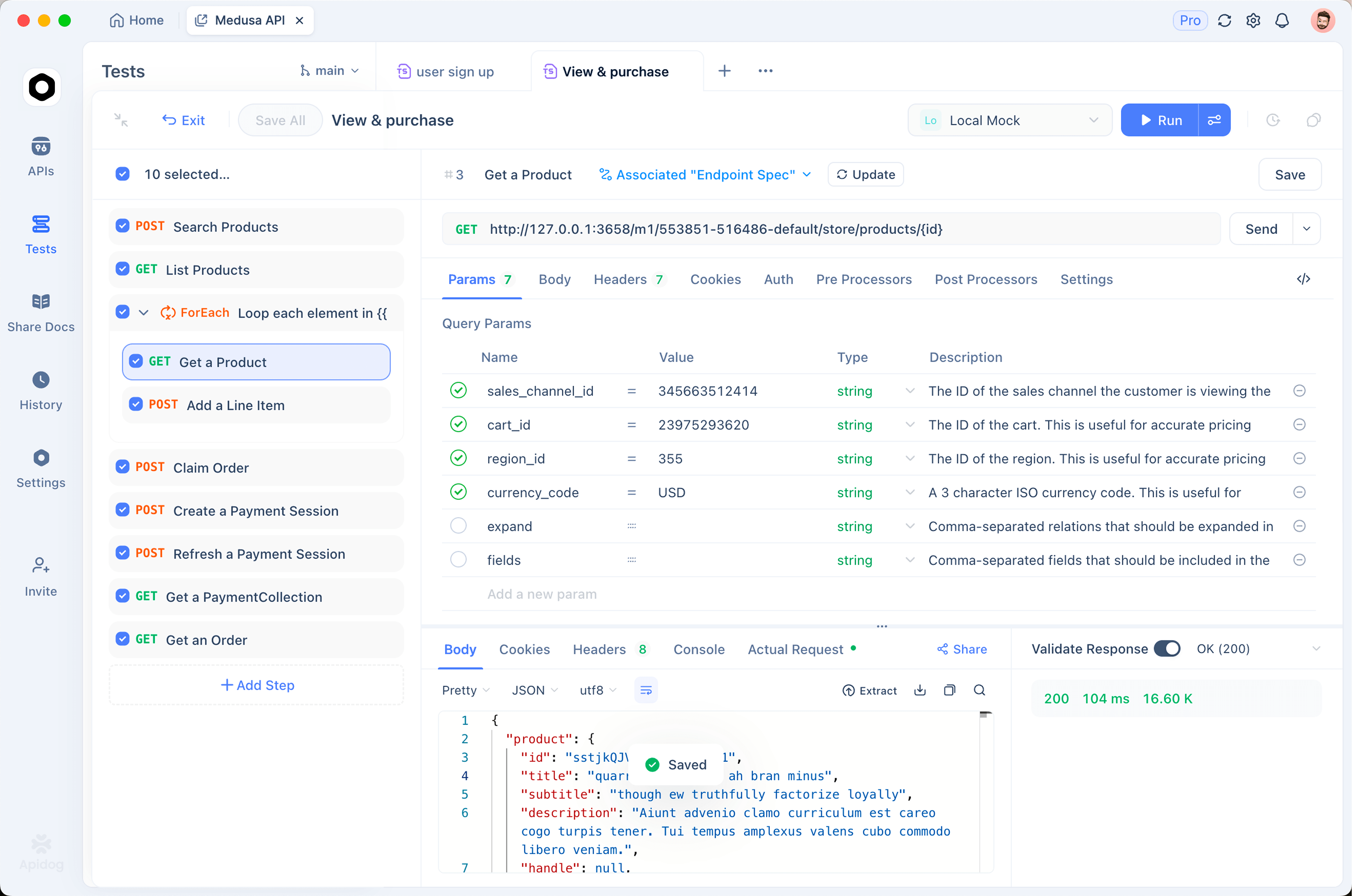
Set it up in Apidog like this:
- Create one request to the Anthropic Messages endpoint and store the API key as an environment variable rather than pasting it into the body.
- Save two variants sharing the same prompt, one with
"model": "claude-opus-5"and one with"model": "claude-sonnet-5". - Read the
usageobject on each response. Real input, output, and cached token counts per model are the only reliable input to a cost model. - Add assertions on the response shape so a refusal or a truncated response fails loudly instead of quietly.
- Repeat the Opus 5 request at different
output_config.effortlevels and compare cost against quality. Opus 5 defaults tohigh, and itslowandmediumlevels are meaningfully stronger than on previous Opus models, so a sweep often finds a cheaper setting that still passes. The effort parameter guide covers the method.
curl https://api.anthropic.com/v1/messages \
  --header "x-api-key: $ANTHROPIC_API_KEY" \
  --header "anthropic-version: 2023-06-01" \
  --header "content-type: application/json" \
  --data '{
    "model": "claude-opus-5",
    "max_tokens": 4096,
    "messages": [
      {"role": "user", "content": "Refactor this handler to use async I/O."}
    ]
  }'
Two gotchas while you test. Adaptive thinking is on by default on both models, and max_tokens caps thinking plus response together, so a budget that worked on an older model can truncate. And on Opus 5, combining thinking: {type: "disabled"} with effort xhigh or max returns a 400. Download Apidog to run the pair side by side, and see the Opus 5 API walkthrough for the complete request flow.
FAQ
Is Claude Opus 5 worth 2.5x the price of Sonnet 5? For long-horizon agentic coding, computer use, and work that is expensive to get wrong, yes. For high-volume classification, extraction, and chat, usually not. And the multiple is only 2.5x until September 1, 2026, after which Sonnet 5’s standard rate of $3 / $15 makes it about 1.67x.
When does Claude Sonnet 5 pricing change? The introductory rate of $2 / $10 runs through August 31, 2026. From September 1, 2026 it moves to $3 / $15. Opus 5 stays at $5 / $25.
Do Opus 5 and Sonnet 5 tokenize text differently? No. Both use the 4.7-generation tokenizer, so identical text produces identical input token counts and the per-token prices compare directly. The roughly 30% token increase Anthropic documents is measured against Sonnet 4.6 and earlier models, which matters if you are upgrading from one of those, not if you are choosing between these two. Compare cost per completed task anyway, since output length and retries move the bill more than the sticker gap does.
Can I switch between Opus 5 and Sonnet 5 without code changes? Mostly. Both take adaptive thinking by default and reject non-default sampling parameters. The differences to watch are the effort levels (Opus 5 exposes a max level and defaults to high) and the Opus-specific 400 when thinking is disabled at xhigh or max.
Which model does Anthropic recommend by default? Anthropic’s own docs now say to start with Claude Opus 5 if you are unsure. That is a recommendation, not a cost analysis. Start there, then measure whether Sonnet 5 gives you the same result for less. The older Sonnet 5 vs Opus 4.8 comparison is still useful background on how the tiers behave relative to each other.
For the full specs, benchmark attributions, and availability matrix, start at what Claude Opus 5 is, and read Anthropic’s Opus 5 launch post and models overview for the primary sources.