Kimi K3.1 Pro pricing on the API is $2.00 per 1M input tokens and $10.00 per 1M output tokens, with cache hits at $0.20 per 1M. Kimi K3.1 Pro Highspeed costs exactly double: $4.00 input and $20.00 output. There’s no subscription and no long-context surcharge across the 1,048,576-token window, but the model unlocks only after a $1 top-up.
Below: cache math, worked examples, rate tiers, consumer plans and a list-price comparison. Numbers come from Moonshot AI’s API pricing page, context caching guide, rate limits page and membership pricing, read October 24, 2026. New to the model? Start with what Kimi K3.1 Pro is.
Kimi K3.1 Pro API price table
The Kimi K3.1 Pro API price is pay as you go, per 1M tokens, excluding tax. Each model has five rates: input, output, cache hit, and a cache-write rate for each of the two cache lifetimes (5 minutes and 1 hour).
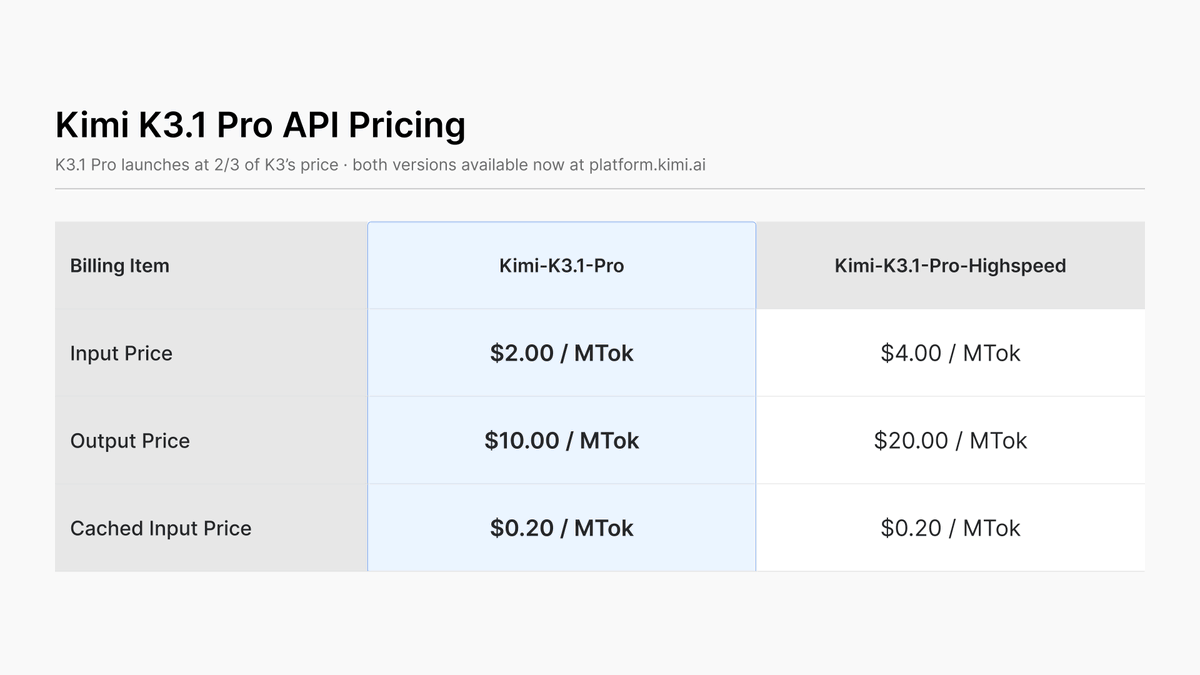
K3.1 Pro costs a third less than K3 (see our Kimi K3 API guide).
How Kimi K3.1 Pro cache pricing works
Kimi K3.1 Pro cache pricing has two parts. The first time a prefix is processed, it bills as a cache write. Later requests that reuse that exact prefix within the cache lifetime bill it as a cache hit at $0.20 per 1M, one tenth of the input price.
What decides your bill:
- Caching is automatic, with a default TTL of 5 minutes.
- A 5-minute write costs the same as input ($2.00). Moonshot says “the write cost was already included in the input price.”
- A 1-hour write costs double: $4.00 per 1M.
- Each hit renews the TTL, which is locked at the first write. The cache is shared within your organization only.
Set the 1-hour TTL on Chat Completions or the Responses API:
"prompt_cache_options": {"mode": "implicit", "ttl": "1h"}
On the Anthropic-compatible Messages API, use a top-level "cache_control": {"type": "ephemeral", "ttl": "1h"}.
5m vs 1h: the break-even
Take a 1M-token prefix. The 1-hour write costs $2.00 more ($4.00 vs $2.00). Each hit then saves $1.80 versus full input ($2.00 minus $0.20). Two hits save $3.60, which covers the extra $2.00.
The rule: if requests can sit more than 5 minutes apart and you’ll reuse the prefix at least twice in the hour, pick 1h. If requests arrive every few minutes, the free 5-minute cache keeps renewing itself.
Worked Kimi K3.1 Pro pricing examples
Both use list prices; swap in your own token counts.
Example 1: a 200K-token codebase prompt reused 20 times in an hour
You load a 200K-token repo snapshot (0.2M tokens) and ask 20 questions over an hour, some more than 5 minutes apart. Input side only:
| Setup | Math | Input cost |
|---|---|---|
| No hits (5m cache keeps expiring) | 20 × 0.2M × $2.00 | $8.00 |
| 1h cache | write 0.2M × $4.00 = $0.80, plus 19 hits × 0.2M × $0.20 = $0.76 | $1.56 |
| 5m cache, a question every 3 minutes | write 0.2M × $2.00 = $0.40, plus $0.76 | $1.16 |
The 1-hour cache cuts input cost from $8.00 to $1.56, saving $6.44 (about 80%). At 2,000 output tokens per answer, add 40,000 × $10.00 per 1M = $0.40 to every row.
Example 2: a chat app at 1,000 requests a day
Each request sends 2,000 input tokens and gets 500 output tokens, with reasoning_effort at "low":
- Input: 1,000 × 2,000 = 2M × $2.00 = $4.00 a day
- Output: 1,000 × 500 = 0.5M × $10.00 = $5.00 a day
- Total: $9.00 a day, about $270 a month, or $0.009 per request
Now make 1,500 of those input tokens a fixed system prompt. One request every 86 seconds on average sits well inside the 5-minute TTL, so nearly every request hits:
- Cached: 1.5M × $0.20 = $0.30; uncached: 0.5M × $2.00 = $1.00
- New total: $1.30 + $5.00 = $6.30 a day, about $189 a month
One catch: 1,000 × 2,500 = 2.5M tokens a day exceeds Tier0’s 1.5M daily cap, so you’d need Tier1.
Kimi K3.1 Pro Highspeed pricing
Kimi K3.1 Pro Highspeed pricing is a flat 2x premium on input, output and cache writes, for what Moonshot calls “2-3x the speed of K3.1 Pro.” Cache hits stay at $0.20.
| Example 2, no cache | Input | Output | Daily total |
|---|---|---|---|
| K3.1 Pro | 2M × $2 = $4.00 | 0.5M × $10 = $5.00 | $9.00 |
| K3.1 Pro Highspeed | 2M × $4 = $8.00 | 0.5M × $20 = $10.00 | $18.00 |
Reasoning effort, batch and web search costs
Three details the table doesn’t show:
- Reasoning tokens count toward your usage. K3.1 Pro always thinks;
reasoning_efforttakes"low","high"or"max"(default"max"), and lowering it cuts token usage. Moonshot doesn’t state verbatim that reasoning bills at the output rate [VERIFY]; if it does, 500 extra reasoning tokens per request add $5.00 a day to Example 2. - No batch discount for K3.1 Pro. The Batch API bills at 60% of standard but supports only
kimi-k2.7-codeandkimi-k2.6. - Web search bills per call.
/v1/tools/searchand/v1/tools/fetchcost $0.002 each,/v1/tools/search_pro$0.003, charged only on HTTP 200 with non-empty results: $2.00 per 1,000 basic searches. The legacy$web_searchcosts $0.005 plus result tokens and isn’t recommended for now (web search pricing).
Requests interrupted by a 429 aren’t charged.
The $1 unlock and API rate tiers
K3.1 Pro “is unlocked after a successful top-up (minimum $1).” That $1 buys about 500K input or 100K output tokens, or about 111 Example 2 requests ($1 ÷ $0.009). Cumulative top-up sets your tier:
| Tier | Cumulative top-up | Concurrency | RPM | TPM | TPD |
|---|---|---|---|---|---|
| Tier0 | $1 | 1 | 3 | 500,000 | 1,500,000 |
| Tier1 | $10 | 15 | 100 | 2,000,000 | Unlimited |
| Tier2 | $20 | 40 | 100 | 3,000,000 | Unlimited |
| Tier3 | $100 | 50 | 200 | 3,000,000 | Unlimited |
| Tier4 | $1,000 | 60 | 200 | 4,000,000 | Unlimited |
| Tier5 | $3,000 | 100 | 300 | 5,000,000 | Unlimited |
At $5 cumulative you get a $5 voucher, which doesn’t count toward your tier; whether vouchers pay for K3.1 Pro isn’t stated [VERIFY]. For $0 options, see how to use Kimi K3.1 Pro for free.
Kimi membership plans
Kimi membership plans cover the Kimi apps and Kimi Code, not the API. Monthly prices:
| Plan | Billed annually | Billed monthly | Yearly saving | Notes |
|---|---|---|---|---|
| Adagio | $0 | $0 | n/a | K3.1 Pro chat, no Kimi Code |
| Plus | $15 | $19 | $48 | Kimi Code with k3.1-pro |
| Pro | $31 | $39 | $96 | Adds Highspeed, 1M context in Kimi Code |
| Max | $79 | $99 | $240 | Up to 1M context in chat |
| Ultra | $159 | $199 | $480 | Up to 1M context in chat |
Saving = (monthly minus annual) × 12; for Ultra, $40 × 12 = $480. API, Kimi Code and membership balances and keys aren’t interchangeable: a membership doesn’t convert to API balance, and API balance can’t buy a membership.
Kimi K3.1 Pro vs Claude Opus 5.5 price
Kimi K3.1 Pro lists at half the price of Claude Opus 5.5 on input and output, and matches Claude Sonnet 5.5 and GPT-6.1 Sol up to 272K input tokens. List prices per 1M tokens, from Claude pricing and OpenAI pricing:
| Model | Input | Output | Cache read | Example 2 per day |
|---|---|---|---|---|
| Kimi K3.1 Pro | $2.00 | $10.00 | $0.20 | $9.00 |
| Claude Opus 5.5 | $4.00 | $20.00 | $0.20 | $18.00 |
| Claude Sonnet 5.5 | $2.00 | $10.00 | $0.10 | $9.00 |
| GPT-6.1 Sol (up to 272K) | $2.00 | $10.00 | $0.10 | $9.00 |
| GPT-6 Astra (up to 272K) | $10.00 | $50.00 | $1.00 | $45.00 |
Above 272K input tokens, OpenAI lists GPT-6.1 Sol at $4 / $15 and GPT-6 Astra at $20 / $75; K3.1 Pro stays flat. For a 500K-token prompt with 5,000 output tokens:
- K3.1 Pro: 0.5M × $2 + 0.005M × $10 = $1.00 + $0.05 = $1.05
- GPT-6.1 Sol: 0.5M × $4 + 0.005M × $15 = $2.00 + $0.075 = $2.075 (if the higher tier covers the whole request [VERIFY])
List price isn’t cost per task: tokenizers and reasoning lengths differ. Moonshot’s own benchmarks compare K3.1 Pro with Opus 5.5 and GPT-6 Astra. See our Claude Opus 5.5 overview.
Confirm caching works with Apidog CLI
Caching saves money only if it hits. Before you scale, have your coding agent test it. Apidog CLI gives Claude Code, Codex, Cursor or OpenCode the commands, and Apidog’s Free plan covers up to 4 users.
npm install -g apidog-cli@latest
apidog login --with-token <YOUR_TOKEN>
apidog skill install
Then give your agent one prompt:
In Apidog project <projectId>, create an environment for https://api.moonshot.ai/v1.
Build a test case for POST /chat/completions with model "kimi-k3.1-pro",
reasoning_effort "low", a long fixed system prompt and a short user message.
Send MOONSHOT_API_KEY as a Bearer token. Assert status 200 and log
usage.prompt_tokens_details.cached_tokens. Validate the payload, run it
3 times and tell me whether cached_tokens rises after the first run.
The agent runs:
apidog environment create kimi-prod --project <projectId> --base-url https://api.moonshot.ai/v1
apidog cli-schema get test-case-create
apidog cli-schema validate test-case-create --file case.json
apidog test-case create --project <projectId> --file case.json
apidog run --test-case <caseId> --project <projectId> -e <envId> -n 3 -r cli,json
The first iteration writes the cache; the next two should report cached_tokens above zero. Moonshot doesn’t state a minimum cacheable prefix length on the pages we read [VERIFY], so keep the system prompt long. Test cases need a valid category ID (apidog test-case category --project <projectId> lists them). More in the run command reference and Apidog CLI in Claude Code.
5 cost-saving rules for Kimi K3.1 Pro
- Put stable content first: system prompt, tool definitions and reference docs. No timestamps or random IDs in the prefix.
- Pick the TTL by gap. Gaps over 5 minutes and two or more reuses an hour: use 1h.
- Set
reasoning_effortper task. Use"low"for simple calls. - Use Highspeed only where speed earns it. It doubles every rate except cache hits.
- Log the cache fields:
cached_tokensandcache_write_tokens, withstream_options.include_usage=truewhen streaming.
For request setup, read our Kimi K3.1 Pro API guide and how to use Kimi K3.1 Pro.
FAQ
How much does Kimi K3.1 Pro cost per 1M tokens?
$2.00 input, $10.00 output and $0.20 for cache hits. Cache writes cost $2.00 (5 minutes) or $4.00 (1 hour).
Does Kimi K3.1 Pro get the Batch API discount?
No. Batch pricing covers only kimi-k2.7-code and kimi-k2.6.
Can I use my Kimi membership for API calls?
No. Kimi API, Kimi Code and membership are separate products with separate balances and keys.
What’s the minimum to start?
A $1 top-up. It unlocks the model and puts you in Tier0: 3 requests per minute and 1.5M tokens a day.