
Claude Opus 5 landed on July 24, 2026, and it reached Claude Code on day one. If you pay for Max, it’s already your default. If you’re on Pro, it’s now the strongest model you can reach. And if you drive Claude Code with an API key, it costs $5 per million input tokens and $25 per million output, the same as Opus 4.8.
The part nobody warned you about is that your existing setup is probably working against it. Opus 5 verifies its own work without being asked, writes longer by default, and reaches for subagents more readily than Opus 4.8 did. Every one of those is a behavior your carefully tuned CLAUDE.md may be amplifying rather than correcting.
This guide covers model selection, what changes by subscription tier, how effort behaves, and the four prompting edits worth making on day one. You’ll also see how to pair it with Apidog so the model tests the API it just wrote instead of assuming it works. For the full model breakdown, start with our Claude Opus 5 overview, and see Anthropic’s Claude Opus 5 announcement for the source specs.
What changes by subscription tier
Access shifted in a way that matters more than usual.
Max subscribers: Opus 5 becomes your default model. You don’t have to do anything. Open a session and you’re on it. The practical consequence is that your muscle memory around cost and verbosity is now calibrated to a model you’re no longer running.
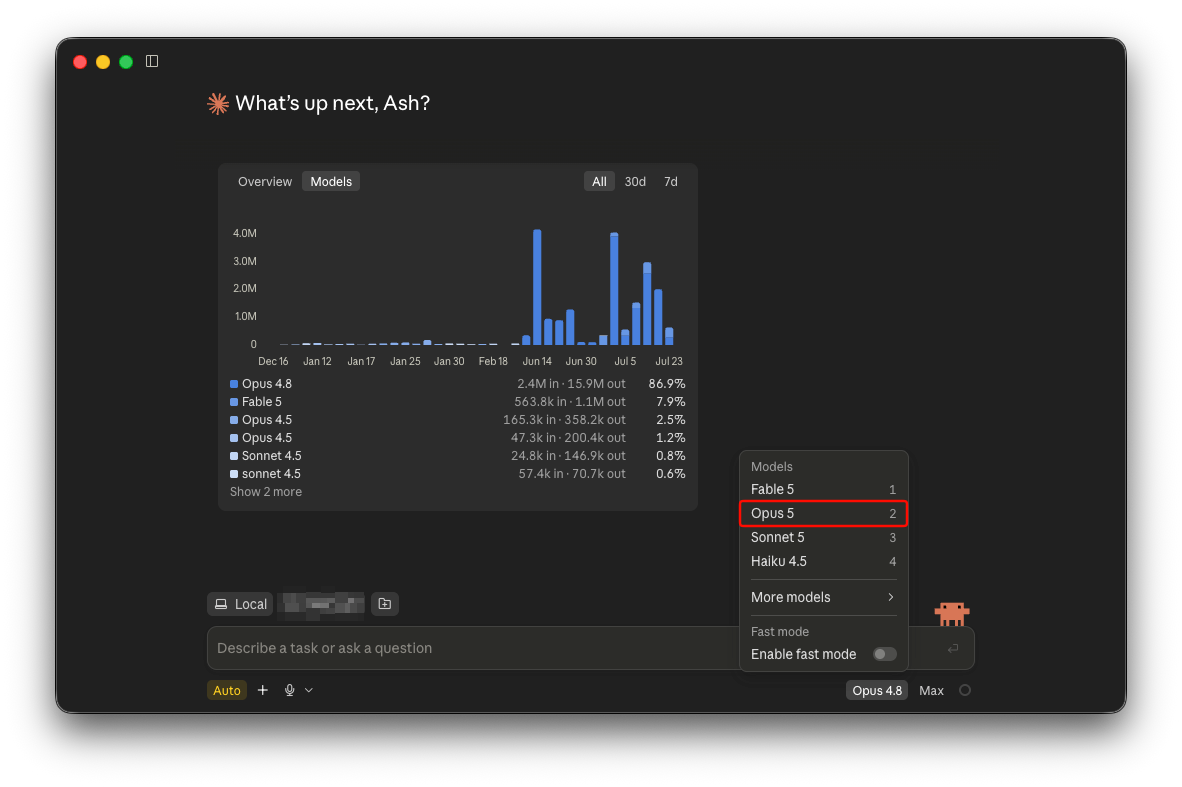
Pro subscribers: Opus 5 is now the highest-performing model available to you. That’s a real change in what a Pro seat buys. Previously the top of your stack was a step below the frontier tier; now it’s Anthropic’s recommended default across their own documentation.
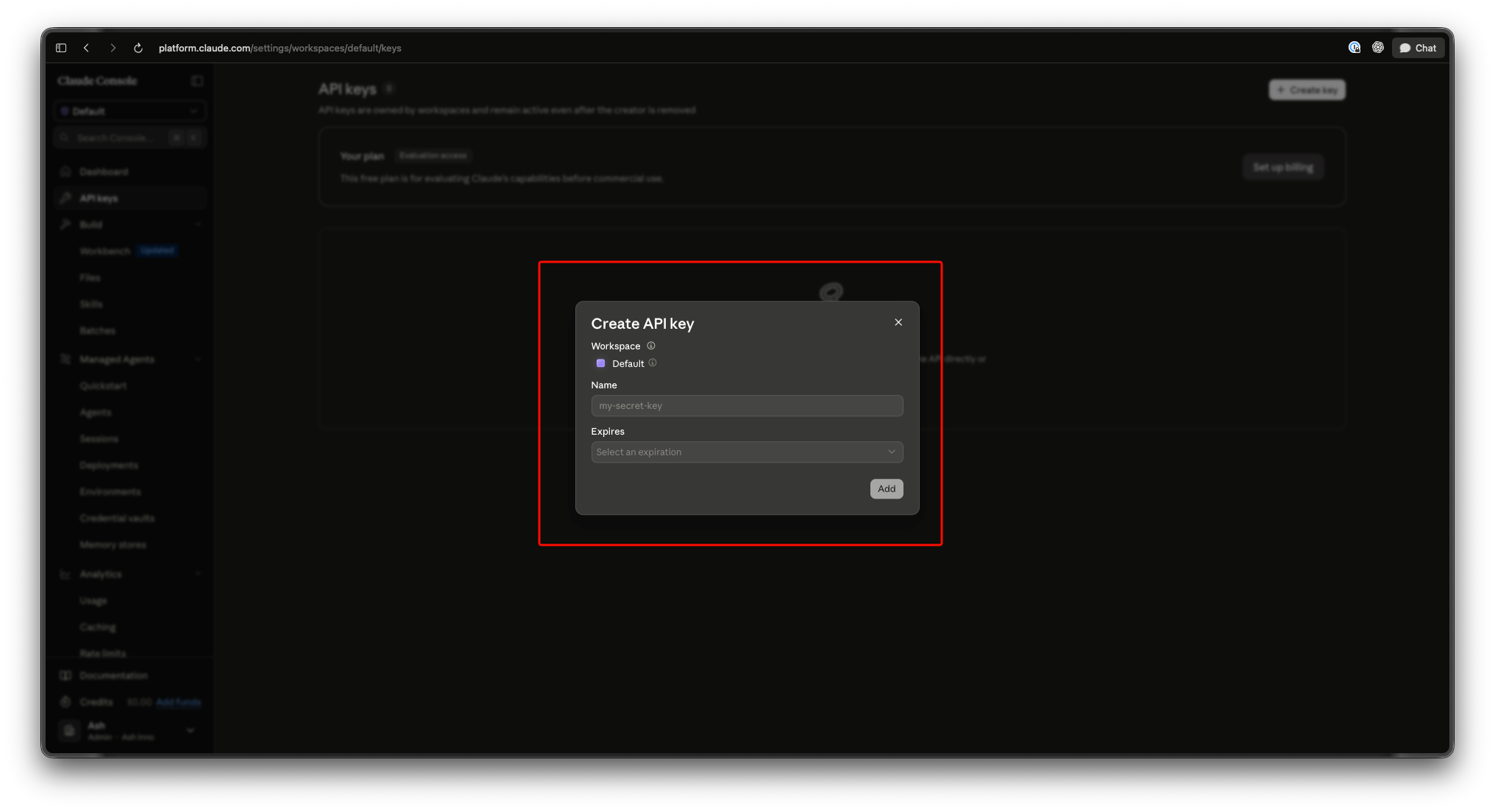
API key users: Opus 5 is available on the Claude API, Amazon Bedrock (anthropic.claude-opus-5), Google Cloud, Microsoft Foundry, and GitHub Copilot. Pricing is $5 input and $25 output per million tokens, unchanged from Opus 4.8 and half of Fable 5’s $10/$50. Our Opus 5 pricing breakdown has the full table including caching and batch rates.
One spec worth knowing before you start: Opus 5 has a knowledge cutoff of May 2026, the freshest of any current Claude model. Fable 5 and Sonnet 5 both stop at January 2026. For a coding tool that spends its day working with library APIs that shipped last quarter, five extra months of training data is not a small thing.
Select Opus 5 in Claude Code
Model selection runs through the /model command. Inside a session:
/model
You get a picker listing available models. Choose Claude Opus 5.
To set it without opening the picker, pass the ID directly:
/model claude-opus-5
The exact API model ID is claude-opus-5. No date suffix, no version stamp. If you’re scripting Claude Code, setting a project default, or writing rules files that name the model, use that string exactly. Anthropic’s model overview docs list the per-platform IDs if you’re on Bedrock or Google Cloud.
Context is 1M tokens by default and at maximum, with no beta header and no long-context price premium. Max output is 128k on the Messages API. For Claude Code that means large repos fit, though feeding the whole thing every turn still wastes money. Our Claude Code cheatsheet covers the rest of the slash commands.
How effort behaves
The press coverage called it a toggle between cost and capability. What it actually is: output_config.effort, an API parameter with five levels (low, medium, high, xhigh, max), which the consumer surfaces expose as an effort selector.
Three things to know about it on Opus 5.
The default is high. Not medium, not adaptive-with-no-floor. If you send a request and say nothing about effort, you get high.
The levels are recalibrated. Anthropic says plainly not to carry your Opus 4.8 effort settings over. Run a fresh sweep on your own evals. The specific change worth acting on is that low and medium are meaningfully stronger on Opus 5 than on any prior Opus model. Work you would never have trusted to medium on 4.8 may run fine on it now, at a real cost saving. For coding and agentic work, xhigh is still Anthropic’s recommended starting point.
There’s a 400 waiting for you. Combining thinking: {type: "disabled"} with effort xhigh or max returns a 400 error, enforced per request. Claude Code manages the request shape for you, so you won’t trip it in an interactive session. You will trip it the moment you script Claude Code or build against the SDK with thinking turned off and effort turned up. The fix is to pick one: keep thinking on and lower effort, or keep effort capped at high.
Keep thinking on, incidentally. With thinking disabled, two artifacts show up occasionally on Opus 5: tool calls written out as plain text that never execute (and the leaked text then poisons later turns in an agentic loop), and internal XML tags appearing in visible output. Anthropic’s own mitigation is to leave thinking enabled and control cost through lower effort instead. Our effort parameter guide walks through running a sweep, and the migration guide covers the rest of the 4.8 breaking changes.
Four prompting edits to make on day one
This is the section that will save you the most money and irritation. All of it comes from Anthropic’s Opus 5 prompting guide, which is worth reading in full.
1. Delete your verification instructions
If your CLAUDE.md says anything resembling “always double-check your work,” “verify the change before reporting,” or “confirm the tests pass and then confirm again,” take it out.
Opus 5 verifies its own work unprompted. It’s a trained behavior, not something you have to request. When you request it on top, you get over-verification: the model re-reads files it already read, re-runs checks it already ran, and burns tokens confirming things it had already confirmed. Anthropic’s guidance is explicit about removing these instructions.
Most Claude Code users accumulated those lines over months of working with earlier models that genuinely needed the nudge. They’re now a tax. Open your project CLAUDE.md and your global one, grep for “verify,” “double-check,” and “confirm,” and delete what you find.
2. Cap subagent spawning
Opus 5 delegates to subagents more readily than Opus 4.8. On a big parallelizable research task, that’s a feature. On a cost-sensitive workload, it’s a bill.
Scope it explicitly. Something like this in your project instructions works:
## Delegation

Do not spawn subagents for tasks that a single pass can finish.
Use at most two parallel subagents. If a task looks like it needs
more, describe the split and ask before spawning.
The point isn’t to prevent delegation. It’s to make the model justify it rather than reach for it by default. If you’re building out a subagent setup deliberately, our guide on creating Claude Code subagents covers the structure.
3. Prompt for conciseness explicitly
Opus 5’s default responses and written deliverables run longer than Opus 4.8’s. Longer summaries, longer explanations, longer docs when you ask it to write docs.
Here’s the trap: lowering effort does not fix this. Effort controls thinking depth, not visible output length. Drop to medium expecting shorter answers and you’ll get the same wall of text with less reasoning behind it.
Length is a prompt-level control now. State it:
## Response style

Report results in under 150 words unless I ask for detail.
No summary of what you just did if I can see the diff.
Skip preamble. Lead with the answer.
4. Constrain narrow tasks explicitly
Opus 5 expands task scope more than its predecessor and narrates its corrections as it goes. Ask it to fix one function and it may reasonably decide the surrounding module needs attention too.
When you want exactly one thing changed, say so as a boundary rather than as a description. “Fix the null check in parseConfig and change nothing else” reads differently to the model than “fix the null check in parseConfig.” Our deeper piece on prompting Opus 5 has copy-paste snippets for each of these behaviors.
Build an API, then let Opus 5 test it
Claude Code can scaffold your routes. It cannot see whether the running endpoint behaves the way the contract says. That gap is where most “it looked right” bugs live, and it’s wider now that the model verifies its own reasoning confidently.
Design and mock the API in Apidog first: endpoints, request and response schemas, and a mock server returning realistic data. Then, as Opus 5 writes the implementation, point it at the real spec through the Apidog MCP server so it reads the actual schema instead of inferring one. When it’s done, have it run the test scenario:
apidog run --access-token $APIDOG_TOKEN \
  --project-id $PROJECT_ID \
  --test-scenario "user-signup-flow"
Failed assertions come back as output the model can read and act on. That’s a verification loop grounded in something external, which is worth more than self-verification no matter how good the model’s self-checking is.
The same setup helps if you’re calling the Claude API directly from your code. You can send claude-opus-5 requests from Apidog, watch SSE streaming events arrive, inspect tool-call payloads, store your API key as an environment variable instead of pasting it into a script, run the same prompt at two effort levels side by side, and read the usage block to confirm cache hits are landing. Download Apidog to set the project up locally.
The honest ceiling
Opus 5 is not the top of the Claude stack, and it’s worth being clear about that before you commit a workload.
Fable 5 still holds Anthropic’s “most capable widely released” designation. And Opus 5 trails Mythos 5 on cybersecurity exploitation and autonomous biology research; Anthropic states this themselves rather than us inferring it. If your Claude Code work sits in either of those areas, Opus 5 is not the right ceiling. Our Mythos-class explainer covers what that tier is for.
On the benchmark claims: Anthropic reports that Opus 5 more than doubles Opus 4.8’s Frontier-Bench v0.1 score, lands roughly 3x the next-best model on ARC-AGI 3, and comes within 0.5% of Fable 5’s CursorBench 3.2 peak at half the price. Those are vendor-run numbers. As of July 25, 2026, none have been independently reproduced. Treat them as a reason to run your own eval, not as a settled result.
The fair summary is frontier-class capability at half the frontier price, with a named ceiling above it. That’s a good deal. It just isn’t the same claim as “best model available.”
When to use something else
Stay on Opus 5 for most Claude Code work: agentic coding, multi-file refactors, long-horizon tasks, anything where the model runs commands and reads output in a loop.
Reach elsewhere when the workload is high-volume and cost-dominated, where Sonnet 5 covers standard editing at a lower rate, or when you’re in Fable 5 or Mythos 5 territory on the hardest frontier problems. Switching is one command: /model claude-sonnet-5 for the cheap stretch, /model claude-opus-5 for the hard part. If you previously ran Sonnet 5 in Claude Code or Fable 5 in Claude Code, the workflow here will feel familiar.
Practical tips
- Audit
CLAUDE.mdfirst. Delete verification instructions, add a length constraint, add a delegation cap. Fifteen minutes, and it changes every session after it. - Re-sweep effort. Your 4.8 settings are stale.
lowandmediummay now handle work you’d have refused to give them. - Leave thinking on. Control cost with effort, not by disabling thinking. The disabled-thinking artifacts are worse than the token savings.
- Scope your context. 1M tokens is a lot of room, not a reason to dump the repo in every turn.
- Verify externally. Self-verification is good; a failing test against a real contract is better.
FAQ
Is Claude Opus 5 available in Claude Code?
Yes, from its July 24, 2026 release. Select it with /model and pick Claude Opus 5, or pass the ID directly with /model claude-opus-5. It’s the default for Max subscribers and the highest-performing model available to Pro subscribers.
Do I need to change my CLAUDE.md for Opus 5?
Probably. Anthropic’s prompting guide says carried-over verification instructions cause over-verification on Opus 5, because it verifies its own work unprompted. Remove them. Also add an explicit conciseness instruction (default responses run longer) and a subagent cap (it delegates more readily).
Why did lowering effort not make responses shorter?
Effort controls thinking depth, not visible output length. Lowering it cuts reasoning tokens while leaving the response about as long. If you want shorter output, ask for it in the prompt.
What causes a 400 error when I set effort to xhigh?
Combining thinking: {type: "disabled"} with effort xhigh or max returns a 400 on Opus 5, enforced per request. Either enable thinking or cap effort at high. See the migration guide for the other breaking changes from Opus 4.8.
Can I use Opus 5 in Claude Code on a free plan?
Opus 5 is available on Pro and Max subscriptions and through the API. Pro reaches it as the top model on that tier; Max gets it as the default. Our Opus 5 free access guide covers the honest paths and the cheapest paid ones.