Gemini 3.7 Flash is Google’s newest workhorse AI model, released on August 13, 2026, three weeks after Gemini 3.6 Flash. It keeps the 1M token context window and multimodal input of its predecessor while posting large gains on coding and agent benchmarks, and it launches at an introductory API price of $0.75 per 1M input tokens. Google calls it “our most intelligent workhorse model.”
That three-week gap between releases is the story. Google is shipping Flash updates on a sprint cadence while Gemini 3.5 Pro stays delayed, which means the mid-tier model is now where the interesting engineering lands first. The benchmark deltas back that up: DeepSWE jumps 16 points, AutomationBench nearly doubles, and the intro pricing undercuts the 3.6 Flash launch rate by half.
This post covers everything that changed: the full benchmark table Google scattered across its announcement, the pricing windows you need to calendar, every place you can access the model today, and a working cURL request you can fire in five minutes. If you want the deeper endpoint walkthrough, the Gemini 3.7 Flash API quickstart pairs with this explainer, and Apidog gives you a workspace to test the new model against your existing prompts before you commit to a switch.
TL;DR
- Gemini 3.7 Flash launched August 13, 2026, three weeks after 3.6 Flash. Model ID:
gemini-3.7-flash. - Coding and agent benchmarks jumped: DeepSWE v1.1 49.0% to 65.3%, AutomationBench 17.0% to 30.4%, WebDev Arena Elo 1538 to 1588.
- Intro API pricing is $0.75 per 1M input tokens and $3.75 per 1M output, half of 3.6 Flash’s launch price. Standard rates ($1.50 / $7.50) start January 1, 2027.
- Specs hold steady: 1M token input context, 64k output limit, multimodal input (text, image, video, audio, PDF), function calling, search as a tool, and computer use.
- Available now in the Gemini API, AI Studio, the Gemini app, Gemini Spark, Google Antigravity, Android Studio, and Gemini Enterprise, across 160+ countries.
- Gemini 3.5 Pro is still delayed; Google is shipping Flash improvements ahead of its next flagship.
What Gemini 3.7 Flash is
Flash is the middle tier of the Gemini line: cheaper and faster than Pro, smarter than Flash-Lite, and tuned for the high-volume workloads that make up most production AI traffic. Gemini 3.7 Flash is the third Flash release in the 3.x line, and Google’s framing has shifted with it. The official announcement positions it as a coding and agent model first, a chat model second.
The spec sheet carries over from 3.6 Flash:
- Context: 1M token input window, 64k token output limit.
- Input modalities: text, image, video, audio, and PDF. Output is text.
- Tooling: function calling, search as a tool, and computer use.
- Safety: updated CBRN and cyber safeguards ship with the release.
What changed is behavior, not architecture. Google says 3.7 Flash debugs better, generates deployable production-ready code on the first try more often, adapts when it hits roadblocks, asks clarifying questions when intent is ambiguous, and follows instructions with greater fidelity. Those are the claims. The benchmarks below are the evidence.
Benchmark improvements: 3.6 vs 3.7
Google spread these numbers across a blog post and a model card. Here they are in one table, with the deltas that matter:
| Benchmark | Gemini 3.6 Flash | Gemini 3.7 Flash | Change |
|---|---|---|---|
| DeepSWE v1.1 (agentic coding) | 49.0% | 65.3% | +16.3 pts |
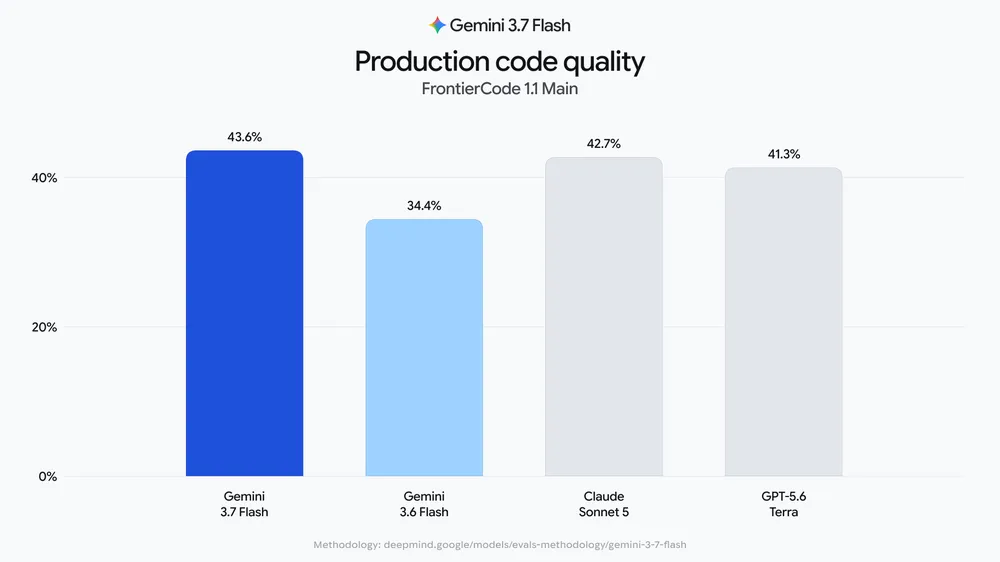
| FrontierCode 1.1 Main | 34.4% | 43.6% | +9.2 pts |
| WebDev Arena (Elo) | 1538 | 1588 | +50 Elo |
| GDP.pdf (document reasoning) | 22.0% | 34.0% | +12.0 pts |
| AutomationBench (agent tasks) | 17.0% | 30.4% | +13.4 pts |
Two standalone scores round out the picture: 90.7% on Harvey LAB-AA, a legal reasoning benchmark, and 97.0% on 128k-needle long-context retrieval. That second number matters if you feed the model long documents; retrieval quality at depth is where many models quietly fall apart.
The pattern across the table is consistent. The biggest jumps land on agentic benchmarks, the ones that measure multi-step work rather than single-shot answers. AutomationBench moving from 17.0% to 30.4% is the kind of delta that changes which tasks you can hand to a mid-tier model at all. Coverage of the launch singled out the DeepSWE gain as the headline result, and for good reason: a 16-point jump on agentic coding in three weeks is unusual for any model line. For context on how benchmark deltas translate across competing models, the Grok 4.6 vs GPT 5.6 vs Claude comparison shows how similar gaps play out in real workloads.
Coding and agent improvements
The benchmark table tells you what improved. Google’s release notes tell you how it shows up in practice, and the claims are specific enough to test:
- Debugging. The model is better at locating the cause of a failure rather than patching symptoms. The DeepSWE gain is the supporting number here, since that benchmark scores multi-file bug fixes in real repositories.
- First-try deployable code. Google claims more generated code runs without a correction round. FrontierCode’s 9.2-point improvement is the closest public measure.
- Roadblock handling. When a tool call fails or a file is missing, 3.7 Flash adapts its plan instead of looping. This is the behavior AutomationBench stresses.
- Intent clarification. The model asks a question when the request is ambiguous rather than guessing. In an agent pipeline, one clarifying turn is cheaper than a wrong 5,000-token answer.
- Instruction fidelity. Output format requests, length limits, and negative constraints stick more reliably across long conversations.
The tool stack matters as much as the raw scores. Function calling and search-as-a-tool carry over from 3.6, and computer use support means the model can drive a browser when no API exists for the task. That last capability sits in an odd spot for developers: powerful, but slower and less deterministic than a structured endpoint. The computer use vs structured APIs breakdown covers when each approach earns its keep.
Pricing: half price until December 31, 2026
Gemini 3.7 Flash launches with a two-phase price schedule on the Gemini API:
| Period | Input (per 1M tokens) | Output (per 1M tokens) |
|---|---|---|
| Through December 31, 2026 | $0.75 | $3.75 |
| From January 1, 2027 | $1.50 | $7.50 |
The introductory rate is half of what Gemini 3.6 Flash cost at launch, which makes the next four and a half months the cheapest window this model family has ever had. The catch is the doubling on January 1. If you build a budget around $0.75 input tokens, that budget breaks in five months unless you plan for it now.
Two practical takeaways. First, verify current rates on the official pricing page before you ship anything; intro windows have shifted before. Second, model your 2027 costs at the standard rate, not the promo rate. The full worked examples, including token math for chatbots, document pipelines, and agent loops, live in the Gemini 3.7 Flash pricing breakdown.
Where you can use it today
Google shipped 3.7 Flash across its whole surface area on day one, in 160+ countries:
- Gemini API. The developer path. Grab a key from AI Studio and call
gemini-3.7-flashdirectly. - Google AI Studio. Browser playground for prompt testing before you write code.
- Gemini app. The consumer chat app picked up the new model at launch.
- Gemini Spark. Available to AI Pro and Ultra subscribers.
- Google Antigravity. Google’s agentic development environment runs on it.
- Android Studio. The IDE integration gets the model for code assistance.
- Gemini Enterprise. The managed offering for organizations with compliance requirements.
For API access at scale, you also get the Vertex AI path on aiplatform.googleapis.com with OAuth, IAM, and audit logging. Same model, same request schema, different auth and hosting guarantees.
Why Google shipped Flash before Gemini 3.5 Pro
The release order is unusual. Flagship models normally lead and the cheaper tiers follow. Google inverted that: 3.6 Flash in late July, 3.7 Flash three weeks later, and Gemini 3.5 Pro still without a date. Axios reports that Google is deliberately shipping Flash updates ahead of its next flagship while Pro remains delayed.
Read as strategy rather than schedule slip, the move makes sense. Most production traffic runs on mid-tier models because that’s where cost per token meets acceptable quality. Improving Flash improves the model most customers touch every day. It also keeps Google in the release-cycle conversation during a stretch when every major lab is shipping fast, without burning the flagship announcement.
For developers, the practical consequence is that the Flash tier is no longer the trailing edge. Agent capabilities are landing here first. If you deferred moving workloads off 3.6 because you were waiting for Pro, the 3.6 to 3.7 Flash migration guide covers the swap, which for most codebases is a one-line model ID change plus a regression pass.
How to try the API in five minutes
You need an API key from AI Studio. Create one, export it, and send your first request:
export GEMINI_API_KEY="AIza..."

curl "https://generativelanguage.googleapis.com/v1beta/models/gemini-3.7-flash:generateContent" \
  -H "x-goog-api-key: $GEMINI_API_KEY" \
  -H "Content-Type: application/json" \
  -d '{
    "contents": [{
      "parts": [{ "text": "Review this function for bugs: def dedupe(items): return list(set(items))" }]
    }],
    "generationConfig": {
      "temperature": 0.4,
      "maxOutputTokens": 1024
    }
  }'
The response comes back as a candidates array with the generated text in content.parts, plus a usageMetadata block that reports exact input and output token counts. Watch that block from day one; it’s your cost meter. For streaming, swap :generateContent for :streamGenerateContent?alt=sse and the API returns server-sent events.
Once the first call works, move the experimentation out of your terminal. In Apidog, import the Generative Language API spec, bind GEMINI_API_KEY to the x-goog-api-key header as an environment variable, and save the model ID as a path variable. Now you can rerun the same prompt against gemini-3.6-flash and gemini-3.7-flash side by side, watch SSE streams render live, and save responses as examples so regression checks don’t burn tokens. It’s the fastest way to verify Google’s “better instruction following” claim against your own prompts instead of taking the launch post’s word for it.
FAQ
Is Gemini 3.7 Flash free to use?
The Gemini API has a free tier through AI Studio with daily quota, which covers prototyping. Paid usage starts at the introductory rate of $0.75 per 1M input tokens through December 31, 2026. If you want to stretch the free quota further, the guide to free Gemini API access covers the limits and how to work within them.
What’s the difference between Gemini 3.6 Flash and 3.7 Flash?
Same specs, better behavior. Context window, output limit, modalities, and tool support are unchanged. The gains are on coding and agent benchmarks: DeepSWE up 16.3 points, AutomationBench up 13.4 points, WebDev Arena up 50 Elo. Google also claims better debugging, instruction following, and multi-step planning.
Does Gemini 3.7 Flash replace Gemini 3.5 Pro?
No. Pro remains the flagship tier for the hardest reasoning tasks, and Gemini 3.5 Pro is still in development. Flash 3.7 is the model Google recommends for high-volume production work where cost and latency matter as much as quality.
What happens to pricing on January 1, 2027?
The introductory rate ends and standard pricing takes over: $1.50 per 1M input tokens and $7.50 per 1M output tokens, double the launch rate. Budget against the standard rate for any workload that outlives 2026.
Can Gemini 3.7 Flash process images and PDFs?
Yes. Input modalities cover text, image, video, audio, and PDF in the same contents array. Output is text only. The GDP.pdf benchmark score of 34.0%, up from 22.0%, is Google’s evidence that document understanding improved alongside the coding gains.
Where 3.7 Flash fits in your stack
Gemini 3.7 Flash is a mid-tier model with agent-tier benchmark scores and a four-month pricing discount. That combination makes the decision less about whether to evaluate it and more about how fast. The agentic gains are real numbers on public benchmarks, the specs match what you run today on 3.6, and the intro price means testing it now costs half of what the same evaluation will cost in January.
The sensible sequence: run your existing prompt suite against gemini-3.7-flash, compare outputs and token usage against your current model, and let the results pick the winner. Download Apidog to run that comparison in one workspace; save your 3.6 responses as examples, replay the same requests against 3.7, and you’ll know within an afternoon whether the benchmark story holds for your workload.