Moonshot AI shipped Kimi K2.6 with a bold claim: it’s the new state of the art in open-source coding, long-horizon execution, and agent swarms. The numbers back it up. 80.2% on SWE-Bench Verified, 96.4% on AIME 2026, 90.5% on GPQA-Diamond, and 73.1% on OSWorld-Verified. Those aren’t marketing snippets; they come straight from the official announcement on kimi.
This post unpacks what Kimi K2.6 is, how the Agent Swarm architecture changes what a single model can do, the benchmark picture against GPT-5.4 and Claude 4.6, and where you can start using it today.
TL;DR
- Release: Moonshot AI, April 2026, open source (weights on Hugging Face, API on platform.kimi.ai).
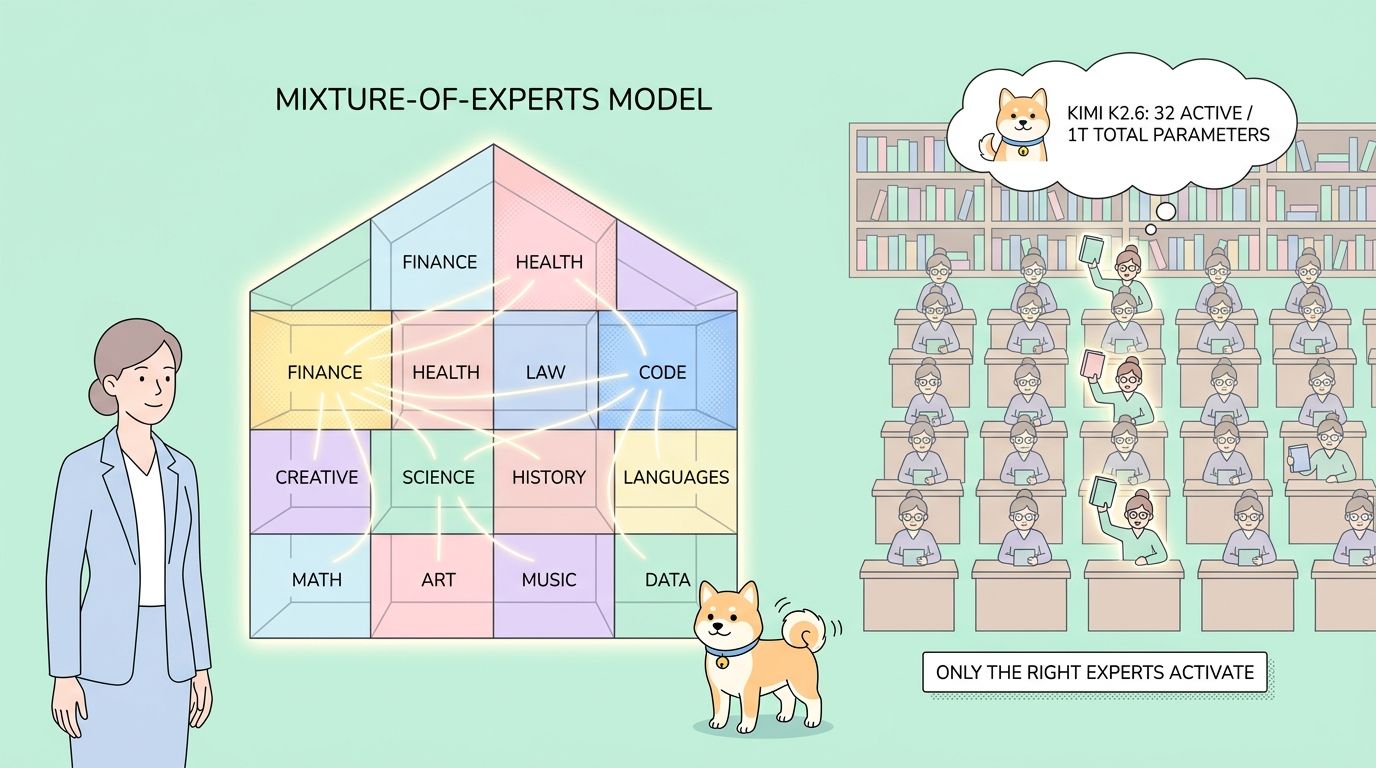
- Architecture: 1T-parameter mixture-of-experts, 32B active parameters per token, 262,144-token context (256K).
- Max output: up to 98,304 tokens for reasoning tasks.
- Agent Swarm: up to 300 sub-agents, 4,000+ coordinated steps per task (3x the K2.5 cap).
- Top benchmarks: SWE-Bench Verified 80.2%, Terminal-Bench 2.0 66.7%, AIME 2026 96.4%, HLE-Full (tools) 54.0%, OSWorld-Verified 73.1%.
- Surfaces: kimi.com chat, Kimi App, Kimi Code, API, open weights.
Kimi K2.6 in one paragraph
Kimi K2.6 is Moonshot AI’s next-generation open-source model focused on state-of-the-art coding, long-horizon execution, and agent swarms. It runs on kimi.com, the Kimi App, Kimi Code, and the API at platform.kimi.ai. It’s the first K-line release to push the Agent Swarm cap to 300 sub-agents and 4,000+ simultaneous steps, making it capable of autonomous work sessions that last days, not seconds. If you’re familiar with how other frontier models like Qwen 3.6 (see our OpenRouter guide) or Qwen3.5-Omni fit into an API-first workflow, Kimi K2.6 slots into the same shape with a sharper agent focus.
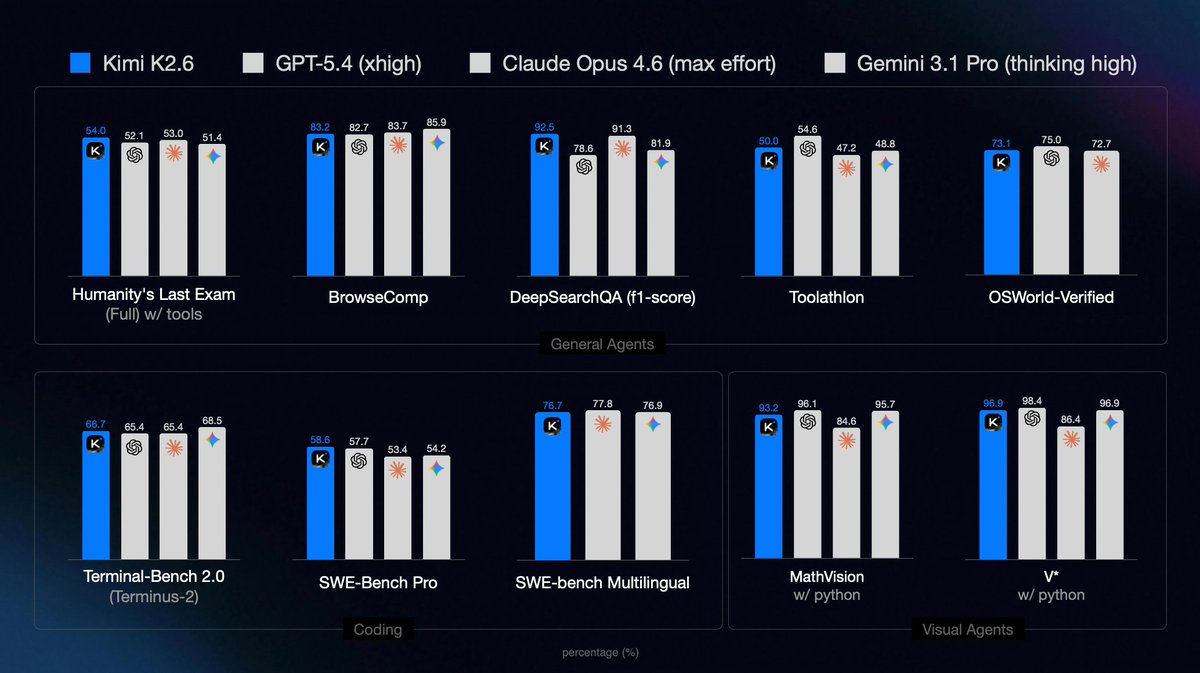
Moonshot published a full benchmark table in the Kimi K2.6 announcement. The highlights:
Coding
| Benchmark | Kimi K2.6 |
|---|---|
| SWE-Bench Verified | 80.2% |
| SWE-Bench Multilingual | 76.7% |
| SWE-Bench Pro | 58.6% |
| Terminal-Bench 2.0 | 66.7% |
SWE-Bench Verified at 80.2% matches or exceeds Claude 4.6 on the same harness, and does so with open weights you can download. Terminal-Bench 2.0 at 66.7% represents a 15.9-point jump over K2.5, which shows Moonshot doubled down on shell and file-manipulation reliability.
Agent and tool use
| Benchmark | Kimi K2.6 |
|---|---|
| HLE-Full (with tools) | 54.0% |
| BrowseComp | 83.2% (86.3% with Agent Swarm) |
| DeepSearchQA (F1) | 92.5% |
| Toolathlon | 50.0% |
| Claw Eval (pass@3) | 80.9% |
| OSWorld-Verified | 73.1% |
HLE-Full at 54.0% puts K2.6 ahead of GPT-5.4 (52.1%) and Claude 4.6 (53.0%) on that specific reasoning-plus-tools benchmark. OSWorld-Verified at 73.1% means K2.6 can drive a real desktop environment for operating-system-level tasks, which is the same space Claude Code computer use targets.
Reasoning and knowledge
| Benchmark | Kimi K2.6 |
|---|---|
| AIME 2026 | 96.4% |
| HMMT 2026 (Feb) | 92.7% |
| GPQA-Diamond | 90.5% |
| IMO-AnswerBench | 86.0% |
AIME 2026 at 96.4% is near-perfect on a competition-math benchmark that was brutal for models only a year ago.
Vision
| Benchmark | Kimi K2.6 |
|---|---|
| MathVision (with Python) | 93.2% |
| V* (with Python) | 96.9% |
| MMMU-Pro | 79.4% |
| CharXiv (RQ, with Python) | 86.7% |
The “with Python” results highlight how vision now chains into tool use: K2.6 reads a figure, writes Python, and computes the answer in the same trajectory.
Agent Swarm: the structural leap
Agent Swarm is the headline architectural change in K2.6. Moonshot’s blog frames it plainly: K2.6 orchestrates up to 300 sub-agents with 4,000+ coordinated steps, a 3x expansion over K2.5’s 100 agents and 1,500 steps.
Three patterns matter:
- Heterogeneous task decomposition. The model doesn’t clone itself 300 times. It splits a task into sub-tasks with different skill profiles (code, research, vision, planning) and routes each to the right specialist.
- Compositional intelligence. Sub-agents talk through a shared state, producing document, website, slide, and spreadsheet outputs in a single session. This is close in spirit to how Hermes agent architectures structure multi-agent orchestration.
- Document-to-skill conversion. A spec becomes a skill preserving “structural DNA,” meaning the model can absorb a design doc and act as if it has tribal knowledge.
Real runs from the Kimi announcement
Three proof-of-work examples :
- Qwen3.5-0.8B inference optimization on Mac — 12+ hours of continuous work, 4,000+ tool calls, 14 iterations, lifting throughput from 15 to 193 tokens/sec (roughly 20% faster than LM Studio’s baseline).
- Exchange-core financial engine tuning — 13 hours, 1,000+ tool calls, 4,000+ lines of code modified, medium throughput gain of 185% (0.43 → 1.24 MT/s), performance throughput of 133% (1.23 → 2.86 MT/s).
- Autonomous 5-day infrastructure run — multi-threaded task handling and incident response without human oversight.
If you’ve ever watched a coding agent lose the plot after 20 tool calls, these numbers read differently. The interesting scaling law here isn’t parameters; it’s agent-hours.
How the architecture holds up
Mixture of experts
K2.6 is a 1 trillion-parameter MoE model with 32 billion active parameters per token. You get frontier-class capability with inference cost closer to a 32B dense model. The same trade-off applies as with other MoE-family releases like the GLM-5V Turbo API; routing is where the engineering dollars go.
Long context: 262,144 tokens
The context window is exactly 262,144 tokens (the round number Moonshot cites). Max generation lengths go up to 98,304 tokens for reasoning tasks. That’s enough to fit:
- An entire mid-sized codebase and still have room for the agent trajectory
- A full legal or research document with room for multi-turn Q&A
- A multi-day tool-call history for ongoing agent sessions
Moonshot rewrote parts of the attention stack for K2.6 to keep long-context inference stable where K2.5 degraded.
Default sampling
The blog recommends default parameters of temperature 1.0 and top-p 1.0 for K2.6, which is aggressive compared to most coding models. Don’t cargo-cult the low-temperature defaults you see in OpenAI or Anthropic documentation; the Kimi team tuned K2.6 to produce reliable output at higher temperatures.
Claw Groups: the multi-agent layer above the model
Claw Groups is a research preview in the K2.6 announcement: an open ecosystem where multiple agents and humans work on the same task across laptops, mobile, and cloud. Four capabilities:
- Dynamic task matching based on specialized toolkits
- Failure detection with automatic task reassignment
- Cross-device deployment
- Human-in-the-loop checkpoints
The Claw Eval score of 80.9% (pass@3) measures how reliably K2.6 can operate inside this layer. If you’re thinking about teams of autonomous agents the way Paperclip’s AI agent company describes, Claw Groups is a ready-made substrate.
Design-driven development and proactive agents
K2.6 ships with frontend-generation capabilities beyond chat code completion. From the official post:
- Full-stack generation including authentication, databases, and transactions
- Image and video generation tool integration inside agent trajectories
- Scroll-triggered animations, interactive elements, and production-ready output
Proactive agents run 24/7 inside OpenClaw and Hermes, orchestrating multiple applications in the background. That’s the same “agent never sleeps” pattern teams are building around Google Agent Smith and custom stacks like build your own Claude Code.
Kimi K2.6 vs the closed frontier
From the official comparison table:
| Task | K2.6 | GPT-5.4 | Claude 4.6 | Gemini 3.1 | K2.5 |
|---|---|---|---|---|---|
| HLE-Full (tools) | 54.0 | 52.1 | 53.0 | 51.4 | 50.2 |
| BrowseComp | 83.2 | 82.7 | 83.7 | 85.9 | 74.9 |
| Terminal-Bench 2.0 | 66.7 | 65.4 | 65.4 | 68.5 | 50.8 |
| SWE-Bench Pro | 58.6 | 57.7 | 53.4 | 54.2 | 50.7 |
Three takeaways:
- K2.6 wins or ties three of the four on this table, including pulling ahead of GPT-5.4 on HLE-Full and SWE-Bench Pro.
- Gemini 3.1 leads Terminal-Bench and BrowseComp, so for pure browsing or terminal reliability it’s still on the shortlist.
- K2.6 ships with open weights, which none of the closed competitors do.
Where Kimi K2.6 lives
kimi.com (chat)
The consumer Kimi interface is the fastest way to try K2.6. Sign in, pick K2.6 in the model selector, and you have chat, agent mode, Agent Swarm, vision, and Kimi Code tool integration. See our companion guide on using Kimi K2.6 for free for the specifics.
Kimi App
The mobile app (iOS, Android) mirrors the web experience with voice input and push notifications for long-running agent tasks.
Kimi Code
Kimi Code is the terminal-native coding surface. It’s closer in feel to Claude Code workflows than to a chat window: K2.6 drives your local filesystem, commits, and tests, with Agent Swarm under the hood. If you’re shopping coding agents, compare it to Cursor Composer 2.
API
The API is OpenAI-compatible. Base URL is https://api.moonshot.ai/v1, model IDs are kimi-k2.6 and kimi-k2.6-thinking. We wrote a full walkthrough in How to Use the Kimi K2.6 API, including auth, streaming, tool calling, vision, video, and Agent Swarm invocation.
Open weights on Hugging Face
The full K2.6 weights are on Hugging Face at moonshotai/Kimi-K2.6 under a modified MIT license. Community quantizations (ubergarm GGUF, unsloth) make running it on your own hardware feasible for teams with H100-class GPUs.
How K2.6 was trained (what Moonshot has disclosed)
The Kimi K2.6 announcement doesn’t publish the full training recipe, but the product cues tell you where the engineering effort went:
- Long-horizon stability — Moonshot points to 12-hour and 13-hour agent runs as proof of training against session-length failure modes. K2.5 degraded after a few hundred tool calls; K2.6 sustains 4,000+.
- Tool-call reliability — CodeBuddy’s 96.60% tool invocation success rate is the public number. Synthetic tool-use data in training is the common way labs hit this.
- Compositional swarm training — heterogeneous sub-agent behavior implies training signal across multiple agent roles (planner, coder, researcher, reviewer), not a single generalist.
- Vision + code chaining — the “MathVision with Python” pattern (93.2%) indicates multi-modal + tool-use joint training, not a bolt-on vision adapter.
If you’re writing a retrospective on what separates a good 2026-era open model from a great one, those four bullets are most of the story.
Who should care
Pick Kimi K2.6 if you’re building
- Long-running coding agents. The 4,000-step, 12-hour demo runs aren’t marketing; they’re part of the architecture.
- Multi-agent systems. Agent Swarm and Claw Groups give you 300-agent orchestration without writing it yourself.
- Open-weight production. You need model sovereignty, custom fine-tuning, or regulatory control.
- High-throughput API work. MoE inference cost is well below closed-model pricing, and the OpenAI-compatible API drops into existing code.
Stick with closed models if you need
- Hard safety alignment. Claude 4.6 still leads on nuanced refusals and policy compliance.
- Sub-second consumer chat latency. Agent Swarm runs are minutes, not milliseconds.
- Locked vendor SLAs. For regulated industries, a frontier lab’s support contract may matter more than model quality.
How to test Kimi K2.6 in five minutes with Apidog
Once you have a Moonshot/Kimi API key, Apidog gets you from zero to a working test in minutes:
- Create an environment:
BASE_URL = https://api.moonshot.ai/v1,KIMI_API_KEY = sk-.... - New request:
POST {{BASE_URL}}/chat/completions. - Headers:
Authorization: Bearer {{KIMI_API_KEY}},Content-Type: application/json. - Body:
{
  "model": "kimi-k2.6",
  "messages": [{"role": "user", "content": "Summarize the Kimi K2.6 announcement."}],
  "stream": true
}
- Click Send. Watch tokens stream in.
Apidog also handles request history (replay failing tool-call sequences), schema validation against the OpenAI chat completions spec, team sharing with per-member keys, and VS Code integration for in-editor testing. If you’re currently on Postman, our guide to API testing without Postman in 2026 walks through the switch.
FAQ
Is Kimi K2.6 open source?The weights are open source under a modified MIT license (moonshotai/Kimi-K2.6). Training data and training code are not public. That makes it “open-weight” in common usage.
How does Kimi K2.6 compare to K2.5?Major jumps across the board, per the official benchmark table: +3.8 points on HLE-Full, +8.3 on BrowseComp, +15.9 on Terminal-Bench 2.0, +7.9 on SWE-Bench Pro, +20.5 on Claw Eval, 3x increase in Agent Swarm capacity.
What’s the Kimi K2.6 context window?262,144 tokens. Max generation for reasoning tasks goes up to 98,304 tokens.
Can I run Kimi K2.6 locally?Yes, with serious hardware. The full 1T MoE needs multi-GPU H100-class nodes. Quantized builds (4-bit, 3-bit) from community contributors fit on smaller setups with some quality loss. See our free-access guide for quantization options.
Does Kimi K2.6 support tool calling?Yes. The API follows the OpenAI tool-calling format. Agent Swarm handles parallel tool calls natively.
What’s the difference between Kimi K2.6 and Kimi K2.6 Thinking?K2.6 is the fast agent variant. K2.6 Thinking exposes a visible chain of thought before answering. Use Thinking for math proofs, hard debugging, or complex planning.
How do I access Kimi K2.6 for free?kimi.com web chat is free with a daily quota. Cloudflare Workers AI has a free tier. Self-hosting from Hugging Face weights has zero per-token cost once you have hardware. Full breakdown in How to Use Kimi K2.6 for Free.
How does Kimi K2.6 compare to other open-weight models?Against Qwen 3.6 and Qwen3.5-Omni, Kimi K2.6 leads on coding and agent benchmarks; Qwen still has stronger multilingual and small-model variants. Against DeepSeek V3.x, K2.6 has the agent-orchestration edge.
Summary
Kimi K2.6 is the most production-ready open-weight model released to date for agentic coding and long-horizon work. The 300-agent swarm, 4,000-step execution, 262K context window, and open weights combine to make it a unique tool in the current model lineup. Moonshot’s announcement post frames it as the new state-of-the-art in open-source agent work, and the public benchmarks support the claim.
If you’re evaluating models for a coding agent, a long-running research assistant, or a multi-agent system, Kimi K2.6 belongs on your shortlist. Grab a key from platform.kimi.ai, open Apidog, and send your first request. Then work your way through our deeper guides on the API and free access methods.