
Gemini 3.6 Flash is Google’s new workhorse model. It went generally available on July 21, 2026, and it’s cheaper and more token-efficient than the Gemini 3.5 Flash it replaces. If you send high-volume API traffic and want solid quality without paying flagship prices, this is the tier Google built for you.
This guide covers what the model is, what changed from the last version, the full specs, how it scores on benchmarks, what it costs, and how to get access. You’ll also see how to send and regression-test the API call yourself, so the numbers on Google’s pages match what you actually get back.
What is Gemini 3.6 Flash?
Gemini 3.6 Flash is the mid-tier, high-throughput model in Google’s Gemini family. “Workhorse” is the right word for it. The model is tuned for the everyday jobs that make up most production traffic: summarizing, extraction, classification, chat, and multi-step tool calls. It’s fast, it’s affordable, and it reads text, images, video, audio, and PDFs in a single call.
Google shipped it as one of three models on July 21, 2026. The other two are Gemini 3.5 Flash-Lite, a cheaper and faster tier for high-volume work, and Gemini 3.5 Flash Cyber, a gated security model that only governments and trusted partners can access. You can read the full breakdown of the cheap tier in our what is Gemini 3.5 Flash-Lite explainer, and the gated security model in what is Gemini 3.5 Flash Cyber.
Here’s the part that trips people up: the versioning is mixed. The workhorse jumped to 3.6, but Flash-Lite and Flash Cyber stayed on 3.5. So “the new Flash models” are not all on the same version number. When you pick a model ID, read it carefully. gemini-3.6-flash and gemini-3.5-flash-lite are different tiers, not a typo.
Google published the announcement on the Google blog, and the model card lives on the DeepMind Flash page.
What’s new versus Gemini 3.5 Flash
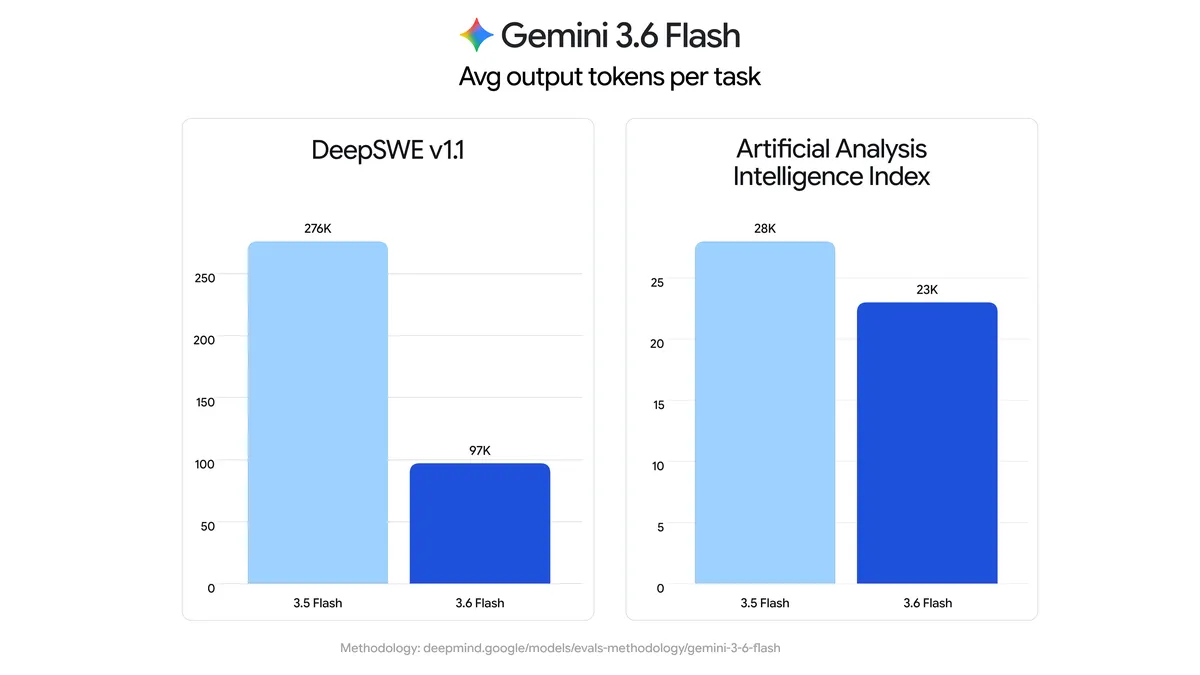
The headline change is efficiency. Gemini 3.6 Flash uses about 17% fewer output tokens than 3.5 Flash to finish the same work. Fewer tokens means lower bills and faster responses, because output tokens are what you pay the most for and what take the longest to stream.
Google also cut the output price. On 3.5 Flash you paid $9.00 per million output tokens. On 3.6 Flash you pay $7.50. Stack the price cut on top of the token savings and the effective cost per task drops more than the sticker numbers alone suggest.
The model is better at coding and computer use too, and it reaches answers in fewer reasoning steps and fewer tool calls on multi-step workflows. That matters for agents. Every extra reasoning loop and tool call adds latency and cost, so trimming them makes agent runs cheaper and quicker from start to finish.
If you’re deciding whether to move existing traffic over, we walk through the trade-offs in Gemini 3.6 Flash vs 3.5 Flash.
Gemini 3.6 Flash specs
| Attribute | Gemini 3.6 Flash |
|---|---|
| Model ID | gemini-3.6-flash |
| Input context window | 1M tokens |
| Max output | 64k tokens |
| Input modalities | Text, image, video, audio, PDF |
| Output | Text only |
| Input price | $1.50 per 1M tokens |
| Output price | $7.50 per 1M tokens (includes thinking tokens) |
| Free tier | Yes, via Google AI Studio (rate-limited) |
| Launched | July 21, 2026 |
Two numbers deserve a note. The 1M input context window means you can feed the model large documents, long transcripts, or whole codebases in one request. The 64k max output cap is the ceiling on a single response, so if you need book-length generation you’ll chunk the work across calls.
How it performs
Benchmarks are proxies, not promises, but they tell you where a model is strong. Here’s how Gemini 3.6 Flash scores on the public suites Google reported.
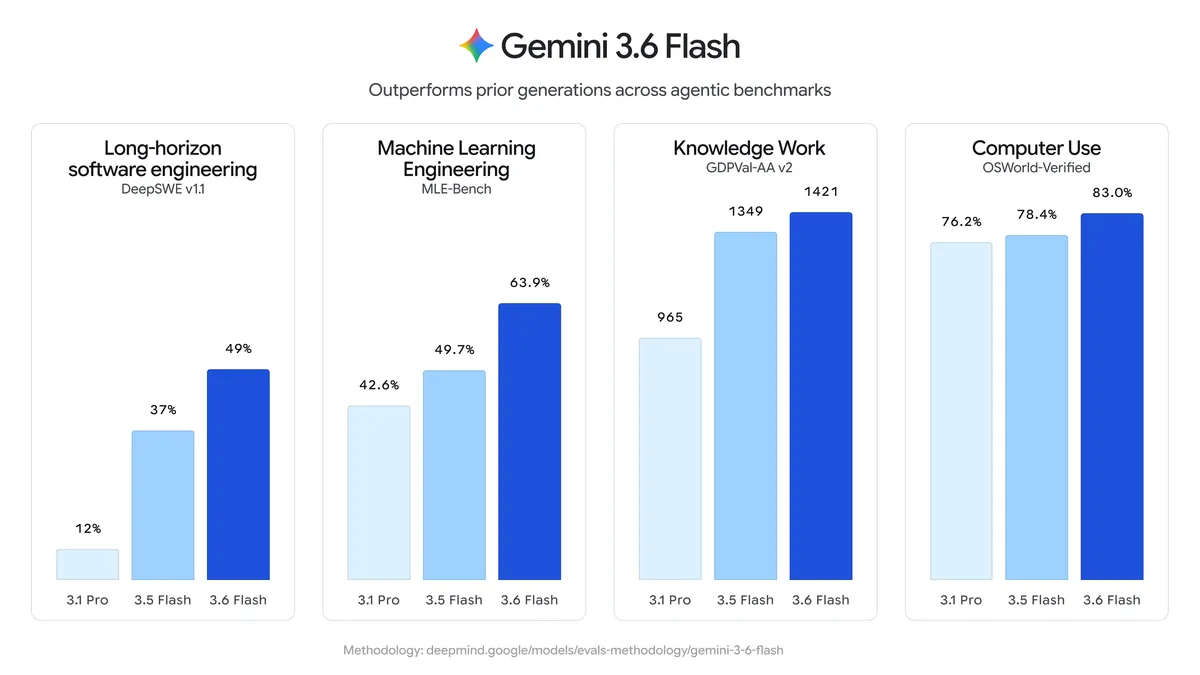
On coding, it hits 58.7% on SWE-Bench Pro, a test that checks whether a model can resolve real GitHub issues in production repositories. It scores 49% on DeepSWE v1.1, another software-engineering benchmark. On Terminal-bench 2.1, which measures running commands in a real terminal, it reaches 78.0%.
Computer use is where the jump shows most. On OSWorld-Verified, which scores a model driving a desktop and its apps, 3.6 Flash lands at 83.0%, up from 78.4% on 3.5 Flash. That’s a meaningful gain for anyone building agents that click through real interfaces.
On broad quality, it posts a GDPVal-AA v2 Elo of 1421. GDPVal measures performance on real-world professional tasks, and the Elo score rates models head to head the way chess ratings work, so a higher number means it wins more matchups.
Long context is a mixed picture, and it’s worth being honest about. At 128k tokens the model averages 91.8% on retrieval, which is strong. Push toward the full 1M-token window with pointwise retrieval and accuracy drops to 54.0%. In plain terms, the model stays sharp across large inputs, but don’t assume perfect recall when you fill the entire context window. Test your own retrieval at the length you actually use.
Pricing at a glance
Gemini 3.6 Flash costs $1.50 per million input tokens and $7.50 per million output tokens. The output price includes thinking tokens, so reasoning you never see in the final answer still counts toward the bill. Context caching runs $0.15 per million tokens plus $1.00 per million tokens per hour of storage, which helps when you send the same large prompt over and over.
There’s a free tier through Google AI Studio. It’s rate-limited, and Google may use free-tier data to improve its products, so it’s for prototyping, not production. We cover the limits and the fine print in how to use Gemini 3.6 Flash for free, and the full cost breakdown with worked examples in Gemini 3.6 Flash pricing. Google’s own numbers are on the Gemini API pricing page.
How to access Gemini 3.6 Flash
You have a few front doors:
- Gemini API through Google AI Studio. Grab a key and you can call
gemini-3.6-flashfrom any REST client or SDK. Android Studio also wires it in for app development. - Google Antigravity, Google’s agentic development surface, has the model available.
- Gemini Enterprise Agent Platform for teams building governed agents at work.
- The Gemini app if you just want to chat with it directly.
For most developers the API is the path that matters. We have a step-by-step walkthrough in how to use the Gemini 3.6 Flash API, and if you’re coming from an older release, our Google Gemini 3 API guide still covers the request shape and auth. The official reference lives at ai.google.dev.
Where it fits in Google’s lineup
Think of the Flash refresh as a cost-and-quality ladder. Gemini 3.5 Flash-Lite sits below 3.6 Flash: it’s cheaper, at $0.30 input and $2.50 output per million tokens, and it’s fast, at roughly 350 output tokens per second. Reach for Flash-Lite on high-volume, latency-sensitive jobs where you don’t need the workhorse’s full quality. Reach for 3.6 Flash when the task is harder or the output has to be more reliable.
Now the honest caveats. Gemini 3.5 Pro is not out. Google says it’s still testing with partners, so there’s no public Pro model in this wave, and most coverage led with that gap. Google also teased a Gemini 4 pre-training run and called it their most ambitious yet, but teased is not shipped. Neither one is something you can call today. If you need a frontier flagship right now, 3.6 Flash isn’t it. It’s a fast mid-tier built to be cheap and quick at scale, and that’s exactly what it delivers.
For the prior generation, our what is Gemini 3.5 explainer gives you the baseline these models improve on.
Testing Gemini 3.6 Flash in Apidog
Model pages quote best-case numbers. The only way to know what 3.6 Flash returns for your prompts, at your context length, is to send the call and check the response. That’s where an API client earns its keep.
Apidog is an API client and testing platform, and it treats the Gemini endpoint like any other REST call. Here’s a clean setup:
- Create a
POSTrequest to the Gemini API endpoint and set the model togemini-3.6-flash. - Store your API key in an Apidog environment variable instead of pasting it into the URL. Then you can switch between a test key and a production key without editing the request.
- Send the call and read the response. Add assertions on the status code and the JSON fields you care about, so a bad payload or a schema change fails loudly instead of slipping through.
- Save it as a regression test and schedule it to run so you catch it when a response shape or latency changes after a model update.
Be clear about what this does and doesn’t do. Apidog doesn’t run the model and it isn’t an AI framework. It’s the tool you use to build the request, send it, and hold the response to a standard you set. When Google ships the next Flash update, your saved tests tell you in minutes whether anything you depend on moved. Download Apidog if you want to wire up that first request.
FAQ
Is Gemini 3.6 Flash free? There’s a free tier through Google AI Studio, but it’s rate-limited and meant for prototyping. Google may use free-tier data to improve its products. For production traffic you pay per token: $1.50 per million in, $7.50 per million out.
Is Gemini 3.6 Flash better than 3.5 Flash? For most work, yes. It uses about 17% fewer output tokens, the output price dropped from $9.00 to $7.50 per million, and it’s stronger on coding and computer use, including a jump to 83.0% on OSWorld-Verified from 78.4%. It supersedes 3.5 Flash as the default workhorse.
Is Gemini 3.5 Pro out? No. Google says it’s still testing 3.5 Pro with partners, so there’s no public Pro model in this release. A Gemini 4 pre-training run was teased but not shipped.
What’s the model ID? It’s gemini-3.6-flash. Don’t confuse it with gemini-3.5-flash-lite, which is the cheaper Flash-Lite tier on a different version number.
What can Gemini 3.6 Flash not do? It only outputs text, so it won’t generate images, audio, or video even though it can read them as input. Its recall drops toward the far end of the 1M-token window, around 54.0% on pointwise retrieval at full length. And it’s a mid-tier workhorse, not a frontier flagship, so pick the right tier for genuinely hard reasoning.
Gemini 3.6 Flash is the model most Gemini API traffic should run on now: cheaper, more token-efficient, and better at agentic work than the version it replaces. Confirm the pieces you depend on with a couple of saved API tests before you migrate at scale. When Flash-Lite, Cyber, or the eventual Pro and Gemini 4 land, you’ll know exactly what changed in your own responses.