
GPT-6.1 Terra is OpenAI’s new middle-tier model, released on October 26, 2026. It replaces GPT-5.6 Terra, costs $1 per million input tokens and $5 per million output tokens on the API, and is built for computer use, visual understanding, coding and everyday work. OpenAI says it finishes tasks more than three times faster on average than GPT-6 Astra and GPT-6.1 Sol. The API model ID is gpt-6.1-terra.
It’s also the first Terra since GPT-5.6. The GPT-6 family launched with Astra, Sol and Luna and no Terra at all, so GPT-6.1 Terra fills a gap that sat open for a month. This guide covers the specs, the price history nobody else is tracking, the benchmarks with their sources, and how it compares with the models around it. If you just want to know whether you can use it without paying, read is GPT-6.1 Terra free.
GPT-6.1 Terra at a glance
| Spec | GPT-6.1 Terra |
|---|---|
| API model ID | gpt-6.1-terra |
| Released | October 26, 2026 |
| Context window | 1,050,000 tokens |
| Max input | 922,000 tokens |
| Max output | 128,000 tokens |
| Knowledge cutoff | June 1, 2026 |
| Input / output | Text and image in, text out |
| Reasoning effort | none, low, medium (default), high, xhigh, max |
| Endpoints | Responses, Chat Completions, Batch |
| Standard price | $1 input, $0.05 cached input, $5 output per 1M tokens |
All figures are from OpenAI’s GPT-6.1 Terra model page and pricing page. Realtime, Live, Assistants and fine-tuning aren’t supported.
Where it sits in OpenAI’s lineup
OpenAI now sells four tiers, and GPT-6.1 Terra lands between the flagship-class models and the budget one:
| Model | Input | Cached input | Output | Role |
|---|---|---|---|---|
| GPT-6 Astra | $10.00 | $1.00 | $50.00 | Top of the range |
| GPT-6.1 Sol | $2.00 | $0.10 | $10.00 | Strong all-rounder |
| GPT-6.1 Terra | $1.00 | $0.05 | $5.00 | Fast, cheap middle tier |
| GPT-6 Luna | $0.10 | $0.01 | $0.50 | High-volume budget |
Prices are per million tokens for prompts up to 272K input tokens. Terra is exactly half of GPT-6.1 Sol on every line and a tenth of Astra. OpenAI’s own advice is to keep GPT-6.1 Sol or GPT-6 Astra for the hardest coding and in-depth research, and use Terra for the large share of work that doesn’t need them.
The price history: the cut is bigger than the headline
OpenAI describes GPT-6.1 Terra as “a significant step up over GPT-5.6 Terra, with 50% lower standard API prices.” That’s true for input against today’s GPT-5.6 Terra price. It understates the rest.
GPT-5.6 Terra launched in July 2026 at $2.50 input and $15 output. Its price was later reduced, and OpenAI’s pricing page now lists it at $2 input, $0.20 cached and $12 output. Here’s the full lineage:
Output is where most agent bills go, and output fell 58%, not 50%. Cached input, which dominates long agent sessions, fell 75%. Our GPT-6.1 Terra pricing guide works through what that means per call.
What’s new compared with GPT-5.6 Terra
OpenAI positions the release around four things.
Computer use. The launch tagline is “fast and capable computer use at a lower price.” Terra “understands what’s on screen, takes action across apps, writes naturally,” per OpenAI’s announcement. The computer_use tool is available on the Responses API, alongside web_search, file_search, code_interpreter, hosted_shell, apply_patch, skills, mcp, tool_search and image_generation.
Speed. OpenAI says it “finishes tasks over 3x faster on average than both Astra and GPT-6.1 Sol.” That’s an average across OpenAI’s task set, not a tokens-per-second figure, so measure it on your own prompts.
Fewer factual errors. On OpenAI’s internal adversarial factuality test, the error rate at low reasoning effort fell from 53.6% on GPT-5.6 Terra to 16.7%. At maximum effort it fell 18 points to 4.3%. This is an internal test built from flagged conversations, not a public benchmark.
none effort is back. GPT-6.1 Sol removed the none reasoning effort. Terra supports it, and a developer on OpenAI’s community forum reports that none lets you set temperature and top_p again. That matters for classification and extraction jobs that want deterministic, reasoning-free output at the lowest cost.
Benchmarks
Every number below names its source. OpenAI’s figures come from its launch post and press coverage of it; the third-party figures are from Artificial Analysis.
| Benchmark | GPT-6.1 Terra | Comparison | Source |
|---|---|---|---|
| Terminal-Bench 4.0, max effort | 50.3% | GPT-5.6 Terra 21.5% | OpenAI |
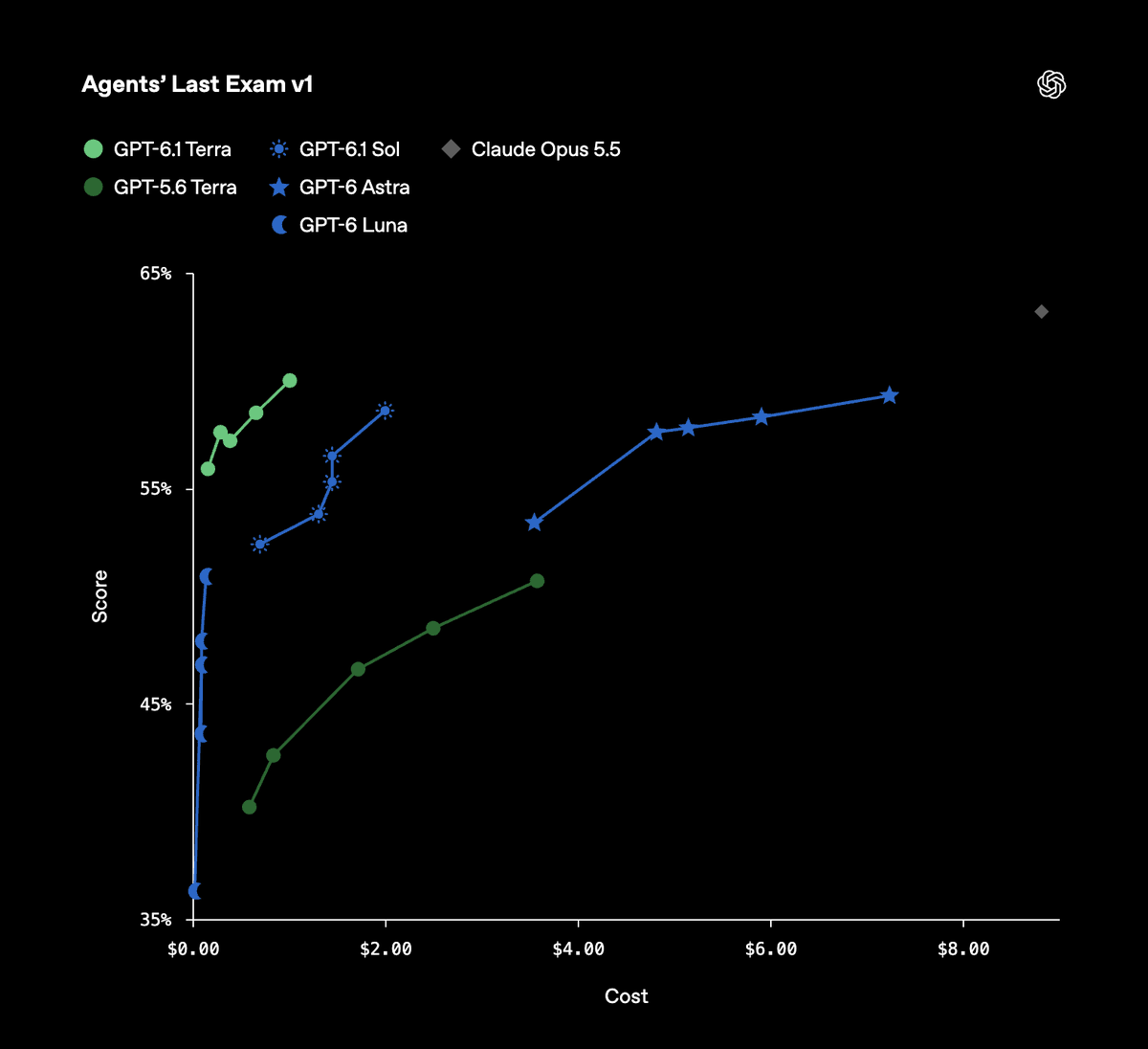
| Agents’ Last Exam, medium effort | +15 points | vs GPT-5.6 Terra, about a third of the cost | OpenAI |
| Agents’ Last Exam | On par with GPT-6 Astra | At a tenth of Astra’s per-token price | OpenAI |
| Coding Agent Index v2.0 | 48 | GPT-6.1 Sol 54, GPT-6 Luna 31 | Artificial Analysis |
| AA-Omniscience hallucination rate | 38% | GPT-5.6 Terra 88% | Artificial Analysis |
| Intelligence Index, max effort | +6 vs GPT-5.6 Terra | 4 below 6.1 Sol, 10 above Luna | Artificial Analysis |
| Cost per task, max effort | $0.40 | GPT-5.6 Terra $1.40 | Artificial Analysis |
Two readings. First, the gap to GPT-6.1 Sol is real but narrow: 6 points on Artificial Analysis’s coding-agent index, 4 on its overall index, at half the price. Second, the hallucination drop from 88% to 38% is the largest single change and the one most likely to show up in production, especially on retrieval and question-answering work.
Who can use it, and where
OpenAI’s announcement says GPT-6.1 Terra “is rolling out now and is available to all Plus, Pro, Enterprise, and Edu users in ChatGPT Work and Codex.” Developers get it through the API as gpt-6.1-terra.
A few details from OpenAI’s ChatGPT models docs:
- Surfaces listed for Terra: Work and Codex in the desktop app, ChatGPT Work on the web, Codex CLI, ChatGPT Credits and API access.
- Codex needs CLI 0.159.0 or later. Run
codex -m gpt-6.1-terrato pick it. - OpenAI says usage limits in Work and Codex “go further” with Terra than with GPT-5.6 Terra, and much further than with Sol or Astra.
- Free and Go aren’t on the list. Those plans are pointed to GPT-6 Luna in the desktop app.
There’s no free API tier, and OpenRouter’s openai/gpt-6.1-terra listing has no free endpoint. The free guide ranks the cheapest routes.
When to pick Terra, Sol or Luna
- Pick Terra for agent loops that click through apps, read screens and draft text; for coding tasks of normal difficulty; and for anything where speed and cost per task matter more than the last few points of accuracy.
- Pick GPT-6.1 Sol for hard multi-file refactors, long research chains, and the coding work OpenAI itself steers to Sol. The Terra vs Sol comparison has the full breakdown.
- Pick GPT-6 Luna for classification, extraction and routing at very high volume, where a tenth of Terra’s price beats its extra capability. See what GPT-6 Luna is.
Let your coding agent test GPT-6.1 Terra with Apidog CLI
Switching a model ID is a one-line change that can break things quietly: a different reasoning default, a tool that behaves differently, a response that no longer matches the shape your code expects. Your coding agent should check that for you, and Apidog CLI gives it the commands to do it.
Install the CLI, log in, and give your agent the Apidog skill:
npm install -g apidog-cli@latest
apidog auth login --with-token <YOUR_TOKEN>
apidog skill install
Then give Claude Code, Codex or Cursor one prompt:
In Apidog project <id>, add a POST https://api.openai.com/v1/responses endpoint
that sends model gpt-6.1-terra with reasoning effort low. Create a test case that
asserts status 200, that output_text is not empty, and that usage.output_tokens
is under 4000. Run it against the <env> environment, then rerun it with
gpt-5.6-terra and compare the two runs.
The agent reads each payload schema, validates its JSON, creates the endpoint and test case, and runs it:
apidog cli-schema get endpoint-create
apidog endpoint create --project <id> --file endpoint.json
apidog cli-schema get test-case-create
apidog cli-schema validate test-case-create --file case.json
apidog test-case create --project <id> --file case.json
apidog run --test-case <caseId> --project <id> -e <envId> -r cli,json
Keep your OpenAI key in the Apidog environment, not in the prompt. Once the case passes, the same apidog run with -r junit drops into CI, as shown in our Apidog CLI CI/CD guide. For agent-specific setup, see Apidog CLI in Codex.
FAQ
What is GPT-6.1 Terra? OpenAI’s middle-tier model, released October 26, 2026, replacing GPT-5.6 Terra. It costs $1/$5 per million tokens and targets computer use, coding and everyday work.
Is there a GPT-6 Terra? No. GPT-6 shipped as Astra, Sol and Luna. GPT-6.1 Terra is the first Terra since GPT-5.6.
How big is the context window? 1,050,000 tokens, with up to 922,000 input tokens and 128,000 output tokens. Prompts over 272K input tokens are billed at a higher rate.
Is GPT-6.1 Terra better than GPT-6.1 Sol? No, it’s cheaper and faster. Artificial Analysis scores it 48 on its Coding Agent Index against Sol’s 54, and OpenAI still recommends Sol or Astra for the hardest coding.
Is GPT-6.1 Terra in ChatGPT? Yes, in ChatGPT Work and Codex for Plus, Pro, Enterprise and Edu. OpenAI hasn’t listed it for Free or Go.
Bottom line
GPT-6.1 Terra is the price-performance pick of OpenAI’s current range: half of GPT-6.1 Sol’s price, within a few points of it on third-party indexes, faster on OpenAI’s tasks, and with far fewer hallucinations than the Terra it replaces. If you’re running GPT-5.6 Terra today, it’s a straight upgrade that cuts your output bill by more than half. Start with the GPT-6.1 Terra API guide, and let your coding agent prove the switch with Apidog CLI before you ship it.