GLM-5.3 is a large language model released on August 14, 2026 by Zhipu AI, the Chinese lab that operates internationally as Z.ai. It is a post-training upgrade of the GLM-5 base model aimed squarely at coding and agentic work, and Zhipu plans to publish its open weights on Hugging Face about two weeks after launch. In Zhipu’s internal evaluations, coding capability improved 50% over GLM-5.2.
That combination is why the release matters: a lab that Seeking Alpha describes as a “Chinese OpenAI challenger” is shipping a coding model it says is “approaching Claude Fable 5”, then giving away the weights. It lands one day after DeepSeek’s latest release, which we covered in our DeepSeek V4 Pro API guide, so the open-model race in China is now moving on a weekly cadence.
This article explains what GLM-5.3 is, what the benchmarks say (and which come from Zhipu’s own testing), how the open-weights plan works, and how to send your first request. You can test that request in Apidog without writing any code.
TL;DR
- GLM-5.3 shipped August 14, 2026 from Zhipu AI (Z.ai). Same GLM-5 base model; all gains come from scaled post-training.
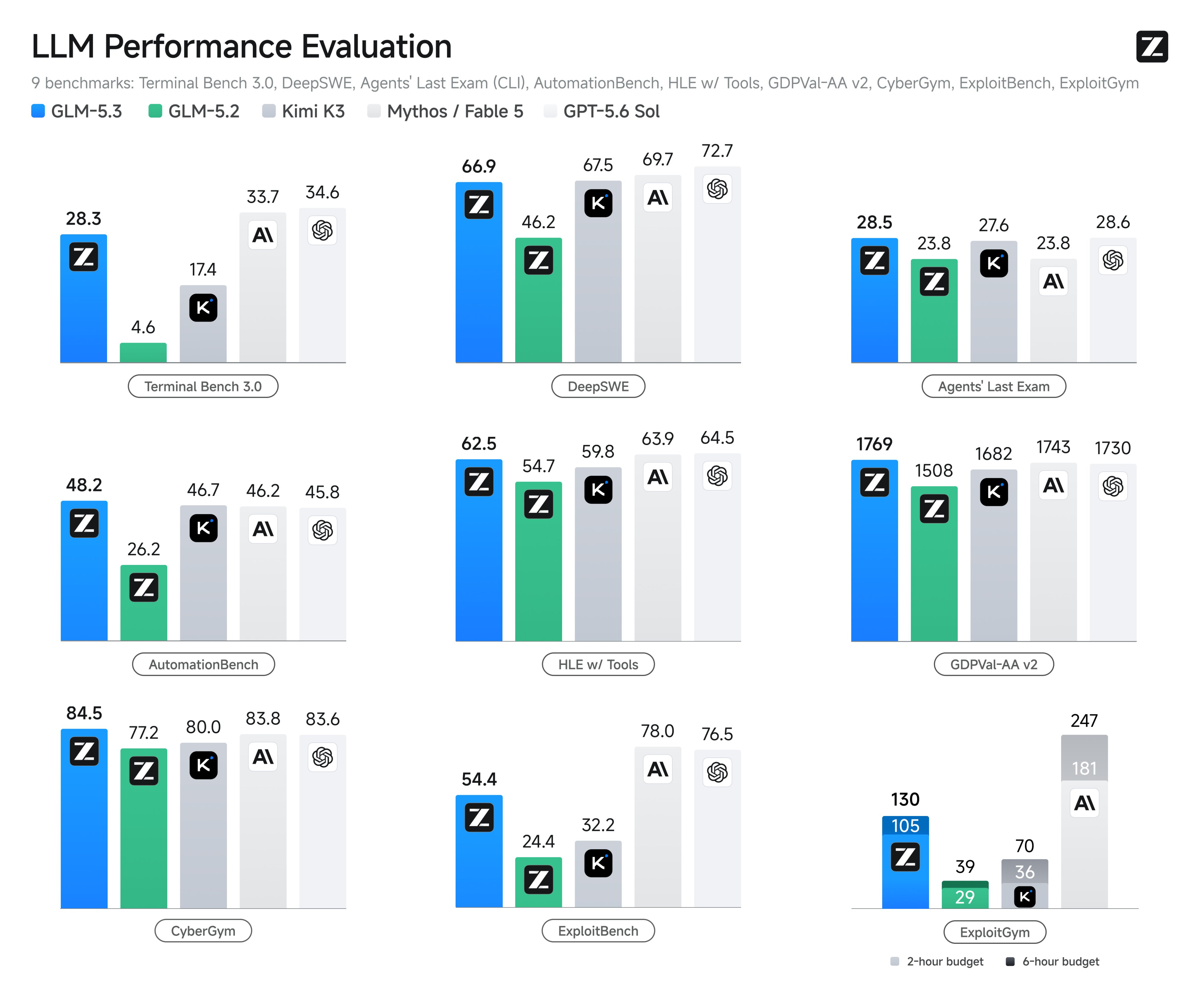
- Terminal-Bench 3.0 score jumped from 4.6 to 28.3, a 6.2x improvement, ranking first among open-source models. It also ranks first among open models on Agents’ Last Exam.
- CyberGym: 84.5%, slightly above Claude Mythos 5 and GPT-5.6 Sol. ExploitBench: 54.4%, still behind frontier models.
- Open weights arrive on Hugging Face around August 28, 2026, after what Zhipu calls its most extensive risk review to date.
- GLM-5 family architecture per official docs: Mixture of Experts, 744B total parameters, roughly 40B active per forward pass, 200K context window.
- The API is OpenAI-compatible at
https://api.z.ai/api/paas/v4/chat/completions. No 5.3-specific pricing was published at launch.
What GLM-5.3 is
GLM-5.3 is the third point release in the GLM-5 family, and the most focused one. Zhipu didn’t retrain the foundation. The official docs describe the GLM-5 base as a Mixture of Experts model with 744B total parameters, around 40B activated per forward pass, and a 200K token context window; those specs carry over unchanged. What changed is everything on top: the gains come entirely from scaled post-training applied to the same base weights.
That detail matters more than it sounds. When a lab improves a model this much without touching the base, the post-training pipeline itself is the product. Zhipu claims a 50% coding improvement over GLM-5.2, and the target workloads are specific: terminal-driven agent tasks, long-horizon software engineering, and security analysis. This is not a general chat upgrade.
The practical summary: GLM-5.3 is the model you’d evaluate if you want strong autonomous coding behavior at open-model economics, with the option to run it on your own hardware once the weights drop.
GLM-5.3 benchmarks: the numbers and their sources
Launch coverage from BigGo Finance and Pandaily reported the following results. Treat the “source” column seriously: some numbers come from public leaderboards, others from Zhipu’s own evaluation runs, and those are not the same kind of evidence.
| Benchmark | GLM-5.3 result | Context | Source |
|---|---|---|---|
| Terminal-Bench 3.0 | 28.3 (up from 4.6) | 6.2x jump; first among open-source models | Launch report |
| Agents’ Last Exam | First among open-source models | Score not disclosed at launch | Launch report |
| CyberGym | 84.5% | Slightly above Claude Mythos 5 and GPT-5.6 Sol | Launch report |
| ExploitBench | 54.4% | Trails frontier models | Launch report |
| SWE-Marathon | Roughly 2x GLM-5.2 | Long-horizon software engineering | Zhipu internal |
| Coding capability (aggregate) | +50% vs GLM-5.2 | Zhipu’s headline claim | Zhipu internal |
Two readings are fair. The generous one: a 4.6 to 28.3 jump on Terminal-Bench 3.0 is not noise. Terminal benchmarks measure whether a model can chain shell commands, read output, and recover from errors across many steps, and GLM-5.2 was weak there. Going from near-bottom to first among open models in one point release changes which model you reach for in agent pipelines.
The skeptical one: the two most quotable claims, the 50% coding gain and the doubled SWE-Marathon score, are Zhipu internal numbers with no public harness to reproduce them. That doesn’t make them false, but they stay unverified until the weights land and independent evaluators rerun the suites.
What “approaching Claude Fable 5” means in practice
Zhipu’s own framing is that GLM-5.3’s coding and agent capability is “approaching Claude Fable 5”. That phrase is doing careful work.
Where the claim holds up: on the agent and terminal side, the reported numbers are close to frontier territory. First place among open-source models on Terminal-Bench 3.0 and Agents’ Last Exam means GLM-5.3 leapfrogged every open competitor on the tasks that matter for autonomous coding agents. The CyberGym result of 84.5% even edges past Claude Mythos 5 and GPT-5.6 Sol, though the margin is small enough that run-to-run variance could account for it.
Where it doesn’t: ExploitBench, at 54.4%, still sits clearly behind the frontier models. Exploit development stresses deep multi-step reasoning under ambiguity, and the gap there suggests the frontier still holds an edge on the hardest reasoning-heavy work. “Approaching” is the honest word. It is not “matching”, and Zhipu, to its credit, didn’t say matching.
The practical translation for your stack: GLM-5.3 is worth benchmarking head-to-head for terminal agents, CI automation, and repository-scale coding tasks. For the hardest reasoning problems, frontier closed models likely keep the lead for now. If you want a feel for how frontier models separate on exactly these axes, our Grok 4.6 vs GPT-5.6 vs Claude Fable 5 comparison walks through the same benchmark categories with worked examples.
The open-weights plan: ~August 28 on Hugging Face
The release detail with the longest shelf life isn’t a benchmark. Zhipu committed to publishing GLM-5.3’s open weights about two weeks after launch, which puts the drop around August 28, 2026, on the zai-org Hugging Face organization where the company’s previous open releases live.
The two-week gap is deliberate. Zhipu says it built its most extensive risk review system to date for this release, and the security benchmarks explain why: a model scoring 84.5% on CyberGym has meaningful offensive-security capability, and releasing those weights publicly is a different decision than serving them behind a monitored API. The review window is the cost of the open release.
What the drop means for you depends on your hardware. Full-precision inference on a 744B-parameter MoE is server-class territory even with only ~40B parameters active per token, so most teams will wait for quantized community variants. If you plan to run it locally, our guide to self-hosting GLM-5.3 covers sizing, serving stacks, and building a baseline against the hosted API before the weights arrive.
How GLM-5.3 fits the open-model landscape
The obvious comparison is DeepSeek. Both labs are Chinese, both release open weights, both price aggressively, and both shipped within 24 hours of each other. The difference is focus: DeepSeek’s V4 Pro line is a generalist flagship, while GLM-5.3 is a specialist bet that coding agents are the workload worth winning. If your traffic is mostly agentic coding, that specialization is the argument for testing GLM-5.3 first.
Economics shape the rest of the picture. DeepSeek’s recent price increase, which we analyzed in our DeepSeek API cost optimization guide, showed how fast open-model API pricing can move, and it pushed more teams toward self-hosting as a hedge. An open-weight GLM-5.3 that leads Terminal-Bench gives those teams another credible option. Zhipu had not published 5.3-specific API pricing at launch; for reference, the official pricing page listed GLM-5.2 at $1.4 per 1M input tokens and $4.4 per 1M output tokens as of this writing, so expect the 5.3 number to land in that neighborhood, and check the page before budgeting.
The open ecosystem context matters too. Once quantized variants exist, GLM-5.3 joins the pool of models you can run without any API dependency at all. Our roundup of the best local LLMs in 2026 covers where the current open leaders stand; a Terminal-Bench-topping entrant will reshuffle that list.
GLM Coding Plan quotas were reset
One launch-day detail that affects existing users directly: Zhipu reset GLM Coding Plan quotas for all users on August 14. If you subscribe to the Coding Plan through Z.ai, your allowance started fresh on release day, an open invitation to spend that quota trying 5.3.
The Coding Plan is Zhipu’s flat-rate offering for coding tools, distinct from pay-per-token API access, and the reset applies only to the plan, not to API billing. Mainland China users get the same ecosystem through open.bigmodel.cn, with its own plans and billing.
Try the API in five minutes
Z.ai’s API is OpenAI-compatible, so the request shape will look familiar if you’ve called any major LLM API. The international endpoint is https://api.z.ai/api/paas/v4/chat/completions; mainland China uses https://open.bigmodel.cn/api/paas/v4/chat/completions. Auth is a Bearer token. One caveat: at launch, the official docs still listed glm-5 as the documented model ID, so the glm-5.3 ID below follows the GLM-5 family convention. Confirm the exact string on the model docs page before you ship anything.
export GLM_API_KEY="your-key-from-z.ai"

curl https://api.z.ai/api/paas/v4/chat/completions \
  -H "Authorization: Bearer $GLM_API_KEY" \
  -H "Content-Type: application/json" \
  -d '{
    "model": "glm-5.3",
    "messages": [
      {
        "role": "user",
        "content": "Write a bash script that finds the five largest files in a git repo, excluding the .git directory."
      }
    ],
    "temperature": 0.6,
    "max_tokens": 1024
  }'
The response follows the OpenAI schema: a choices array with the message content, plus a usage block with token counts.
A faster loop than editing cURL strings: import the request into Apidog, store GLM_API_KEY as an environment variable, and create two environments, one for the Z.ai endpoint and one for bigmodel.cn. Switching regions or model IDs becomes a dropdown instead of an edit, and saved responses become a regression baseline for the day the open weights drop.
For the full walkthrough, including Python and Node.js clients, streaming, and error handling, see the complete GLM-5.3 API quickstart.
FAQ
Is GLM-5.3 open source?
Not yet, but it will be open weight. Zhipu committed to releasing the weights on Hugging Face around August 28, 2026, roughly two weeks after the API launch, following a risk review the company describes as its most extensive to date. Until then, the only access is through the hosted API.
How is GLM-5.3 different from GLM-5.2?
The base model is identical. Every improvement comes from scaled post-training: Zhipu reports a 50% coding capability gain in internal evaluations, a Terminal-Bench 3.0 jump from 4.6 to 28.3, and a roughly doubled SWE-Marathon score. Context window, parameter count, and architecture are unchanged from the GLM-5 family baseline.
What does GLM-5.3 cost?
Zhipu had not published 5.3-specific API pricing at launch. The official pricing page listed GLM-5.2 at $1.4 per 1M input tokens and $4.4 per 1M output tokens, which is the best available anchor. Check the live pricing page before committing to a budget, and if cost is your main constraint, our guide to API cost optimization after the DeepSeek price increase covers tactics that apply to any per-token API.
Can I run GLM-5.3 on my own hardware?
After the weights drop, yes, with caveats. The GLM-5 family is a 744B-parameter Mixture of Experts model with about 40B active parameters per forward pass, so full-precision serving needs multi-GPU server hardware. Quantized community builds will lower the bar; see the self-hosting preparation guide for realistic sizing.
Is GLM-5.3 better than Claude or GPT for coding?
On the reported agent and terminal benchmarks it is competitive, ranking first among open models on Terminal-Bench 3.0 and edging past Claude Mythos 5 and GPT-5.6 Sol on CyberGym. On ExploitBench it trails the frontier at 54.4%. The honest answer is workload-dependent: run your own evaluation set against both before switching production traffic, the same way you’d test any API before adopting it.
Where GLM-5.3 fits in your stack
GLM-5.3 is a specialist release with a clear pitch: near-frontier coding agent performance, open weights in two weeks, and an OpenAI-compatible API you can point existing code at today. The benchmark story is strong on terminal and agent tasks, honest about the ExploitBench gap, and partly unverified until independent runs land after August 28. That is enough signal to justify an evaluation, not yet enough to justify a migration.
The low-cost way to start: send the cURL request above, save the response, and build a small prompt suite against your real workloads. Download Apidog to organize that suite, keep the Z.ai and bigmodel.cn endpoints as switchable environments, and turn today’s exploratory calls into the regression baseline you’ll want when the open weights arrive and you’re comparing your own deployment against the hosted API.