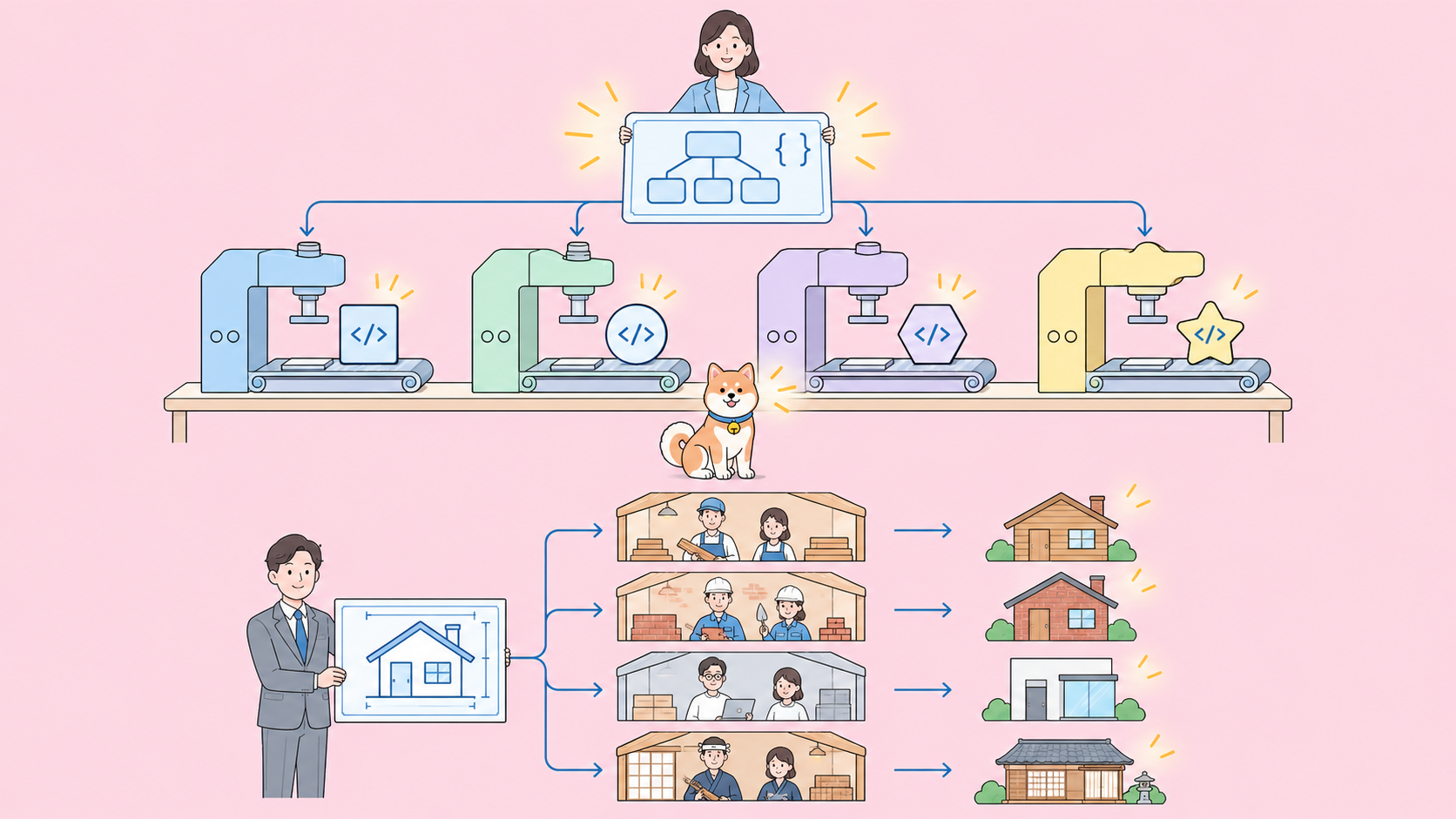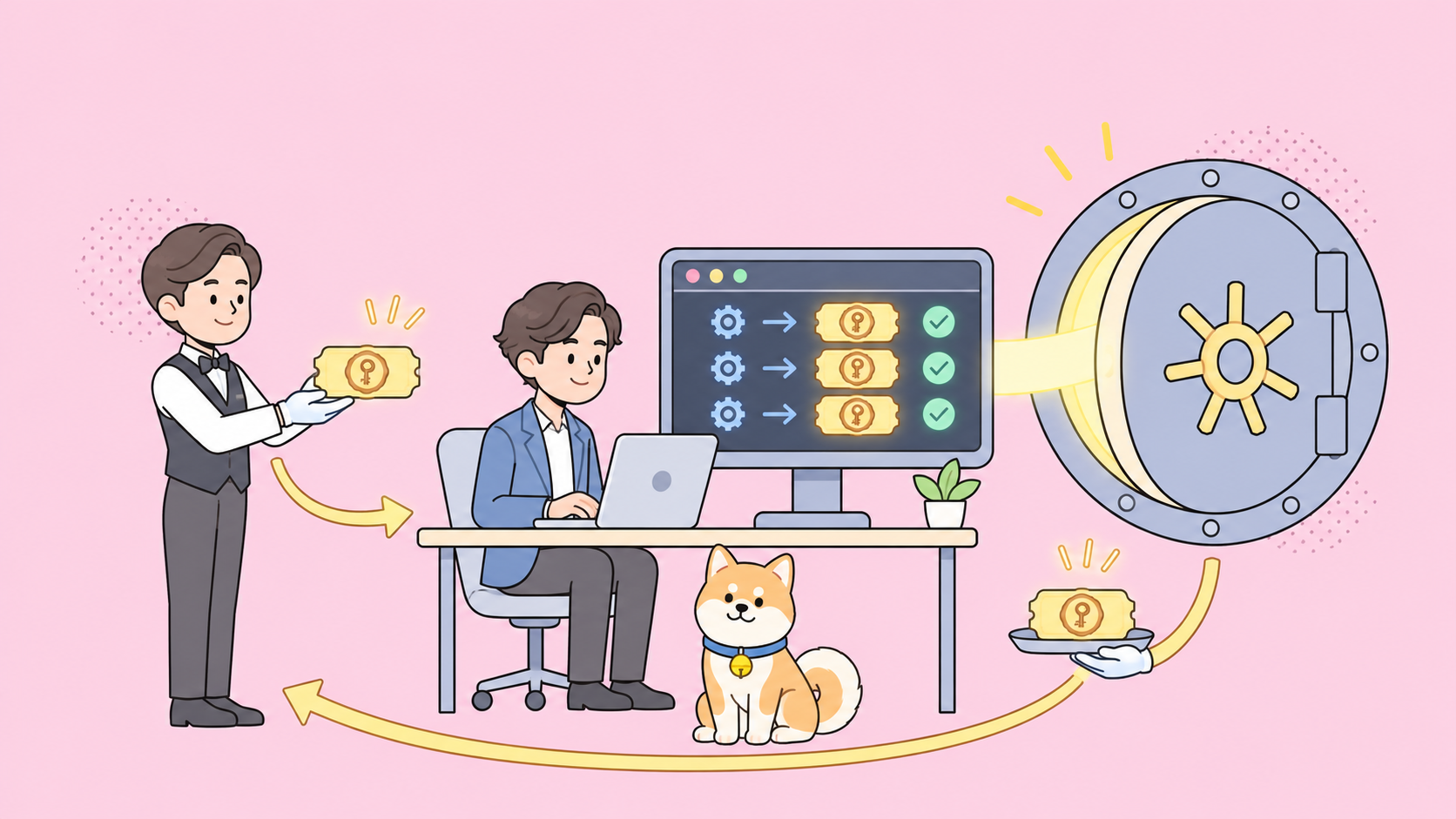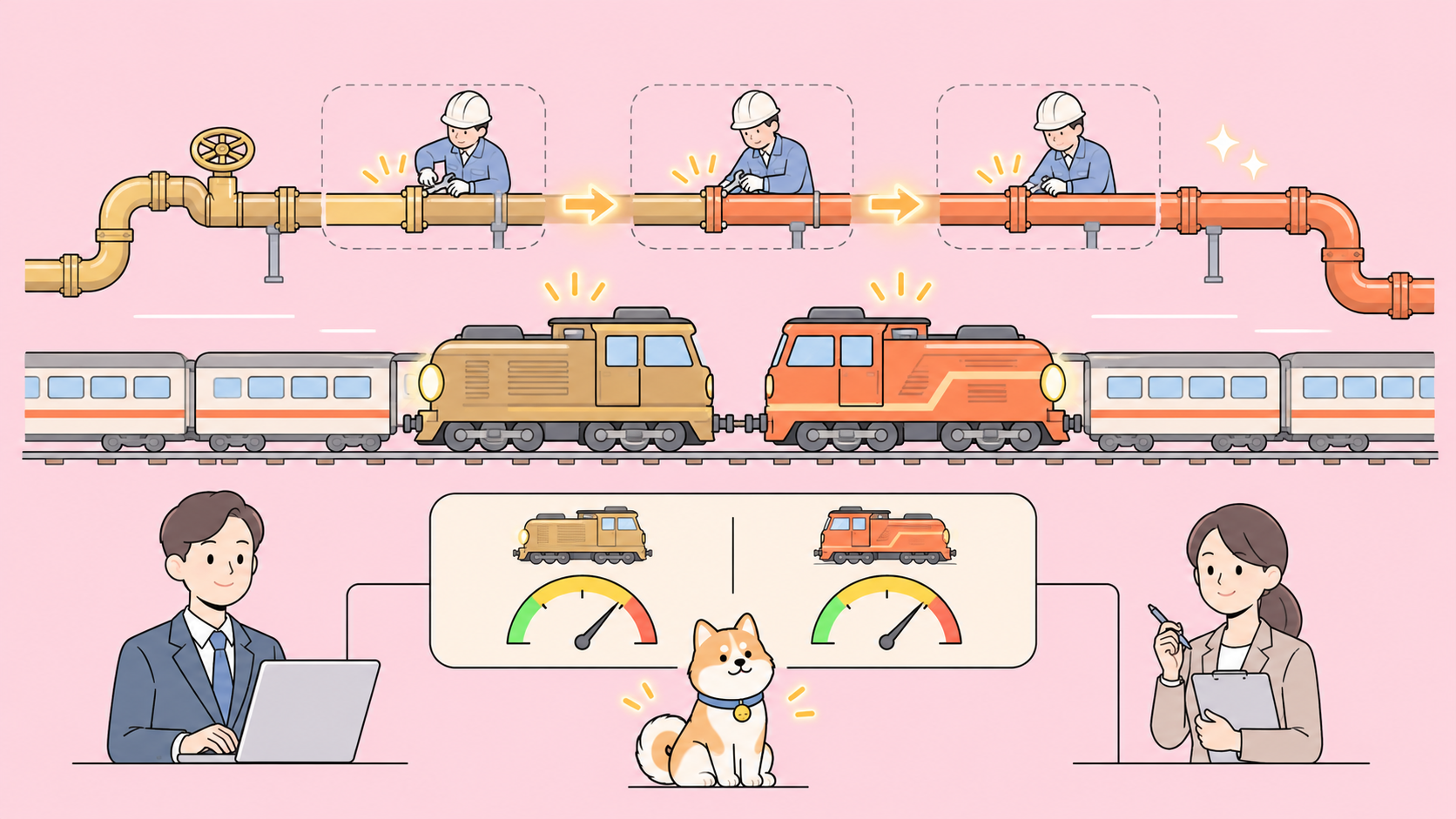
Differential testing an API rewrite means you send the same requests to the old service and the new one, normalize the fields that are allowed to differ, and diff everything else: status codes, headers and bodies. The old service is your oracle. Any difference it can’t explain is a bug in the rewrite, or a behavior your users depend on that nobody wrote down.
Anthropic just showed why this matters. When it moved its Messages API from Python to Rust, the Rust version passed about 98% of its tests in April, yet only about a quarter of inputs matched on production traffic. The tests had also drifted: an audit of the ported suite found more than 100 weakened assertions. The fix was to stop trusting the suite and compare the new service against the old one.
You can do the same for your own language port, framework swap or monolith split. Here’s the method, the fields to ignore, and how to hand the comparison to your coding agent.
What is differential testing for an API rewrite?
Differential testing feeds identical inputs to two implementations of the same behavior and flags any output that differs. For an API rewrite, the old service defines “correct”, the rewrite is the candidate, and a mismatch in status, headers or normalized body is a finding to explain or fix before cutover.
It answers a different question from your other tests:
| Test type | Question it answers | Source of “correct” |
|---|---|---|
| Unit and integration tests | Does the code do what we wrote down? | Assertions someone wrote |
| Contract testing | Does the response match the spec? | OpenAPI or a consumer contract |
| Regression testing | Did this change break what used to pass? | Last green run |
| Differential testing | Does the new service behave like the old one? | The old service itself |
Why your test suite isn’t enough to verify a rewrite
The existing suite falls short in three ways:
- The suite is coupled to the old code. Mocks and fixtures get ported with it, and every ported test is a chance to weaken an assertion until it passes.
- It only covers combinations someone thought of. Twenty boolean options make over a million combinations. Real clients send the odd ones.
- Users depend on quirks. A field that’s
nullinstead of missing, an emoji escaped instead of written raw. Anthropic hit that last one: Python escaped certain characters in JSON tool calls and Rust wrote them as is.
The old service already encodes every one of those behaviors. Differential testing turns it into the test.
Shadow traffic vs replayed fixtures
There are two ways to feed both services the same requests. Start with replay; add shadowing once the replay diff is quiet.
| Replayed fixtures | Shadow (mirrored) traffic | |
|---|---|---|
| Input | A saved corpus of real or synthetic requests | A copy of live production requests |
| Where it runs | Staging, CI, a laptop | Production, out of band |
| Coverage | What you captured | Whatever users actually send |
| Side effects | Easy to isolate with test data | Writes must be blocked or sandboxed |
| Repeatable | Yes, same corpus every run | No, traffic changes daily |
| Best for | Fast inner loop, CI gate | Finding the long tail before cutover |
Shadowing usually lives in your proxy or mesh. Istio’s traffic mirroring sends each request to a second service “fire and forget” and discards the mirrored response, so users only see the old answer. Your differ has to capture both responses itself.
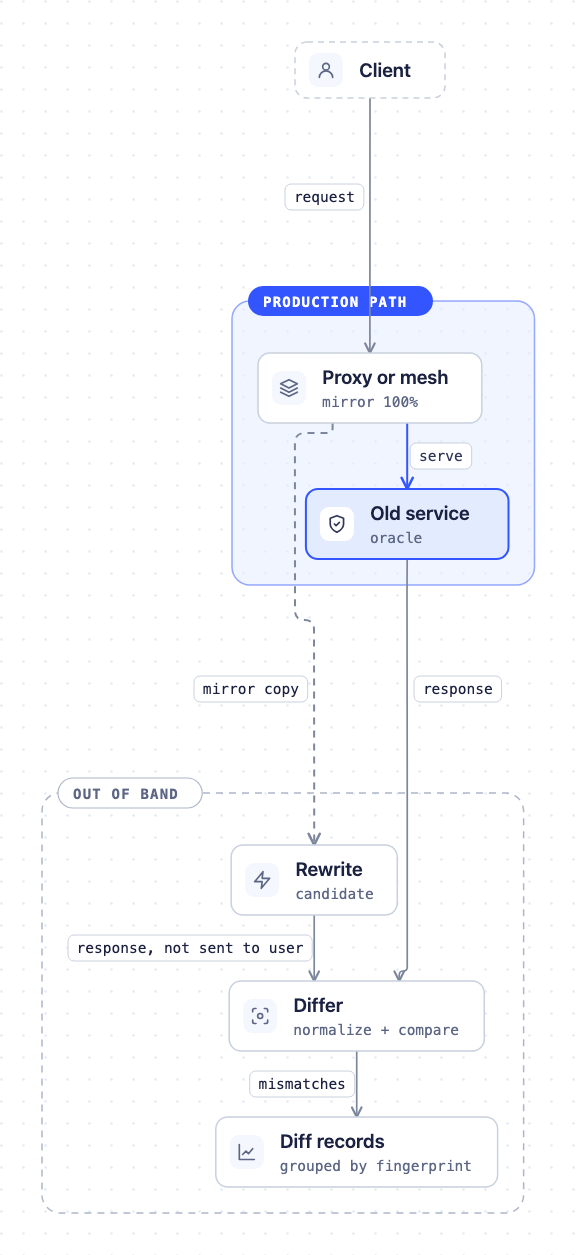
For a single code path, GitHub’s Scientist library does the same in-process: it runs old and new, returns the old result and publishes the comparison.
How to run a differential test on an API rewrite
- Build a request corpus. Sample real requests from access logs, strip secrets and personal data, and add edge cases: empty bodies, unicode, maximum lengths, every error path.
- Send each request to both services against the same data. If they read different databases, they’ll disagree on everything.
- Normalize volatile fields such as ids, timestamps and request ids (next section).
- Diff in layers. Status code, then chosen headers, then the parsed body. Key order and whitespace aren’t behavior, so diff JSON, not text.
- Fingerprint and group. One bug can cause thousands of identical mismatches. Group by endpoint, the JSON path of the first difference and the kind of change.
- Fix, then rerun the whole corpus. One fix often reveals a bug it was hiding.
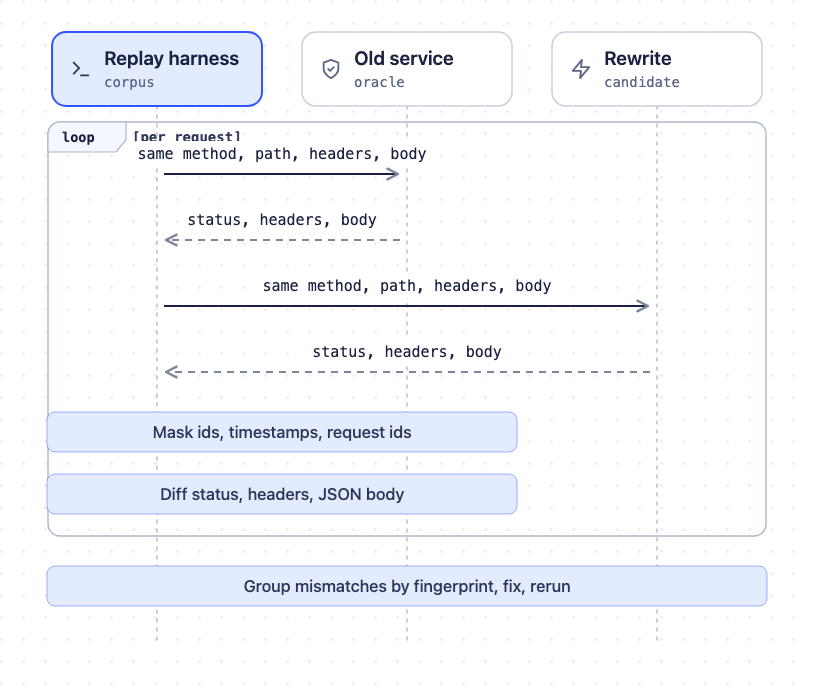
A minimal differ for step 4 fits in a few lines of Python:
import re

VOLATILE = {"id", "created_at", "updated_at", "request_id", "etag"}
UUID = re.compile(r"[0-9a-f]{8}-[0-9a-f]{4}-[0-9a-f]{4}-[0-9a-f]{4}-[0-9a-f]{12}")

def normalize(value):
    if isinstance(value, dict):
        return {k: "<volatile>" if k in VOLATILE else normalize(v) for k, v in value.items()}
    if isinstance(value, list):
        return [normalize(v) for v in value]
    if isinstance(value, str):
        return UUID.sub("<uuid>", value)
    return value

def compare(old, new):
    diffs = []
    if old.status_code != new.status_code:
        diffs.append("status")
    for h in ("content-type", "location"):
        if old.headers.get(h) != new.headers.get(h):
            diffs.append(f"header:{h}")
    if normalize(old.json()) != normalize(new.json()):
        diffs.append("body")
    return diffs
In the shell, jq can do the same normalization with walk and del.
Which fields to ignore when you compare old and new APIs
Ignore as little as you can: every masked field is a place a bug can hide.
| Field | Why it differs | How to handle it |
|---|---|---|
Generated ids (id, UUIDs) |
Each service mints its own | Mask the value, keep the type and position |
| Timestamps | Clock and timing | Mask, or allow a small window |
Date, Server, X-Request-Id headers |
Per-response | Exclude from the header diff |
ETag, signatures |
Derived from volatile bytes | Exclude or recompute |
| Array order | Only if the API never promised an order | Sort before comparing, and document why |
| Floats | Rounding across languages | Compare with a tolerance |
Be careful with automatic noise detection. Diffy runs two copies of the old service to learn which fields are noise, which works well for deterministic APIs. Anthropic noted the trap: when output legitimately varies, that approach ignores the field and any bug inside it.
Side effects and nondeterminism
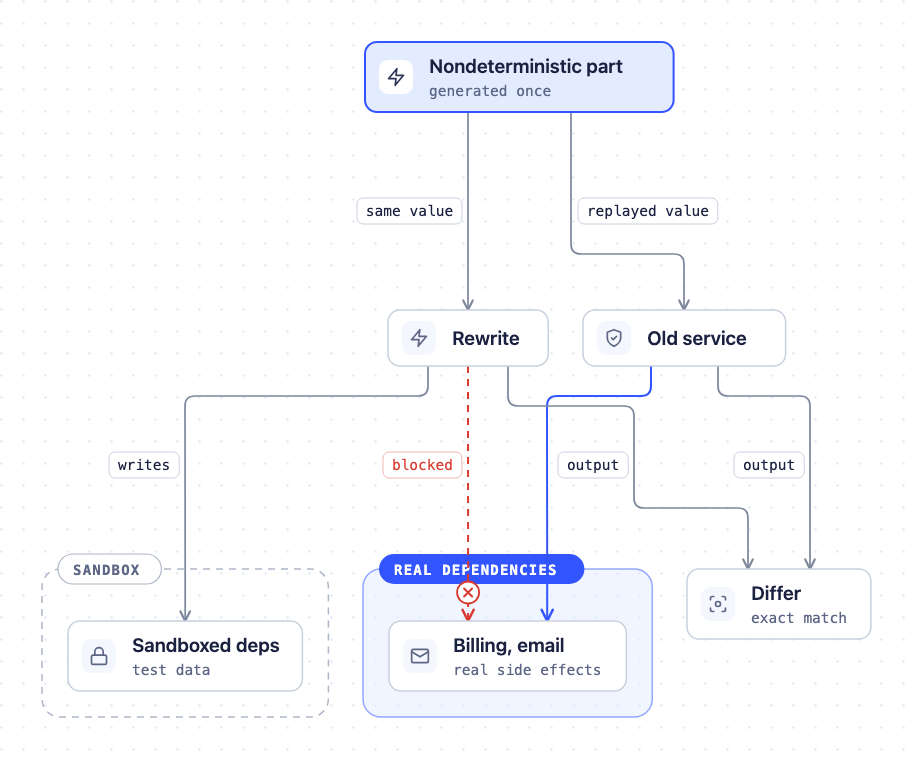
- Writes. Never let shadow traffic charge a card or send an email twice. Point the candidate at sandboxed dependencies, or replay writes only in staging.
- Multi-step flows. Run a create, read, delete flow on each service separately and compare step by step.
- Nondeterministic output. If part of a response comes from a model or a random source, generate it once and replay it to both services, as Anthropic did with model output. Everything around it can then match exactly.
Let your coding agent run the comparison with Apidog CLI
Flow-level comparison is tedious by hand and easy to hand to an agent. Model your critical flows once as an Apidog test scenario with assertions, point two environments at the old and new base URLs, and let your coding agent run both and compare.
Set up Apidog CLI and the agent skill once:
npm install -g apidog-cli@latest
apidog login --with-token <YOUR_TOKEN>
npx -y skills add https://apidog.com   # pick your agent when prompted
Then give your agent one prompt:
In Apidog project <projectId>, find the environments for the old and the new
service. Run test scenario <scenarioId> against each one with cli and json
reports, then compare the two runs step by step: status codes, assertion
results and failures. Ignore generated ids and timings. List every difference.
The agent looks up the environment ids, then runs the same scenario twice:
apidog environment list --project <projectId>
apidog run --project <projectId> -t <scenarioId> -e <oldEnvId> -r cli,json --out-file old
apidog run --project <projectId> -t <scenarioId> -e <newEnvId> -r cli,json --out-file new
Add --branch <branchName> if the scenario lives on a sprint or AI branch. Here’s a real run on a sandbox project whose two environments hit the same public API: all 7 assertions passed on each side, and only the generated object ids differ.
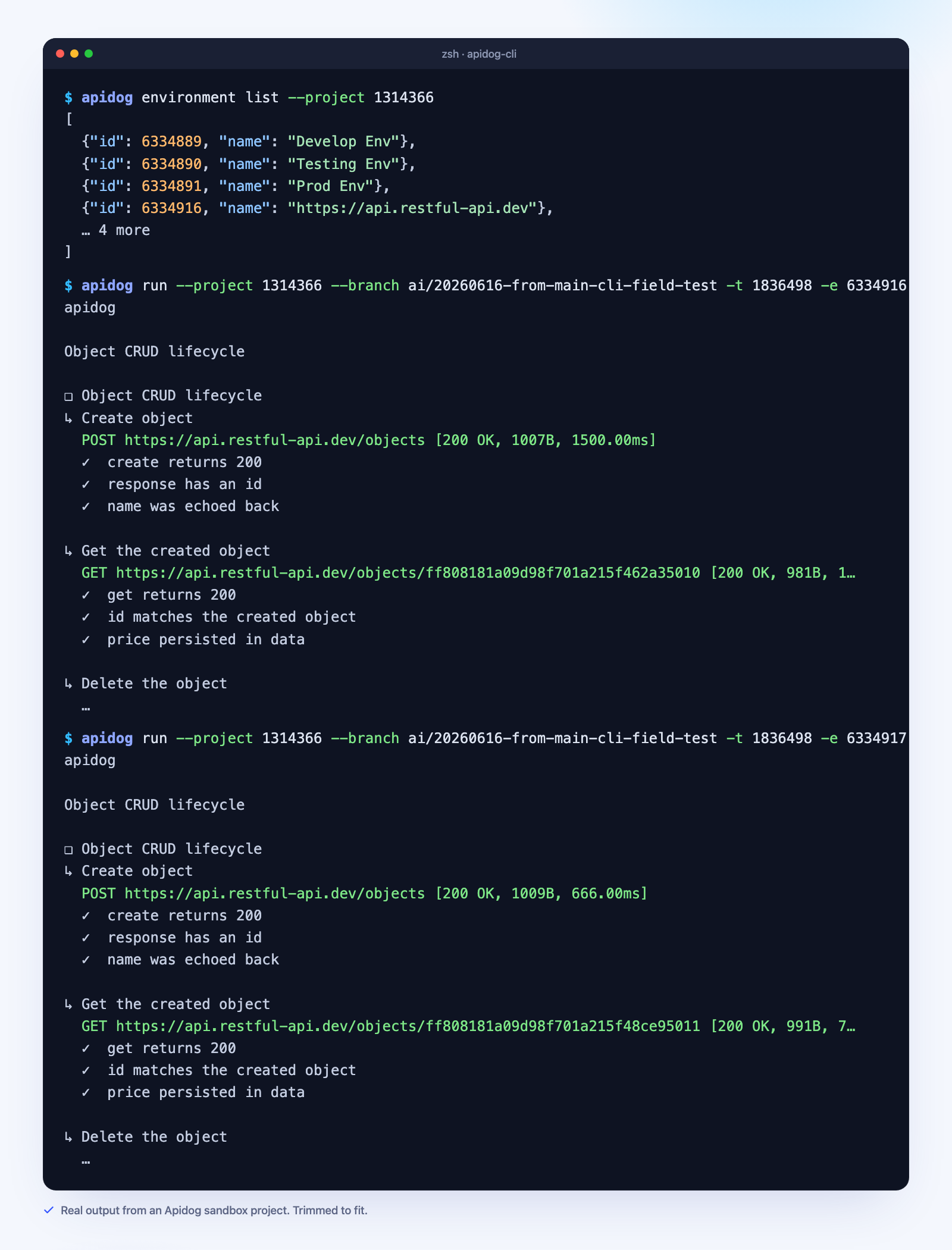
The JSON reports hold run stats and failures, not raw bodies, so put what must match into the scenario’s assertions and use the Python differ for body-level parity. Once both sides agree, the same apidog run ... -r junit becomes your CI gate: see Apidog CLI in a CI/CD pipeline, the apidog run command reference and Apidog CLI in Claude Code.
Once a rewrite throws off dozens of diff fingerprints, you can file each one as a task on Sharkly, where your team’s coding agents pick them up in parallel on your own machines and you review each fix before it merges. It’s free to start.
When is the rewrite ready to cut over?
Set the bar before you start, so “good enough” doesn’t drift:
- Zero unexplained diffs on the replay corpus for a week of runs.
- A shadow match rate you agreed on in advance, measured on live traffic, with every remaining fingerprint labelled “intended change” or “known quirk”.
- Error parity. The new service rejects the same bad requests with the same status codes and error shapes.
- Performance at or better than the old service at p50 and p99 under the same load.
- A rollback path. Route traffic back with a config change, not a deploy. Martin Fowler’s Strangler Fig pattern lets you move one route at a time.
After cutover, keep the differ running with the roles swapped for a while. It’s the cheapest canary you’ll get.
FAQ
What’s the difference between differential testing and regression testing? Regression testing checks a version against assertions or a previous green run; differential testing checks it against another running implementation. A rewrite needs both: regression tests for known behavior, differential tests for what nobody wrote down.
Do I need production traffic to do differential testing? No. A replayed corpus plus edge cases runs anywhere and catches a lot. Shadow traffic adds the long tail you didn’t capture, so add it before cutover if you can isolate side effects.
How do I handle fields that are always different, like ids and timestamps? Mask the value but keep its key and type, so a missing or renamed field still shows up. Exclude per-response headers like Date.
Can I differential test an API whose responses are nondeterministic? Yes, if you isolate the nondeterministic part. Generate it once, replay the same value to both services, and compare everything around it exactly.
Is shadow traffic safe for write endpoints? Only if the candidate can’t reach real side effects. Point it at sandboxed dependencies or restrict shadowing to reads, and replay writes in staging.
Wrapping up
Your test suite knows what you wrote down; the old service knows what your users rely on. Capture a corpus, normalize carefully, diff in layers, group by fingerprint, and set the cutover bar early.