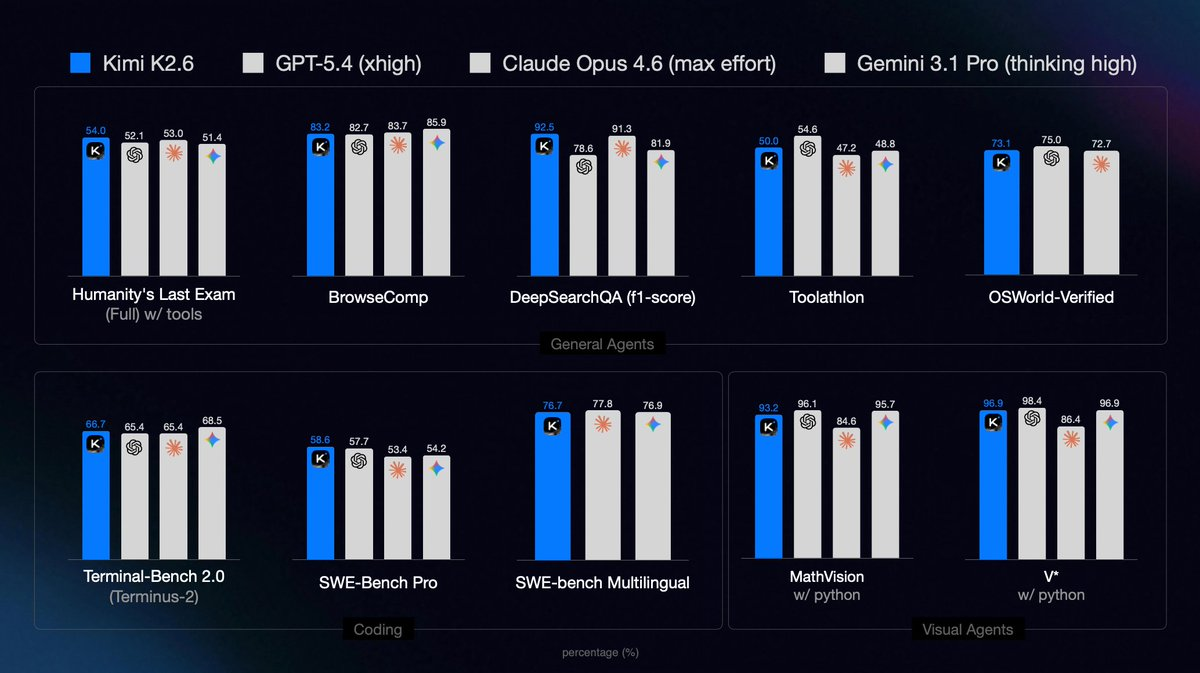
Moonshot AI’s Kimi K2.6 announcement calls it the new state of the art in open-source coding, long-horizon execution, and agent swarms, with SWE-Bench Verified at 80.2%, Terminal-Bench 2.0 at 66.7%, and Agent Swarm capacity expanded 3x to 300 sub-agents and 4,000+ coordinated steps. The best part for builders: it’s fully open source, and there are real free paths to use it in chat, via API, and even locally on your own hardware.
This post covers every working free access method as of April 2026: kimi.com web chat, the Kimi App, Cloudflare Workers AI, OpenRouter (with caveats), self-hosted quantizations, and free-credit programs. You’ll see what each option gives you, what it limits, and when to pick it.
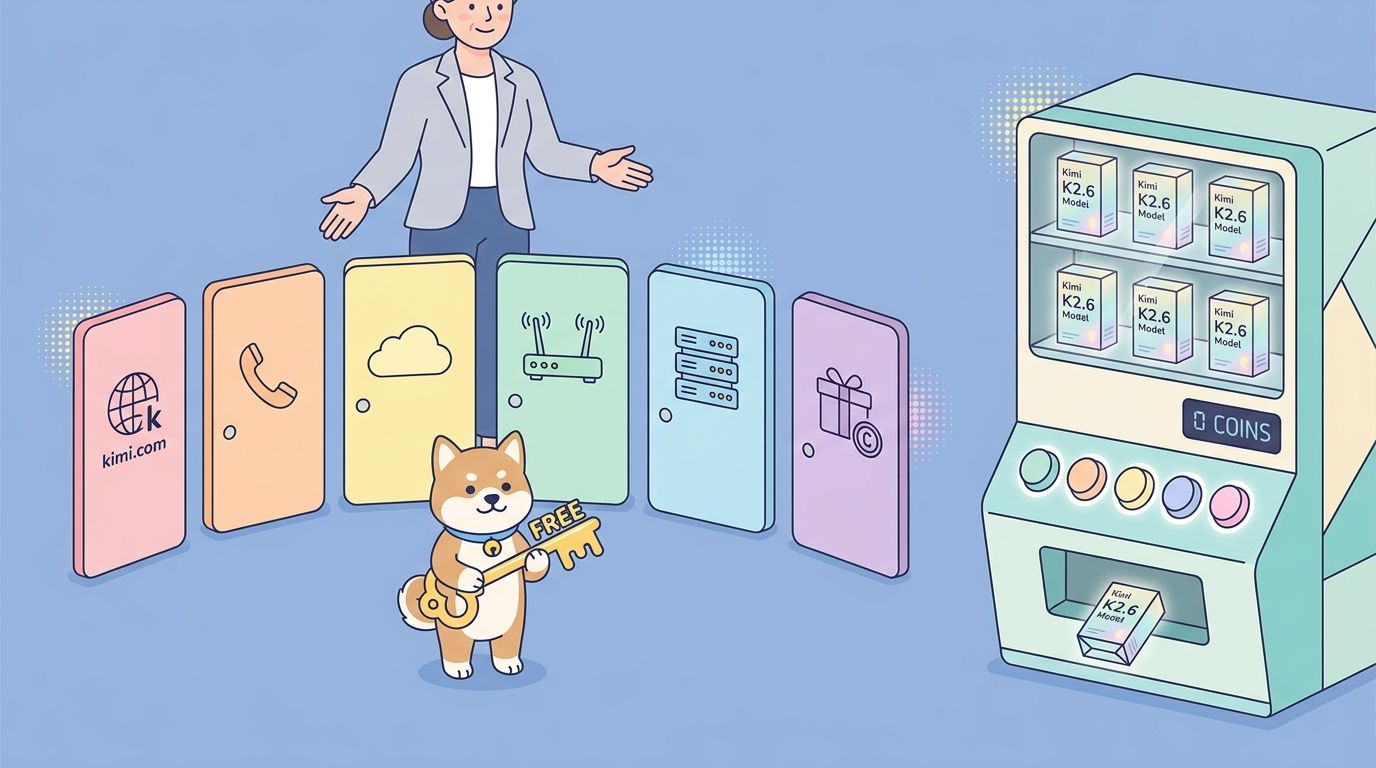
TL;DR: 6 free paths to Kimi K2.6
| Method | Type | Best for | Daily limit |
|---|---|---|---|
| kimi.com web chat | Chat UI | Quick questions, Agent Swarm, vision | Daily message quota |
| Kimi mobile App | Chat UI | On-the-go use | Matches web |
| Cloudflare Workers AI | API (free tier) | Developers inside Workers | 10K neurons/day |
| OpenRouter free variants | API | Quick integration testing | Older Kimi K2 only |
| Self-hosted open weights | Local inference | Teams with GPU hardware | None |
| Free credit programs | API trials | First-time users | Account-based |
Pick based on what you’re building. Chat UIs are instant. API tiers are programmable. Self-hosting has zero per-token cost but real hardware cost.
Option 1: kimi web chat (easiest)
The fastest free path is the official consumer Kimi product at kimi. Moonshot hosts the full K2.6 model there, with Agent Swarm active and no credit card required.
Setup
- Go to kimi.com.
- Click Sign Up (email, Google, or phone).
- Pick K2.6 from the model dropdown at the top of the chat.
That’s the whole setup. You can now use the model for chat, agent mode, coding (via Kimi Code integration), vision input (images), video understanding, and full Agent Swarm runs.
What you get
- Full Kimi K2.6 and Kimi K2.6 Thinking
- Agent Swarm in the browser (side panel shows sub-agent progress)
- Kimi Code terminal integration if you install the companion CLI
- Image and video upload (MathVision 93.2%, MMMU-Pro 79.4%)
- Chat history across sessions
- Daily message quota that resets every 24 hours
The free tier covers most personal and research needs. For sustained developer use you’ll want an API path; see Option 3.
Limits
- Daily message count (Moonshot tunes this by load; estimate 30-50 messages for K2.6)
- Agent mode counts as multiple messages per task
- No programmatic access from this interface
- Enterprise features (SSO, audit logs, team accounts) require paid membership
Option 2: Kimi mobile App
Same model, phone form factor. Download Kimi from the App Store or Google Play. Sign in with the same account you use on the web; chat history syncs across devices.
The app adds voice input, photo capture for image understanding, and push notifications when long agent tasks finish. Useful pair to the web client for anyone moving between desk and phone.
Same free quota as web. Same lack of programmatic access.
Option 3: Cloudflare Workers AI (free API tier)
Cloudflare Workers AI hosts Kimi K2.6 as @cf/moonshotai/kimi-k2.6. The Workers AI free plan grants 10,000 neurons per day, which is roughly 2 to 5 million tokens of K2.6 inference depending on prompt length. That’s enough for most personal projects and prototypes.
Setup
- Sign up at dash.cloudflare.com (free).
- Go to AI > Workers AI and accept the terms.
- Under My Profile > API Tokens, create a token with Workers AI read/write scope.
- Copy your account ID (top of the Workers AI page).
Call K2.6 via the Cloudflare REST API
curl https://api.cloudflare.com/client/v4/accounts/$ACCOUNT_ID/ai/run/@cf/moonshotai/kimi-k2.6 \
  -H "Authorization: Bearer $CF_API_TOKEN" \
  -H "Content-Type: application/json" \
  -d '{
    "messages": [
      {"role": "user", "content": "Write a haiku about APIs."}
    ]
  }'
Inside a Cloudflare Worker (the best fit)
export default {
  async fetch(request, env) {
    const response = await env.AI.run("@cf/moonshotai/kimi-k2.6", {
      messages: [
        { role: "user", content: "Explain recursion simply." }
      ],
    });
    return Response.json(response);
  }
};
Deploy with wrangler deploy. You now have a free K2.6 endpoint at your own Workers URL.
Limits
- 10,000 neurons/day on free (resets midnight UTC)
- Per-request cap on context window (smaller than the full 262,144 tokens; check current Workers AI limits)
- Streaming availability depends on the current endpoint version
- Rate-limited per region
Cloudflare Workers AI is the best free-API option for developers. You get a real production URL, rapid deploys, and no card required. For integration testing around the edge of the free tier, pair it with Apidog’s environment switching so you can flip between Cloudflare and the paid Moonshot endpoint with one click.
Option 4: OpenRouter (free routing, mostly paid)
OpenRouter carries Kimi K2.6 on a paid tier. Two tricks make it useful for free workflows:
Trick 1: older free Kimi variants
OpenRouter hosts moonshotai/kimi-k2:free (the earlier Kimi K2, pre-2.6). It’s free with rate limits. Quality is lower than K2.6, but it’s useful for wiring up integration code before you pay:
curl https://openrouter.ai/api/v1/chat/completions \
  -H "Authorization: Bearer $OPENROUTER_API_KEY" \
  -H "Content-Type: application/json" \
  -d '{
    "model": "moonshotai/kimi-k2:free",
    "messages": [{"role": "user", "content": "Hello"}]
  }'
Develop against the free variant, then swap the model string to moonshotai/kimi-k2.6 when you’re ready to pay. For context on how Qwen handles the same pattern, see our Qwen 3.6 OpenRouter guide.
Trick 2: free credit promotions
OpenRouter regularly runs new-account promotions with a few dollars in credit, enough for millions of K2.6 tokens. Check the OpenRouter dashboard or their Discord for current offers.
OpenRouter’s value is flexibility. One API key covers Kimi K2.6, Claude, GPT, Gemini, DeepSeek, and Qwen, with transparent per-model pricing.
Option 5: self-host the open weights (zero per-token cost)
This is the most “free” option, with the most setup. Moonshot publishes the full K2.6 weights under a modified MIT license at huggingface.co/moonshotai/Kimi-K2.6. You can download, run, and fine-tune them without paying Moonshot.
The hardware problem
The full K2.6 has 1 trillion parameters. At FP8 that’s about 1TB of GPU memory, meaning a multi-GPU H100 or H200 cluster. Not a realistic “free” path for most teams.
Quantization makes it doable
The open-source community has published quantized builds:
- ubergarm/Kimi-K2.6-GGUF — llama.cpp-compatible quantizations. A 4-bit quant fits on a single DGX-style 8xH100 node. Lower quants (Q3, Q2) run on smaller setups with quality loss.
- unsloth/Kimi-K2.6 — tuning-friendly quantizations designed for LoRA fine-tuning.
- Cloud rental — RunPod, Vast.ai, or Modal for hourly GPU rental. Not strictly free, but a weekend of testing costs under $10.
Running locally with llama.cpp
# Install llama.cpp
git clone https://github.com/ggerganov/llama.cpp
cd llama.cpp && make

# Download a quantized build
huggingface-cli download ubergarm/Kimi-K2.6-GGUF kimi-k2.6-q4_K_M.gguf --local-dir ./models

# Run with server mode
./llama-server -m ./models/kimi-k2.6-q4_K_M.gguf --host 0.0.0.0 --port 8080
The server exposes an OpenAI-compatible API at http://localhost:8080/v1. Point the OpenAI SDK or Apidog at it and you have fully local, fully free K2.6 inference.
Memory math for self-hosting
Quick reference for what fits where:
- FP16 full weights: ~2 TB. Needs a full rack.
- FP8 quantized: ~1 TB. 2x 8xH100 80GB nodes.
- 4-bit (Q4_K_M): ~500 GB. A single 8xH100 node.
- 3-bit (Q3_K_M): ~375 GB. 4x H100 with some CPU offload.
- 2-bit (Q2_K): ~250 GB. Runs on prosumer hardware with quality loss.
For hobbyists, a rented 2x H100 instance on Vast.ai costs around $4/hour and runs the Q4 quantization. Not free, but close enough for a weekend.
When self-hosting is the right call
- On-premise requirements (compliance, data sovereignty, like HIPAA workflows covered in our HIPAA API guide)
- High-volume inference where per-token API costs add up
- Fine-tuning on proprietary data
- You already have GPU hardware
When it’s not
- You’re prototyping (hardware setup takes longer than the prototype)
- You need high throughput or low latency
- You don’t have DevOps capacity
Option 6: free-credit programs
Most commercial providers offer free credits for new accounts. Stack them:
- Moonshot platform: new accounts typically get a small free balance. Sign up at platform.moonshot.ai or platform.kimi.ai.
- OpenRouter: promotional credits for new accounts.
- Together AI: free trial credits for Kimi K2.6 endpoint.
- Fireworks AI: free credits for first-time users.
- Cloudflare Workers AI: 10K neurons/day on free forever, no credit card.
Stacked credits cover millions of tokens for side projects, prototypes, and model evaluation.
Which free option should you pick?
Personal use or research
kimi.com web chat. Zero setup, full Agent Swarm, generous daily quota.
Hobbyist coding
Cloudflare Workers AI. Programmable API, 10K neurons/day for free, real production URL.
Prototyping a commercial product
Combination. Iterate prompts on kimi.com, then take the Moonshot free credit and build real API integration with Apidog. When credits run out, you have a proven integration to budget around.
Enterprise or data-sensitive work
Self-host quantized weights. Only free-in-production path. See air-gapped API testing tools for adjacent enterprise patterns.
Agent or coding-agent scale
Start with Cloudflare free tier, promote to Moonshot paid API when you hit the daily cap.
Free-tier limits you’ll hit
Each path has a wall. Knowing where saves frustration:
- kimi.com: daily message count, Agent Swarm tasks count as multiple messages.
- Cloudflare Workers AI: 10K neurons/day. Heavy K2.6 use can burn through in a few hundred calls.
- OpenRouter free variants: rate-limited, typically 20 req/min on free models.
- Moonshot free credits: exhaust after a few million tokens.
- Self-hosted: no token wall, but hardware + electricity cost.
Mix and match. Many teams use kimi.com for exploration, Cloudflare for dev/test, and paid Moonshot for production.
Testing free endpoints with Apidog
When you’re stitching together free tiers across kimi.com, Cloudflare, OpenRouter, and a local llama.cpp build, you end up with four or five endpoint configurations. Apidog centralizes them.
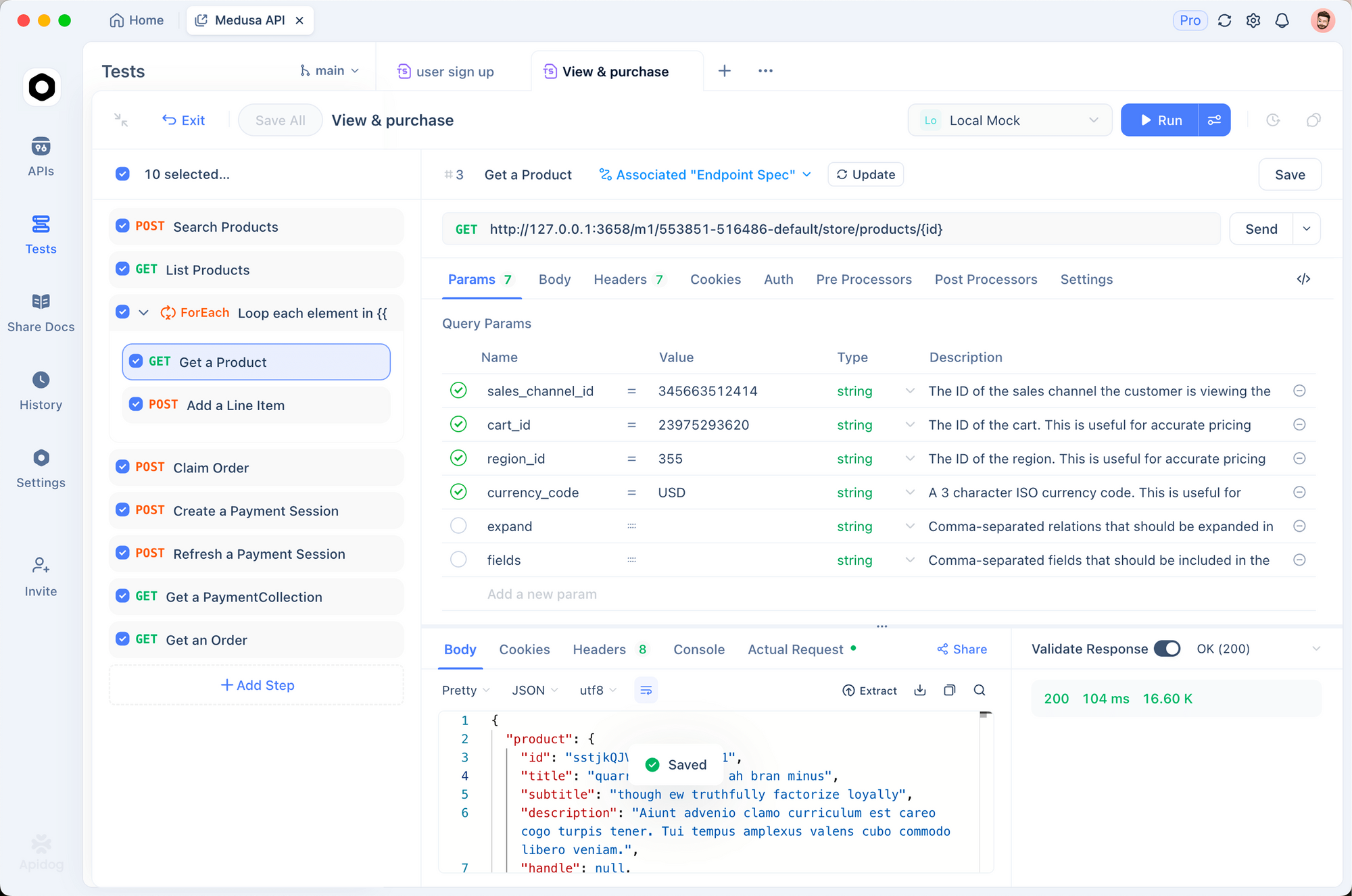
In a single Apidog project:
- Save the Cloudflare Workers AI endpoint with your account ID
- Save the Moonshot API endpoint with your Bearer token
- Save a local endpoint for your self-hosted build
- Save an OpenRouter endpoint with model switching
- Run the same test prompt across all four and compare outputs
Apidog handles SSE streams across all these backends, saves request history so you can replay failing calls later, and supports team sharing for developer-focused workflows. The free tier covers individual use with team collaboration for up to four members. Download Apidog and you can have all four free K2.6 backends configured in under 20 minutes.
For deeper dives into related tool-testing patterns, see our guides on API testing without Postman, Apidog inside VS Code, and API testing tools for QA engineers.
A 20-minute free-tier evaluation workflow
If you’re deciding whether Kimi K2.6 fits a project, run this in 20 minutes before you burn real money:
- 5 minutes — sign up at kimi.com and throw your hardest real-world prompt at it. Does it nail the task?
- 5 minutes — spin up a Cloudflare Workers AI account and hit
@cf/moonshotai/kimi-k2.6from curl. Does the response time fit your latency budget? - 5 minutes — open Apidog, save both endpoints, and run an identical streaming request on each. Compare token counts and streaming cadence.
- 5 minutes — check kimi.com/membership/pricing and the Moonshot API dashboard to model what production volume would cost.
At the end of 20 minutes you have enough signal to pick a production path. If chat is enough, stay free. If you need API, choose between Cloudflare free tier, paid Moonshot, or self-hosting.
Avoid “free Kimi K2.6 API key” scams
You’ll see websites and Discord groups offering “free Kimi K2.6 API keys.” Skip them. They’re usually:
- Stolen keys that will stop working.
- Proxy services logging your prompts.
- Phishing attempts after your payment info.
Stick with official paths. The legitimate free options listed above cover real use. If you need more, the paid Moonshot API is affordable; the Kimi K2.6 API guide walks through setup.
FAQ
Is Kimi K2.6 really free?The consumer chat at kimi.com is free with a daily quota. The weights are free under modified MIT. API access is free up to a limit (Cloudflare, new-account credits) or paid.
Do I need a credit card to use Kimi K2.6 free?Not for kimi.com web chat or Cloudflare Workers AI free tier. Sometimes for OpenRouter. Card verification for Moonshot platform credits varies.
Can I use Kimi K2.6 free for commercial projects?Yes. The license permits commercial use. At very large scale (>100M MAU or >$20M monthly revenue) you must visibly credit “Kimi K2.6.” Below that, no attribution needed.
Does the free tier support Agent Swarm?kimi.com web chat yes, with full 300-agent capability. Most API free tiers yes for the base model. Sub-agent ceilings may vary by provider.
How much does Kimi K2.6 cost after the free credits?See kimi.com/membership/pricing for official tier details. OpenRouter and other gateways list their own per-token rates.
Can I use Kimi K2.6 for free on the command line?Yes. Install Kimi Code or point any OpenAI-compatible CLI at Cloudflare Workers AI. Self-hosted with llama.cpp gives you a local CLI that never talks to the cloud.
Is my data private on the free tier?On kimi.com, conversations may be used for model improvement (check privacy settings). On Cloudflare Workers AI, Cloudflare logs for billing. On self-hosted, data never leaves your machine. If privacy is critical, self-host.
Do free tiers include vision and video features?kimi.com chat includes image and video input. Cloudflare Workers AI supports text and images; video support depends on the endpoint version. Self-hosted quantizations preserve vision; video support varies by build.
How does Kimi K2.6 compare to other free-access AI models?It’s the strongest open-weight agent model in 2026. Against Qwen 3.6 it leads on coding and agent benchmarks. Against Qwen3.5-Omni it trades multimodal variety for sharper agent focus. Against DeepSeek V3.x it has the agent-orchestration edge.
If K2.6 access proves rate-limited or you simply want a fallback, the free routes to the original Kimi K2 still hold up well for everyday tasks.
Summary
Kimi K2.6 is one of the few frontier models where “free” isn’t a trial trick. Moonshot’s announcement frames it as state-of-the-art open-source, and the licensing backs that up. kimi gives you the full model for casual use. Cloudflare Workers AI gives you a programmable free API tier. Self-hosting gives you zero per-token cost if you have the hardware.
Pick the path that matches what you’re building, test it with Apidog to catch quirks early, and scale up to paid Moonshot API only when free tiers stop being enough. For most personal and small-team use, they never do.