
TL;DR: AI agents are quietly stripping the UI out of enterprise software. The data layer, exposed through APIs and MCP, is becoming the new product surface. Five shifts API teams need to make this quarter, plus the one problem nobody has solved yet.
The user interface used to be the deepest moat in B2B software. Sales reps lived in Salesforce. Support teams lived in Zendesk. Procurement teams lived in SAP. The frequency of access, the muscle memory, the way an interface enforced data hygiene by forcing every input through a form: that was the moat. The data was what got stored along the way.
That era is closing. AI agents can now read and write enterprise data directly through APIs, without ever opening a browser. Salesforce has already announced a headless product that exposes its data layer to agents. Other systems of record are weeks behind, not years. If the UI is no longer the moat, the API is. That changes what the API has to be.
What “headless software” means in practice
Headless software is enterprise software that exposes its data layer through APIs so agents can read and write directly. The UI doesn’t go away. It stops being the only door.
This is different from “API-first” (a design methodology) and “headless CMS” (a content architecture). Both describe how software is built. Headless software describes a consumer shift. What’s reading and writing your data is no longer a human with a browser. It’s an agent with MCP access and a goal.
Three things made this possible at once: LLMs that can plan and select tools without supervision, MCP standardizing how agents discover external systems, and data extraction so cheap that walling off the API no longer protects what’s underneath.
If your API was designed assuming a developer writes a client against it once, and then a person uses that client every day, you have work to do.
The five stickiness factors that no longer hold
Five things historically kept enterprise systems sticky. Look at each one through the lens of an agent and most of them break.
Frequency of access kept users locked in through muscle memory. Sales reps logged into Salesforce eight times a day for years. Agents don’t have muscles, and the cost of switching their tooling is the cost of editing a config file.
Read-write workflows made migration dangerous because data was always in motion. Agents read and write at machine speed; they don’t care which database is behind the API as long as the contract is stable.
Undocumented SOPs are the rules nobody wrote down: “Deals over $100K need VP approval.” Still hard for agents to navigate, which gives incumbents breathing room. But every agent that runs the workflow learns the rules, and the rules end up encoded somewhere readable.
Internal habit loops, the way a team’s daily standup gets shaped around the tool they all share, dissolve when the team’s daily work flows through agents instead.
Compliance criticality is the one that holds. Regulatory exposure doesn’t care whether a human or an agent moved the data; the audit trail still has to exist. We’ll come back to this.
Four out of five moats are weakening. The fifth is the seam where new defensibility is going to grow.
Five things API teams need to change this quarter
If the API is the new product surface, here is what needs to be different about it.
1. Treat your API as the product surface, not plumbing
A REST endpoint that exists “so the frontend can call it” is a different artifact than a REST endpoint that an agent reasons about and chooses to call. The first one can be inconsistent, undocumented, and shaped by whatever the UI happened to need this quarter. The second one cannot.
If you’re designing APIs for AI agents, the contract has to be the interface. That means descriptive names, predictable shapes, no overloaded fields that mean three different things depending on context, and error responses that say what went wrong in language a model can act on. “400 Bad Request” is not enough. “400: missing required field customer_id; pass the ID of the customer this invoice belongs to” is.
The litmus test: can a competent agent call your API correctly with nothing but the OpenAPI spec and the field descriptions? If the answer requires also reading the source of your old UI to understand what an endpoint does, the API is still plumbing.
2. Ship MCP alongside REST and GraphQL
REST is how agents call your API once they know it exists. MCP is how they discover what it can do in the first place. A REST API without an MCP server is like a website with no robots.txt and no sitemap; technically callable, practically invisible to the systems that want to reach it.
This is not a question of replacing your existing API surface. Keep REST. Keep GraphQL if you have it. Add MCP as a third dialect that exposes the same capabilities through a protocol agents already speak. The Anthropic MCP specification covers the contract; Apidog covers the testing and documentation work that has to happen around it.
If you want a primer on what MCP is and why it matters for API teams specifically, see our deep dive.
3. Redesign schemas around intents and outcomes, not CRUD objects
Salesforce’s data model has Opportunities, Leads, Accounts, Contacts. An agent doesn’t think in those nouns. It thinks in goals: “find every account about to churn,” “draft the proposal for yesterday’s closed deal,” “escalate the account that opened a P0 ticket overnight.”
The next generation of systems of record will be built around tasks, intents, threads, policies, and outcomes, not the CRUD objects we’ve been modeling since the early 2000s.
That doesn’t mean rewriting your schema overnight. It means adding a layer above it. A /intents/capture endpoint that takes “this lead is buying” and returns the right Opportunity + Activity + Task records, instead of forcing the agent to compose three separate writes. The intent becomes the API; the CRUD becomes an implementation detail.
Our walkthrough of making your API ready for AI agents covers the patterns in more depth.
4. Solve agent identity and scoped permissions
This is the one nobody has fully solved, so it gets its own section below. The short version: every agent call needs an identity that is not the user’s, scoped to permissions that are not the user’s, and audited as a separate class of action. If your API can’t tell the difference between “Alice clicked the button” and “Alice’s agent clicked the button on her behalf at 3am while she was asleep,” you have a problem.
See MCP security policies for current patterns.
5. Build the action layer with audit trail and closed-loop feedback
The new defensibility isn’t in storing the record. It’s in taking the action, capturing the outcome, and using that feedback to improve future decisions. A SaaS product that holds your CRM data is a database with a UI. A SaaS product that takes actions on your behalf, observes what happened, and gets better at the action over time is something else entirely.
For API teams, this means three changes. Action endpoints need outcome callbacks or webhooks so the agent learns what happened. Every action has to be replayable, or you can’t debug what the agent did. And every action needs an audit row with inputs, outputs, agent identity, and the reasoning trace if you can get it.
Testing agent workflows without losing data is the operational version of this shift.
The unsolved part: agent permissioning
Of all the gaps in agent-ready software, this is the one that’s least solved and most consequential. Which agents are authorized to do what, on whose behalf, with what auditability?
The honest answer in 2026 is that almost nobody has shipped this well. OAuth was built for delegated user access, not agents. RBAC was built for human roles. Audit logs were built to track what users did, not which user’s agent did what under what policy.
Four patterns are emerging that work today, even before the standards land.
Scoped tokens per agent identity. Never reuse a user’s session token for an agent that acts on their behalf. Issue a separate token with a separate scope, even if it’s narrower than the user’s full permissions, and rotate it independently. If the token leaks, you revoke the agent, not the user.
Delegation metadata on every request. Every API call should carry a header like X-Acting-On-Behalf-Of: user_id and X-Agent-Identity: agent_name@version. Two extra headers, zero changes to your endpoint logic, and your audit story gets ten times better.
Append-only audit logs for agent actions. Agent actions belong in a separate audit table from user actions. The query patterns are different; compliance teams will want to answer “what did the agents do this week” without scrolling through human activity.
Policy as code. Declare, in a versioned config file, what each agent class is allowed to do. “Customer support agent can read invoices and refund up to $50; cannot delete accounts.” Check it in. Test it. Diff it. Permission policy has to be a build artifact, not a wiki page.
None of this is a finished standard. All of it is shippable now.
Where Apidog fits
If you’re going to treat your API as the product, you need a workbench that handles design, contract, mocking, MCP, testing, and audit in one place. That’s what we built Apidog for, and these five shifts map cleanly onto the work it already supports.
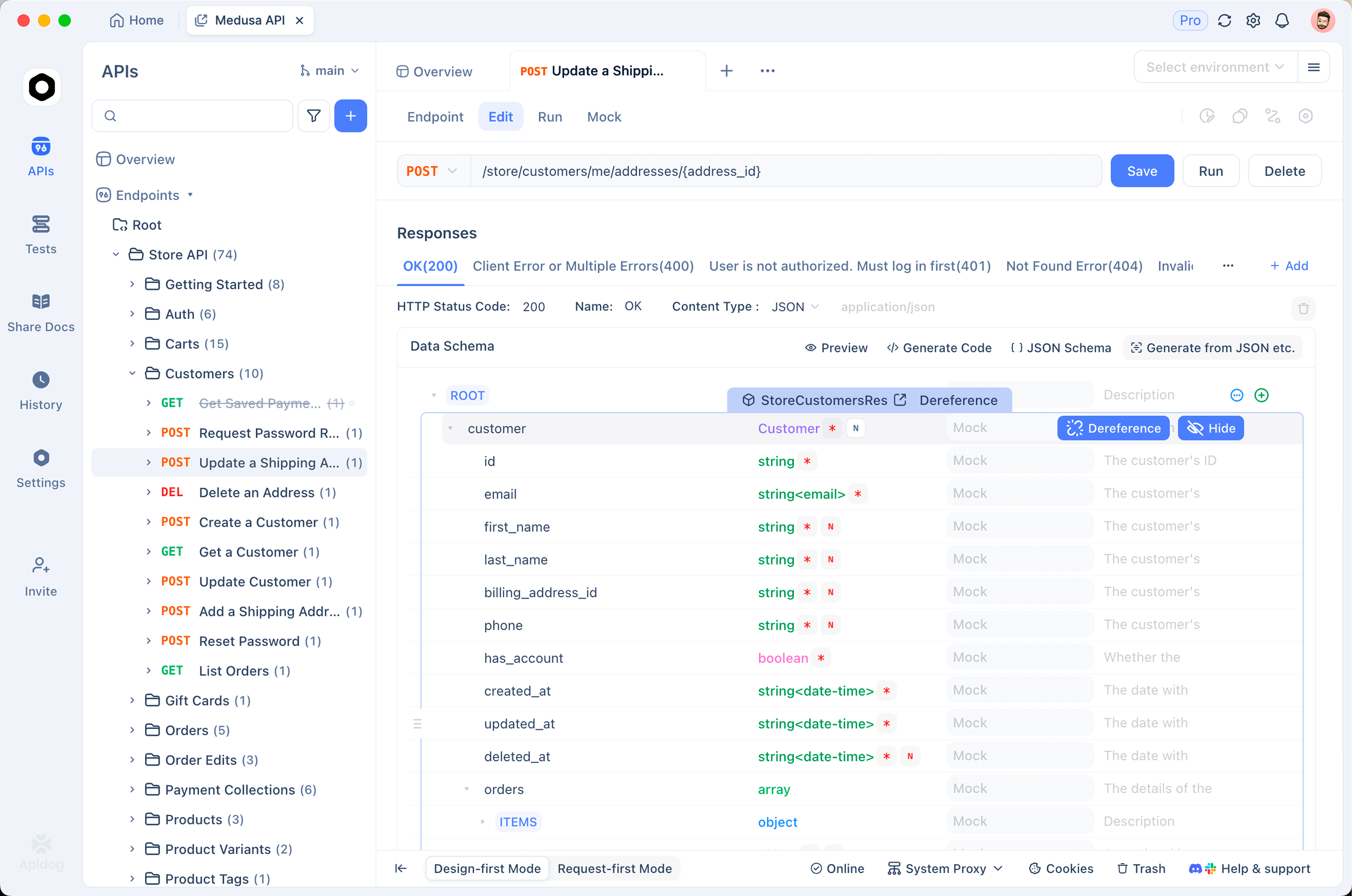
- Shift 1 (API as product): schema-first design and auto-generated documentation, so the contract is the single source of truth your agents read.
- Shift 2 (MCP alongside REST): dedicated MCP server testing tooling for verifying your MCP server before it ships.
- Shift 3 (intent-shaped APIs): mocking with dynamic responses, so you can prototype an intent endpoint and have your agent client call it before the backend exists.
- Shift 4 (permissioning): environment management for separating agent tokens from user tokens, plus assertion testing for policy enforcement.
- Shift 5 (action layer + audit): the AI Agent Debugger and A2A Debugger that shipped in April let you trace, replay, and assert on agent-driven API calls end to end.
If you haven’t tried it yet, download Apidog and run your existing OpenAPI spec through it. The mock server alone usually pays for the migration.
The bet
The bet API teams should make right now is straightforward. The API itself is the product. If it’s plumbing, it’s a commodity. If it’s the surface that agents reason about, choose, trust, and act on, it’s the moat.
Teams that ship this quarter will end up with API surfaces that look nothing like the ones built five years ago. Teams that wait will rewrite them under deadline pressure in 2027, after a major customer asks why the agent integration “didn’t work right.”