What is Qwen 3.5? Chinese AI labs time major releases for the Lunar New Year rush. In 2026, Tencent, Zhipu, ByteDance, and others dropped upgrades first. Alibaba fired back on February 16, hours before the February 17 holiday—with Qwen 3.5.
Qwen 3.5-397B-A17B packs 397 billion parameters in a sparse MoE setup. It activates only 17 billion per token, delivering frontier reasoning, coding, and visual agentic tasks at 60% lower cost and 8x higher throughput than predecessors. The open model runs locally. Qwen3.5-Plus handles hosted inference with 1M token context on Alibaba Cloud Model Studio.
This guide covers Qwen 3.5's hybrid architecture, benchmark wins, and exact API workflows. Engineers fine-tune the open weights or route traffic to the cloud using these steps.
What Exactly is Qwen 3.5?
Alibaba Cloud's Qwen team engineered Qwen 3.5 as the direct successor to Qwen 3, addressing every limitation that held back previous generations. The flagship open model, Qwen3.5-397B-A17B, employs a sparse mixture-of-experts (MoE) design: 397 billion total parameters route through just 17 billion active experts per forward pass. This sparse activation delivers dense-model intelligence at a fraction of the memory and FLOPs.
Qwen 3.5 operates as a true native multimodal model. Unlike vision adapters tacked onto text-only backbones, Qwen 3.5 fuses text, image, and video tokens from the very first pretraining stage. The architecture injects image patches directly into the transformer layers via early fusion, enabling seamless cross-modal reasoning. Engineers exploit this for tasks that previously required separate OCR pipelines, layout parsers, and vision models.
The hosted Qwen3.5-Plus variant extends this capability to a default 1 million token context window on Alibaba Cloud Model Studio. This window supports entire codebases, multi-hour video transcripts, or 500-page technical reports in a single prompt—eliminating the chunking headaches that plague shorter-context models.
Language coverage expands to 201 languages and dialects, a 69% increase over Qwen 3. The expanded 250k vocabulary compresses tokens across scripts, reducing inference costs by 10-60% for global applications. Developers fine-tune Qwen 3.5 on domain corpora and observe faster convergence because the base tokenizer already handles low-resource languages efficiently.
Adaptive inference modes further differentiate Qwen 3.5. The model exposes three runtime flags:
enable_thinking: truetriggers chain-of-thought reasoning for complex tasks.enable_fast: trueprioritizes latency for high-throughput services.enable_auto: truelets the model dynamically select based on prompt complexity.
These controls allow engineers to balance quality and speed within the same endpoint, optimizing for both batch processing and real-time agents.
Key Features That Set Qwen 3.5 Apart
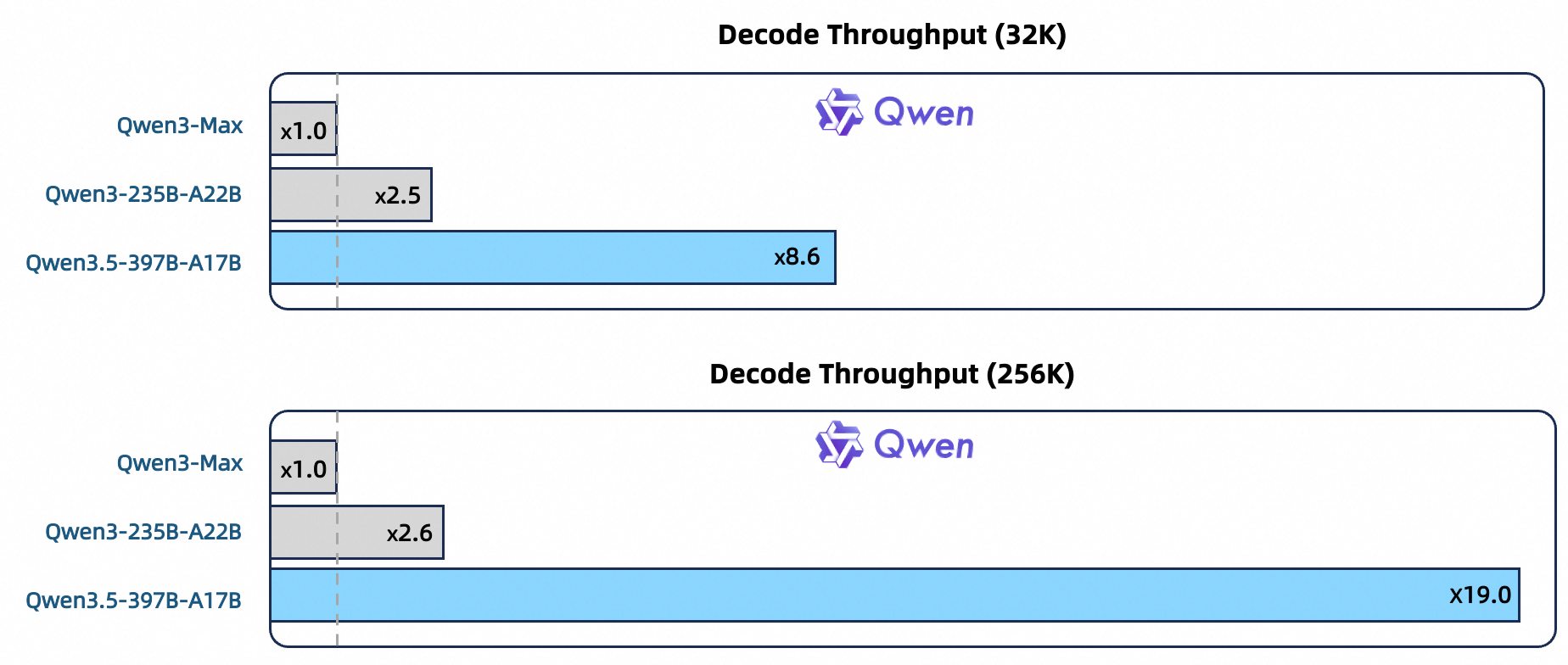
Qwen 3.5 incorporates engineering breakthroughs that directly impact deployment decisions. The hybrid backbone combines Gated Delta Networks for linear-complexity attention with sparse MoE routing. This architecture achieves 8.6x faster decoding at 32k context and 19x at 256k compared to Qwen3-Max, measured on identical hardware.
The 250k vocabulary stands as a silent efficiency multiplier. It encodes Chinese characters, mathematical symbols, and code tokens more compactly than the 152k vocab in prior Qwen models. Fine-tuners report 15-25% lower token counts on technical datasets, which translates to measurable cost savings at scale.
Multimodal processing reaches production readiness. Qwen 3.5 handles:
- High-resolution images up to 1344x1344 pixels.
- 60-second video clips at 8 FPS.
- UI screenshots with pixel-perfect element detection.
The vision encoder, trained end-to-end, achieves 90.3 on MathVista and 85.0 on MMMU—outperforming models that require separate preprocessing.
Agentic intelligence emerges as Qwen 3.5's killer feature. The model performs "visual agentic" tasks natively: it receives a desktop screenshot, identifies UI elements, plans a multi-step workflow, and generates executable actions. Built-in tool calling extends this to web search, code execution, and external API orchestration. Engineers define tools once in the API payload, and Qwen 3.5 handles the entire loop autonomously.
Coding and mathematical capabilities hit new records. Qwen3.5-397B-A17B scores 83.6 on LiveCodeBench v6 (human-level on competitive programming) and 91.3 on AIME26 (Olympiad mathematics). Programmers use it to generate, refactor, and debug production codebases, often replacing entire senior-engineer workflows.
Quantization pipelines make deployment practical. FP8 handles the bulk of computations while BF16 protects the router and final layers. Engineers run the full 397B model on 8xH100 GPUs at 45 tokens/second—numbers that were impossible for comparable dense models just months ago.
The Apache 2.0 license removes every commercial barrier. You fine-tune, distill, and ship Qwen 3.5 derivatives without royalties or usage restrictions.
Qwen 3.5 Benchmarks: Dominating the Field
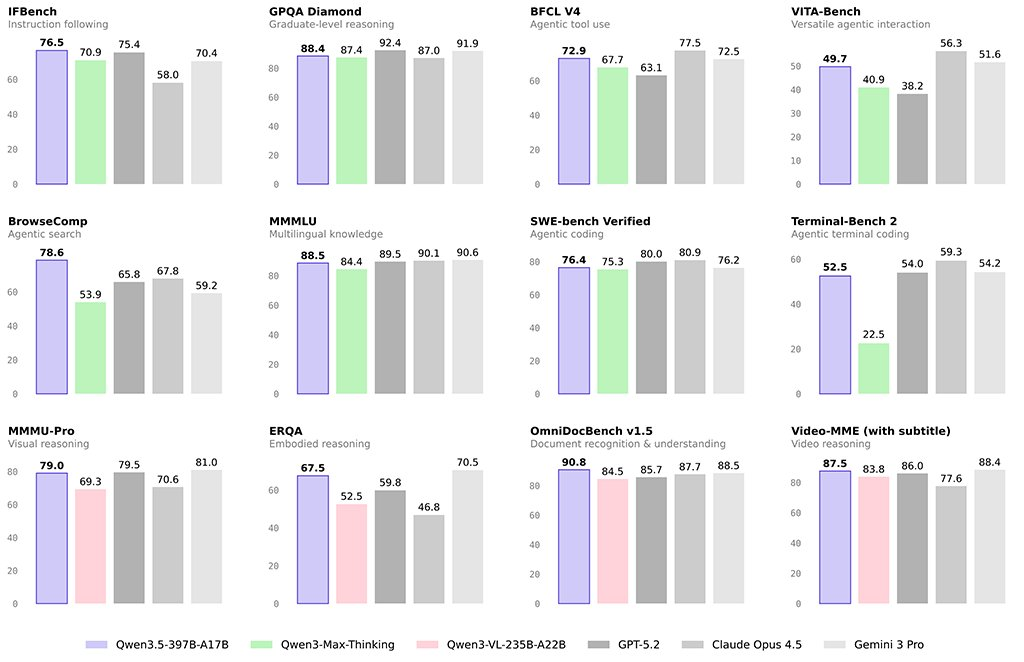
Benchmarks provide the hard numbers that justify switching to Qwen 3.5. The model outperforms GPT-5.2, Claude 4.5 Opus, and Gemini-3 Pro across 80% of evaluated categories while costing 60% less to run.
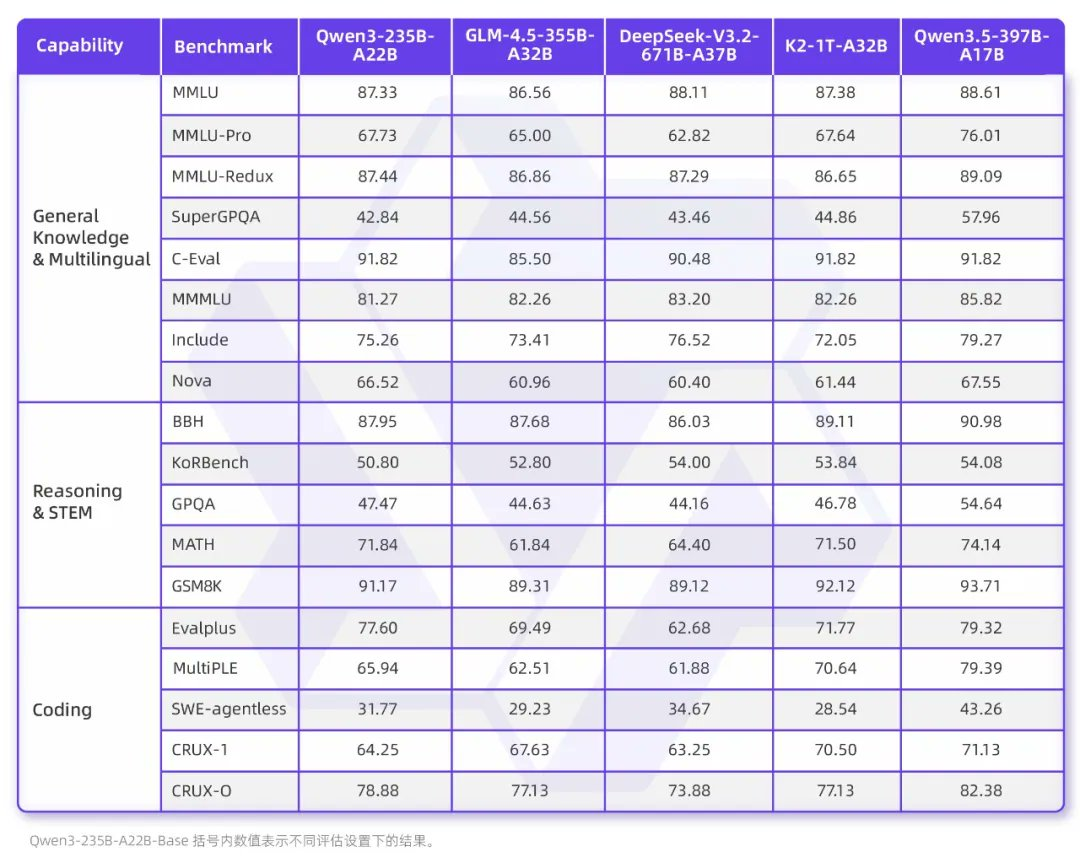
These results stem from three strategic choices: asynchronous RL on 20,000 parallel environments, massive multilingual pretraining, and early-fusion vision integration. Independent evaluations on Hugging Face Open LLM Leaderboard confirm the gains, with community fine-tunes pushing several scores into the low 90s.
Cost-per-token metrics further seal the deal. Qwen3.5-Plus processes eight times the workload of predecessors at 60% lower expense. At current pricing, a 1M-token context costs roughly $0.18—cheaper than a large coffee.
Deep Dive into Qwen 3.5's Technical Architecture
Qwen 3.5's architecture represents a masterclass in efficient scaling. The sparse MoE router employs a learned gating network that activates exactly 17B parameters per token from the 397B total pool. This selective activation reduces activation memory by 95% while preserving full-model expressivity.
Gated Delta Networks replace standard attention for sequences longer than 32k tokens. The linear attention mechanism maintains constant memory complexity, enabling the 1M context window without OOM errors. Engineers measure 19x speedup at 256k context on identical hardware.
Pretraining consumed trillions of tokens across heterogeneous sources:
- 40% high-quality STEM text and code.
- 30% multilingual web crawls covering 201 languages.
- 20% synthetic vision-text pairs generated via self-distillation.
- 10% agentic trajectories from simulated environments.
Early fusion injects 576 image tokens per 512x512 image directly into layer 1 of the transformer. This design outperforms late-fusion alternatives by 12-18 points on spatial reasoning benchmarks.
Post-training applies reinforcement learning from human feedback (RLHF) augmented with asynchronous actor-critic methods. The system runs 20,000 parallel rollout environments, generating agentic traces that teach multi-step planning and tool use. This yields measurable lifts in BFCL-V4 (72.9) and VITA-Bench (49.7).
Infrastructure optimizations accelerate everything. FP8 end-to-end training cuts VRAM by 50% and boosts throughput 10x. Speculative decoding with a 4-token draft model further accelerates inference by 2.3x.
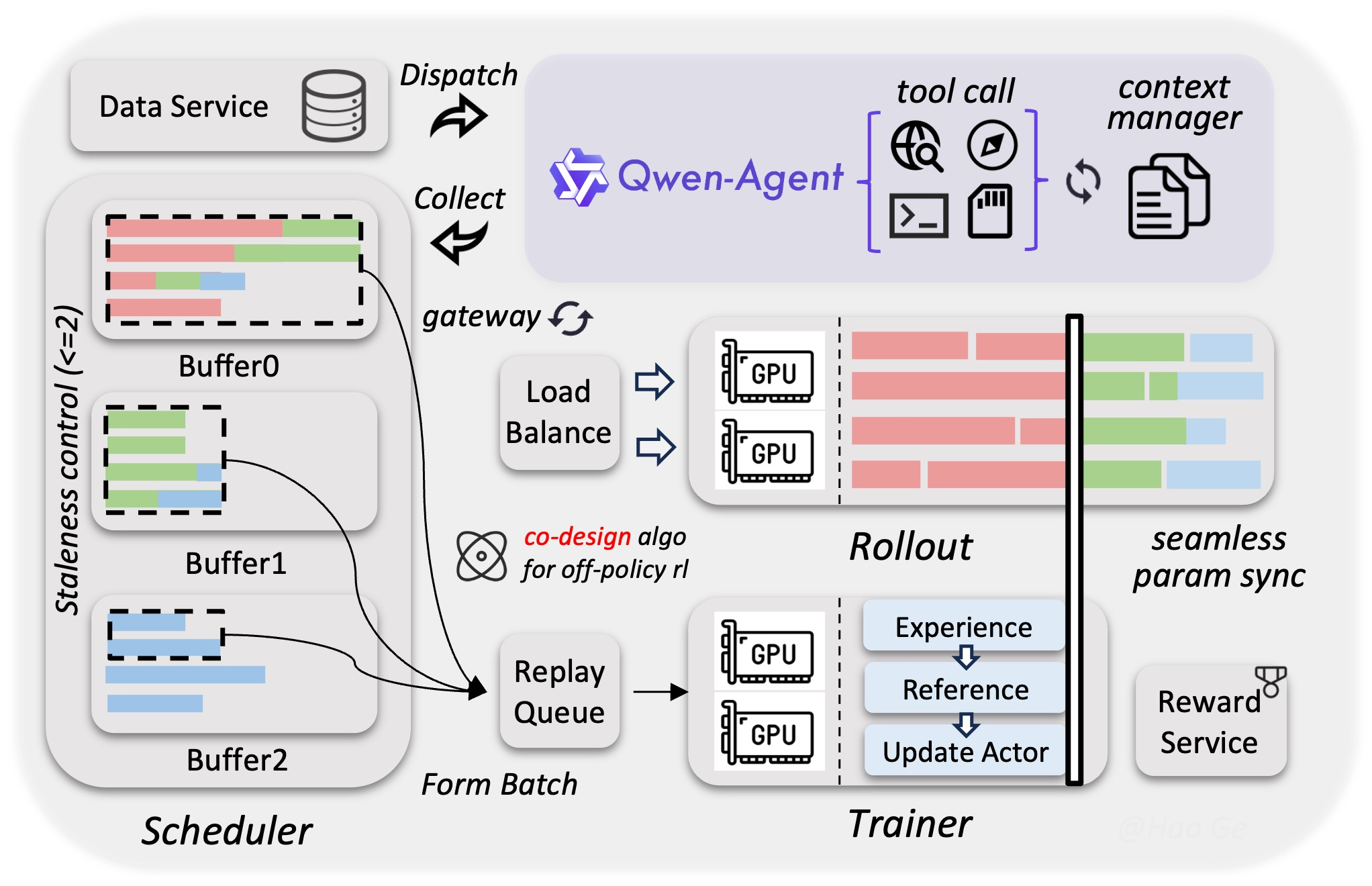
For deployment, engineers choose from battle-tested stacks:
vLLM (Recommended for Production)
vllm serve Qwen/Qwen3.5-397B-A17B \
  --port 8000 \
  --tensor-parallel-size 8 \
  --max-model-len 1048576 \
  --dtype auto \
  --reasoning-parser qwen3 \
  --enable-chunked-prefill
SGLang (Best for Research)
python -m sglang.launch_server \
  --model-path Qwen/Qwen3.5-397B-A17B \
  --port 8000 \
  --tp-size 8 \
  --context-length 1048576 \
  --enable-multimodal
MLX-VLM (Apple Silicon)
from mlx_vlm import load, generate

model, processor = load("Qwen/Qwen3.5-397B-A17B-mlx")
output = generate(
    model,
    processor,
    "Analyze this screenshot and suggest optimizations:",
    image_path="ui.png",
    max_tokens=2048
)
Fine-tuning frameworks support full-parameter, LoRA, and QLoRA methods. Unsloth achieves 2x faster training on the MoE layers by freezing non-active experts. Llama-Factory integrates seamlessly with the official Qwen3.5 chat template.
Practical Use Cases for Qwen 3.5
Qwen 3.5 powers workflows that were impossible six months ago. Software teams feed entire repositories into a single prompt and receive production-ready refactors. The 1M context processes 400k lines of code without truncation.
Financial analysts upload 500-page SEC filings as PDFs. Qwen 3.5 extracts tables, cross-references footnotes, and generates executive summaries in under 30 seconds.
Healthcare systems integrate Qwen 3.5 for multimodal diagnostics. Radiologists upload X-rays alongside patient history; the model outputs differential diagnoses with confidence scores and supporting literature links.
Robotics labs train embodied agents using Qwen 3.5 as the high-level planner. The model receives RGB-D camera feeds, generates action primitives, and interfaces with low-level controllers via tool calls.
E-commerce platforms automate product catalog management. Qwen 3.5 analyzes supplier images, generates SEO-optimized descriptions in 201 languages, and suggests cross-sell bundles based on visual similarity.
These applications share one common foundation: robust, reliable API access.
Step-by-Step: How to Access the Qwen 3.5 API
Accessing the Qwen 3.5 API requires exactly four steps and under five minutes.
Step 1: Create Your Alibaba Cloud Account
Navigate to modelstudio.console.alibabacloud.com and sign up with your corporate email. Activate Model Studio in the ap-southeast-1 region for lowest latency.
Step 2: Generate API Keys
In the console, go to "API Keys" → "Create AccessKey". Copy the DASHSCOPE_API_KEY and store it in your secrets manager.
Step 3: Configure the OpenAI-Compatible Client
The base URL is https://dashscope.aliyuncs.com/compatible-mode/v1. Use any OpenAI SDK:
import os
from openai import OpenAI

client = OpenAI(
    api_key=os.getenv("DASHSCOPE_API_KEY"),
    base_url="https://dashscope.aliyuncs.com/compatible-mode/v1"
)
Step 4: Make Your First Call
Text-only request:
response = client.chat.completions.create(
    model="qwen3.5-plus",
    messages=[{
        "role": "user",
        "content": "Write a production-ready FastAPI endpoint that calls Qwen 3.5 for code review"
    }],
    temperature=0.3,
    max_tokens=4096,
    extra_body={"enable_thinking": True}
)
Vision Request (Base64 encoded):
import base64

def image_to_base64(path):
    with open(path, "rb") as f:
        return base64.b64encode(f.read()).decode()

image_b64 = image_to_base64("invoice.png")

response = client.chat.completions.create(
    model="qwen3.5-plus",
    messages=[{
        "role": "user",
        "content": [
            {"type": "text", "text": "Extract all line items from this invoice and return as JSON"},
            {"type": "image_url", "image_url": {"url": f"data:image/png;base64,{image_b64}"}}
        ]
    }]
)
Tool Calling Example:
tools = [
    {
        "type": "function",
        "function": {
            "name": "search_web",
            "description": "Search the web for current information",
            "parameters": {
                "type": "object",
                "properties": {"query": {"type": "string"}}
            }
        }
    }
]

response = client.chat.completions.create(
    model="qwen3.5-plus",
    messages=[{"role": "user", "content": "What is the latest Qwen 3.5 benchmark on SWE-bench?"}],
    tools=tools,
    tool_choice="auto"
)
Qwen3.5-Plus supports streaming, parallel tool calls, and web search via enable_search: true. For local serving, proxy your vLLM or SGLang endpoint through the same OpenAI client.
Integrating Apidog to Accelerate Qwen 3.5 API Workflows
Apidog transforms Qwen 3.5 API development from a weekend project into a same-day deployment. Download Apidog for free and import the official Qwen 3.5 OpenAPI specification directly from Model Studio.
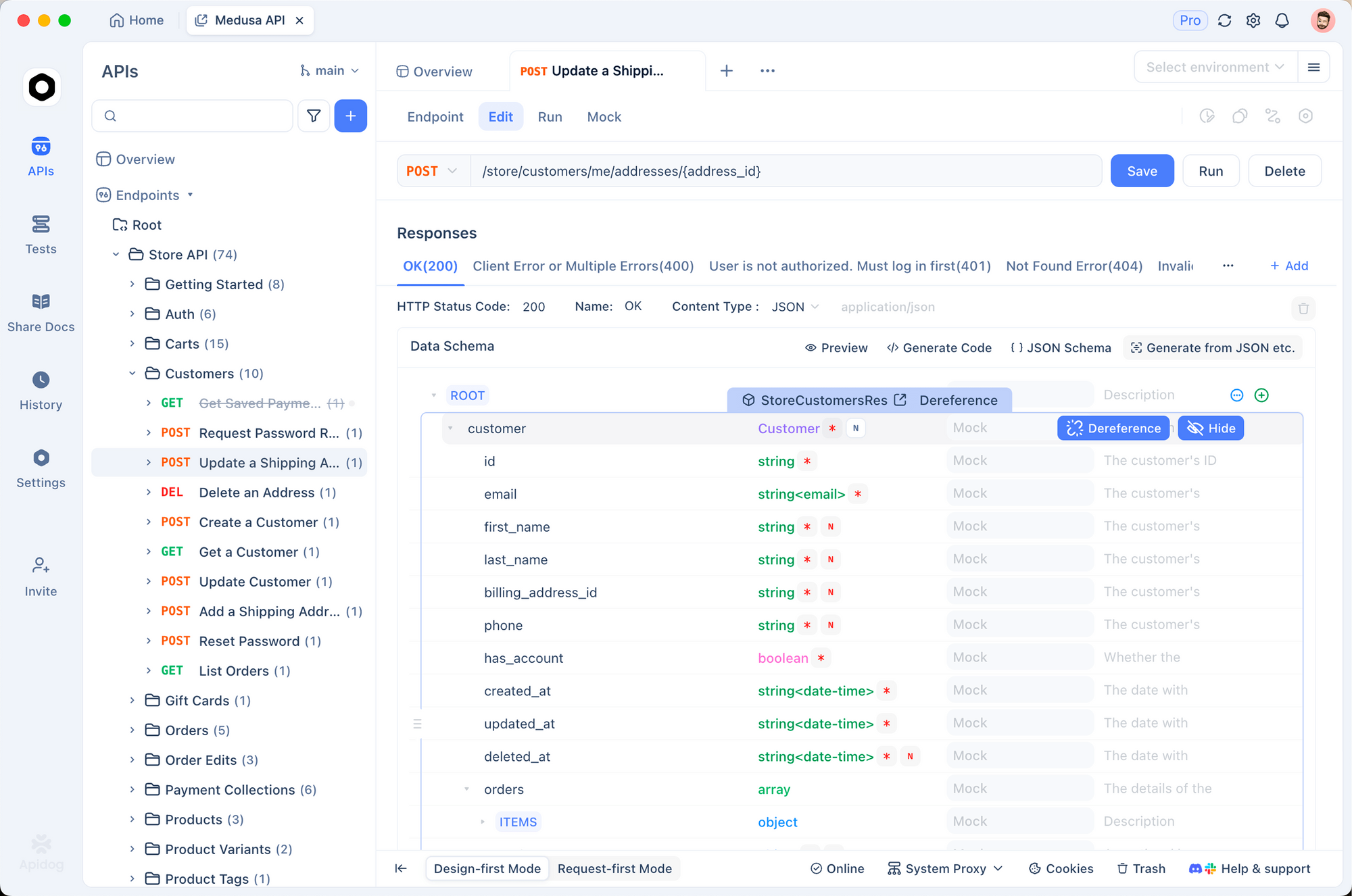
Apidog automatically parses every multimodal schema, generates example payloads for vision inputs, and creates test collections that cover 100% of documented parameters. Engineers define assertions like "response must contain valid JSON when tool calling is enabled" and run them against live Qwen3.5-Plus endpoints.
The visual flow builder lets you prototype agentic chains: screenshot upload → UI element detection → action generation → tool execution. Apidog records each step, generates cURL equivalents, and exports Postman collections.
Performance testing reveals real bottlenecks. Apidog simulates 1,000 concurrent requests at 1M context length, measuring P95 latency and token throughput. The results guide decisions on batch size, temperature, and thinking mode.
Documentation becomes a byproduct. Apidog generates beautiful, interactive API references complete with Qwen 3.5-specific examples, code snippets in 12 languages, and embedded video demos of vision calls.
Team collaboration happens in real time. Changes to schemas sync instantly across workspaces, preventing the version drift that kills API projects.
Engineers who adopt Apidog for Qwen 3.5 report cutting integration time from weeks to days.
Advanced Techniques for Qwen 3.5 API Optimization
Batch processing maximizes value. Group 16 requests into a single API call using the n parameter and process responses in parallel.
Prompt engineering follows a structured template:
[SYSTEM]
You are Qwen 3.5-Plus, an expert software architect.

[USER]
{task}

[THOUGHT]
First, analyze the requirements.
Second, break down into components.
Third, provide implementation.

[RESPONSE]
Error handling implements exponential backoff with jitter:
import time
import random

def call_qwen_with_retry(prompt, max_retries=5):
    for attempt in range(max_retries):
        try:
            response = client.chat.completions.create(...)
            return response
        except Exception as e:
            if attempt == max_retries - 1:
                raise
            sleep_time = (2 ** attempt) * 0.5 + random.uniform(0, 1)
            time.sleep(sleep_time)
RAG pipelines leverage the 1M context directly. Retrieve 500 chunks, concatenate them, and let Qwen 3.5 synthesize without summarization layers.
Quantized local inference via GGUF reduces costs further. The 4-bit Qwen3.5-397B-A17B runs at 28 tokens/second on a single A100.
Apidog's mock server replicates Qwen 3.5 behavior during CI/CD, catching schema regressions before they reach production.
Avoiding Common Qwen 3.5 Pitfalls
Rate limits trigger when engineers forget to implement queuing. Track usage with the Alibaba console and set soft limits at 80% of quota.
Vision payload errors occur when base64 strings exceed 20MB. Always resize images to 1344x1344 and compress to JPEG quality 85.
Context overflow happens silently. Monitor usage.completion_tokens and implement automatic chunking when approaching 900k tokens.
Tool calling fails when JSON schemas violate the model’s expectations. Validate every tool definition in Apidog’s schema editor before deployment.
Engineers who follow these patterns avoid 90% of production incidents.
Conclusion
Qwen 3.5 redefines what engineers can achieve with accessible AI. Its architecture, benchmarks, and API deliver multimodal intelligence at unprecedented efficiency.
This guide provided the complete technical roadmap—from architecture deep dives to production-ready code samples. Implement these patterns today and watch your systems outperform the competition.
The difference between good AI and transformative AI comes down to the small technical choices you make right now. Qwen 3.5 rewards precision.
Start building.