
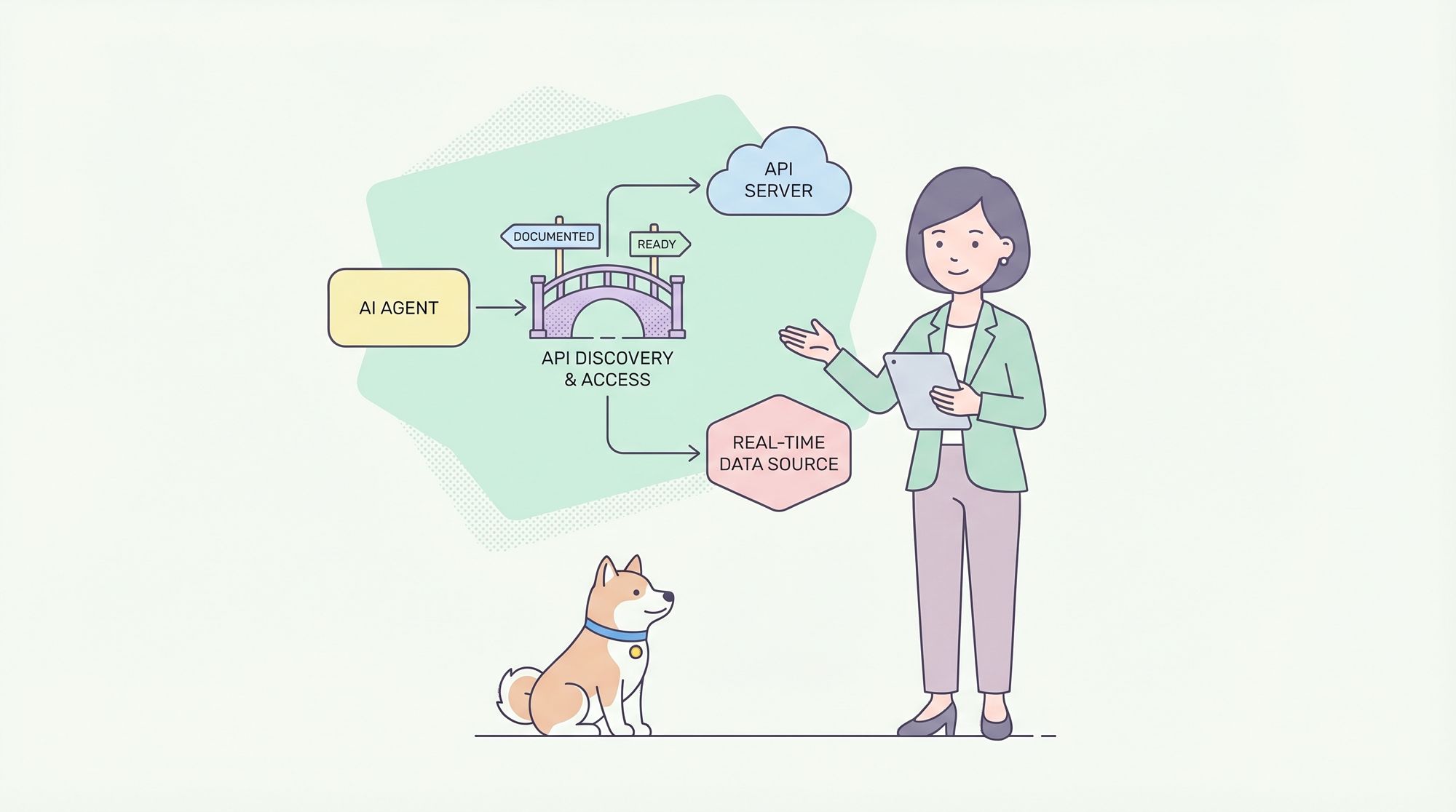
APIs are the backbone of modern digital ecosystems, but the rise of AI and autonomous agents is redefining what APIs need to deliver. Gone are the days when APIs simply served traditional apps or human developers—today, your APIs must be AI-ready: discoverable, self-describing, robust, and context-aware. This guide walks you step by step through how to make your APIs AI ready, with practical examples, best practices, diagrams, and actionable insights.
Why AI Readiness for APIs Matters
APIs that aren't designed for AI agents create friction—slow automation, inconsistent results, and missed opportunities for intelligent workflows. AI-ready APIs enable:
- Seamless integration with AI/ML models and agents
- Real-time data access for decision-making
- Self-service and discoverability for autonomous consumption
- Scalability and resilience under unpredictable demand
- Enhanced security and governance for sensitive operations
Let’s dive into how to make your APIs AI-ready, from foundational architecture to hands-on implementation and validation.
1. Rethink API Architecture for AI Integration
Design for Machine and Agent Consumption
Traditional APIs are often optimized for human developers. To be AI ready, your API must be:
- Self-describing: Use OpenAPI or Swagger specifications to detail endpoints, data types, and error codes.
- Consistent and predictable: Standardize response formats, error handling, and authentication.
- Context-aware: Allow agents to send metadata or context parameters for richer, more relevant responses.
Example: AI-Ready Endpoint Design (OpenAPI YAML)
paths:
  /recommendation:
    post:
      summary: Get personalized recommendations
      requestBody:
        content:
          application/json:
            schema:
              $ref: '#/components/schemas/RecommendationRequest'
      responses:
        '200':
          description: Success
          content:
            application/json:
              schema:
                $ref: '#/components/schemas/RecommendationResponse'
      x-context-aware: true
Notice the explicit schema and the custom extension (x-context-aware: true) for agent understanding.
Tip: Tools like Apidog can auto-generate and validate OpenAPI/Swagger specs, ensuring your API’s documentation is always up-to-date and AI-friendly.
2. Build Robust Schemas and Standardize Data
AI agents thrive on structured, unambiguous data. To make your APIs AI ready:
- Leverage JSON Schema or similar standards to define inputs and outputs.
- Validate all payloads rigorously—invalid or ambiguous data can break AI pipelines.
- Version your schemas so agents can adapt to changes gracefully.
Sample JSON Schema for an AI-Ready API
{
  "title": "RecommendationRequest",
  "type": "object",
  "properties": {
    "userId": { "type": "string" },
    "context": { "type": "object" },
    "preferences": { "type": "array", "items": { "type": "string" } }
  },
  "required": ["userId"]
}
Pro Tip: Use Apidog's schema validation and testing features to catch issues early and maintain robust, AI-ready contracts.
3. Document and Annotate for Agent Discoverability
AI agents need to “read” and reason about your API just like a human would. This means:
- Detailed, machine-readable documentation: OpenAPI, Swagger, or API Blueprint are musts.
- Metadata and semantic annotations: Tag endpoints with business domains, use cases, or context hints.
- Examples and test scenarios: Provide sample payloads and expected responses for every endpoint.
Documentation Example:
x-ai-use-case: "product_recommendation"
x-domain: "ecommerce"
Why it matters: These annotations let AI agents discover the right API for the right task, improving automation and reliability.
4. Mock, Test, and Validate AI-Ready APIs
Testing for AI readiness isn’t just about functional correctness—it’s about ensuring APIs behave as expected under a variety of scenarios, including those introduced by AI agents (e.g., high-frequency calls, unexpected data patterns).
Key Steps
- Create mock APIs and test data to simulate AI agent behavior.
- Run automated test suites covering edge cases, concurrency, and schema validation.
- Test for performance and real-time requirements—AI systems often need low-latency, high-throughput access.
Hands-on Example: Using Apidog for Mocking and Testing
1. Mock Server: Instantly spin up a cloud or local mock of your API.
2. Automated Test Generation: Generate test cases directly from your OpenAPI spec.
3. Performance Testing: Simulate AI-scale loads to ensure your API won't break when an agent hits it 100 times per second.
5. Ensure Real-Time Data Access and Context Awareness
AI agents make decisions in real time and often require up-to-the-second data and contextual insights. To make your APIs AI ready:
- Support streaming and push-based data (e.g., WebSockets, Server-Sent Events, or gRPC for real-time applications).
- Allow context parameters (e.g., user state, environment, session info) as first-class citizens in your API design.
- Maintain statelessness where possible, but provide mechanisms for agents to supply context as needed.
6. Build for Scalability, Reliability, and Security
Making your APIs AI-ready means preparing for unpredictable, automated, and potentially massive consumption patterns.
- Scale horizontally: Use stateless servers, autoscaling, and cloud-native deployments.
- Implement robust authentication and authorization: OAuth2, JWTs, and mutual TLS are best practices.
- Rate limiting and abuse detection: AI agents can overwhelm APIs—define clear quotas and anomaly detection.
- Monitor, log, and alert: Set up observability for latency, error rates, and unusual traffic.
Sample: REST vs. gRPC for AI-Ready APIs
| Protocol | Latency | Streaming | Tooling | AI Use Cases |
|---|---|---|---|---|
| REST | Medium | Limited | Mature | Most |
| gRPC | Low | Native | Strong | Real-time, ML pipelines |
Tip: Choose the protocol that matches your AI use case. For most business APIs, REST is still the default, but gRPC shines for real-time ML and agent workflows.
7. Lifecycle Management and Versioning
AI agents might depend on specific API versions or schema contracts. To avoid breaking intelligent workflows:
- Version APIs explicitly (e.g.,
/v1/in the path or via headers). - Deprecate with clear communication—include
x-deprecatedtags in your API spec. - Automate lifecycle governance with tools for tracking usage, dependencies, and deprecation.
8. Case Study: Transforming a Legacy API to Be AI Ready
Let’s walk through a real-world scenario where an e-commerce API was upgraded for AI readiness.
Before:
- Inconsistent JSON responses
- Poor documentation
- No support for context or real-time triggers
Process:
1. Generated OpenAPI spec for all endpoints.
2. Refactored responses to be uniform, with explicit error handling.
3. Added context parameters (e.g., sessionId, userPreferences).
4. Used Apidog to validate the new API spec, run automated performance tests, and mock agent-like interactions.
5. Updated documentation with AI-specific annotations.
Result:
- 40% faster integration by AI agents
- 80% reduction in integration errors
- Ability to support real-time recommendation workflows
9. Best Practices Checklist for Making Your APIs AI Ready
- [ ] Use OpenAPI/Swagger for all API documentation
- [ ] Define and validate strict schemas
- [ ] Provide machine-readable metadata and examples
- [ ] Mock and test APIs under AI-like conditions (e.g., with Apidog)
- [ ] Support real-time and context-aware operations
- [ ] Ensure robust security, rate limiting, and monitoring
- [ ] Version and deprecate APIs with clear governance
10. Tools and Platforms to Accelerate AI-Ready API Development
- Apidog: Design, document, mock, and test APIs with advanced automation and AI-readiness in mind.
- Swagger/OpenAPI: Industry standard for machine-readable API specs.
- Kong, Apigee, or Azure API Management: For scaling, securing, and governing APIs at the enterprise level.
Conclusion: The Future of APIs Is AI Ready
As AI agents become central to business processes and digital experiences, making your APIs AI ready is no longer optional—it’s a strategic imperative. By following the steps above and leveraging platforms like Apidog to automate validation, testing, and documentation, you’ll ensure your APIs are discoverable, robust, and ready for the AI-driven future.