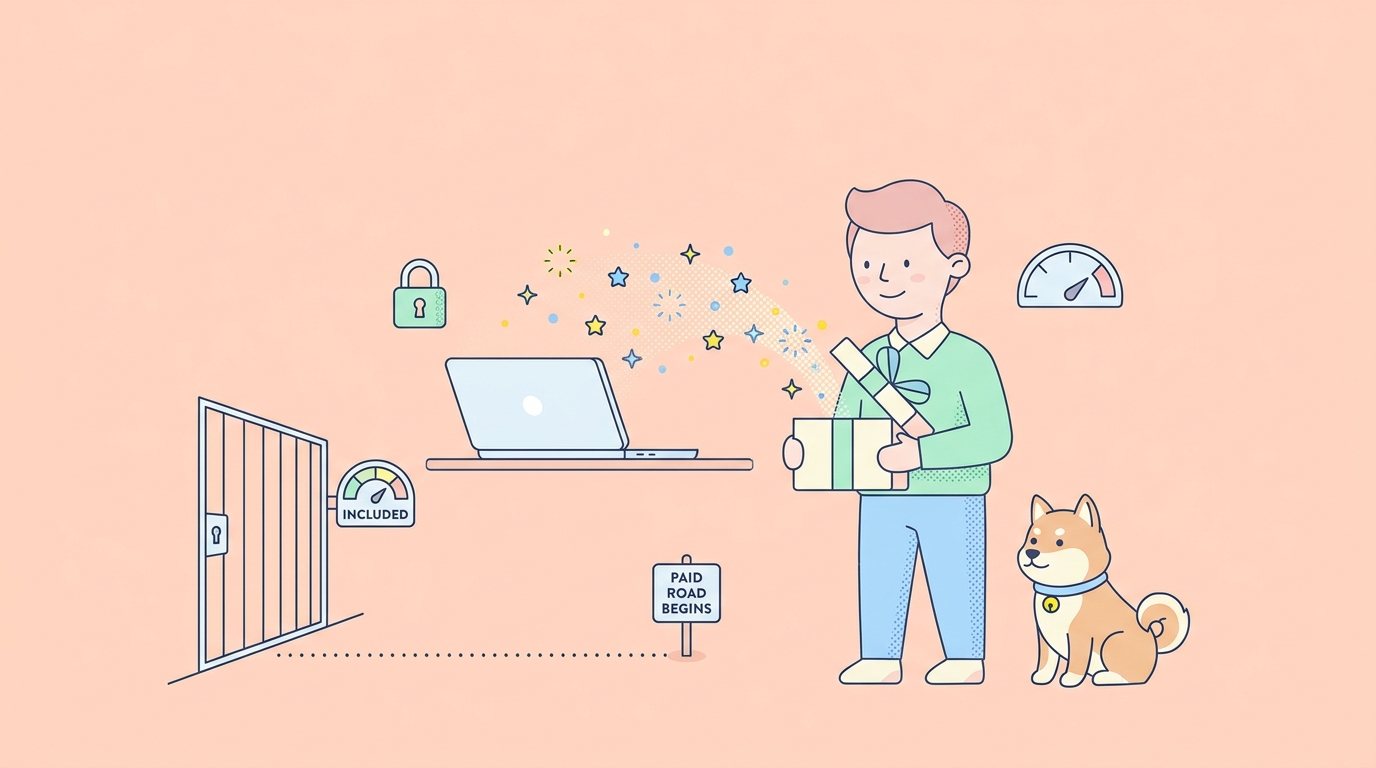
Gemini 3.8 Flash shipped on September 2, 2026, and unlike most frontier launches this year it comes with a real free path. You can chat with it in Google AI Studio for nothing, and you can call it from the Gemini API on the free tier with a key that takes about a minute to create. Google’s launch post calls it “our most intelligent Flash model,” and the free tier gives you the same model ID (gemini-3.8-flash) that paying customers use, not a cut-down variant.
There are three catches, and this guide covers all of them. The free tier is rate-limited. Google says free-tier data is used to improve its products. And the Gemini app does not include 3.8 Flash on its free plan; you need a Google AI Pro or Ultra subscription for that. If you want the full spec sheet first, start with what Gemini 3.8 Flash is. If you want to run a request in the next five minutes, keep reading.
Free access at a glance
| Surface | Cost | Gemini 3.8 Flash included? | The catch |
|---|---|---|---|
| Google AI Studio (web playground) | $0 | Yes | Rate-limited; data used to improve products |
| Gemini API free tier | $0 | Yes | Same limits, shown on the AI Studio rate-limit page |
| Gemini app, free plan | $0 | No | 3.8 Flash requires Google AI Pro or Ultra |
| AI Mode in Google Search | $0 | Yes (consumer) | No API, no control over thinking level |
| Gemini in Google Sheets | Plan-dependent | Yes (consumer) | No API |
| Google Search grounding | 5,000 requests/month free | Shared across Gemini 3.x | Then $14 per 1,000 requests |
| Batch API | 50% off paid rates | Yes | Not free; the cheapest paid path |
| Gemini 3.8 Flash Cyber | Not sold | No | Fairwind Program only, no public API at any price |
Step 1: open AI Studio and pick gemini-3.8-flash
Go to Google AI Studio and sign in with a Google account. No billing account, no credit card. In the model picker choose gemini-3.8-flash; it’s the stable ID with no preview suffix. The run settings expose the thinking level, which on 3.8 Flash has three values: low, medium, and high. Medium is the default. There’s no minimal on this model, and if you send it through the API you get a validation error instead of a quiet fallback. The thinking levels guide explains what each level costs in tokens and time.
Two settings matter for free use. First, leave temperature alone. Google’s guidance for every Gemini 3 model is to keep it at the default of 1.0, because lowering it can cause looping or degraded output. Second, start at low while you’re exploring. 3.8 Flash is designed to “work harder” on complex tasks, taking smaller reasoning steps and calling tools iteratively, and Google says it “can use more tokens on longer running and complex tasks, by design.” On a tier measured in tokens per minute, that appetite eats your quota faster than 3.7 Flash did. Low keeps the experiments cheap.
Step 2: get a free API key
Inside AI Studio, open the API keys page and create a key in a new or existing project. The key is free and works immediately against the free tier. The pricing page lists 3.8 Flash input and output as “Free of charge” on that tier, with the paid rates alongside. Our Gemini API key walkthrough has screenshots if you’ve never done it.
Store the key as an environment variable and keep it out of your code and your shell history:
export GEMINI_API_KEY="paste-your-key-here"
Treat the key like a password. The free tier has no billing attached, so a leaked key can’t run up a bill, but it can burn through your daily quota before you do.
Step 3: make your first free call
Gemini 3.x now runs primarily on the Interactions API. One request, no SDK required:
curl -X POST "https://generativelanguage.googleapis.com/v1beta/interactions" \
  -H "x-goog-api-key: $GEMINI_API_KEY" -H 'Content-Type: application/json' \
  -d '{"model":"gemini-3.8-flash","input":"Explain HTTP caching in 3 sentences.","generation_config":{"thinking_level":"low"}}'
The response is a list of execution steps (model thoughts, tool calls if any) ending in a model_output step with the text. If you have existing code on generateContent, it still works; Google calls it legacy but “fully supported” with no sunset date, and generationConfig.thinkingConfig.thinkingLevel is where the level goes on that endpoint. Both shapes, plus the Python equivalents and multi-turn with previous_interaction_id, are in the Gemini 3.8 Flash API guide.
If you get a 429, you’ve hit the free tier’s rate limit. Wait, or read on to Tier 1.
What the free tier costs you
Nothing in dollars. Three things otherwise.
Rate limits. The free tier caps requests per minute, tokens per minute, and requests per day per model. Google publishes the exact figures only on the AI Studio rate-limit page, not in the docs text, and they change without a changelog entry. Check that page instead of trusting any number you read on a blog, including this one. The rate-limits doc explains how the tiers stack.
Your data. Google states that free-tier prompts and outputs are used to improve its products. That’s fine for a benchmark prompt or a toy app. It’s not fine for customer records, unreleased source code, or anything under an NDA. Paid tiers carry different terms; if you need them, link billing before you send the sensitive request, not after.
Token appetite. Artificial Analysis measured 3.8 Flash at high using about 48k output tokens per task on their index, 30% more than 3.7 Flash. Thinking tokens count against the same token-per-minute limits as visible output. A model that reasons harder is a model that spends your free quota faster, which is the practical reason to default to low or medium until you’ve paid for headroom.
The Gemini app is not a free path
This is where most “Gemini 3.8 Flash free” searches go wrong. On the consumer side, 3.8 Flash is available in the Gemini app for Google AI Pro and Ultra subscribers. The free app plan does not get it, per the launch coverage. If you open the app without a subscription and see a Flash model, it isn’t 3.8.
The consumer surfaces where you can meet 3.8 Flash at no extra charge are AI Mode in Google Search and Gemini in Google Sheets. Both are useful for reading its answers. Neither gives you a thinking-level control, a token count, or an API, so for anything you’d call development, AI Studio and the free API tier are the real free path.
Free grounding: 5,000 Google Search requests a month
Google Search grounding, which lets the model pull current web results into its answer, comes with 5,000 free requests per month shared across all Gemini 3.x models. After that it’s $14 per 1,000 requests. The quota is a monthly pool, not per model, so a grounded 3 Pro experiment and a grounded 3.8 Flash experiment draw from the same 5,000. For a prototype that needs fresh data that’s a generous allowance; for a production feature you’ll want a budget line.
When free runs out: the cheapest paid paths
You’ll know the moment. A 429 arrives mid-demo, or the daily cap lands at 3 p.m. Four paid steps, cheapest first.
Link a billing account (Tier 1). Attaching billing to your project in AI Studio moves you to Tier 1, which raises the rate limits and sets a $250 spend cap. Tier 2 opens after $100 of spend plus three days, with a $2,000 cap; Tier 3 after $1,000 and 30 days. You don’t have to spend anything to unlock Tier 1; the billing link itself does it.
Pay the intro rate. Through December 31, 2026, 3.8 Flash costs $0.75 per million input tokens and $3.75 per million output tokens, with thinking tokens billed as output. From January 1, 2027 both double to $1.50 and $7.50. A thousand requests at 2,000 input and 500 output tokens each comes to about $3.38 at intro pricing. The pricing breakdown works the per-task math, including why a cheaper per-token price doesn’t mean a cheaper task on this model.
Batch anything that can wait. The Batch API halves the rate: $0.375 input and $1.875 output per million through year-end. Same thousand requests, about $1.69. Tier 1 accounts can have up to 3M tokens enqueued at once. Evals, backfills, and nightly jobs belong here; our Gemini batch mode guide covers the request shape.
Cache the stable prefix. Context caching costs $0.075 per million cached tokens on the intro rate, a tenth of fresh input. A long system prompt or a document you re-send on every turn is the first place to look.
What free won’t get you
An honest list, because the search results for this topic are full of dishonest ones.
- The Gemini app. Pro or Ultra only, as above.
- Privacy. Free-tier data is used to improve Google’s products. There is no toggle on the free tier.
- Headroom. The limits are shown on the rate-limit page and they are not generous. Free is for evaluation and small tools, not a launch.
- Gemini 3.8 Flash Cyber. The security-tuned twin is gated behind the Fairwind Program for governments, infrastructure operators, and software maintainers. No public API, no price, no self-hosting. Nobody outside that program has it, free or paid.
- Live API, image generation, or audio generation. 3.8 Flash doesn’t support these at any tier. Inputs can be text, image, video, audio, and PDF; output is text.
- An “unlimited” tier. Sites promising unrestricted Gemini access are proxying someone’s key or serving a different model. The free Gemini API access guide explains how to tell, and the same free-tier playbook that worked for Gemini 3.6 Flash still applies here.
Make the free quota go further with Apidog
A free tier rewards discipline. Every request you re-type by hand, every 429 you trigger by accident, and every high-thinking call you didn’t need is quota you don’t get back. Apidog makes the discipline cheap.
Store GEMINI_API_KEY as an environment variable in an Apidog environment, so the key never appears in a request body or a shared collection. Save the Interactions call and the legacy generateContent call as named requests with the prompt, model, and thinking_level filled in, and switch levels with a variable instead of editing JSON. Add an assertion on the status code so a 429 shows up as a failed test instead of a confusing blank response, and one on usageMetadata.thoughtsTokenCount on the legacy endpoint so you can see how much of your quota went to thinking.
Then schedule a tiny smoke test: one low request a day. It tells you when the model’s behavior or the free limits change before your users do. Download Apidog to set it up, and see how to schedule API tests in Apidog for the timing options.
FAQ
Is Gemini 3.8 Flash free? Yes, through Google AI Studio and the Gemini API free tier, with rate limits and with your data used to improve Google’s products. The model is the same gemini-3.8-flash that paid tiers use.
Can I use Gemini 3.8 Flash in the Gemini app for free? No. The app offers 3.8 Flash to Google AI Pro and Ultra subscribers. AI Mode in Google Search and Gemini in Sheets are the consumer surfaces where you can use it without a subscription.
What are the free-tier rate limits for Gemini 3.8 Flash? Google shows them per model on the AI Studio rate-limit page instead of in the documentation text, and they change. Check that page for your project. When you need more, linking a billing account moves you to Tier 1 with no spend required.
Does the free tier include thinking? Yes. All three levels (low, medium, high) work on the free tier, and medium is the default. minimal returns an error on 3.8 Flash. Since thinking tokens count toward your token limits, low stretches the free quota furthest; see the thinking levels comparison for the measured cost per level.
Is Gemini 3.8 Flash Cyber free? It isn’t available at all outside the Fairwind Program. Regular developers get 3.8 Flash and can run their own API security tests against it.
For developers who want to apply the same free-access approach to Google's multimodal flagship, where Gemini Omni is free and where it isn't follows a different set of rules from Flash.
Start free, then decide
The free tier is a real evaluation environment for Gemini 3.8 Flash, not a teaser. Create a key, keep thinking at low, keep sensitive data out of it, and read the rate-limit page instead of guessing. When a 429 starts costing you time, link billing for Tier 1 and use batch for anything asynchronous; at $0.375 per million input tokens through December, the first paid month is likely to cost less than the coffee you drank waiting for the free tier to reset.