TL;DR
Grok Imagine removed its free tier on March 19, 2026, and tightened content filters after a deepfake controversy in January. Free users now get zero image generations. SuperGrok ($30/month) restores access with higher limits but the NSFW filter is still enforced. The xAI API (grok-imagine-image) offers the most flexible access for developers. If you want genuinely uncensored local image generation, Stable Diffusion and FLUX are your best options.
Introduction
For a few months in late 2025, Grok Imagine was the most talked-about image generator on the internet. It was free. It was fast. And it was noticeably less filtered than DALL-E or Midjourney. That changed on January 9, 2026, when xAI restricted image generation to paying subscribers after a wave of deepfake content went viral. Then on March 19, 2026, the free tier was removed entirely.
If you're searching for "Grok Imagine no restrictions," you probably want one of three things: you want to know exactly what the current limits are, whether you can get around them, or what to use instead. This article covers all three.
POST /v1/images/generations response so your frontend can handle success, error, and rate-limit states without touching the real API. Download Apidog free to follow along with the testing section later in this guide.What happened to Grok Imagine's free tier
The timeline matters here because the situation changed three times in under three months.
November 2025: xAI launched Grok Imagine as part of the free Grok tier on X (formerly Twitter). Free users got a limited number of image generations per day. The model was aurora and it ranked near the top of text-to-image benchmarks.
January 9, 2026: After a Mashable report documented explicit deepfake images of public figures being generated and shared, xAI restricted image generation to paying subscribers. Free users lost access. xAI added additional safety filters to the aurora model. The change was announced quietly, without a public blog post.
March 19, 2026: The last remnants of free image access were removed. xAI confirmed that Grok Imagine is now a paid feature across all tiers.
The short version: Grok Imagine was free, it got abused, and xAI pulled the free tier entirely.
What the current limits actually are (April 2026)
Free Grok
No image generation. None. If you're on the free tier, the Imagine tab still shows up in the UI but you'll hit a paywall the moment you try to generate.
SuperGrok ($30/month)
SuperGrok restores image generation access with these limits:
| Feature | Limit |
|---|---|
| Image generations | ~100/month (not officially published) |
| Video generations | Limited via grok-imagine-video |
| NSFW content | Blocked by safety filter |
| Realistic human faces | Partially restricted |
| Public figures | Restricted |
| API access | Not included (separate billing) |
The content filter on SuperGrok is enforced at the model level. xAI added a two-layer system after the January controversy: a prompt guard that catches explicit keywords and context, and a post-generation image classifier. Both layers run on every generation.
SuperGrok Heavy ($300/month)
This tier is aimed at heavy users and teams. You get more generations and faster response times, but the content policy is identical to SuperGrok. The $300 price point doesn't buy you a different safety policy.
xAI API (developer access)
The API is the most flexible option. You call POST https://api.x.ai/v1/images/generations with the grok-imagine-image model. Pricing is $0.02 per image.
The content filter still applies through the API. xAI's usage policy prohibits sexual content, real person deepfakes, and content that violates their terms. But the filter is less aggressive on artistic and creative prompts than the consumer UI, and you have full programmatic control over what you send.
The content filter: what it blocks and what it doesn't
The filter blocks explicit sexual content, real person deepfakes, graphic violence, and content involving minors. That part is non-negotiable on any Grok tier.
What the filter doesn't block is most artistic and creative content. Violence in a stylized or historical context often passes. Suggestive but not explicit content passes. Abstract and surreal imagery passes. Gore in a cinematic context sometimes passes.
The filter is trained on semantic intent, not just keywords. Prompts that use clinical language, artistic framing, or indirect descriptions behave differently than direct requests. This is why you'll see people on Reddit reporting inconsistent results with similar prompts. It's not random. The model is making a contextual judgment call each time.
The prompt reframing technique
The main workaround researchers have documented is artistic reframing. A prompt that describes a scene as part of a painting, sculpture, or art book context gets evaluated differently than a direct description. This isn't a secret. xAI knows about it. They've tried to close the gap but the fundamental tension between creative freedom and safety filters hasn't been resolved.
This technique doesn't bypass the filter for explicitly prohibited content. It shifts borderline content from "blocked" to "allowed" in some cases.
Grok Imagine vs other image generators: what's actually less restricted
If your goal is fewer content restrictions, here's how the main options compare honestly:
| Generator | Restrictions | Cost | Local? |
|---|---|---|---|
| Grok Imagine (SuperGrok) | Moderate — blocks explicit, allows artistic | $30/month | No |
| DALL-E 3 (ChatGPT Plus) | Strict — refuses stylized violence and partial nudity | $20/month | No |
| Midjourney | Moderate — similar to Grok, strong on artistic | $10-$120/month | No |
| Adobe Firefly | Strict — commercial-safe only | $5-$55/month | No |
| Stable Diffusion (local) | None — you control everything | Hardware cost | Yes |
| FLUX.1 (local) | None — you control everything | Hardware cost | Yes |
| ComfyUI + any model | None — depends on model | Hardware cost | Yes |
The honest answer is that no cloud-based image generator gives you genuinely no restrictions. They all have content policies enforced at the API level. Grok was the least filtered cloud option in late 2025, but that's no longer true after the January changes.
Running image generation locally: the actual no-restrictions option
Local image generation means installing the model on your own hardware and running it without any external API. There's no content policy because there's no cloud service. What you generate stays on your machine.
Stable Diffusion
Stable Diffusion is the most established option. The SDXL and SD 3.5 models are open weights, meaning you can download and run them on a consumer GPU.
Minimum hardware: 8GB VRAM GPU (NVIDIA RTX 3060 or better). Mac users can run it on Apple Silicon via CPU with slower performance.
Setup options:- AUTOMATIC1111 (WebUI): browser-based, easiest for beginners - ComfyUI: node-based graph editor, more control - Invoke AI: polished UI, good for iterating
The uncensored models are community-maintained fine-tunes. They're widely available on Hugging Face and CivitAI. You load them into any of the above interfaces.
FLUX.1
FLUX from Black Forest Labs is newer than Stable Diffusion and produces sharper, more realistic output. The FLUX.1-dev model is free for non-commercial use. FLUX.1-schnell is fully open.
FLUX runs on the same hardware as Stable Diffusion but uses more VRAM for larger generations. A 12GB GPU handles it well. You can run it through ComfyUI or the diffusers Python library.
from diffusers import FluxPipeline
import torch

pipe = FluxPipeline.from_pretrained(
    "black-forest-labs/FLUX.1-schnell",
    torch_dtype=torch.bfloat16
)
pipe.to("cuda")

image = pipe(
    "your prompt here",
    height=1024,
    width=1024,
    num_inference_steps=4,
    max_sequence_length=256,
).images[0]

image.save("output.png")
No API key. No content filter. No rate limits. The only ceiling is your GPU.
Using the xAI API for image generation (developer guide)
If you want cloud generation with more control than the consumer UI, the xAI API is the right path. It's still filtered, but it supports programmatic access, batch generation, and integration with your own applications.
Authentication
export XAI_API_KEY="your_key_here"
Get your key from console.x.ai. You need a billing method attached before image generation works.
Your first image generation request
curl https://api.x.ai/v1/images/generations \
  -H "Authorization: Bearer $XAI_API_KEY" \
  -H "Content-Type: application/json" \
  -d '{
    "model": "grok-imagine-image",
    "prompt": "a photorealistic mountain lake at sunrise, mist over the water",
    "n": 1,
    "response_format": "url"
  }'
The response comes back synchronously with a URL:
{
  "created": 1744123456,
  "data": [
    {
      "url": "https://..."
    }
  ]
}
This is different from the video API, which uses an async polling pattern. Image generation is synchronous. You POST and get your URL back in the same response, usually within 3-5 seconds.
Python example
import os
import requests

api_key = os.environ["XAI_API_KEY"]

response = requests.post(
    "https://api.x.ai/v1/images/generations",
    headers={
        "Authorization": f"Bearer {api_key}",
        "Content-Type": "application/json"
    },
    json={
        "model": "grok-imagine-image",
        "prompt": "a cyberpunk city street at night, neon reflections in rain puddles",
        "n": 1,
        "response_format": "url"
    }
)

data = response.json()
image_url = data["data"][0]["url"]
print(f"Image URL: {image_url}")
Parameters
| Parameter | Type | Description |
|---|---|---|
model |
string | Must be "grok-imagine-image" |
prompt |
string | Your text description |
n |
integer | Number of images (1-4) |
response_format |
string | "url" or "b64_json" |
Testing the xAI image API with Apidog
Building a product feature on top of Grok Imagine means your app needs to handle several states correctly: successful generation, content policy rejections (HTTP 400 with a specific error body), rate limit responses (HTTP 429), and network timeouts.
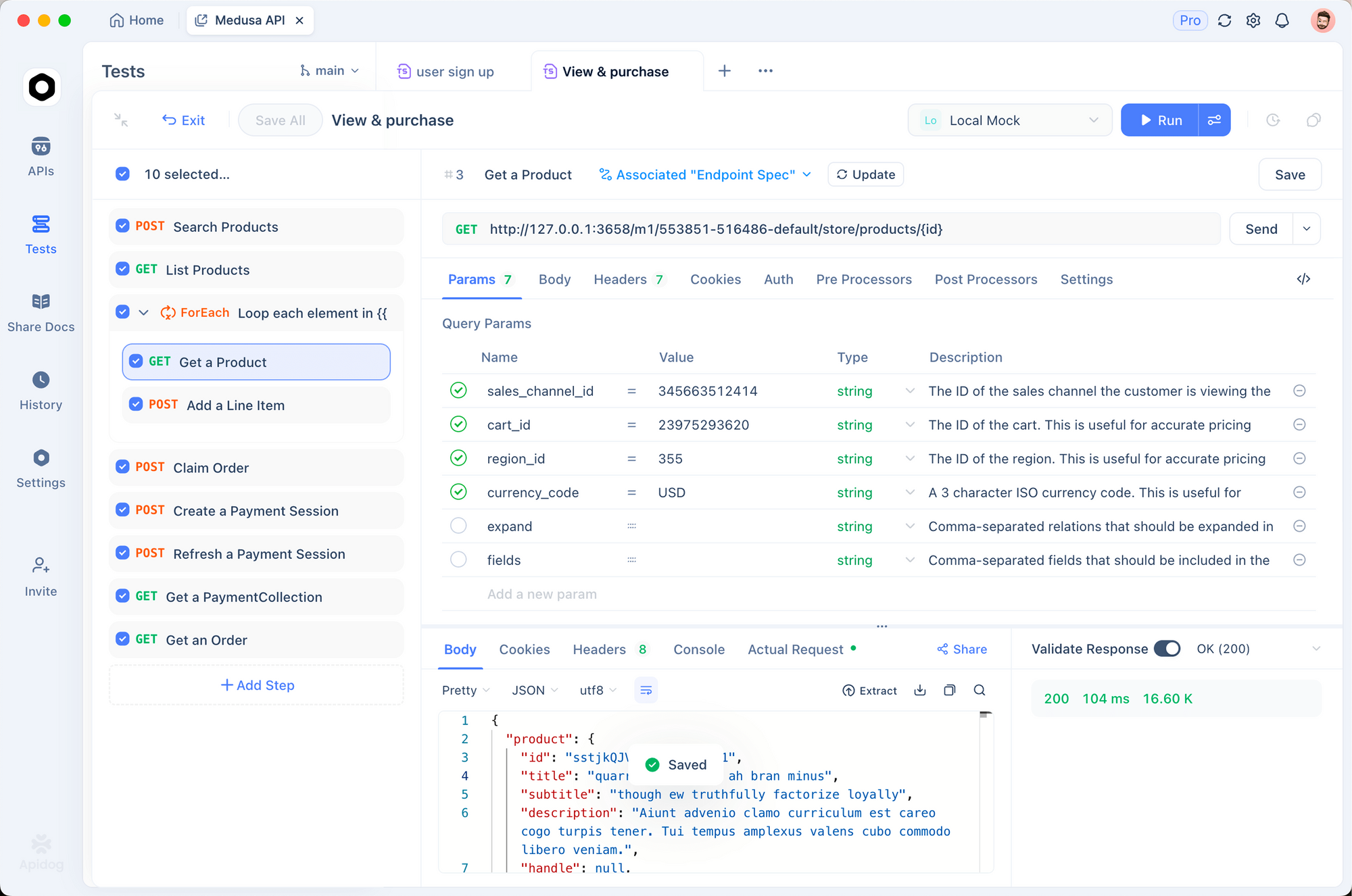
Testing all of these against the real API costs $0.02 per call and requires internet access. That's fine for final integration checks but wasteful during frontend development.
Apidog's Smart Mock solves this. You define the POST /v1/images/generations endpoint in Apidog, set up mock responses for each state, and your frontend hits the mock during development instead of the real API.
Setting up the content policy error mock:
- In Apidog, create a new endpoint:
POST https://api.x.ai/v1/images/generations - Add a Mock Expectation with a condition on the request body
- Set it to return a 400 response with this body when the prompt contains flagged content:
{
  "error": {
    "message": "Your request was rejected as a result of our safety system.",
    "type": "invalid_request_error",
    "code": "content_policy_violation"
  }
}
- Add a second expectation returning a valid 200 for normal prompts
Now your error handling code can be tested without triggering the real safety filter. This is worth setting up early if your app needs to surface meaningful error messages to users when their prompts get rejected.
For the full video generation API testing setup, see the Grok image to video API guide and the Grok text to video API guide.
What the grok-companion-ani model is (and why it's different)
While researching this article, you might come across references to grok-companion-ani in the xAI docs. This is a different model from grok-imagine-image. It's designed for character animation and companion-style interactions rather than general image generation.
It has different pricing and different content policies. It's not a less-filtered version of the image generator. Worth knowing because the names are similar enough to cause confusion.
Alternatives to Grok Imagine worth knowing
For cloud generation with fewer restrictions than DALL-E:
Midjourney remains the strongest cloud option for artistic and creative content. Its filter is similar to Grok's post-January update, but the image quality on complex prompts is consistently better. Starts at $10/month.
Leonardo AI has a more permissive content policy than most cloud providers for artistic content. The free tier is limited but usable for testing.
Ideogram works well for text-in-image use cases and has a reasonable free tier. Less relevant if your use case is photorealistic content.
For local generation:
FLUX.1-schnell for fast iteration. FLUX.1-dev for quality. SDXL Turbo for real-time generation. All of these run on consumer hardware with no content restrictions.
Grok Imagine is one option in a growing field — our comparison of the best unrestricted AI image generators in 2026 covers the alternatives worth testing.
Conclusion
Grok Imagine had a brief window when it was the least filtered, most accessible image generator available at no cost. That window closed in January 2026 and finished closing in March when xAI removed the free tier entirely.
The current situation is straightforward. SuperGrok gives you cloud image generation with a moderate content filter at $30/month. The xAI API gives you programmatic access at $0.02 per image with the same filter applied. If you want genuine no-restrictions generation, the only reliable path is running Stable Diffusion or FLUX locally on your own hardware.
The question of which cloud provider is "least restricted" changes every few months as safety teams patch their models. Local generation doesn't change. Your hardware, your models, your output.
For a full list of free and open AI models you can run without restrictions, see the free AI models guide.
FAQ
Does Grok Imagine still have a free tier?No. As of March 19, 2026, image generation on Grok requires a paid subscription. SuperGrok at $30/month is the entry tier for image access.
Can you bypass Grok Imagine's content filter?For explicitly prohibited content (sexual content involving real people, minors, graphic violence), no. Artistic reframing can shift borderline prompts from blocked to allowed in some cases, but this doesn't work for content that violates xAI's core usage policy.
Is Grok Imagine available through the API?Yes. The grok-imagine-image model is available via POST https://api.x.ai/v1/images/generations at $0.02 per image. You need an xAI API key from console.x.ai and a billing method attached.
What's the difference between Grok Imagine and Grok image-to-video?Grok Imagine (grok-imagine-image) generates a static image from a text prompt. Grok image-to-video (grok-imagine-video) animates an existing image into a short video clip. They're separate models with different pricing and endpoints.
What's the best no-restrictions image generator in 2026?For local generation with no restrictions: FLUX.1-schnell or SDXL. Both run on consumer GPUs (8GB+ VRAM), are fully open weights, and have no content policy because they run on your hardware.
Which cloud image generator has the fewest restrictions?After Grok's January 2026 filter update, the landscape is relatively even. Midjourney and Leonardo AI are generally considered more permissive than DALL-E or Adobe Firefly for artistic content. No cloud provider allows explicit sexual content or deepfakes.
How does Grok Imagine compare to Midjourney?Post-January 2026, content policies are similar. Grok Imagine tends to produce more photorealistic output. Midjourney produces stronger results on artistic, stylized, and complex compositional prompts. Midjourney starts at $10/month; Grok image access starts at $30/month with SuperGrok.