Grok 4.6 landed on August 12 with a claim that reshapes the frontier-model decision: intelligence that ties GPT-5.6 Sol on the Artificial Analysis Index, at $6 per million output tokens instead of $30. Most comparison articles you’ll find still benchmark Grok 4.5, which trailed the frontier badly enough that the price didn’t matter. That’s no longer the situation, so this comparison starts fresh with the 4.6 numbers.
The short answer: GPT-5.6 Sol remains the strongest pick for repository-scale coding agents, Claude Fable 5 leads long-horizon autonomous work by a nose, and Grok 4.6 is now the value pick that’s close enough on capability to make the other two justify their price. The right choice depends on your workload, so below are the numbers, the API considerations, and a reproducible way to test all three on your own stack. If you want to run that test today, Apidog lets you hit all three APIs side by side from one workspace, free.
TL;DR
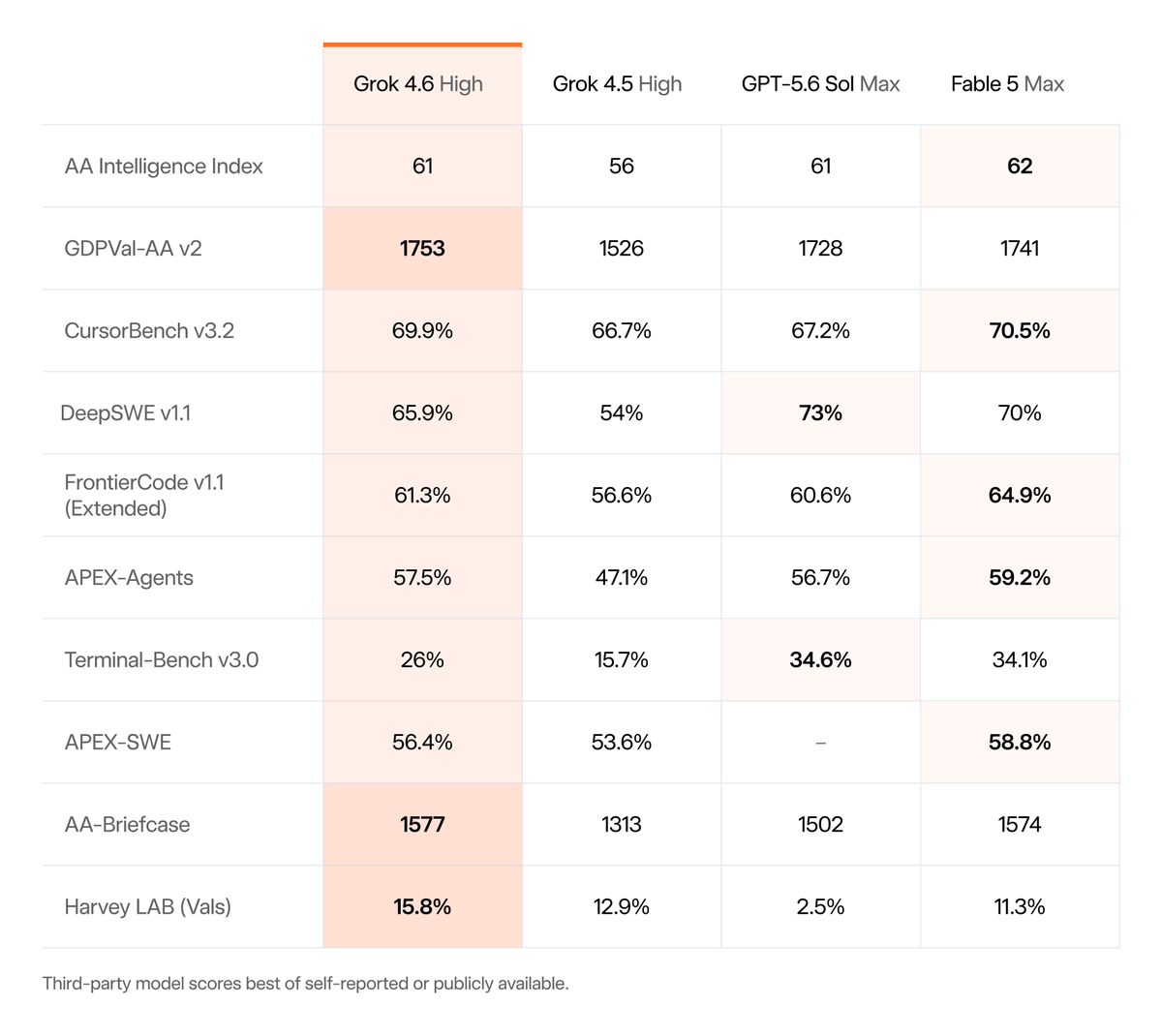
- Intelligence Index: Claude Fable 5 leads at 62; Grok 4.6 and GPT-5.6 Sol tie at 61.
- Pricing (output, per 1M tokens): Grok 4.6 at $6, Claude Opus 4.8 at $25, GPT-5.6 Sol at $30, a 5x spread.
- Context: GPT-5.6 Sol 1.05M tokens, Claude Fable 5 1M, Grok 4.6 500K.
- Coding: Sol Max leads DeepSWE (73.0% vs Grok’s 65.9%); Fable 5 Max leads FrontierCode (63.6% vs 61.3%).
- Agents: Fable 5 Max leads APEX-Agents at 59.2%; Grok 4.6 (57.5%) edges Sol Max (56.7%).
- Cost per completed task: Grok 4.6 measured at $0.84 by Artificial Analysis, the lowest at the frontier.
- Don’t decide on benchmarks alone: run a 20-prompt bake-off on your own workload (method below).
Specs and pricing side by side
| Grok 4.6 | GPT-5.6 Sol | Claude Fable 5 | |
|---|---|---|---|
| Developer | xAI | OpenAI | Anthropic |
| Intelligence Index | 61 | 61 | 62 |
| Context window | 500K | 1.05M | 1M |
| Input price / 1M | $2 | $12 | $10 |
| Output price / 1M | $6 | $30 | $25* |
| Fast/premium variant | 2x price | Sol Max tier | Fable 5 Max tier |
| API style | OpenAI-compatible | OpenAI native | Anthropic Messages |
| Knowledge cutoff | Feb 2026 |
*Claude pricing shown for Opus 4.8; Fable 5 tier pricing varies by effort setting. See our GPT-5.6 pricing guide and Claude cost-cutting breakdown for the full matrices.
The pricing asymmetry is the story. At the input end Grok charges a sixth of what OpenAI does; at the output end a fifth. For chat workloads that’s nice; for agent workloads, where a single task can generate dozens of model calls and long tool-use transcripts, it compounds into the difference between a $50/day and a $250/day agent.
Coding benchmarks: Sol for depth, Grok for value
On the launch numbers, each model owns territory:
| Benchmark | Grok 4.6 | GPT-5.6 Sol Max | Claude Fable 5 Max |
|---|---|---|---|
| DeepSWE v1.1 (repo-scale fixes) | 65.9% | 73.0% | |
| FrontierCode v1.1 Extended | 61.3% | 60.6% | 63.6% |
| CursorBench v3.2 | 69.9% | ||
| APEX-Agents | 57.5% | 56.7% | 59.2% |
| Terminal-Bench v2.1 | 88.4% |
Read it this way:
- GPT-5.6 Sol Max’s 7-point DeepSWE lead is real and it matters. Repository-scale bug fixing is the hardest, most economically valuable coding benchmark. If your agent works across large existing codebases with minimal supervision, Sol is still the safest bet. Our GPT-5.6 Sol vs Claude Fable 5 comparison covers that matchup in depth.
- Claude Fable 5 wins on consistency. It leads the composite index, FrontierCode, and APEX-Agents. Nothing spiky, it’s simply rarely worse than second. That profile suits long-horizon autonomous work where one bad step derails an hour of progress.
- Grok 4.6 is never far behind, and sometimes ahead. Leading CursorBench and Terminal-Bench while staying within striking distance elsewhere, at a fraction of the cost, is exactly the profile of a model you route the bulk of your traffic to, escalating only the hard cases.
One honesty note: these are launch-week, largely vendor-reported numbers. Grok 4.5’s launch benchmarks needed careful reading, and the same caution applies to every vendor here.
Cost per task, not cost per token
Token prices mislead when models differ in verbosity and retry rates. A cheap model that fails a terminal run creates review-and-repair work that costs more than the tokens saved. The better metric is cost per completed task, and here Artificial Analysis’s independent measurement is striking: Grok 4.6 averaged $0.84 per task across its agentic evaluations, the lowest among frontier models, helped by relatively disciplined token usage rather than just low prices.
A worked example. Say your coding agent averages 500K input and 100K output tokens per completed task:
| Model | Input cost | Output cost | Per task |
|---|---|---|---|
| Grok 4.6 | $1.00 | $0.60 | $1.60 |
| Claude Opus 4.8 | $5.00 | $2.50 | $7.50 |
| GPT-5.6 Sol | $6.00 | $3.00 | $9.00 |
At 1,000 tasks a month, Grok saves roughly $6,000–7,400 against the alternatives, if its success rate on your workload holds. That conditional is the entire game, which is why you test before you commit.
API ergonomics: what integration actually costs you
- Grok 4.6 is OpenAI-compatible. If you have any OpenAI-style client, you point
base_urlathttps://api.x.ai/v1and you’re running. It’s also on OpenRouter, Vercel, and Cloudflare for gateway users. - GPT-5.6 Sol has the deepest ecosystem: the Responses API, programmatic tool calling, and first-party SDKs everywhere. See how to use the GPT-5.6 API for the tier structure.
- Claude Fable 5 uses Anthropic’s Messages API, different request shape, excellent tool-use reliability, and an effort parameter that trades cost for capability within one model.
Migration friction is lowest between Grok and OpenAI (shared format), highest moving either to or from Anthropic. If you anticipate switching or routing between models, that asymmetry belongs in your architecture decision.
Context windows: when 500K is enough
On paper, GPT-5.6 Sol’s 1.05M-token window doubles Grok 4.6’s 500K, with Claude Fable 5’s 1M close behind. In practice, the question is what your workload actually holds in context.
A 500K window fits roughly 350,000 words: a mid-sized service’s entire codebase, a year of support transcripts, or several hundred pages of legal documents. Most agent tasks never approach it. The workloads that genuinely need the million-token tier are narrow: whole-monorepo analysis, very long multi-session agent transcripts you refuse to summarize, and single-shot processing of massive document sets.
Two practical notes cut against picking on window size alone. First, every model degrades as context fills; retrieval quality at 80% capacity is worse than at 20% on all three, so architectures that stuff the window rarely beat architectures that retrieve selectively. Second, input tokens are where budgets die: filling Sol’s full window costs about $12.60 per request at list price, while filling Grok’s costs $1. If your prompts routinely exceed 400K tokens, you don’t just need a bigger window, you need a caching and retrieval strategy, whichever vendor you pick.
Knowledge cutoffs and ecosystem maturity
Grok 4.6 ships with a knowledge cutoff of February 1, 2026, the freshest of the three, which matters for coding agents that reference fast-moving frameworks. It’s a real but minor edge: any serious agent stack grounds itself with retrieval and documentation tools rather than trusting parametric knowledge.
Ecosystem is the reverse story. OpenAI has the deepest third-party integration surface, Anthropic has the strongest agent-framework mindshare, and xAI is the newcomer leaning on OpenAI compatibility to borrow both. That bet mostly works: anything speaking the chat completions format runs against Grok today, and gateway availability through OpenRouter, Vercel, and Cloudflare means you can adopt it without touching your infrastructure. What you give up is first-party polish, batch APIs, caching tiers, and fine-grained usage controls are less mature than the incumbents’.
Which model for which job
- Autonomous repo-scale coding agent, quality first: GPT-5.6 Sol. The DeepSWE lead translates to fewer derailed runs on large codebases.
- Long-horizon knowledge work and multi-hour agent sessions: Claude Fable 5. Best composite score, best agent benchmark, strongest track record of staying on the rails.
- High-volume agent traffic, cost-sensitive products, or a router’s default model: Grok 4.6. Frontier-tier output at commodity-tier prices; escalate the hardest 10% of tasks to Sol or Fable.
- Interactive coding in an IDE: Grok 4.6’s CursorBench lead plus its 2x fast variant make it a serious contender; it was effectively built for this after training on real Cursor sessions.
Test all three on your stack in an afternoon
Benchmarks predict averages, not your workload. Here is a reproducible bake-off using Apidog:
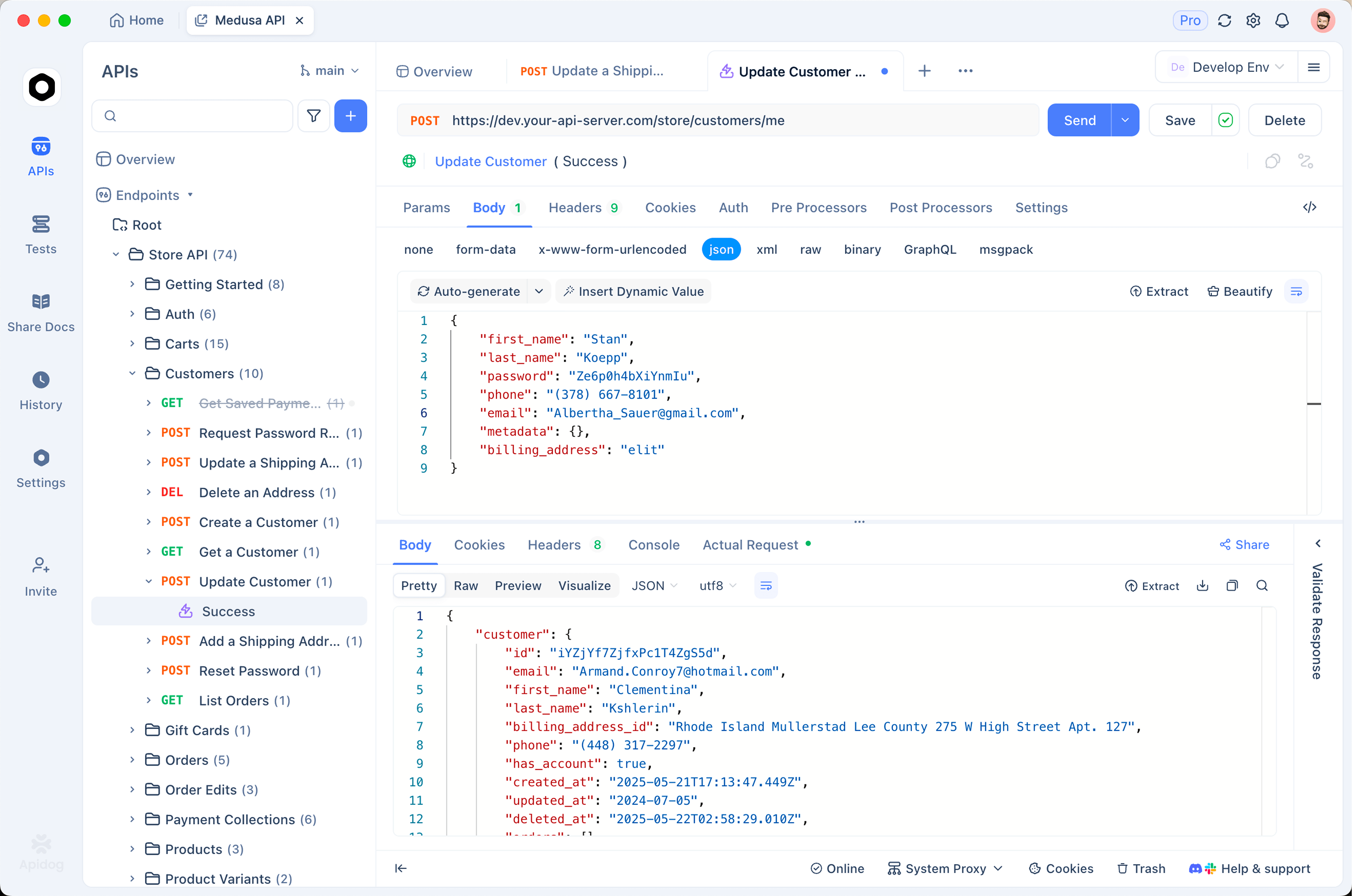
- One project, three environments. Create environments for xAI (
api.x.ai/v1), OpenAI, and Anthropic, each carrying its own auth. The same request switches providers with one dropdown. - Collect 20 real prompts. Pull actual tasks from your product, not toy questions. Include your system prompt, your tool definitions if you use function calling, and at least five known-hard cases.
- Assert what you care about. Add Apidog assertions for response validity, token usage from the
usageobject, and latency thresholds. For tool-calling workloads, assert the tool-call JSON parses and matches your schema, models fail here far more often than in prose. - Run as a test scenario, thrice per model. LLM outputs vary; three runs expose the variance a single demo hides. Export the results and compare success rate and cost per success, not cost per token.
- Keep the suite. When the next model version ships (on current cadence, within months), rerun it. Model choice is now a quarterly decision, and teams with a standing evaluation harness switch weeks faster than teams that re-decide by anecdote.
FAQ
Is Grok 4.6 better than GPT-5.6 Sol? They tie on the composite index at 61. Sol clearly leads repository-scale coding (DeepSWE 73.0% vs 65.9%); Grok leads CursorBench and Terminal-Bench and costs 5x less at the output end. “Better” depends on whether your workload looks more like DeepSWE or more like an IDE session.
Is Grok 4.6 better than Claude Fable 5? Fable 5 leads on the index (62 vs 61), FrontierCode, and APEX-Agents, all narrowly. Grok’s advantage is price. For accuracy-critical autonomous work, Fable 5; for cost-sensitive volume, Grok.
Which AI model is cheapest at the frontier in 2026? Grok 4.6, at $2/$6 per million tokens and an independently measured $0.84 per agentic task. The nearest frontier competitor’s output tokens cost about 4x more.
Should I switch my production agent to Grok 4.6? Not on benchmarks alone. Run the bake-off above on your real workload first, the 5x price gap only pays off if the success rate holds on your tasks.
Can I use all three models behind one API format? Mostly. Grok 4.6 speaks the OpenAI chat completions format natively, so it shares client code with GPT-5.6. Claude requires Anthropic’s Messages API, or a gateway like OpenRouter that normalizes all three behind one interface at a small markup.
Does Grok 4.6’s smaller context window matter? For most agent and chat workloads, no; 500K tokens is far above typical usage, and all three models degrade near their limits anyway. It matters if you routinely process whole monorepos or massive document sets in a single call, where Sol’s 1.05M window buys real headroom.