
xAI launched Grok 4.5 on July 8, 2026 with four coding benchmarks and one efficiency chart. The numbers are genuinely interesting, and they’re also carefully chosen. This piece lays out every published figure, where each one comes from, what’s missing, and how to run your own evaluation instead of waiting for the leaderboards to catch up.
The one-sentence honest take: Grok 4.5 benchmarks like a strong tier-two coding model, splitting results with Claude Opus 4.8 while trailing the frontier, and its standout number is output efficiency rather than any accuracy score.
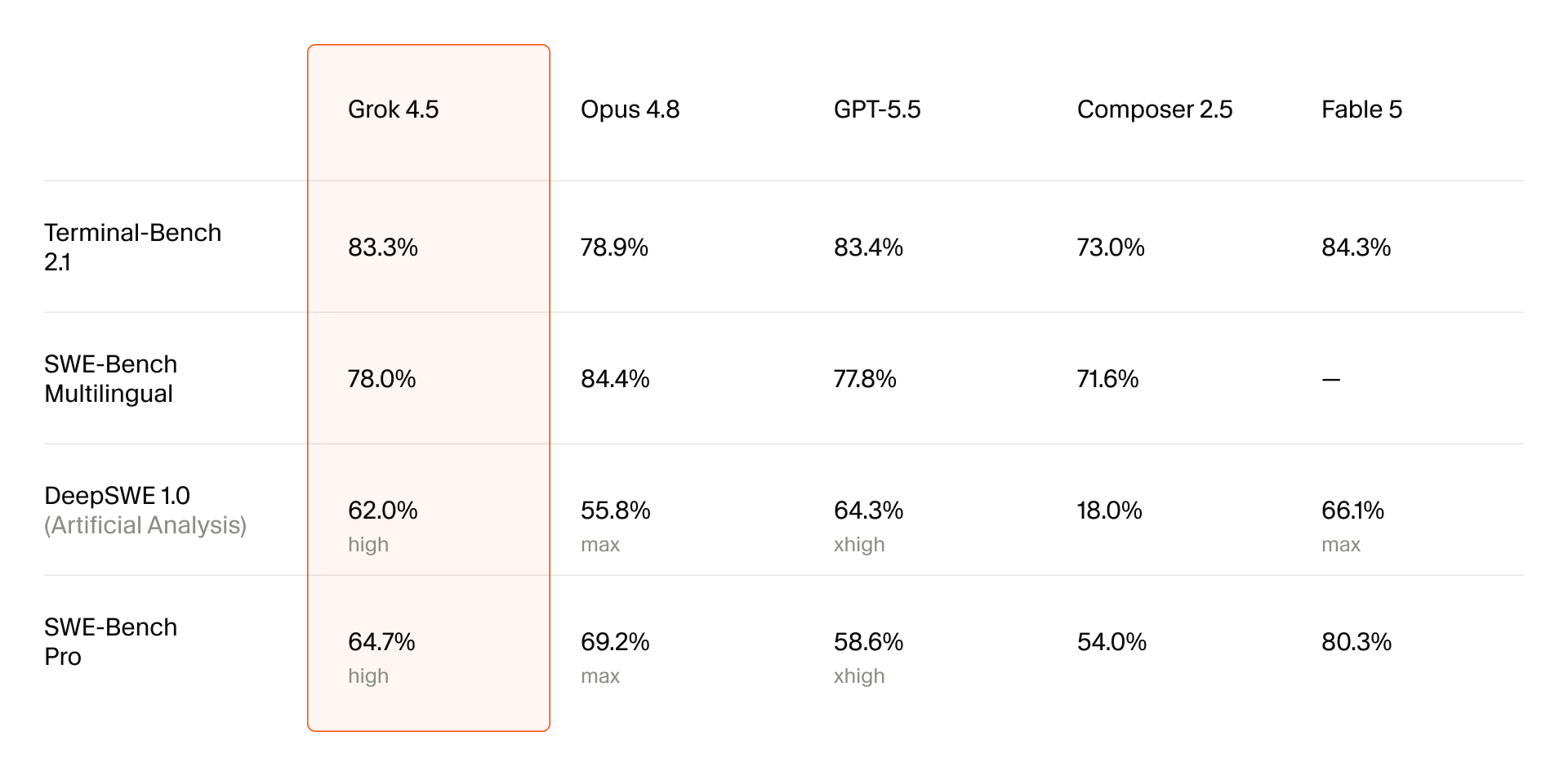
Every number xAI published
From the announcement, all four charts in full:
DeepSWE 1.0 (pass@1)
| Model | Score |
|---|---|
| Claude Fable 5 (max) | 66.1% |
| GPT 5.5 (xhigh) | 64.31% |
| Grok 4.5 | 62.0% |
| Claude Opus 4.8 (max) | 55.75% |
| Claude Opus 4.7 (max) | 40.12% |
DeepSWE 1.1
| Model | Score |
|---|---|
| Claude Fable 5 (max) | 70% |
| GPT 5.5 (xhigh) | 67% |
| Claude Opus 4.8 (max) | 59% |
| Grok 4.5 | 53% |
| GLM 5.2 | 44% |
Terminal Bench 2.1
| Model | Score |
|---|---|
| Claude Fable 5 (max) | 84.3% |
| GPT 5.5 (xhigh) | 83.4% |
| Grok 4.5 | 83.3% |
| Claude Opus 4.8 (max) | 78.9% |
| Claude Opus 4.7 (max) | 78.9% |
SWE Bench Pro (resolve rate)
| Model | Score |
|---|---|
| Claude Fable 5 (max) | 80.4% |
| Claude Opus 4.8 (max) | 69.2% |
| Grok 4.5 | 64.7% |
| Claude Opus 4.7 (max) | 64.3% |
| GLM 5.2 | 62.1% |
| GPT 5.5 (xhigh) | 58.6% |
Plus the efficiency chart: 15,954 average output tokens per SWE Bench Pro task for Grok 4.5, versus 67,020 for Opus 4.8 (max), a 4.2x difference.
Where these numbers come from
The fine print on xAI’s charts matters more than usual:
- DeepSWE 1.0 was “created by Datacurve, run with each model provider’s harnesses by AA.”
- DeepSWE 1.1 used the “mini-swe-agent harness run by Datacurve.”
- “Competitor figures are drawn from the respective developers’ published system cards or benchmark leaderboards.”
Translate: this is a mosaic. Some numbers come from third-party eval shops, some from rival vendors’ own marketing pages, assembled by the vendor with something to sell. That’s more transparent than pure self-reporting, and Datacurve’s involvement adds credibility. It still isn’t an independent evaluation: harnesses, scaffolding, and effort settings differ across sources, and each of those can move agentic scores by several points. Nobody outside this mosaic has published Grok 4.5 numbers yet.
Three readings of the same charts
Against Opus 4.8, it’s a genuine split. Two wins (DeepSWE 1.0 by 6.25, Terminal Bench by 4.4), two losses (DeepSWE 1.1 by 6, SWE Bench Pro by 4.5). Musk’s “Opus-class” framing survives contact with the data he published; a stronger claim wouldn’t. Notice which benchmarks fall on which side: Grok wins the terminal-oriented and older evals, Opus wins the newer, messier repo-level ones. Full head-to-head, with pricing folded in, at Grok 4.5 vs Claude Opus 4.8.
Against the frontier, there’s no contest, and xAI didn’t pretend otherwise. Claude Fable 5 (max) tops all four charts on xAI’s own page, and GPT 5.5 (xhigh) beats Grok 4.5 on three of four. The interesting move is that xAI printed these rather than cropping them out. The pitch is explicitly price-performance, not supremacy. What Fable’s numbers mean in practice is covered in our Fable 5 benchmark analysis.
Against its own predecessor, the upgrade is real but narrow. Opus 4.7-to-4.8 jumps on these charts dwarf most generational gaps, and Grok 4.5’s edge over models like GLM 5.2, which costs a fraction as much, is 9-11 points on the two shared benchmarks. Capability-per-dollar shoppers should read those gaps carefully in both directions.
The metric xAI wants you to see
The efficiency chart is the strategic heart of the launch. 15,954 output tokens per resolved task, against 67,020 for Opus 4.8 (max), means Grok 4.5 completes comparable work in under a quarter of the output volume, delivered at 80 tokens per second.
This is a legitimate metric, not spin. Output tokens are billed money and elapsed time; in agent loops they compound across every step. A model that scores 4.5 points lower on SWE Bench Pro but emits 4.2x fewer tokens can still be the rational choice for high-volume pipelines, which is exactly the trade our pricing analysis quantifies (~$0.10 vs ~$1.68 of output per resolved task at list prices).
Two caveats. Vendor-measured, single benchmark. And verbosity isn’t waste for the comparison model: Opus’s long outputs are extended reasoning, which is part of how it wins the evals it wins. Efficiency and depth are a real trade-off, not a free lunch.
What’s missing
Reasons to hold judgment for a few weeks:
- No independent third-party evaluation. No Artificial Analysis intelligence index entry, no LMArena placement, no community SWE-bench replication as of July 9.
- Coding only. xAI published no general-reasoning, math, science, or safety benchmarks for a model it markets for “knowledge work” too. The Office-work capabilities shipped as demos, not evals.
- No effort-mode disclosure for Grok itself. Competitors are labeled (max, xhigh); whether Grok 4.5’s scores reflect its default or maximum configuration isn’t stated.
- A week-one model. Regressions, serving instability, and quiet capability changes are common in the first month after any launch.
Run the benchmark that matters: yours
Public benchmarks predict averages, not your workload. A lightweight private eval beats all of the above for a switching decision:
- Collect 10-20 real tasks from your own backlog: the prompts, the codebase context, the expected outcomes.
- In Apidog, build one saved request per candidate model. Both xAI and Anthropic expose OpenAI-compatible surfaces, so the harness is one collection with a model variable, not three codebases.
- Run each task against
grok-4.5and your incumbent. Assert on theusageobject and capture latency, so you’re scoring quality, speed, and token burn in the same pass. - Score outputs blind if you can; model names bias reviewers more than anyone admits.
That last step is where the efficiency claim gets tested against reality: if Grok 4.5’s outputs on your prompts aren’t measurably shorter, the headline economics don’t apply to you. Download Apidog free and the whole harness takes an hour. Setup details for the xAI side are in our Grok 4.5 API guide.
FAQ
What benchmarks did xAI publish for Grok 4.5? Four coding evals (DeepSWE 1.0 and 1.1, Terminal Bench 2.1, SWE Bench Pro) plus a token-efficiency comparison against Opus 4.8. Nothing outside coding.
Are there independent Grok 4.5 benchmarks? Not yet. The published figures mix Datacurve-run evals with numbers from other vendors’ system cards. Independent indexes usually land within weeks of a major launch.
Does Grok 4.5 beat Claude Opus 4.8? On two of four published benchmarks, at much lower cost. Opus wins the two harder repo-level evals. See the full comparison.
Is Grok 4.5 the strongest coding model available? No, and xAI’s own charts say so: Claude Fable 5 (max) leads every published benchmark. Grok 4.5 competes on intelligence per dollar.