OpenAI announced GPT-5.6 Sol on June 26, 2026, and the first thing most developers noticed was not the benchmarks. It was the lock. You cannot open ChatGPT and pick this model. You cannot drop a model ID into your existing code and call it. Right now the only people who can touch GPT-5.6 are roughly 20 partners whose names were individually approved by the US government, working through the OpenAI API and Codex.
So before anything else, here is the honest version: GPT-5.6 is a limited preview. It is not in ChatGPT during the preview. It is API plus Codex only, gated behind a hand-picked partner list, and OpenAI says general availability across ChatGPT, Codex, and the API is coming “in the coming weeks.” If you came here to sign up, you cannot yet, and this article will explain why that is the whole story.
TL;DR
- GPT-5.6 is one model generation with three durable tiers: Sol (flagship), Terra (balanced, cheaper), and Luna (fastest, lowest cost).
- It launched June 26, 2026 as a government-gated limited preview. API and Codex only, not ChatGPT, about 20 approved partners.
- The gate comes from a June 2, 2026 US executive order that set up benchmarking and assessment for new AI models. OpenAI agreed as a temporary step.
- New controls: a “max” reasoning effort and a new “ultra” mode that spawns subagents inside a single run.
- Per 1M tokens: Sol is $5 input / $30 output, Terra $2.50 / $15, Luna $1 / $6.
- You cannot use Sol right now unless you are one of the approved partners. The useful move today is to understand it and pick a frontier model you can actually call.
The access reality, in a box
Can you use GPT-5.6 Sol today? Almost certainly not. The preview runs through the OpenAI API and Codex only. It is not available in ChatGPT during the preview. Access is restricted to roughly 20 partners whose names were individually approved by the US government. OpenAI says GA in ChatGPT, Codex, and the API is coming in the coming weeks. Until then, you are a spectator on this model, not a customer. Plan around that.
That framing matters because the rest of the announcement reads like a normal launch, and it is easy to forget the part where you cannot actually run any of it. Keep it in mind as you read the specs below.
The family: Sol, Terra, and Luna
GPT-5.6 is a single generation. What changed is how OpenAI splits that generation into tiers. Instead of names like “Pro” or “mini,” you get three named tiers that are meant to last across future versions:
- Sol is the flagship and the strongest of the three. It is the model with the new reasoning modes and the coding, science, and cyber tuning.
- Terra is the balanced tier. OpenAI describes it as roughly 2x cheaper than GPT-5.5 with similar performance, which makes it the quiet replacement most teams would reach for at GA.
- Luna is the fastest and lowest priced, positioned as a strong-capability model for high-volume work.
The point to hold onto: the number is the generation, the name is the tier. We dig into that shift on its own in the breakdown of what Sol, Terra, and Luna actually mean. For a sense of what came before, our explainer on what GPT-5.5 is sets the baseline this generation is measured against.
The new naming system is the real change
For years OpenAI shipped model names that mixed version, size, and speed into one label, and you had to relearn the lineup every release. Sol, Terra, and Luna break that pattern. The tier names are durable. They advance on their own cadence, so a future generation can ship a stronger Sol without renaming the tier, and you can reason about “the flagship tier” versus “the fast tier” without decoding a new suffix each time.
That is a structural change, not a marketing one. If it holds, every future OpenAI release becomes easier to slot into a mental model: pick your tier by the job, then track the generation number for capability. It is the kind of decision that quietly reshapes how you plan model choices for the next two years.
The new reasoning controls: max and ultra
Two controls are genuinely new in this release, and both live on Sol.
The first is a “max” reasoning effort. Reasoning effort is the dial that decides how long the model thinks before it answers. Max gives Sol the most time to reason deeply, which is the setting you would reach for on a hard, multi-step problem where a wrong answer costs more than the extra compute.
The second is “ultra” mode, and it is the more interesting one. Per OpenAI, ultra “goes beyond a single agent by leveraging subagents to accelerate complex work.” In plain terms, a single call can spin up its own helper agents to split a task and work in parallel, instead of you wiring an external orchestrator. That blurs the line between “a model” and “an agent system,” and it changes how you would budget tokens and design a complex workflow. We cover ultra mode on its own because it is the part of this launch that most affects how builders will architect agents.
The capability focus: coding, science, and cyber
Sol is tuned for three areas, and the third one is the reason the whole thing is locked.
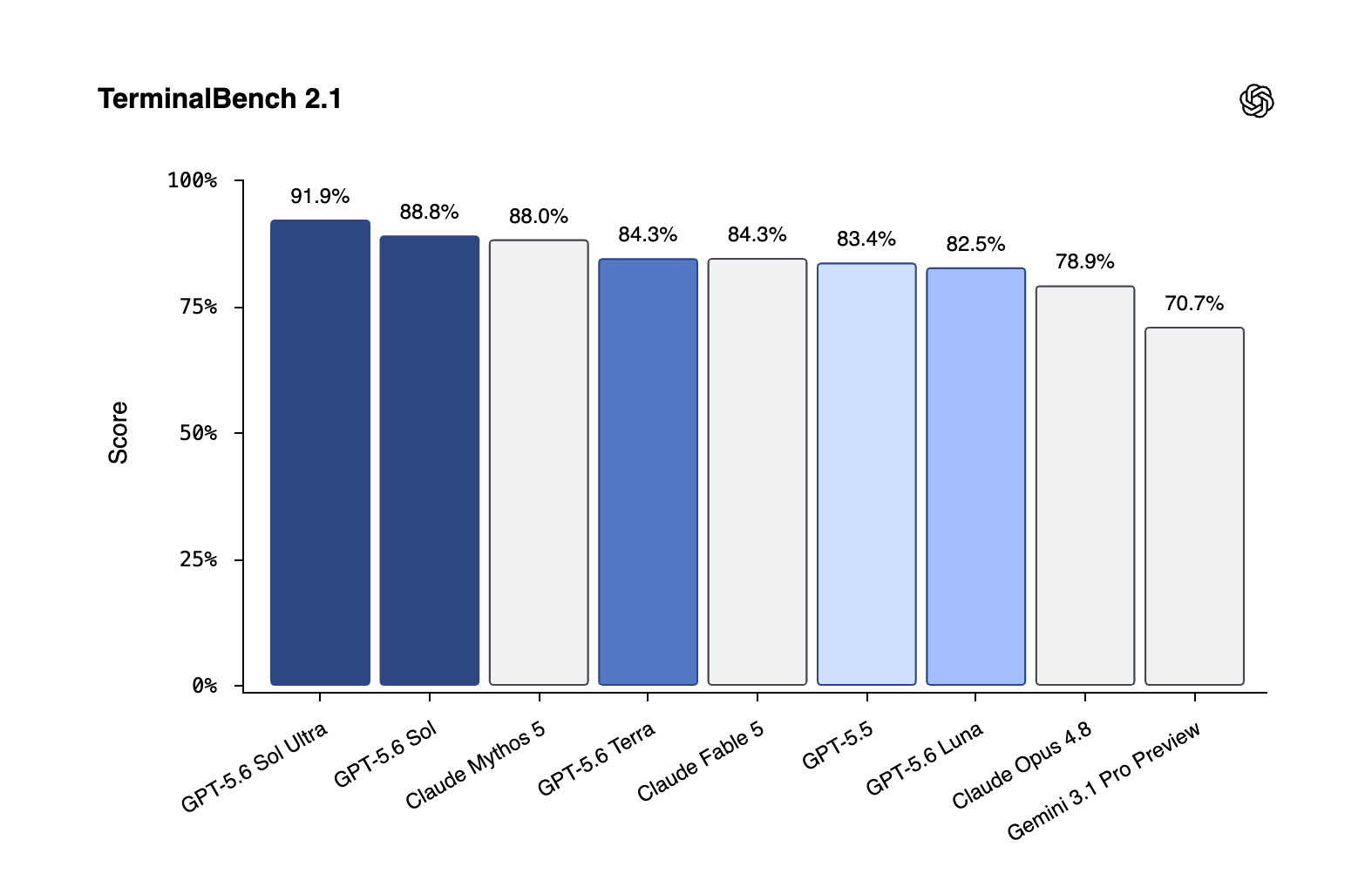
Coding. This is the headline capability. Sol is built for agentic coding work, the kind where the model runs commands, reads output, and iterates rather than emitting a single block of code.
Science and biology. OpenAI cites GeneBench v1 as part of the evaluation set, signaling a push into scientific reasoning and biology tasks.
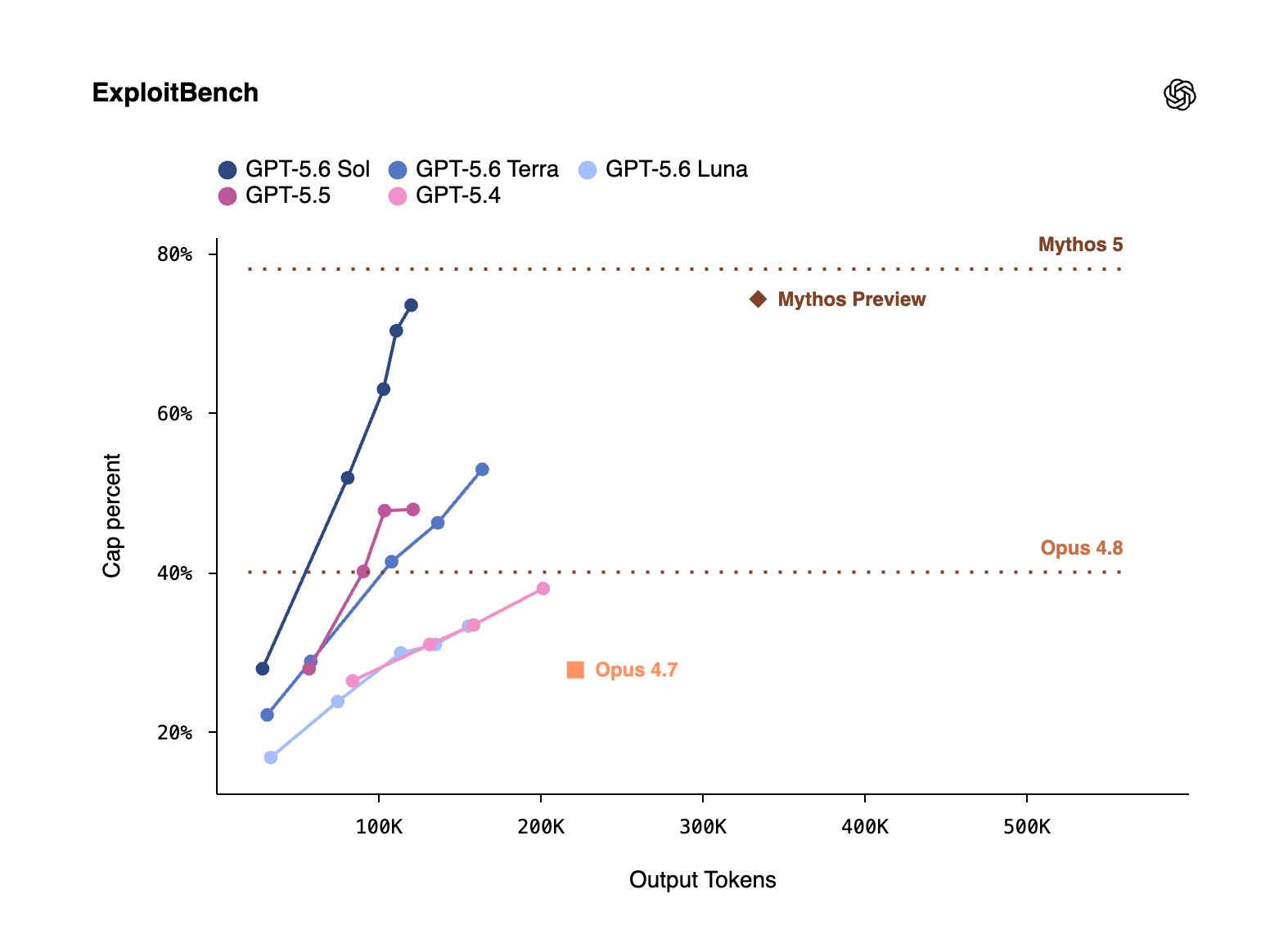
Cybersecurity, framed defensively. This is the careful part. Sol is tuned to find software vulnerabilities and write fixes, while resisting efforts to assemble full exploit chains. It is a defensive security tool, not an offensive hacking model, and OpenAI calls the release its “most robust safety stack to date.” The cyber and bio reach is exactly what triggered the government review, which is why the capability story and the gate story are the same story.
Why you can’t touch it: the government gate
Here is the part that makes GPT-5.6 different from any prior OpenAI launch. The US administration limited the launch under a June 2, 2026 executive order that set up benchmarking and assessment for new AI models. A frontier model now ships, at least at first, only after government sign-off and only to a hand-picked list of partners.
OpenAI agreed to this as a temporary measure. Per OpenAI, via MacRumors coverage: “We are taking this short-term step because we believe it is the strongest path to broader availability in the coming weeks.” You can read the reporting on the gate in the MacRumors writeup and the broader rollout context in VentureBeat’s coverage.
For developers, the precedent is bigger than the model. If frontier models start shipping only after government pre-clearance, your access timeline is no longer set purely by the vendor. That is a new variable in planning. We treat the gate as its own subject in the piece on why the government is gating GPT-5.6 and what it means for developers, because it is the most durable story in this launch. It also echoes the appetite we saw around Anthropic holding back a model, which we covered in the Claude Mythos story.
Pricing as a positioning signal
You cannot spend money on GPT-5.6 yet, so the rate card is not a buying decision. It is a signal of where each tier sits. Per multiple outlets, the prices per 1M tokens are:
| Tier | Input (per 1M) | Output (per 1M) | Position |
|---|---|---|---|
| Sol | $5 | $30 | Flagship, highest cost |
| Terra | $2.50 | $15 | Balanced, about 2x cheaper than GPT-5.5 |
| Luna | $1 | $6 | Fastest, lowest cost |
Read top to bottom, the card tells you the intended use. Sol is the model you call when the answer is worth the spend. Terra is the workhorse most teams would standardize on. Luna is for volume. We unpack the cost logic further alongside the GPT-5.5 pricing breakdown, which is the baseline Terra is being priced against.
GPT-5.6 also adds prompt caching with explicit cache breakpoints. The cache has a 30-minute minimum life, cache writes are billed at 1.25x the uncached input rate, and cache reads get the standard 90% cached-input discount. If you run repeated context, that is the lever that changes your real cost the most.
The spec table, with honest gaps
A lot of the detail you would normally expect is not published yet. Here is what is confirmed and what is not.
| Spec | Status |
|---|---|
| Release date | June 26, 2026 (confirmed) |
| Tiers | Sol, Terra, Luna (confirmed) |
| Access | API + Codex preview, not ChatGPT, ~20 approved partners (confirmed) |
| Reasoning controls | “max” effort, “ultra” subagent mode (confirmed, per OpenAI) |
| Pricing | Sol $5/$30, Terra $2.50/$15, Luna $1/$6 per 1M (confirmed across outlets) |
| API model IDs | Not published. Do not assume an ID yet |
| Context window | Reported around 1.5M tokens, see callout below |
| Max output, knowledge cutoff, modalities | Not stated |
Verify live as of June 2026. GPT-5.6 is in limited preview and OpenAI has not published every detail. The context window is reported by early coverage as roughly 1.5M tokens, framed by one outlet as about +43% over GPT-5.5’s ~1.05M, while another says it is “not specified.” Treat that number as unconfirmed. The exact API model identifiers have not been published, so do not hardcode an ID yet.
On benchmarks, the same caution applies. Per early coverage and per OpenAI’s own figures, Sol leads on agentic coding evals like Terminal-Bench and is reported as the only model above 50% on Agent’s Last Exam in code mode, with strong token efficiency on the cyber and bio evals. We did not measure any of these. The numbers come from secondary coverage, so we attribute them and we hold a full benchmark breakdown for the dedicated piece rather than restating figures as fact here.
How GPT-5.6 stacks up against what you can use today
Here is the useful reframe. Sol is being hyped against a field of models you can actually call right now: Claude Mythos 5, Claude Fable 5, GPT-5.5, Gemini 3.5 and 3.1 Pro, GLM-5.2, and Fugu Ultra. Every one of those is available today. Sol is not.
So the real decision in front of you is not “Sol or my old model.” It is “do I wait, or do I use a frontier model that ships today.” For most teams the answer is to ship now with a model you can reach, then re-evaluate at GA. We lay out that comparison in the frontier models you can use instead of GPT-5.6 Sol, matched to the exact jobs Sol is being marketed for.
This is also where Apidog fits, honestly. You cannot test Sol yet because there is no endpoint and no published model ID. What you can do is test the OpenAI-compatible APIs you are allowed to use today, the alternatives above, inside Apidog: send real requests, assert on responses, save the scenarios. Then when your preview access lands, the same setup is ready to point at Sol on day one.
FAQ
Is GPT-5.6 Sol available in ChatGPT? No. During the preview it is not in ChatGPT. Access is through the OpenAI API and Codex only, and only for roughly 20 government-approved partners. OpenAI says ChatGPT availability is coming in the coming weeks.
What do Sol, Terra, and Luna mean? They are durable capability tiers within the GPT-5.6 generation. Sol is the strongest, Terra is the balanced and cheaper tier, and Luna is the fastest and lowest cost. The number is the generation and the name is the tier, a shift we cover in the GPT-5.5 explainer for contrast with the older naming.
Why is GPT-5.6 restricted by the government? A June 2, 2026 US executive order set up benchmarking and assessment for new AI models, and the administration limited the launch under it. OpenAI agreed as a temporary step, calling it the strongest path to broader availability soon. Coverage is in the Android Authority report.
Can I test GPT-5.6 in Apidog right now? No, because there is no public endpoint or published model ID yet. You can test the alternatives you can use today in Apidog, then point the same scenarios at Sol once your access opens.
When will GPT-5.6 be generally available? OpenAI says GA across ChatGPT, Codex, and the API is coming in the coming weeks. No exact date has been confirmed, so treat any specific timeline as unverified.
Conclusion
GPT-5.6 Sol is a strong-looking flagship wrapped in a launch you cannot join. The model is real, the tiers are clear, and the new max and ultra reasoning modes are worth understanding. But the defining fact is the gate: API and Codex only, not ChatGPT, about 20 government-approved partners, with GA promised in the coming weeks. Until that opens, the smart play is to understand Sol, watch the rollout, and ship with a frontier model you can actually call.
Want to be ready the day your access lands? Download Apidog to build and test your scenarios against today’s models, then point them at Sol on day one.