Within a few weeks of each other in the summer of 2026, OpenAI and Google both shipped a security-specialized model that most developers can’t touch. OpenAI’s GPT-5.6-Cyber landed August 10. Google’s Gemini 3.5 Flash Cyber arrived July 21. Both find software vulnerabilities. Both are gated behind approval. And both refuse to hand you a normal API key.
They are not the same kind of tool, though. One leans defensive, one leans offensive, and they sit on very different model tiers. If you’re trying to understand the two, here’s how they actually compare, and why a straight benchmark shootout between them isn’t possible.
Side by side
| GPT-5.6-Cyber | Gemini 3.5 Flash Cyber | |
|---|---|---|
| Vendor | OpenAI | |
| Launched | August 10, 2026 | July 21, 2026 |
| Built on | GPT-5.6 Sol (flagship tier) | Gemini Flash (fast, cheap tier) |
| Leans | Offensive: exploit chains, zero-day discovery | Defensive: find and fix vulnerabilities |
| Access | Daybreak Red (vetted security teams) | Limited pilot (governments, trusted partners) |
| Public API | No | No |
| Public pricing | No | No |
| Program | OpenAI Daybreak | Google CodeMender |
The one-line takeaway: GPT-5.6-Cyber is a frontier-tier offensive research model, and Gemini 3.5 Flash Cyber is a lighter-tier defensive patching model. That difference in orientation explains almost everything else.
Different model tiers
The clearest technical split is the base model. GPT-5.6-Cyber is built on GPT-5.6 Sol, OpenAI’s most capable reasoning model. Real-world vulnerability research needs sustained reasoning across large, unfamiliar codebases, and OpenAI put its top-tier model underneath Cyber to get it.
Gemini 3.5 Flash Cyber is built on the Flash tier, Google’s fast and inexpensive workhorse rather than its Pro flagship. That’s a deliberate fit for its job. CodeMender, the Google program behind it, is about scanning code to find and fix flaws at scale, which rewards speed and cost efficiency over maximum single-shot reasoning depth. Note the version quirk too: the general Flash model moved to 3.6, but Cyber stayed at 3.5, because the two are on different release tracks.
Different orientation: offense vs defense
This is the real distinction. Read each vendor’s own framing and the split is obvious.
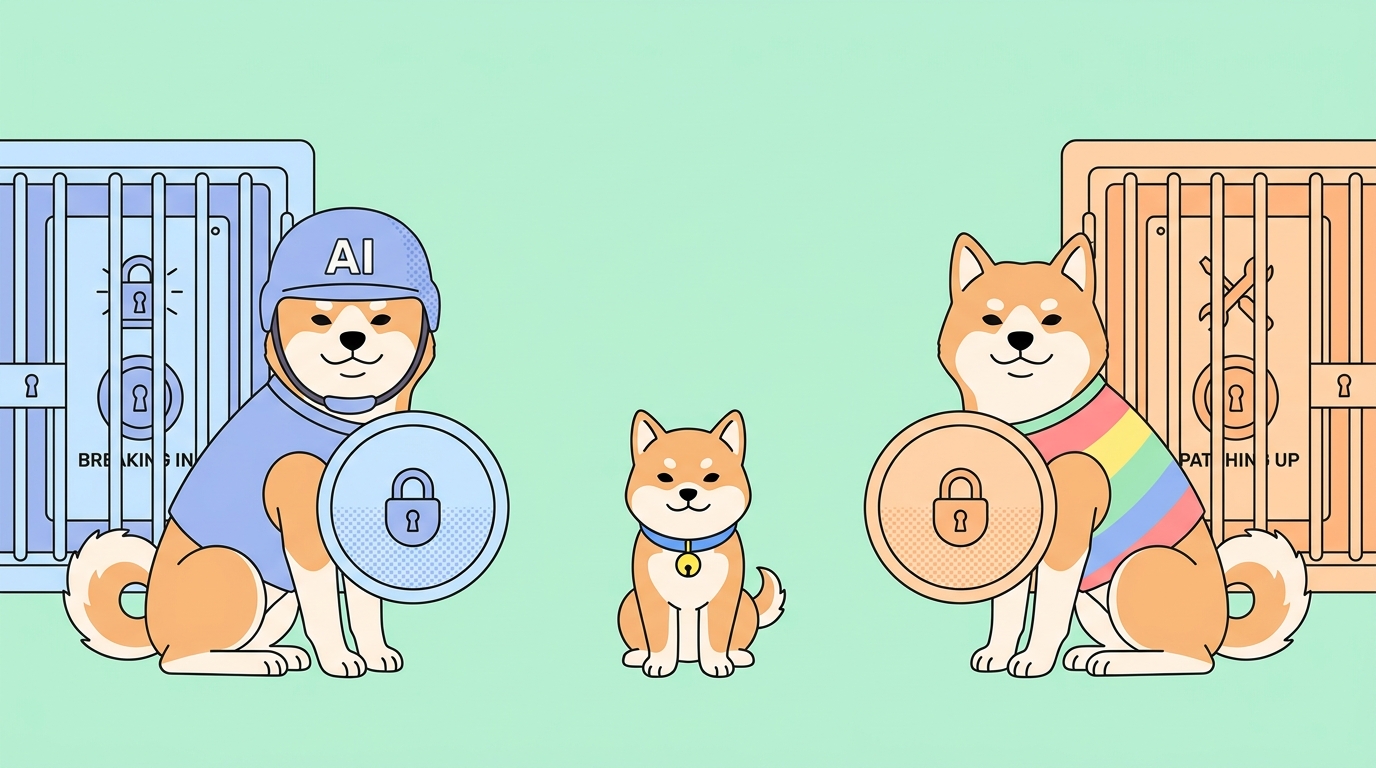
OpenAI trained GPT-5.6-Cyber to reduce refusals on higher-risk dual-use tasks and to get better at finding zero-days and building exploit chains, per its Daybreak expansion announcement. It’s delivered through Daybreak Red, the tier explicitly for “authorized vulnerability research, exploit validation, and security testing.” The launch evidence was offensive: two chained V8 vulnerabilities in Chrome, assigned CVE-2026-15903, plus reported findings across a mobile OS, a database, and an OS kernel.
Google framed Gemini 3.5 Flash Cyber around finding and fixing. Announced in its Gemini models update, it’s part of CodeMender, an effort aimed at spotting security flaws in code and proposing patches for them. The emphasis is remediation, closing holes, not weaponizing them.
That doesn’t make one “safe” and one “dangerous.” A strong vulnerability finder is dual-use no matter how it’s framed, which is exactly why both are gated. But if you’re mapping the space, OpenAI pushed harder toward offensive research, and Google stayed closer to defensive patching.
Different transparency
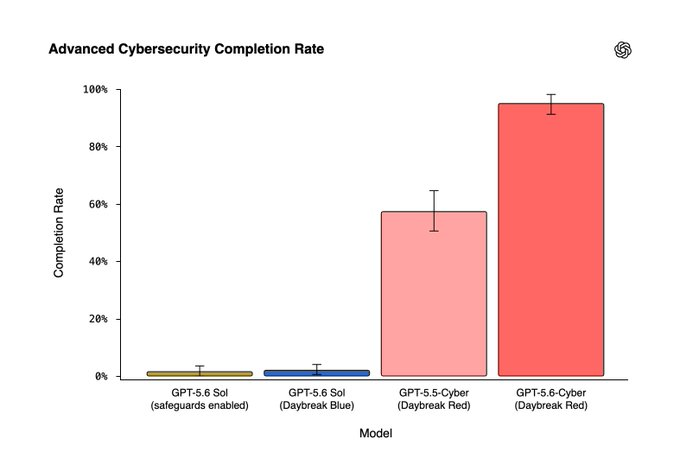
OpenAI published more numbers. It disclosed an internal completion-rate metric (GPT-5.6-Cyber answers 95.0% of advanced cyber prompts versus 1.5% for base Sol), named benchmarks like ExploitGym, reported a real assigned CVE, and stated a Preparedness Framework rating of “High” but below “Critical.” For the full breakdown of who gets access to what, see Daybreak Blue vs Red.
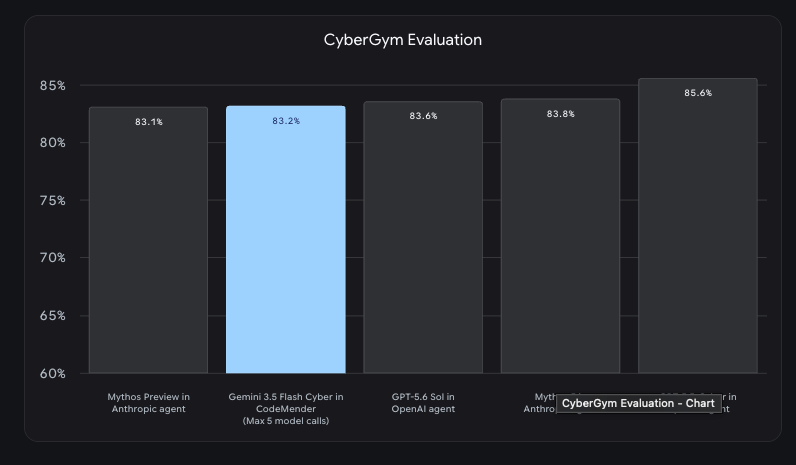
Google was vaguer at launch. It confirmed the model exists, its defensive purpose, and its gated status, without publishing comparable per-task completion rates or benchmark tables. So while you can describe both models, you can’t put them on the same chart. There’s no shared benchmark either vendor has run head-to-head, and their target tasks (exploit development vs patch generation) barely overlap.
What they share
Strip away the differences and the two models tell the same story about where AI security tooling is heading:
- Gated access, not open API. Neither is self-serve. Both require approval, and access is scoped to vetted organizations.
- No public pricing. Because there’s no open access, there’s no published per-token rate for either. Any price table you find circulating is unverified.
- The same dual-use logic. Both vendors reason that a model good at finding vulnerabilities is inherently good at finding vulnerabilities, so they’re starting narrow with trusted partners and watching before widening access.
- A confusing version story. OpenAI’s model sits under the Sol/Terra/Luna naming; Google’s stayed at 3.5 while its sibling went to 3.6.
If you came to either looking for an API key, the answer is the same: not today, and maybe not in the shape you expect.
Which one matters to you? Probably neither, yet
Here’s the practical read. Unless you’re at an approved security vendor or a government partner, you can’t use either model right now. Watching them is useful for understanding the direction of travel, but neither belongs in your stack this quarter.
What does belong in your stack is testing the security of the APIs you actually own. Both of these models exist because vulnerabilities are expensive; the cheapest ones to prevent are the boring boundary bugs in your own services. You don’t need a frontier cyber model to catch those.
With an API client like Apidog, you can run the checks that catch the most for the least effort:
- Auth boundaries. Fire requests with missing, expired, and valid tokens and assert each returns the right status. The same least-privilege discipline applies to your agents; see what your AI agent’s API key can actually do.
- Transport security. Verify client certificates and mTLS behave, and that plain requests are refused.
That’s work you can start today, with tools you can actually access. Download Apidog and begin with the auth cases.
Frequently asked questions
Which is better, GPT-5.6-Cyber or Gemini 3.5 Flash Cyber? They’re built for different jobs, so “better” depends on the task. GPT-5.6-Cyber is a frontier-tier model tuned for offensive research (exploit development, zero-day discovery). Gemini 3.5 Flash Cyber is a lighter-tier model tuned for defensive patching. Neither vendor has published a head-to-head benchmark, so a direct score comparison isn’t available.
Can I use either one through an API? No. Both are gated. GPT-5.6-Cyber requires Daybreak Red approval; Gemini 3.5 Flash Cyber is a limited pilot for governments and trusted partners. Neither offers a self-serve API model ID.
Why are both models restricted? Dual use. A model good at finding vulnerabilities helps defenders patch and helps attackers exploit. Both vendors are limiting access to vetted partners while they monitor real-world use.
What’s the difference in the base models? GPT-5.6-Cyber is built on GPT-5.6 Sol, OpenAI’s flagship reasoning tier. Gemini 3.5 Flash Cyber is built on Google’s faster, cheaper Flash tier, which fits its scan-and-fix purpose.
What should I use instead? For securing your own APIs, run auth, transport, and contract tests with a client like Apidog. No gated model required.