OpenAI announced GPT-5.6 Sol on June 26, 2026, and the benchmarks set the timeline buzzing. Then everyone read the fine print. Sol is in a limited preview through the OpenAI API and Codex only, it is not in ChatGPT, and access is restricted to roughly 20 partners whose names were individually approved by the US government. Unless you are on that short list, you cannot use it today.
So the real question isn’t “should I switch to Sol.” You can’t. The question is what frontier model gets the coding, agentic, or security work done right now, while OpenAI says general availability is coming “in the coming weeks.” This guide matches each job Sol is being hyped for to a model you can call today, with honest tradeoffs and a decision table. The full picture of the launch lives in what GPT-5.6 Sol is and why you can’t use it yet; here we focus on what to run instead.
Verify live as of June 2026. GPT-5.6 is in limited preview and OpenAI has not published every detail. Treat the “coming weeks” timeline and any benchmark figure below as provisional.
TL;DR
- GPT-5.6 Sol is a government-gated preview. API and Codex only, not in ChatGPT, about 20 approved partners. You almost certainly can’t access it.
- For coding agents today: Claude Mythos 5 or GPT-5.5 are the closest in capability you can actually call.
- For high-volume or cost-sensitive work: GLM-5.2 and Gemini 3.1 Pro stretch your budget further.
- For long-context and multimodal jobs: Gemini 3.5 Pro is the practical pick.
- Every alternative below exposes an OpenAI-compatible or standard REST API, so you can test them in Apidog now and be ready to test Sol the day your preview access lands.
Why you can’t just sign up for Sol
The US administration limited the launch under a June 2, 2026 executive order that set up benchmarking and assessment for new AI models. OpenAI agreed as a temporary measure. In its words, quoted by MacRumors, “We are taking this short-term step because we believe it is the strongest path to broader availability in the coming weeks.”
That gate is why a buyer’s guide for Sol is premature. There is no public endpoint, the exact API model identifiers have not been published yet, and the partner list is fixed. VentureBeat confirms the same picture: a frontier release that ships only after government sign-off, to a hand-picked set of names.
Sol sits at the top of the GPT-5.6 family. Terra is the balanced tier, which OpenAI describes as about 2x cheaper than GPT-5.5 with similar performance, and Luna is the fastest and lowest-priced tier with strong capability. On a per-million-token basis, Sol runs $5 input and $30 output, Terra $2.50 input and $15 output, and Luna $1 input and $6 output. Those rates are a positioning signal, not a price you can pay yet.
What Sol is being hyped for
Before you pick a replacement, get clear on the three jobs the hype is built around. OpenAI’s Sol announcement frames the model around coding, science and biology, and cybersecurity.
- Agentic coding. Sol is tuned for long-horizon coding tasks, and a new “max” reasoning effort gives it the most time to reason deeply. There is also a new “ultra” mode that, per OpenAI, “goes beyond a single agent by leveraging subagents to accelerate complex work.”
- Science and biology. OpenAI cites GeneBench v1 as a focus area for the model’s reasoning over biological problems.
- Defensive cybersecurity. Sol is tuned to find software vulnerabilities and write fixes while resisting efforts to craft full exploit chains. OpenAI calls it its “most robust safety stack to date.” This is a defensive posture, not an offensive hacking model, and the safety framing is part of why the launch is gated.
Match your work to one of those buckets, then pick from the models below.
The alternatives, matched to the job
Every model here is available through a public API today. That is the whole point.
Claude Mythos 5: the closest agentic-coding peer
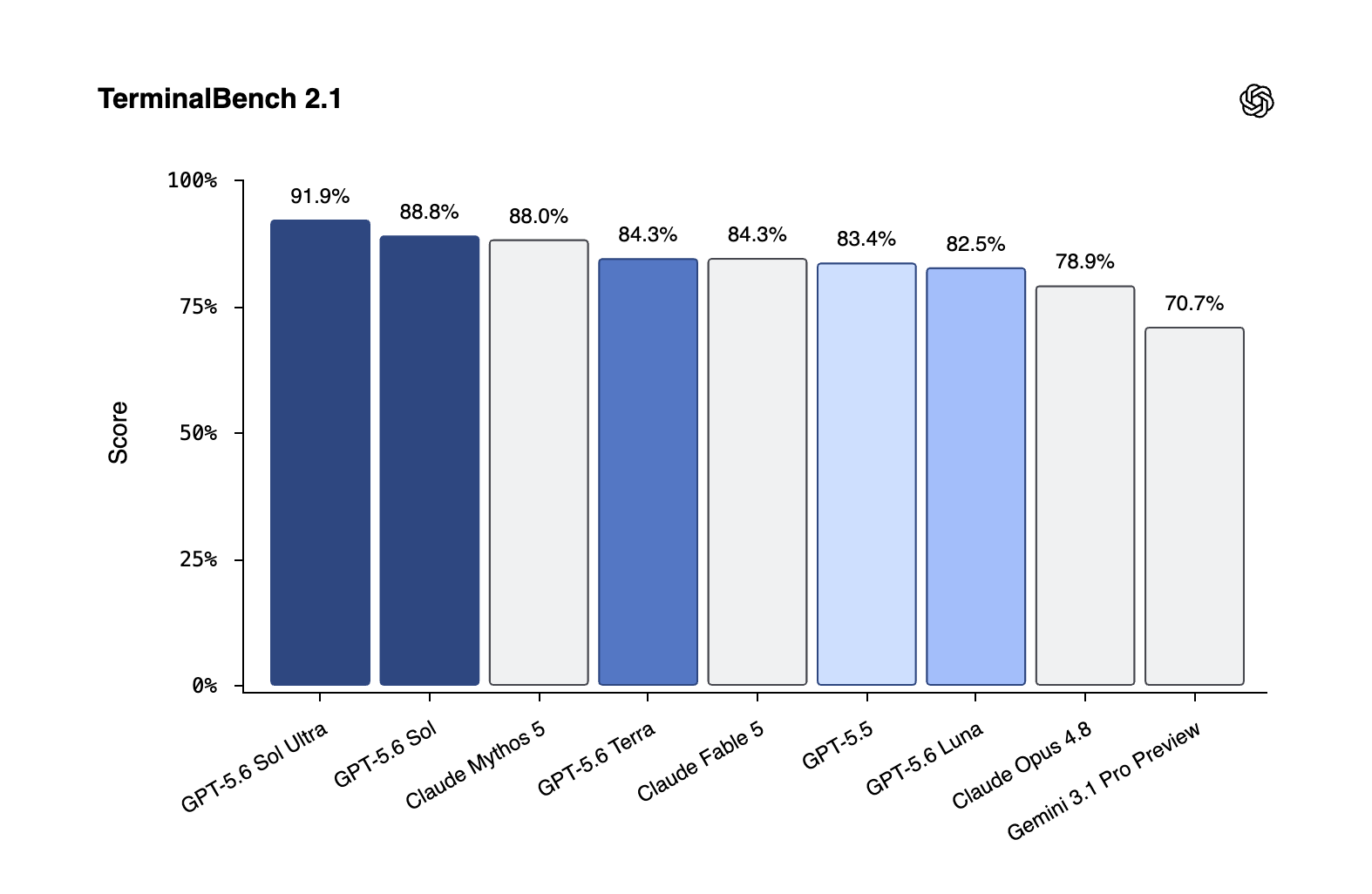
If Sol’s agentic coding is what you want, Mythos 5 is the alternative you can call right now. Early coverage from kingy.ai puts Mythos 5 around 88% on Terminal-Bench 2.1, in the same band OpenAI claims for Sol (about 88.8%, per OpenAI). That number is from secondary coverage, not a page we fetched from OpenAI, so read it as a signal rather than a measurement.
The honest tradeoff: Mythos 5 is strong at multi-step coding and tool use, which is exactly the lane Sol is being sold on. It uses Anthropic’s API rather than an OpenAI-compatible one, so your client code differs, but the work gets done today. For a head-to-head on how Anthropic’s flagship stacks against the GPT-5.5 baseline and Gemini, see Claude Opus 4.8 vs GPT-5.5 vs Gemini 3.5.
GPT-5.5: the OpenAI-stack baseline you already have
If you want to stay on the OpenAI stack and keep your existing client, GPT-5.5 is the obvious pick. It is the model Sol is measured against, OpenAI’s own positioning describes Terra as roughly 2x cheaper than 5.5 at similar performance, which tells you 5.5 is still a capable working baseline.
The tradeoff is plain: GPT-5.5 is not Sol. Per early coverage it trails Sol on Terminal-Bench 2.1 (about 83.4% vs Sol’s 88.8%, per OpenAI). For most production coding and agent work, that gap is smaller than the gap between “available” and “not available.” If you already build on OpenAI, you lose nothing by shipping on 5.5 now. Our walkthrough on how to use the GPT-5.5 API covers the request shape, reasoning controls, and streaming.
GLM-5.2: the cost-aware workhorse
When the job is high-volume coding or agent runs where token cost dominates, GLM-5.2 changes the math. It is competitive on coding tasks and prices well below the frontier flagships, which matters when you are running thousands of agent steps a day.
The tradeoff is that GLM-5.2 may sit a notch below the very top models on the hardest reasoning tasks, so it is a better fit for breadth than for the single most demanding problem. For where it lands against the GPT-5.5 baseline, Claude, and Gemini, see GLM-5.2 vs GPT-5.5, Claude Opus, and Gemini. GLM-5.2 exposes an OpenAI-compatible API, so swapping it in is mostly a base-URL change.
Gemini 3.5 / 3.1 Pro: long context and multimodal
If your work needs a large context window or you are reasoning over images and documents alongside code, Gemini 3.5 Pro (or 3.1 Pro for a lower-cost tier) is the practical choice. Google’s models lead on long-context and multimodal jobs, which is a lane Sol’s coding-and-cyber framing doesn’t emphasize.
The tradeoff: you are on Google’s API surface, and for pure agentic coding the top Claude and OpenAI models still set the bar. But for the long-document, mixed-input work many teams actually do, Gemini is the right tool and you can use it today.
Claude Fable 5 and Fugu Ultra: when you want a different shape
Fable 5 is the faster, lower-cost Claude tier, a good fit when you want Anthropic quality without paying for the flagship on every call. Fugu Ultra is worth a look if you are specifically chasing the multi-agent shape Sol’s “ultra” mode hints at, since it is built as an orchestrator that coordinates subagents. Both are available now, which is more than Sol can say.
Decision table
Pick the row that matches your job. Every model listed is callable today.
| Your job | Best alternative now | Why | API style |
|---|---|---|---|
| Agentic / long-horizon coding | Claude Mythos 5 | Closest Terminal-Bench peer to Sol (per OpenAI) | Anthropic API |
| Stay on OpenAI, ship today | GPT-5.5 | The baseline Sol is measured against; you keep your client | OpenAI |
| High-volume, cost-sensitive | GLM-5.2 | Competitive coding at a lower token price | OpenAI-compatible |
| Long context / multimodal | Gemini 3.5 / 3.1 Pro | Leads on long-document and mixed-input work | Google API |
| Cheaper Claude quality | Claude Fable 5 | Anthropic quality without flagship pricing | Anthropic API |
| Multi-agent orchestration | Fugu Ultra | Coordinates subagents, the shape Sol’s “ultra” hints at | OpenAI-compatible |
Verify live as of June 2026. Benchmark figures attributed “per OpenAI” come from secondary coverage of the preview, not a page we fetched from OpenAI. The context window for Sol is reported as roughly 1.5M tokens by one outlet and “not specified” by another, so treat it as unconfirmed.
Test the alternatives in Apidog today
Here is the genuine product tie, and the reason this piece is more useful than another spec recap. Every alternative above speaks either an OpenAI-compatible API or a standard REST surface. That means you can wire each one into Apidog and test it the same way you test any HTTP endpoint, no matter which provider you land on.
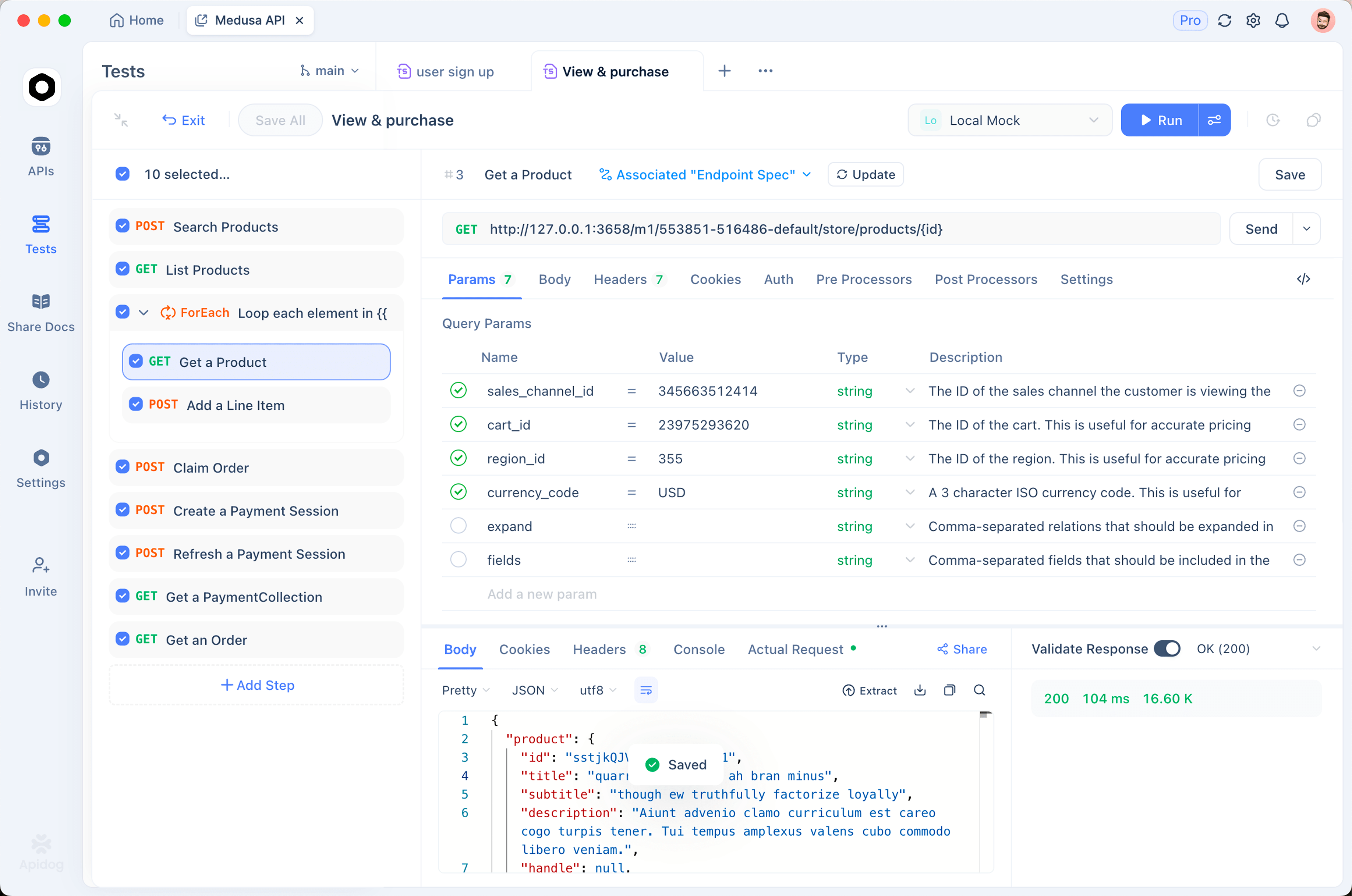
Set up a request for the model you picked, drop in your auth header, and run real prompts against it. Save the call as a test scenario so you can compare GPT-5.5, Mythos 5, GLM-5.2, and Gemini side by side on the prompts that matter to your app. When you settle on one, fold the request into a test suite and run it in CI so a model or prompt change can’t silently break your output.
The same setup pays off when Sol opens up. The day your preview access lands, you swap the base URL and model identifier into the request you already built and start testing immediately, no new tooling required. You can’t test Sol now, but you can be ready for it.
FAQ
Can I use GPT-5.6 Sol right now if I have an OpenAI API key? No. A standard OpenAI API key does not grant Sol access. The preview is limited to about 20 partners individually approved by the US government, through the API and Codex only, and Sol is not in ChatGPT. OpenAI says wider availability is coming “in the coming weeks.” For the full launch picture, see what GPT-5.6 Sol is and why you can’t use it yet.
What is the best coding model in 2026 that I can actually use today? For agentic coding, Claude Mythos 5 is the closest peer to Sol that you can call now, and GPT-5.5 keeps you on the OpenAI stack. If token cost dominates, GLM-5.2 is competitive at a lower price. Match the model to the job rather than chasing a single “best.”
Which alternative is cheapest for high-volume work? GLM-5.2 tends to win on price-for-capability for heavy coding and agent loops. Gemini 3.1 Pro is also a strong cost tier when you need long context. Test both against your own prompts before committing, since cost-per-result depends on how many tokens your task burns.
Will my code need to change when Sol opens up? Probably not much. If you build against an OpenAI-compatible client now, moving to Sol is mostly a base-URL and model-identifier swap once those are published. The exact API model identifiers for GPT-5.6 have not been released yet.
How do I compare two models fairly before I pick one? Run the same prompts against each through a single test harness. Wiring the providers into how to use the GPT-5.5 API style requests and saving them as scenarios lets you swap models without rewriting your test, which keeps the comparison honest.
Conclusion
GPT-5.6 Sol is gated behind a government preview, so the only move that ships today is to pick a frontier model you can actually call. Match the job to the model: Mythos 5 or GPT-5.5 for agentic coding, GLM-5.2 for cost, Gemini for long context and multimodal. All of them expose APIs you can test now, and the test harness you build carries straight over to Sol the day it opens.
Ready to compare them on your own prompts? Download Apidog and test every model you can use today, so you’re set the moment Sol lands.