GLM-5.4 vs Claude Fable 5.2 is a choice between two ways of paying for a coding agent. Claude Fable 5.2 is Anthropic’s top public model at $8 per million input tokens and $40 per million output, with published benchmarks and an API you can ship in production. GLM-5.4 is Z.ai’s new Loop Transformer model, available only through a GLM Coding Plan that starts at $18 a month. Pick Fable for the hardest tasks and anything your product calls; pick GLM-5.4 for high-volume daily agent work.
Z.ai released GLM-5.4 on November 23, 2026, two weeks after Anthropic shipped Fable 5.2. This guide compares specs, prices one agent session on each, lists the limits, and shows how to let your coding agent referee both with Apidog CLI.
GLM-5.4 vs Claude Fable 5.2: the quick verdict
Use Claude Fable 5.2 when a task is hard, long or business-critical, or when your own app needs to call the model through an API. Use GLM-5.4 when you run a coding agent all day inside a supported tool and want a flat monthly bill. If you can afford both, route routine edits to GLM-5.4 and escalate hard ones to Fable.
- Evidence. Anthropic publishes a benchmark table for Fable 5.2. Z.ai hasn’t published one for the 750B GLM-5.4 model yet.
- Access. Fable 5.2 works on the Claude API and three cloud platforms. GLM-5.4 has no pay-as-you-go API yet.
- Cost. A cached agent session costs about $7.77 on Fable 5.2 and draws about 458 credits from a GLM Coding Plan.
- Terms. The Coding Plan only covers officially supported coding tools, so you can’t put it behind your own backend.
How do GLM-5.4 and Claude Fable 5.2 compare on specs?
Both models read a 1M-token context and target long agentic coding sessions. Fable figures come from Anthropic’s Fable 5.2 model page and GLM figures from Z.ai’s GLM-5.4 launch post and Coding Plan overview, checked November 24, 2026.
| Spec | GLM-5.4 | Claude Fable 5.2 |
|---|---|---|
| Developer | Z.ai | Anthropic |
| Released | Nov 23, 2026 | Nov 9, 2026 |
| Model ID | glm-5.4 (glm-5.4[1m] in Claude Code) |
claude-fable-5-2 |
| Architecture | Loop Transformer, 28 shared layers run twice | Not disclosed |
| Context window | 1M tokens | 1M tokens |
| Max output | Not listed | 128K tokens |
| Input | Text and images | Text and images |
| How you pay | Coding Plan from $18/month, credits | $8 input, $40 output per 1M tokens |
| Pay-as-you-go API | Coming soon | Yes, plus Bedrock, Google Cloud, Foundry |
| Open weights | Planned, no date | No |
| Reasoning control | /effort, default max in Claude Code |
effort, default high on the API |
A Loop Transformer runs a block of weight-shared layers more than once per token, adding compute without adding parameters. Z.ai says its 750B-scale model reaches “intelligence levels comparable to 2T-3T parameter models,” a claim nobody has tested independently yet.
How do you pay for each model?
Fable 5.2 bills every token. GLM-5.4 bills a monthly subscription metered in credits, with a 5-hour bucket and a weekly bucket. That difference also decides which tools can reach each model.
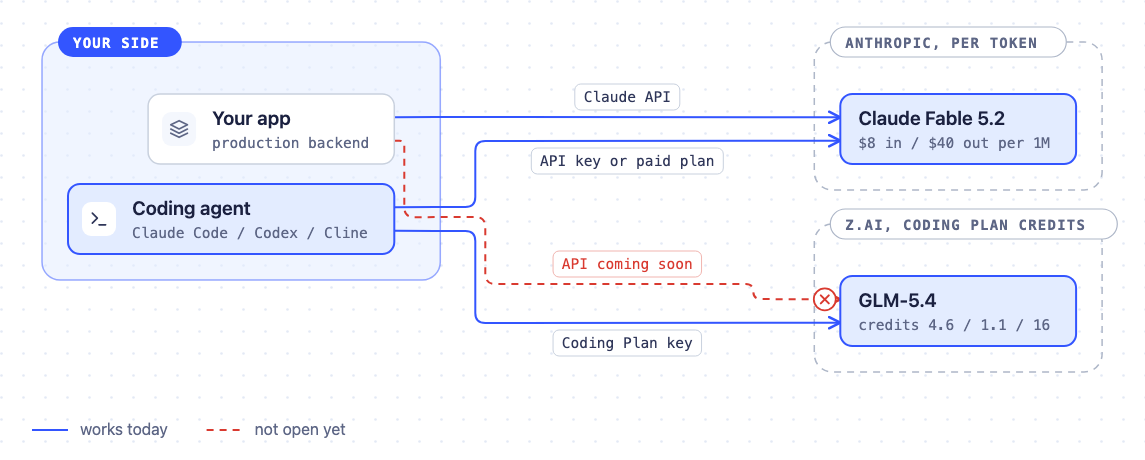
On Fable 5.2, a 5-minute cache write costs $10 per million tokens, a 1-hour write $16 and a cache read $0.20. Batch takes 50% off.
On GLM-5.4, Z.ai converts each request into credits with this formula:
$$\text{credits} = \frac{\text{input} \times 4.6 + \text{cached} \times 1.1 + \text{output} \times 16}{10{,}000}$$
Off-peak usage costs half (peak is Monday to Friday, 14:00 to 18:00 Singapore time). The Lite plan at $18 a month gives 2,000 credits per 5 hours and 10,000 per week. Our Claude Fable 5.2 pricing breakdown covers Anthropic’s rates in more depth.
What does one coding agent session cost on each?
A coding agent reloads the repo and history on every turn, so cache reads dominate input. One sample session: 150K tokens written to cache, 1.35M tokens read from cache and 150K output tokens.
| Line item | Claude Fable 5.2 | GLM-5.4 (Coding Plan) |
|---|---|---|
| 150K fresh input / cache write | $1.50 | 69 credits |
| 1.35M cached input | $0.27 | 148.5 credits |
| 150K output | $6.00 | 240 credits |
| Session total | $7.77 | 457.5 credits (229 off-peak) |
| Sessions per Lite week | n/a | about 21 peak, 43 off-peak |
| Sessions per Lite 5-hour window | n/a | about 4 peak, 8 off-peak |
On Lite, a fully used month is roughly 90 peak sessions for $18. The same 90 sessions on Fable 5.2 cost about $700.
Treat that gap with care: it assumes both models produce the same output, and they won’t. Z.ai says GLM-5.4 “tends to get caught in overly long ‘marathon thinking’ loops,” which raises output tokens on simple requests. A model that needs two attempts costs two sessions. Measure tokens per finished task, not per request.
Which model writes better code?
Fable 5.2 has the stronger public evidence today. Anthropic’s launch announcement lists 69.9% on FrontierSWE v2 and 49.1% on FrontierCode 2.0 at Xhigh effort, ahead of Opus 5.5 (62.3% and 45.5%) and GPT-6 Astra (65.5% and 42.8%).
GLM-5.4’s evidence is thinner. Z.ai’s launch post reports a 30B ablation where the looped version beat the unlooped one, with the biggest gains on math, science and long-context tasks. It shows no benchmark table for the 750B model and no numbers against Fable 5.2.
Early hands-on notes are encouraging: Simon Willison tried GLM-5.4 on launch day and found its output “much more comparable to those I get from OpenAI or Anthropic models” than GLM-5.1 and 5.2.
Fable 5.2 is the safer pick for hard problems today; GLM-5.4 is unproven but promising. Your own tasks settle it. For Fable against Anthropic’s cheaper flagship, see Claude Fable 5.2 vs Opus 5.5.
Which limits should you check before you switch?
GLM-5.4 limits:
- No pay-as-you-go API yet. The Model API opens after Z.ai’s security assessment, no date given.
- Supported tools only. The Coding Plan usage policy says the plan “may only be used within officially supported tools and products.” Don’t wire a plan key into your product.
- No open weights yet. Z.ai plans them after safety hardening.
- Marathon thinking. Lower
/effortfor quick edits to keep answers short.
Claude Fable 5.2 limits:
- Forced tool use fails. A
tool_choiceofanyortoolreturns a 400 error. - No sampling parameters. Omit
temperature,top_pandtop_k. - Thinking is always on. The
effortparameter is your only depth control. - Data retention. Fable 5.2 requires 30-day retention; zero data retention needs Anthropic’s express approval.
The Claude Fable 5.2 API guide has request examples that respect these rules.
How do you run GLM-5.4 and Fable 5.2 in the same coding agent?
Claude Code runs both: Fable 5.2 natively on an Anthropic API key or eligible paid Claude plan, GLM-5.4 through Z.ai’s Anthropic-compatible endpoint. Z.ai’s model switching guide lists these keys for ~/.claude/settings.json:
{
  "env": {
    "ANTHROPIC_BASE_URL": "https://api.z.ai/api/anthropic",
    "ANTHROPIC_AUTH_TOKEN": "your_coding_plan_key",
    "CLAUDE_CODE_AUTO_COMPACT_WINDOW": "1000000",
    "ANTHROPIC_DEFAULT_SONNET_MODEL": "glm-5.4[1m]",
    "ANTHROPIC_DEFAULT_OPUS_MODEL": "glm-5.4[1m]"
  }
}
Keep one settings file per model so keys never cross providers, and run /status to confirm the active model. Codex uses https://api.z.ai/api/v1 and Cline uses https://api.z.ai/api/coding/paas/v4; our GLM-5.3-Flash setup guide for Claude Code and Cline walks through both.
Effort defaults differ too. Fable 5.2 runs at medium effort by default in Claude Code, according to Anthropic. GLM-5.4 starts at max effort in Claude Code, per Z.ai’s guide, so type /effort to lower it for small edits.
Running one agent per model in parallel gets messy in a terminal. Sharkly gives your team a board to assign tasks to coding agents running on your own computers with your own Claude Code plan, so both runs sit side by side for review. It’s free to start.
Let your coding agent referee both models with Apidog CLI
Benchmarks measure someone else’s code. Give both models the same task in your repo, then judge both results with the same API test suite. Your coding agent can run that referee with Apidog CLI.
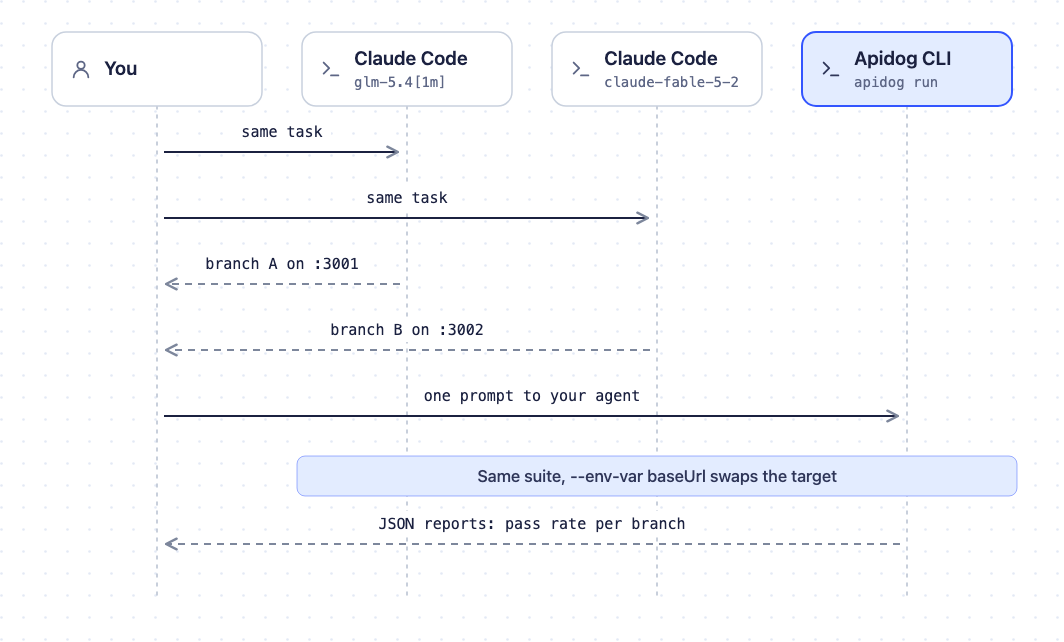
Set up the CLI and its agent skill once:
npm install -g apidog-cli@latest
apidog login --with-token <YOUR_APIDOG_TOKEN>
npx -y skills add https://apidog.com   # pick your agent when prompted
Have each model build the same feature on its own branch, start both servers, then give your agent one prompt:
In Apidog project <projectId>, find the test suite for our orders API
and the local environment. Run the suite twice: once with
baseUrl=http://localhost:3001 (the GLM-5.4 branch) and once with
baseUrl=http://localhost:3002 (the Fable 5.2 branch). Save JSON reports
to referee/ and tell me which branch passed more assertions, and which
failures each branch has that the other doesn't.
The agent finds the suite and environment, then runs the same suite against each branch. Flags come from apidog run --help on CLI 2.2.12:
apidog test-suite list --project <projectId>
apidog environment list --project <projectId>
apidog run --test-suite <suiteId> --project <projectId> -e <envId> \
  --env-var baseUrl=http://localhost:3001 -r cli,json --out-dir referee/glm-5-4
apidog run --test-suite <suiteId> --project <projectId> -e <envId> \
  --env-var baseUrl=http://localhost:3002 -r cli,json --out-dir referee/fable-5-2
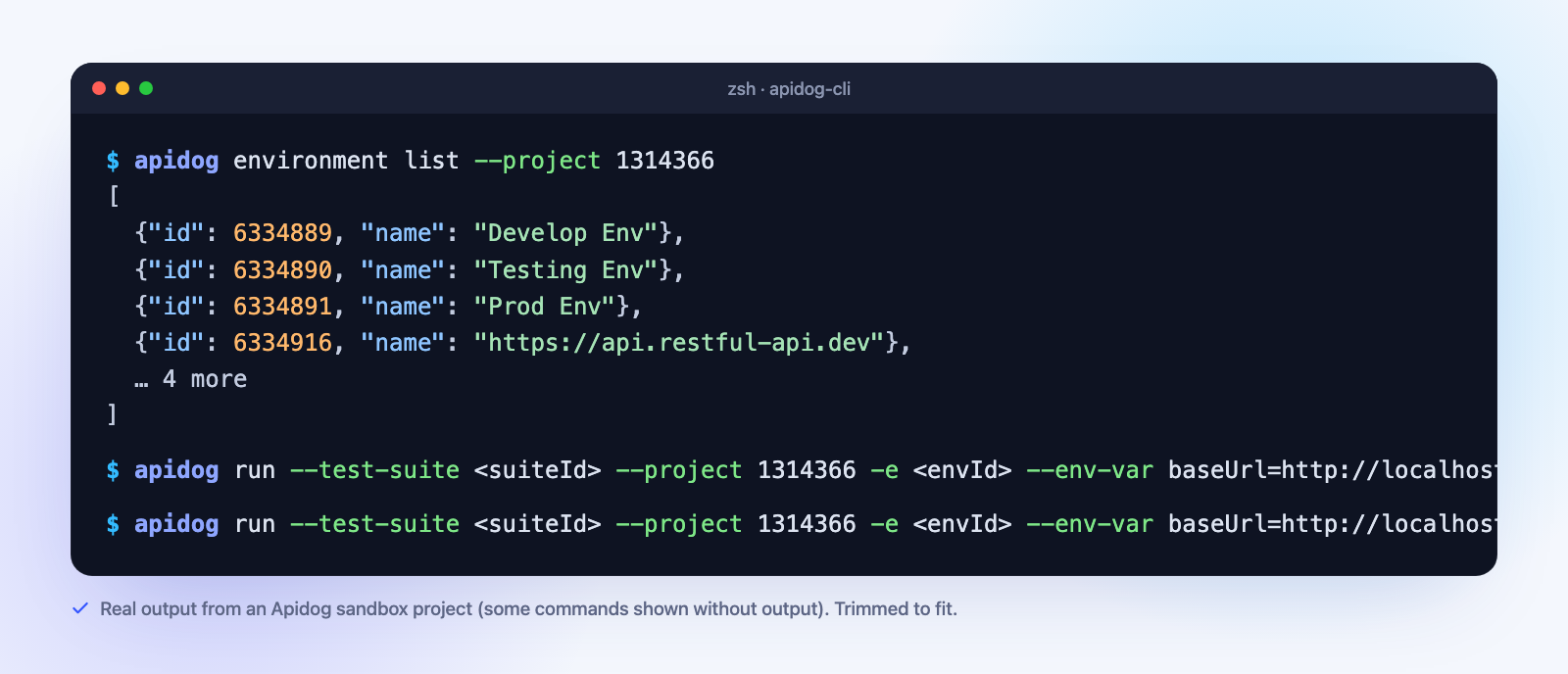
--env-var baseUrl=... swaps the target, so both branches face identical assertions. Add --upload-report to view both runs in the Apidog app, or -r junit to run the same check in CI. Repeat it on 5 to 10 real tasks. The Apidog CLI in Claude Code guide and the apidog run command reference cover the rest. Apidog’s Free plan covers up to 4 users.
FAQ
Is GLM-5.4 better than Claude Fable 5.2 for coding? There’s no public evidence for that yet. Fable 5.2 scores 69.9% on FrontierSWE v2 in Anthropic’s table, while Z.ai hasn’t published a benchmark table for the 750B GLM-5.4.
Is GLM-5.4 cheaper than Claude Fable 5.2? Usually, for agent work inside supported tools. A sample cached session costs $7.77 on Fable 5.2 and about 458 Coding Plan credits on GLM-5.4, so the $18 Lite plan covers roughly 21 such sessions a week at peak.
Can I call GLM-5.4 from my own app? Not yet. The pay-as-you-go Model API opens after Z.ai’s security assessment, and Coding Plan keys are limited to supported coding tools.
Can I use both models in Claude Code? Yes. Fable 5.2 runs natively, and GLM-5.4 runs by pointing ANTHROPIC_BASE_URL at https://api.z.ai/api/anthropic with a Coding Plan key and setting the model to glm-5.4[1m].
Does either model offer open weights? No. Z.ai plans to release GLM-5.4 weights after safety hardening, with no date. Claude Fable 5.2 is closed.