
GLM-5.4 pricing has no per-token API rate yet. As of November 24, 2026, Z.ai sells GLM-5.4 only through the GLM Coding Plan: Lite at $18 a month, Pro at $80 and Max at $168, with 30% off on yearly billing. Inside the plan, GLM-5.4 burns credits at 4.6 per input token, 1.1 per cached token and 16 per output token (divided by 10,000), about a third less than GLM-5.3. If you use a full Max plan, that works out to roughly $0.44 per 1M output tokens at peak hours.
GLM-5.4 pricing at a glance
| Item | GLM-5.4 | Source |
|---|---|---|
| Pay-as-you-go API price | Not published, API not open yet | GLM-5.4 model page |
| How to access it | GLM Coding Plan, in supported coding tools | Coding Plan overview |
| Plan prices (monthly) | Lite $18, Pro $80, Max $168 | Subscribe page |
| Credit multipliers | 4.6 input, 1.1 cached input, 16 output | Coding Plan overview |
| Off-peak discount | 50% of the standard credit rate | Coding Plan overview |
| Context window / max output | 1M / 128K tokens | GLM-5.4 model page |
Every figure was read on Z.ai’s official pages on November 24, 2026.
Is there a GLM-5.4 API price per token?
No. Z.ai’s GLM-5.4 page says “The Model API will be made available upon completion of the security assessment,” and the official pricing page still tops out at GLM-5.3. Until that changes, any per-million-token GLM-5.4 price is a guess.
What you can calculate is the effective cost on the Coding Plan, because Z.ai publishes the plan prices, the credit allowance and the formula that turns tokens into credits. Its Team Plan page also claims off-peak plan use can “save up to 92%” against the GLM-5.4 Standard API, so a list price exists internally. It just isn’t public.
How GLM Coding Plan credits work for GLM-5.4
Every plan gives you two credit buckets: one that refills 5 hours after you spend it, and one that resets every 7 days. Each request draws from both. Z.ai’s formula is:
credits = (input tokens × input multiplier
         + cached input tokens × cached multiplier
         + output tokens × output multiplier) / 10,000
During off-peak hours, model usage costs 50% of that. Peak hours are Monday to Friday, 14:00 to 18:00 Singapore time (UTC+8), which is 06:00 to 10:00 UTC. Everything else, weekends included, is off-peak.
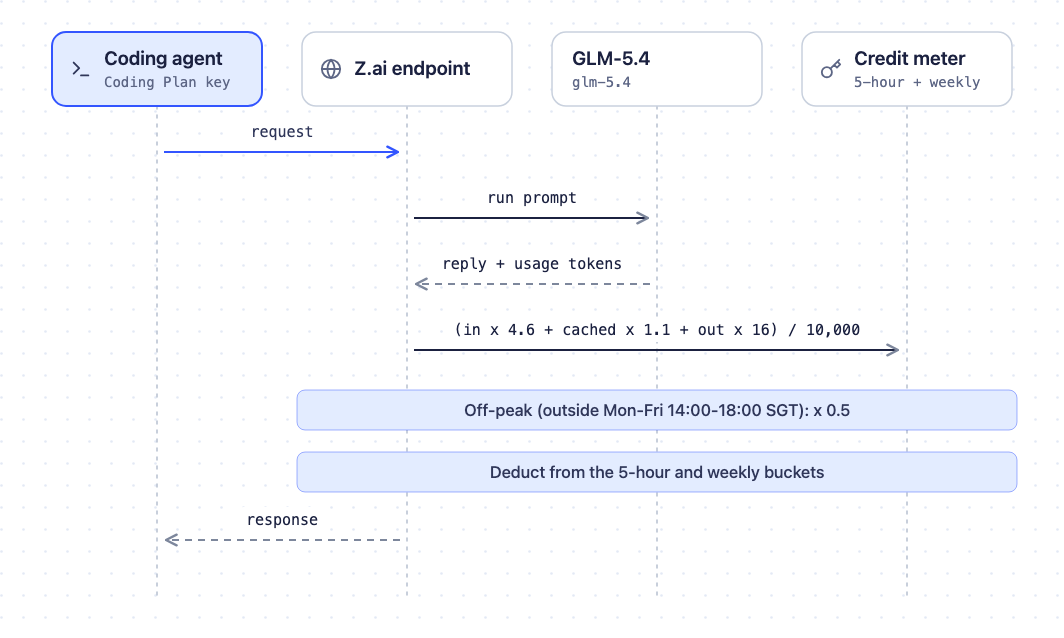
The multipliers decide how fast each model drains your plan:
| Model | Input | Cached input | Output |
|---|---|---|---|
| GLM-5.4 | 4.6 | 1.1 | 16 |
| GLM-5.3 | 6.9 | 1.7 | 24 |
| GLM-5.3-Flash | 2.3 | 0.56 | 8 |
GLM-5.4 costs exactly two thirds of GLM-5.3 on every line, which matches Z.ai’s note that weekly-quota users get 1.5 times as much GLM-5.4 as GLM-5.3. The newer flagship is the cheaper one to run. GLM-5.3-Flash stays at half of GLM-5.4, so it’s still the pick for bulk subtasks. Our GLM-5.3-Flash pricing breakdown covers that model’s API rates.
GLM Coding Plan prices: Lite, Pro and Max
The individual plans differ in price and credit allowance. Pro gives 6 times Lite’s usage and Max gives 14 times:
| Plan | Monthly | Yearly (per month) | 5-hour credits | Weekly credits |
|---|---|---|---|---|
| Lite | $18 | $12.60 | 2,000 | 10,000 |
| Pro | $80 | $56 | 12,000 | 60,000 |
| Max | $168 | $117.60 | 28,000 | 140,000 |
Quarterly billing takes 20% off. Pro adds faster generation; Max adds dedicated resources at peak times. All three include GLM-5.4, GLM-5.3 and GLM-5.3-Flash.
The usage policy says plans aren’t refundable, even unused, and you must cancel at least 3 days before renewal. Start monthly until you know your real usage.
What GLM-5.4 costs per token on the Coding Plan
Here’s the effective rate if you spend every weekly credit. A month averages 4.33 weeks, so Lite gets about 43,300 credits a month, Pro about 260,000 and Max about 607,000. Divide the plan price by those credits, then multiply by GLM-5.4’s credits per million tokens (460 input, 110 cached, 1,600 output).
Effective price per 1M GLM-5.4 tokens, monthly billing, peak hours:
| Plan | Input | Cached input | Output |
|---|---|---|---|
| Lite ($18) | $0.19 | $0.05 | $0.66 |
| Pro ($80) | $0.14 | $0.03 | $0.49 |
| Max ($168) | $0.13 | $0.03 | $0.44 |
Off-peak, every number halves: Max output drops to about $0.22 per 1M tokens. Yearly billing takes another 30% off, which puts Max off-peak output near $0.16.
For scale, GLM-5.3 on the pay-as-you-go API costs $1.40 per 1M input tokens, $0.26 cached and $4.40 output. Even the Lite plan at peak hours charges about a sixth of that for GLM-5.4 output.
These are ceiling-use numbers. Unspent credits vanish at the weekly reset, so using half your allowance doubles your real rate.
Worked example: one coding agent session
Say Claude Code runs a refactor through GLM-5.4: 2M input tokens at a 95% cache hit rate (1.9M cached, 100K fresh) and 40K output tokens, typical of an agent rereading the same repo context each turn.
GLM-5.4 credits:
(100,000 × 4.6 + 1,900,000 × 1.1 + 40,000 × 16) / 10,000
= (460,000 + 2,090,000 + 640,000) / 10,000
= 319 credits (about 160 off-peak)
The same session on GLM-5.3 costs 488 credits. On the GLM-5.3 pay-as-you-go API, it would cost about $0.81.
What that means per plan:
| Plan | Sessions per 5 hours (peak) | Sessions per week (peak) | Sessions per week (off-peak) |
|---|---|---|---|
| Lite | 6 | 31 | 62 |
| Pro | 37 | 188 | 376 |
| Max | 87 | 438 | 877 |
Cached input is the biggest line, not output: 209 of the 319 credits, against 64 for output. A stable prompt prefix matters more than shorter answers. And on Lite, the 5-hour bucket is the real ceiling: six heavy peak sessions and you wait for the refill.
GLM-5.4 vs GLM-5.3 pricing
| GLM-5.4 | GLM-5.3 | |
|---|---|---|
| Pay-as-you-go API | Not open | $1.40 input, $0.26 cached, $4.40 output per 1M |
| Coding Plan multipliers | 4.6 / 1.1 / 16 | 6.9 / 1.7 / 24 |
| Weekly quota on the plan | 1.5 times GLM-5.3 | Baseline |
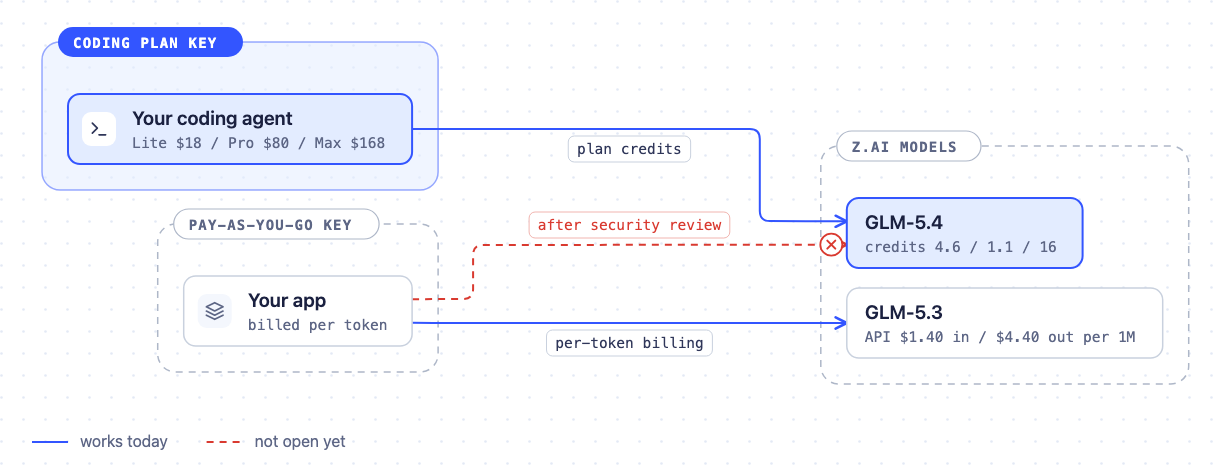
If you already call GLM-5.3 in production, our GLM-5.3 API guide covers that setup. The choice is simple today. For your own coding agent work, GLM-5.4 on the Coding Plan is cheaper per credit than GLM-5.3 and is the newer model. For anything you ship to customers, you can’t use GLM-5.4 yet: the usage policy limits the plan to “officially supported tools and products,” and repeat violations can lead to rate limits, a frozen account or a ban. Production apps stay on the GLM-5.3 API until the GLM-5.4 Model API opens.
GLM-5.4 may also spend fewer tokens per answer: Z.ai reports 10% to 14% shorter outputs on a 30B looped test model. It also warns about “marathon thinking” loops, so measure before you count on savings.
How to cut your GLM-5.4 bill
- Run long jobs off-peak. Anything outside weekdays 14:00 to 18:00 SGT costs half.
- Protect your cache hit rate. Z.ai’s allowance table assumes 95% to 98% cache hits.
- Route subtasks to GLM-5.3-Flash. Half GLM-5.4’s multipliers, fine for search, summaries and simple edits.
- Pay yearly only after a month of data. The 30% discount is real; refunds aren’t.
- Watch the
usageobject. Every response returnsprompt_tokens,completion_tokensandprompt_tokens_details.cached_tokens, which is all you need to compute credits per call.
Let your coding agent track token cost with Apidog CLI
You can’t budget a model you don’t measure. Have your coding agent build a cost check with Apidog CLI: a test that calls the model, asserts the usage fields, and logs the token counts for the credit formula. Run it on GLM-5.3 with a standard API key today, then switch one variable when GLM-5.4’s Model API opens.
Install the CLI and the agent skill once:
npm install -g apidog-cli@latest
apidog login --with-token <YOUR_TOKEN>
npx -y skills add https://apidog.com   # pick your agent when prompted
Then give your agent one prompt:
In Apidog project <projectId>, create a test case for POST https://api.z.ai/api/paas/v4/chat/completions
using my ZAI_API_KEY environment variable and the {{model}} variable. Assert a 200 status and that
usage.prompt_tokens, usage.completion_tokens and usage.prompt_tokens_details.cached_tokens are numbers.
Run it 5 times with model=glm-5.3 and report the token counts per run.
The agent finds your environment, checks the payload schema, writes the case and runs it:
apidog environment list --project <projectId>
apidog cli-schema get test-case-create
apidog cli-schema validate test-case-create --file case.json
apidog test-case create --project <projectId> --file case.json
apidog run --test-case <id> --project <projectId> -e <envId> --env-var model=glm-5.3 -n 5 -r json
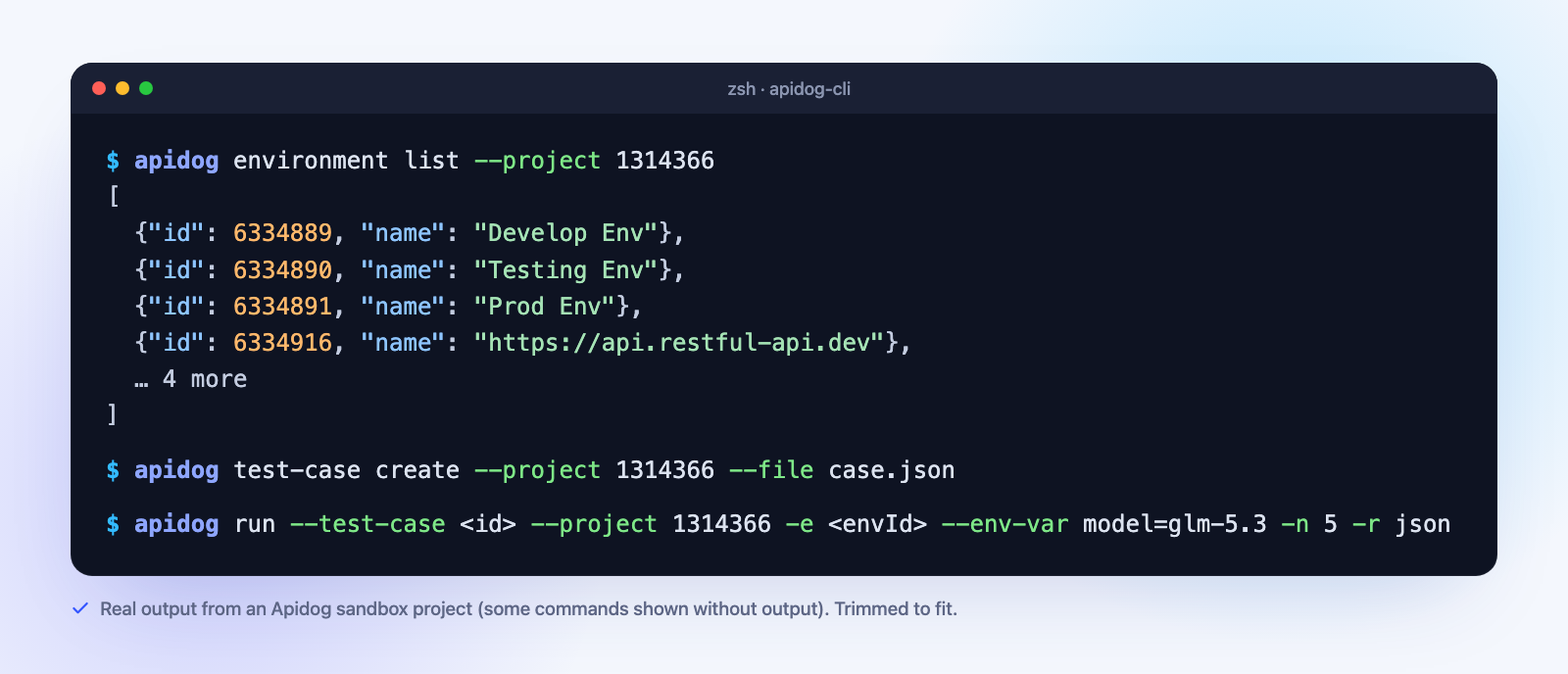
The JSON report gives you real token counts per call, so you can multiply them by 4.6, 1.1 and 16 and know your GLM-5.4 credit cost before you commit to a tier. When the GLM-5.4 API opens, rerun with --env-var model=glm-5.4 and compare. The apidog run command reference lists every flag, and Apidog CLI in Claude Code walks through the agent setup. Apidog is free for teams of up to 4 users.
Conclusion
GLM-5.4 pricing today is plan pricing: $18, $80 or $168 a month, at a credit rate a third below GLM-5.3. Used fully, that’s under $1 per million output tokens on any tier, half that off-peak, but only for your own agent work in supported tools. Pick the smallest tier that fits your 5-hour peaks, and keep a cost test ready for the Model API.
FAQ
How much does GLM-5.4 cost per 1M tokens?
There’s no official per-token API price yet. On the Coding Plan, fully used, GLM-5.4 works out to about $0.13 to $0.19 per 1M input tokens and $0.44 to $0.66 per 1M output tokens at peak hours, depending on the tier, and half that off-peak.
Is GLM-5.4 cheaper than GLM-5.3?
Yes, on the Coding Plan. Its credit multipliers (4.6, 1.1, 16) are two thirds of GLM-5.3’s (6.9, 1.7, 24), so the same work uses a third fewer credits.
Can I use GLM-5.4 for free?
Not as of November 24, 2026. The cheapest route is the Lite plan at $18 a month, or $12.60 a month billed yearly. Z.ai’s free GLM-4.7-Flash and GLM-4.5-Flash models are older and are not GLM-5.4.
When will the GLM-5.4 API be available?
Z.ai says the Model API opens “upon completion of the security assessment” and hasn’t given a date. Watch the pricing page for the first official rate.
Can I use my Coding Plan key in a production app?
No. Z.ai’s usage policy limits the plan to officially supported tools and products, and repeat violations can lead to rate limits or a ban. Use the pay-as-you-go API for anything you ship.