Three frontier-class releases shipped in the last 33 days. Anthropic’s Claude Opus 4.7 landed April 16. OpenAI’s GPT-5.5 followed April 23. Google’s Gemini 3.5 Flash shipped May 19, with Pro arriving in June.
Worth saying upfront: this is a tier-mismatched comparison. Opus 4.7 and GPT-5.5 are flagship models with flagship price tags. Flash is Google’s fast, low-cost variant, priced at a fraction of either. The interesting question is whether Flash holds up when you put it next to models that cost 5–10× more per token.
The short answer: Flash punches well above its tier. It wins on cost, speed, and several agentic benchmarks. It loses on the hardest coding tasks and writing quality. The trick is matching the model to the workload.
The 30-second answer
| Question | Best pick |
|---|---|
| Cheapest production agent loop | Gemini 3.5 Flash |
| Highest score on SWE-Bench Verified bug fixes | Opus 4.7 |
| Most token-efficient at scale | GPT-5.5 |
| Best long-context retrieval (1M tokens) | Gemini 3.5 Flash |
| Best chart and document understanding | Gemini 3.5 Flash |
| Best long-horizon CLI agent | GPT-5.5 (Terminal-Bench 2.0) |
| Best multi-step instruction following | Opus 4.7 |
| Fastest token output | Gemini 3.5 Flash (~4× others) |
| Best repo-wide code refactor | Opus 4.7 |
There’s no single winner. Read on for the workload-by-workload breakdown.
Release timeline
The models shipped close together but with different positioning:
- Opus 4.7, April 16, 2026. Anthropic’s flagship reasoning model, optimized for code and extended multi-step work. Flagship tier.
- GPT-5.5, April 23, 2026. OpenAI’s first fully retrained base model since GPT-4.5. Focus: agentic efficiency and token-cost reduction. Flagship tier.
- Gemini 3.5 Flash, May 19, 2026. Google’s fast variant of the 3.5 family. Focus: agentic execution at low cost and high speed. Mid tier. Gemini 3.5 Pro (flagship tier) ships June 2026.
Each release is a step up from a predecessor that didn’t quite close the gap on production-scale agent work. See our earlier Cursor Composer 2.5 vs Opus 4.7 vs GPT-5.5 piece for the coding-tool angle, and our Gemini 3.1 Pro vs Opus 4.6 vs GPT-5.3 post for how the previous generation stacked up.
Pricing comparison
This is where the tier mismatch is most visible:
| Model | Input ($/1M) | Output ($/1M) | Notes |
|---|---|---|---|
| Gemini 3.5 Flash | ~$1.50 | ~$9.00 | Free tier available |
| GPT-5.5 | ~$10 | ~$30 | Cached input cheaper |
| Claude Opus 4.7 | ~$15 | ~$75 | Highest list price |
Per-token, Flash is 6–10× cheaper on input and 3–8× cheaper on output. For full price math including batch mode and Vertex AI, see the Gemini 3.5 Flash pricing breakdown. For GPT-5.5 details, see GPT-5.5 pricing.
For agentic workloads where the model runs hundreds of turns per task, the cost gap compounds. Google’s “less than half the cost of other frontier models” claim is a flagship-vs-flagship comparison; Flash specifically lands well below half.
Token efficiency tilts the math the other way. GPT-5.5 produces noticeably fewer output tokens for the same task, sometimes 72% less than Opus 4.7. That partially closes the per-task gap even though the per-token rate is higher.
Coding benchmarks
Coding is where the three models trade blows most visibly.
SWE-Bench Verified (single-issue bug fixes)
| Model | Score |
|---|---|
| Opus 4.7 | 87.6% |
| GPT-5.5 | ~85% |
| Gemini 3.5 Flash | Not separately reported |
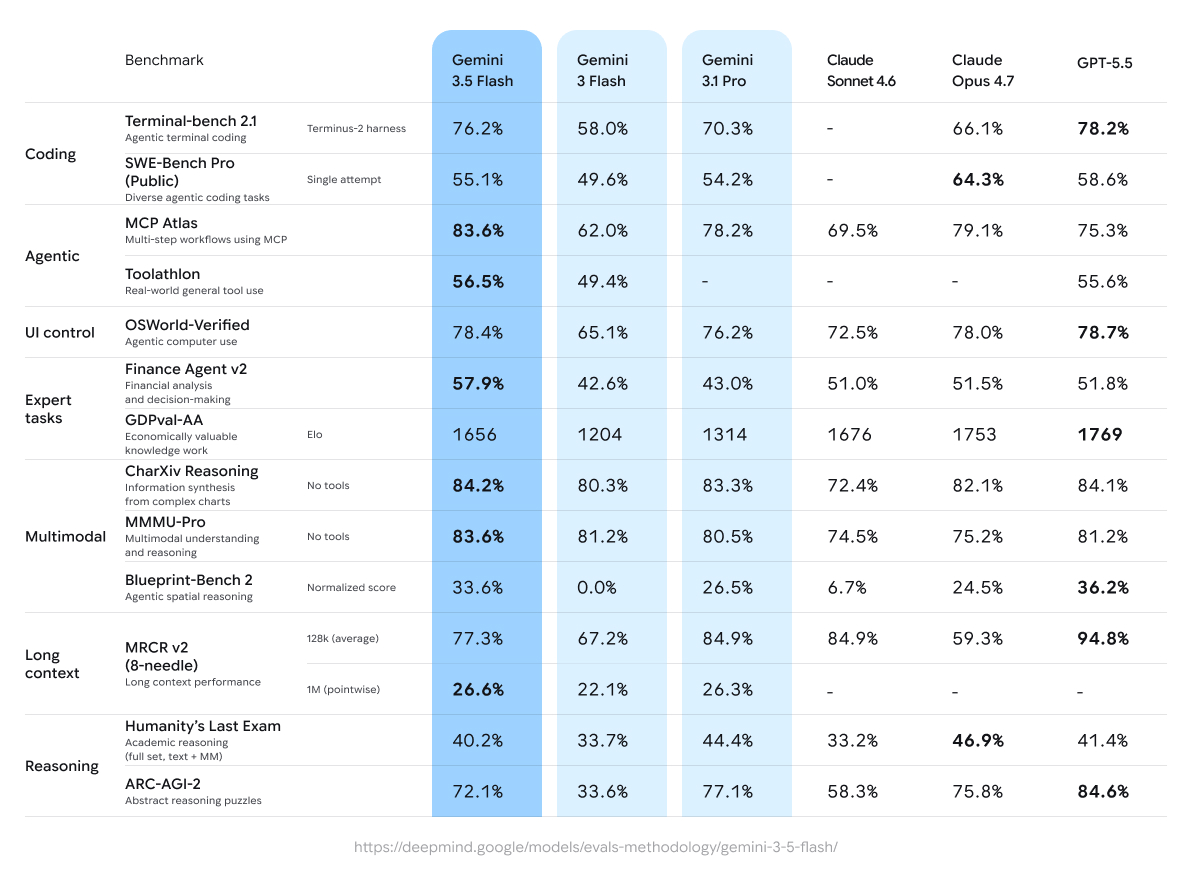
Opus 4.7 still leads on isolated bug-fix benchmarks. The gap to GPT-5.5 is a few percentage points, which means for most one-shot coding tasks both feel competitive. Flash doesn’t publish a comparable number, but informal testing suggests it lands below both flagships on pure SWE-Bench Verified, which is expected for a fast-tier model.
SWE-Bench Pro (multi-file complex fixes)
| Model | Score |
|---|---|
| Opus 4.7 | 64.3% |
| GPT-5.5 | 58.6% |
| Gemini 3.5 Flash | Not separately reported |
Multi-file refactors are Opus 4.7’s strongest suit. If your daily driver is a Cursor Composer or Claude Code workflow doing real-world refactors across a repo, Opus is the safer default. Flash will get you most of the way for routine changes at a fraction of the cost.
Terminal-Bench 2.0/2.1 (CLI agent loops)
| Model | Score | Benchmark |
|---|---|---|
| GPT-5.5 | 82.7% | Terminal-Bench 2.0 |
| Gemini 3.5 Flash | 76.2% | Terminal-Bench 2.1 |
| Opus 4.7 | 69.4% | Terminal-Bench 2.0 |
Two different scoreboards, 2.0 and 2.1 use different task mixes. The takeaway: Flash and GPT-5.5 both pull ahead of Opus on long CLI agent runs. GPT-5.5 still leads here, but Flash has closed most of the gap, while costing far less.
MCP Atlas (multi-tool coordination)
Gemini 3.5 Flash: 83.6%. Google’s headline metric for agentic tool use. OpenAI and Anthropic haven’t published comparable numbers on the same benchmark, which makes direct comparison hard. Anecdotally, all three are credible on tool-call workloads in 2026.
Agentic and long-horizon work
For tasks that run for tens of minutes to hours without supervision:
- Gemini 3.5 Flash: wins on price-per-task and output speed. The MCP Atlas score (83.6%) and Terminal-Bench 2.1 (76.2%) point to consistent tool-use behavior. Subagent dispatch is first-class.
- GPT-5.5: wins on Terminal-Bench 2.0 (82.7%) and on token efficiency. Fewer output tokens per task means lower variance and lower cost overruns.
- Opus 4.7: wins on multi-step instruction following and code quality. Loses on speed and price for very long runs because of verbose, narrative-style output.
If you’re spinning up agents that run continuously like in the /goal command pattern with Codex and Claude Code, the economics matter. Flash wins on cost; Opus wins on output quality per turn; GPT-5.5 wins on token discipline.
Context window and long-context retrieval
| Model | Max input | Max output |
|---|---|---|
| Gemini 3.5 Flash | 1M tokens | 64K tokens |
| GPT-5.5 | 400K tokens | 128K tokens |
| Opus 4.7 | 1M tokens (beta) | 64K tokens |
Flash leads Google’s published table on the 1M token MRCR v2 retrieval benchmark. That makes Flash the cleanest pick when the task is “find the right answer in a 200-page PDF” without chunking strategies, especially given its price tier.
Opus 4.7 matches on raw window size but trails on retrieval consistency at the high end. GPT-5.5’s 400K is generous but loses to Flash for raw scale.
For document-heavy workflows, long reports, full codebases, multi-document analysis, Flash is the practical default.
Multimodal
Flash leads on chart and document reasoning:
- CharXiv Reasoning: 84.2% (Gemini 3.5 Flash)
- MMMU-Pro: 83.6% (Gemini 3.5 Flash)
OpenAI and Anthropic both support image input on their flagships, but neither matches Flash’s chart-reasoning score on launch day. For visual analytics, PDF extraction, or workflows that mix text and screenshots, Flash is the clear pick.
If you’re routing image generation as part of the pipeline, see our take on Gemini 3 Pro Image vs Seedream for model selection on that side.
Output speed
Tokens per second matters when users wait for streaming output.
| Model | Relative output speed |
|---|---|
| Gemini 3.5 Flash | ~4× baseline |
| GPT-5.5 | baseline |
| Opus 4.7 | ~0.7× baseline |
Numbers vary by region and load. Direction is consistent: Flash streams visibly faster than both flagships. For chat UIs and live coding assistants, the perceived-quality bump from instant streaming is real.
Reasoning, math, and science
| Benchmark | Flash | GPT-5.5 | Opus 4.7 |
|---|---|---|---|
| GPQA Diamond | Strong (per Google’s table) | High | High |
| Math reasoning | Strong | Strong | Strong |
| Long-form writing | Good | Good | Best |
This row is close at the top of the leaderboard, but with a caveat: Flash holds its own here despite being a fast-tier model. Opus still has the strongest narrative writing voice. The other two have caught up on raw reasoning.
Tool ecosystem and integrations
- Opus 4.7: Claude Code, MCP, Anthropic API, mature tool ecosystem, Bitwarden Agent and broad IDE support
- GPT-5.5: OpenAI Codex, Responses API, ChatGPT app integration. Function calling has the longest track record
- Gemini 3.5 Flash: Antigravity, Gemini Enterprise Agent Platform, Gemini CLI, Android Studio integration, growing fast
Anthropic has the deepest third-party adapter ecosystem. OpenAI has the broadest developer adoption. Google is catching up rapidly with Antigravity and Agent Platform but starts from a smaller third-party base.
When to pick which model
Skip the benchmarks for a minute and look at workloads.
Pick Gemini 3.5 Flash when:
- You’re on a tight per-task budget
- Output speed in a streaming UI matters
- You’re processing long documents (1M tokens)
- The task involves charts, PDFs, screenshots
- You want a credible agent loop at the lowest price tier
- You’re already in the Google Cloud or Workspace ecosystem
- The workload is high-volume and “good enough” beats “perfect”
Pick GPT-5.5 when:
- Token efficiency is the priority (you pay per million)
- The task is CLI-driven agent work (Terminal-Bench leader)
- You want the broadest third-party tool adapter library
- ChatGPT is already in your team’s flow
- See full setup in How to use GPT-5.5 API
Pick Opus 4.7 when:
- The task is multi-file code refactoring or repo-wide changes (SWE-Bench Pro leader)
- Quality of multi-step instruction following matters more than speed
- Long-form writing or careful narrative output is the deliverable
- You’re already on Claude Code with the Claude plan
- Per-task cost is not the binding constraint
Pick a blend when:
Most production stacks end up running two of these. Common patterns:
- Flash for retrieval and prep, Opus for the final commit: cheap context-heavy work feeds the expensive model the right inputs
- GPT-5.5 for CLI agent loops, Flash for chart/document analysis: each does what it’s best at
- Flash for 80% of traffic, Opus or GPT-5.5 for the hard 20%: route by task complexity
- All three behind a cheap router that picks based on task type
Free-tier comparison
All three have a free path:
- Gemini 3.5 Flash: AI Studio API key, ~1,500 requests/day. See our Flash free guide
- GPT-5.5: limited free queries in ChatGPT, plus gateways covered in GPT-5.5 free guide
- Opus 4.7: Claude.ai daily limit, plus free paths in our Opus 4.7 free guide
Of the three, Flash’s free API path is the most builder-friendly. AI Studio gives you a working key with no credit card and useful daily quotas.
How to actually test these against your own workload
Benchmarks tell you what the model can do on average. Your workload is what matters. Build a small eval harness:
- Pick 20 representative tasks from your actual use case
- Run all three models against each task
- Score on three dimensions: task success, total cost, latency
- Watch for failure modes specific to your workload, refusals, schema drift, tool-call shape changes
This is where Apidog helps. You save the three API endpoints (Gemini, OpenAI, Anthropic) as parameterized requests, store keys as environment variables, and run the same prompt across all three with one click. The responses come back into Apidog’s test framework where you can compare them side by side.
Practical setup:
- Download Apidog
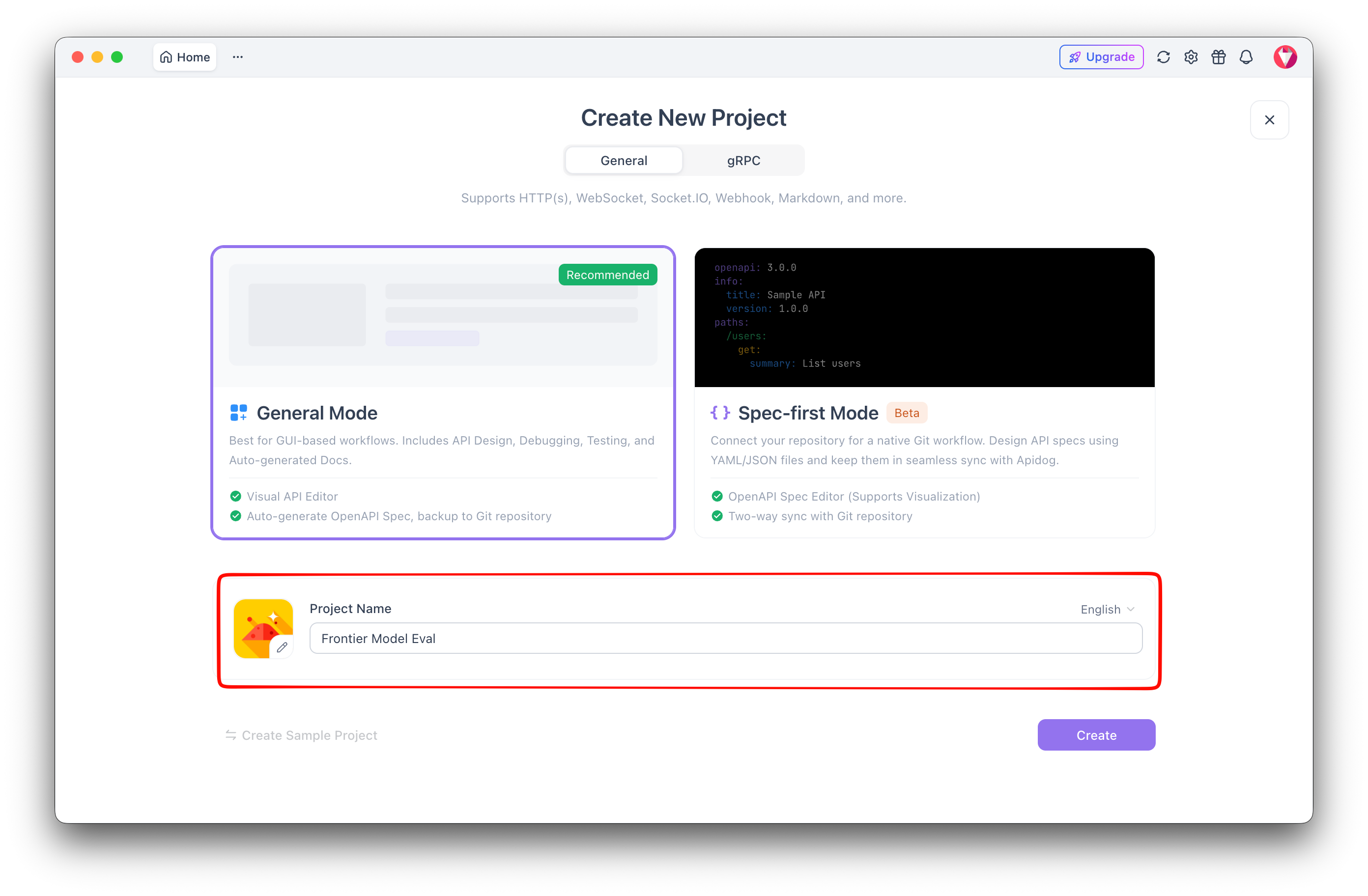
- Create a workspace named “Frontier Model Eval”
- Save three requests, one per provider (Flash, GPT-5.5, Opus 4.7)
- Build a test scenario that runs the same prompt against all three
- Add response assertions (JSON shape, must-include strings, latency thresholds)
- Run the scenario weekly to catch model drift
Two days of setup beats three months of debating which model “feels” better.
What changes next
Three things to watch over the next 90 days:
- Gemini 3.5 Pro GA. Once Pro lands in June, the comparison changes. Flash will still hold the cost/speed corner, but Pro will be the apples-to-apples flagship match for Opus and GPT-5.5.
- OpenAI’s response. GPT-5.5 was an April release. A mid-cycle update or new variant is likely if Gemini 3.5 Pro lands hard.
- Anthropic’s next move. Opus 4.7 is the current Anthropic flagship. A Sonnet refresh or Opus 4.8 in the next quarter would be on cycle.
This space moves monthly now. The smart play is to keep your eval harness running, switch when the numbers move, and never get locked into a single provider’s tooling.
FAQ
Is Gemini 3.5 Flash really competitive with Opus 4.7 and GPT-5.5? Yes, in its tier. Flash punches above its weight class on agentic benchmarks and dominates on cost. For the absolute hardest tasks (complex multi-file refactors, careful long-form writing), the flagships still lead.
Why compare a fast-tier model to flagships? Because the cost gap is so large that many production workloads should be running on Flash even when a flagship would do the task marginally better. The honest question is “is Flash good enough for this workload?” not “is Flash the best at everything?”
Is Opus 4.7 worth the higher price? For workloads where quality of code or writing per turn matters most, yes. For high-volume agent loops where you’re running thousands of turns, the per-task math favors Flash.
Can I use all three through one API? Not directly. Each provider has its own endpoint. OpenAI’s OpenAI-compatible mode is supported by Google (a shim), but you’ll still maintain three sets of credentials. The cleanest pattern is to abstract the model call behind your own thin wrapper.
When does Gemini 3.5 Pro ship? June 2026. That’ll be the flagship-tier match for Opus and GPT-5.5. Until then, Flash is the 3.5 family’s only option.
How do I monitor cost when running three providers? Track per-model spend in Apidog’s request history, or roll up your provider dashboards. Set per-model budget alerts to avoid surprises during testing.
Bottom line
Three credible models, three different sweet spots.
- Gemini 3.5 Flash for cheap, fast, multimodal, long-context work, and a remarkable amount of the agentic workload that used to demand a flagship
- GPT-5.5 for token-efficient, CLI-heavy agent automation
- Opus 4.7 for high-quality code refactors and long-form writing
Build your own eval. Test against your real workload. Switch when the numbers move. That’s the only honest answer in a market where the leader changes monthly. And keep an eye on June: Gemini 3.5 Pro will reshape this matchup.