
On June 9, 2026, Anthropic launched two models that look like a riddle: Claude Fable 5 vs Claude Mythos 5. The names sound like two products, but they share the same underlying model. The difference is not raw capability. It is the safety posture wrapped around that capability. Fable 5 is the public, safeguarded version you can call through the Claude API. Mythos 5 is the same brain with some safeguards lifted, handed to a small set of trusted partners. If you have been squinting at the announcement trying to figure out which one you actually get, this guide clears it up.
The short answer: you almost certainly use Fable 5, and you almost certainly cannot use Mythos 5. But the reasons behind that split are worth understanding, because they tell you how Anthropic is thinking about capable models and where the guardrails sit. Let’s get into the details.
TL;DR
Claude Fable 5 and Claude Mythos 5 are the same underlying model. Fable 5 is the safe, public face: it ships with safeguards and is available on the API and subscription plans. Mythos 5 is the same model with safeguards lifted in some areas, restricted to a small trusted group. Pricing is identical at $10 per million input tokens and $50 per million output tokens.
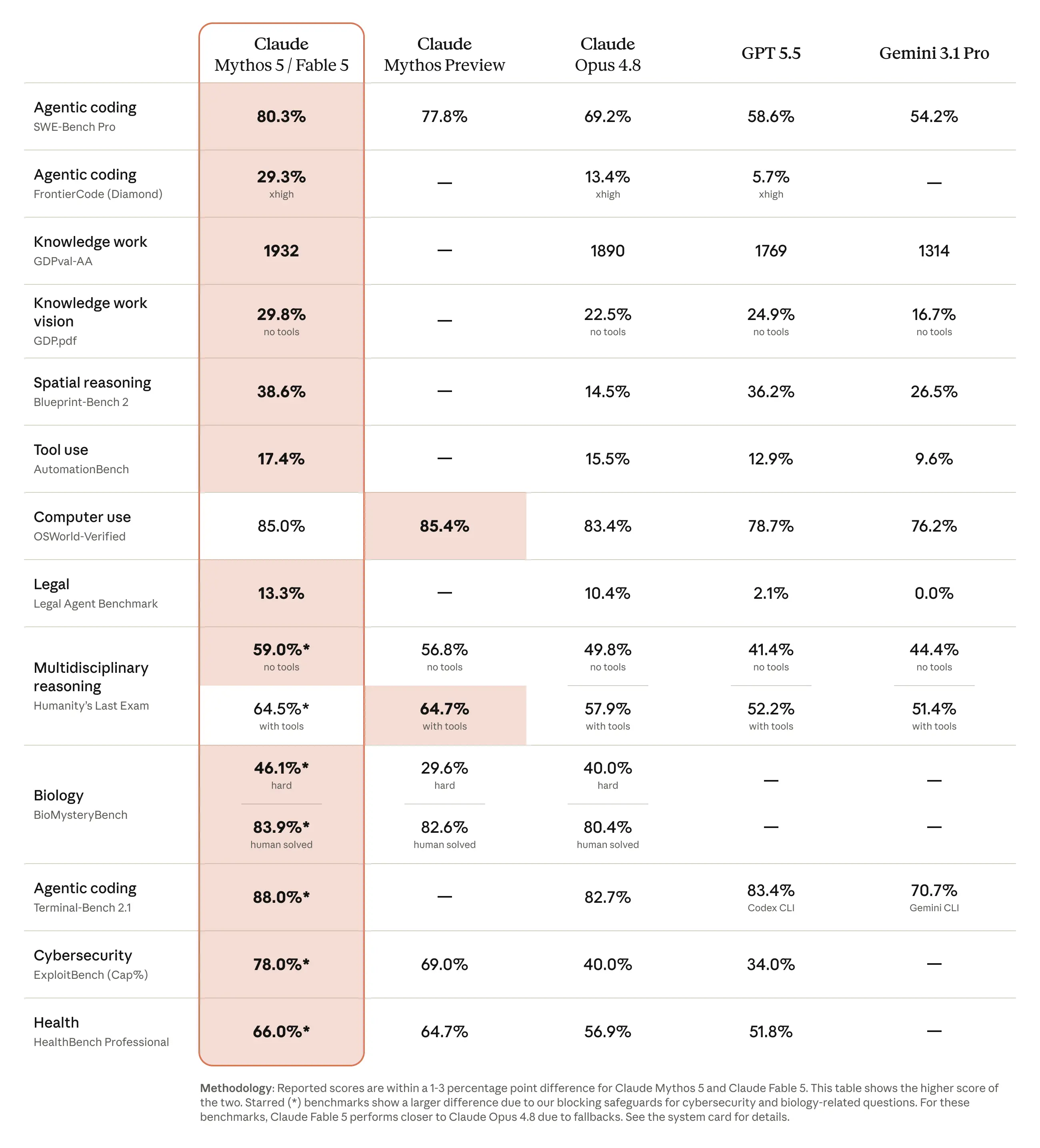
Same model, two safety tiers
Here is the core idea, and once it clicks the rest of the article follows naturally. Fable 5 and Mythos 5 are not two different models. They are one model with two different safety configurations.
Anthropic describes the capability level of this underlying model as “Mythos-class.” That phrase refers to the tier of ability the model sits at, not to a separate product. When you read “Mythos-class,” think of it as a label for how capable the shared base is. Both Fable 5 and Mythos 5 inherit that same capability tier. You can read more in our breakdown of what Mythos-class means.
So if the brains are identical, what separates the two names? Safeguards.
- Claude Fable 5 is the Mythos-class model made safe for general use. It is public. It ships with built-in protections in three sensitive areas. Anyone can reach it through the Claude API or on a subscription plan.
- Claude Mythos 5 is the same Mythos-class model with those safeguards lifted in some areas. It is not public. It goes only to a small group of vetted partners through specific programs.
That is the whole distinction. One model, two postures. Fable 5 trades a sliver of capability in narrow, high-risk domains for broad, safe availability. Mythos 5 keeps the full range of the model but stays locked behind trusted-access programs. Neither one is “better” in a general sense. They are tuned for different users and different risk profiles.
Claude Fable 5 vs Mythos 5
Here is the side-by-side. This table is the fastest way to see the split at a glance.
| Dimension | Claude Fable 5 | Claude Mythos 5 |
|---|---|---|
| Underlying model | Mythos-class (shared) | Mythos-class (shared) |
| Availability | Public | Not public |
| Safeguards | Built in, active in 3 sensitive areas | Lifted in some areas |
| Who can use it | Anyone (API + subscription plans) | A small, vetted group |
| Access route | Claude API (claude-fable-5), subscriptions |
Project Glasswing and trusted-access programs |
| Sign-up | Open and public | No public sign-up |
| Price (input) | $10 per million tokens | $10 per million tokens |
| Price (output) | $50 per million tokens | $50 per million tokens |
Read the table top to bottom and the pattern is clear. Everything about the model itself is shared. Everything about who reaches it and under what protections is different. Pricing does not move at all. For a deeper look at the public side, see our notes on Claude Fable 5 pricing.
How Fable 5’s safeguards work
This is the part that surprises people, so it is worth slowing down on. Fable 5’s safeguards are not a blanket filter that dumbs the model down. They are targeted, and they fire rarely.
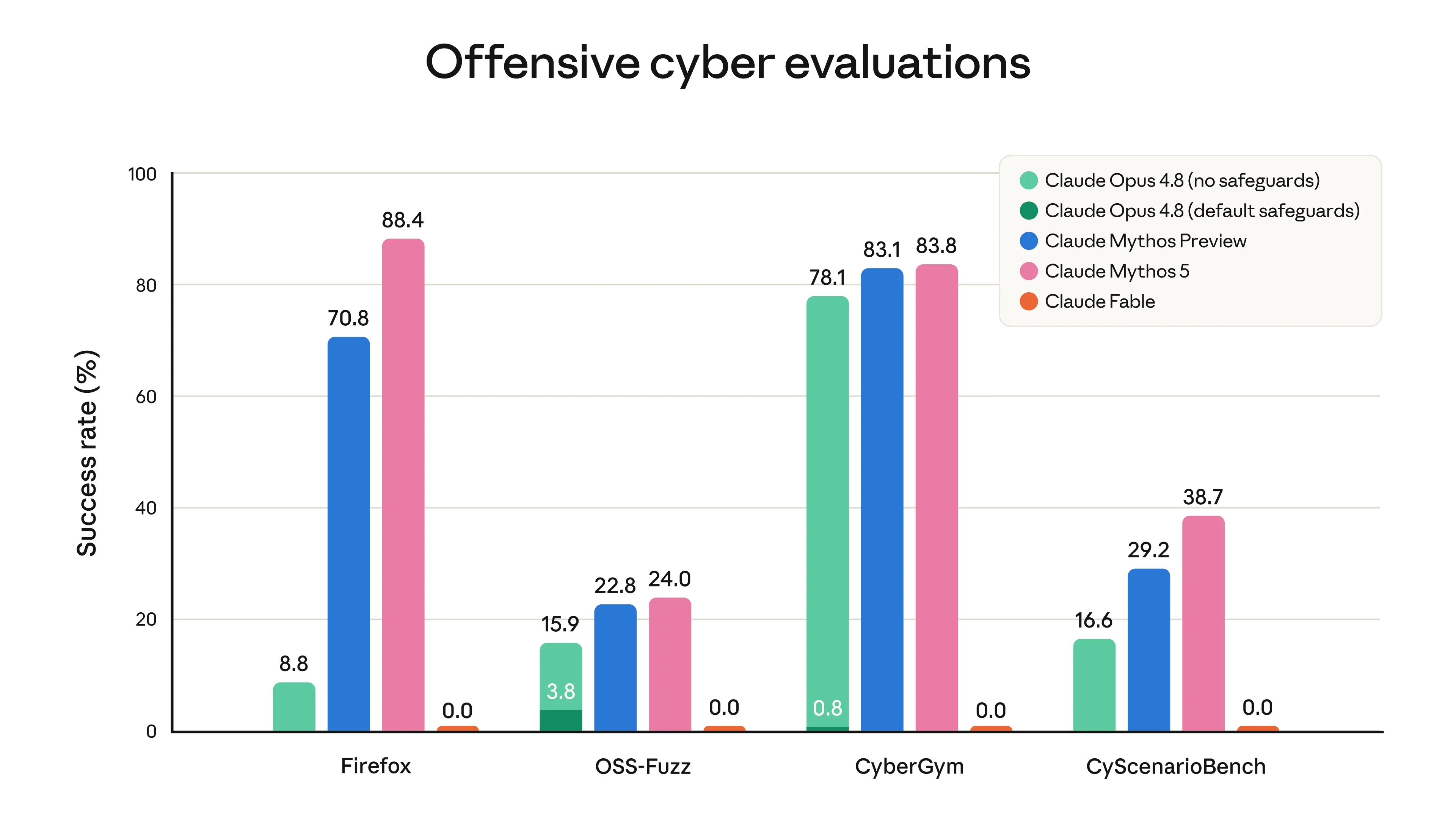
When a query touches one of three sensitive areas, Fable 5 does not answer with the full Mythos-class model. Instead, it routes that specific query to Claude Opus 4.8, an earlier and well-understood model with its own safety record. The full model handles everything else. If you want background on the model doing the catching, we have a primer on what Claude Opus 4.8 is.
The three protected areas are:
- Cybersecurity. This covers exploit development, offensive cyber operations, and agentic hacking. Requests that look like building attack tooling get routed away from the full model.
- Biology and chemistry. This covers high-risk biological and chemical work, including things like AAV design and bioweapons-related requests.
- Distillation. This covers attempts to extract the model in order to train competing models. It protects the model itself from being copied through its outputs.
The routing is narrow by design. Anthropic reports that these safeguards trigger in less than 5 percent of sessions on average. For the other 95 percent and up, you are talking to the full Mythos-class model with no detour. So when people worry that Fable 5 is a watered-down product, the numbers say otherwise. The safe version and the unsafe version are the same model for nearly everything you would actually send.
It is also worth noting that the cyber safeguards held up under outside scrutiny. An external partner that tested Fable 5 found its cyber safeguards among the most resilient they had evaluated. That is a meaningful signal: the routing is not a token gesture, it is a tested control. You can read more about the protections in our overview of Fable 5’s safety safeguards.
To be precise about why this design works: routing sensitive queries to Opus 4.8 means the most capable answers in those three domains simply are not available through the public model. The full Mythos-class capability in cyber, bio/chem, and distillation lives only in Mythos 5, behind access controls. That is the trade Anthropic made, and it is the same trade that defines the whole Fable/Mythos split.
What Mythos 5 unlocks and who gets it
Mythos 5 is the version with safeguards lifted. The obvious question is: lifted for whom, and why?
Anthropic is distributing Mythos 5 through controlled programs, not through a public endpoint. There is no sign-up page. Here is what is known about the rollout.
Project Glasswing. This is a collaboration with the US government. Through it, Mythos 5 reaches cyberdefenders and infrastructure providers with the cyber safeguards lifted. The logic is defensive: the people protecting networks and critical infrastructure benefit from the full cyber capability that the public model routes away. Lifting the cyber safeguard for vetted defenders is meant to put the strongest version of the model on the defensive side of the ledger.
Biology researchers, soon. Anthropic has said biology researchers will get Mythos 5 with the biology and chemistry safeguards removed. Note the boundary here: for that group, the cyber protections stay on. The lifting is scoped to the domain the researcher actually works in, not a blanket removal of every guardrail. That scoping is a recurring theme. Mythos 5 is not “the model with no rules.” It is the model with specific, domain-matched safeguards lifted for specific, vetted users.
A broader trusted-access program. Anthropic has signaled that a wider trusted-access program is planned. The details are not public. What is clear is that access stays gated and granted, not open and self-serve.
Existing Mythos Preview users. If you were already using Claude Mythos Preview, you can upgrade to Mythos 5. That is the one path that does not require entering a new program, and it only applies to people who were already inside the preview.
Put plainly: most readers cannot get Mythos 5. There is no public sign-up, and the programs that grant it are aimed at cyberdefenders, infrastructure operators, vetted researchers, and existing preview users. If you are a general developer building a product, Mythos 5 is not on your menu, and that is by design.
Why Anthropic split them this way
The split comes down to a tension every capable-model release has to manage: utility versus safety. A more capable model is more useful and, in narrow domains, more dangerous. Anthropic’s answer was to stop treating that as a single dial and instead ship two configurations of one model.
Fable 5 maximizes safe reach. By routing only the three sensitive categories to Opus 4.8, Anthropic can hand the full Mythos-class model to the public for nearly everything while keeping the highest-risk capabilities off the open API. The cost is small for ordinary users (under 5 percent of sessions) and the safety benefit is concentrated exactly where the risk is.
Mythos 5 preserves full capability for cases where the safe routing would block legitimate, high-value work. Defensive cyber is the clearest example. A cyberdefender protecting infrastructure needs the model’s full cyber reasoning, and routing those queries away would blunt the defense. So Anthropic lifts that specific safeguard, but only for vetted defenders through Project Glasswing, and only for the domain they operate in. The same scoping applies to biology researchers, who get the bio/chem safeguard lifted while cyber stays locked.
This is a defensible structure whatever your view on AI policy. The capability is the same; what changes is who is trusted with which guardrails removed, and that trust is granted through named programs rather than assumed. You can read Anthropic’s own framing in the Claude Fable 5 and Mythos 5 announcement and in their broader safety and responsible scaling writing. We are staying neutral here and reporting the design, not endorsing or critiquing the policy.
What this means for everyday developers
If you build with Claude, here is the practical reality.
You use Fable 5. The API model id is claude-fable-5. That string is what goes in your request body. You do not need to think about Mythos 5 at all, because there is no public way to call it. There is no claude-mythos-5 endpoint waiting for you to find the right plan. Mythos 5 is not something you can invoke.
For nearly everything you build, this changes nothing about your experience. Code generation, refactoring, data extraction, summarization, agent loops, and tool use all run on the full Mythos-class model. The only time you would notice the safeguard is if you sent a request that lands in cybersecurity exploit territory, high-risk bio/chem, or model distillation, and even then the model still answers, only via Opus 4.8 for that query. Under 5 percent of sessions hit that path.
When you wire up Fable 5, treat it like any other capable Claude model. Set your model id to claude-fable-5, budget against the $10 input and $50 output per-million pricing, and test your prompts before you ship. For the API plumbing and request structure, our Claude Opus 4.8 API guide walks through patterns that carry straight over to Fable 5, since the request shape is the same across these models.
Testing is where a dedicated API client earns its keep. When you are validating Fable 5 responses, comparing prompts, or checking how the model behaves at the edges of those safeguarded domains, you want to fire requests fast and inspect every field of the response. Apidog lets you send requests to the Claude API, save them into collections, and document the exact request and response shapes your team relies on. You can set up an environment variable for your API key, drop claude-fable-5 into the model field, and run the same call across staging and production without rewriting anything. When you want to share a reproducible test with a teammate, you export the collection instead of pasting a curl command into chat.
If you are wiring Fable 5 into a larger pipeline, the ability to mock and document endpoints around the model call helps the rest of the team move in parallel. Download Apidog to set up your Fable 5 request collection, then use Apidog to keep the request and response contracts documented as your integration grows. The model id never changes, so once the collection is built it stays valid.
FAQ
Is Claude Mythos 5 the same as Claude Fable 5?
They share the same underlying Mythos-class model, so at the capability level they are the same. The difference is the safety configuration. Fable 5 ships with safeguards active in three sensitive areas and is public. Mythos 5 has those safeguards lifted in some areas and is restricted to a small trusted group. Same model, different posture.
Can I get Claude Mythos 5?
Almost certainly not. There is no public sign-up. Mythos 5 is distributed through controlled programs: Project Glasswing for cyberdefenders and infrastructure providers, an upcoming track for biology researchers, and a planned broader trusted-access program. The only self-upgrade path is for existing Claude Mythos Preview users. If you are a general developer, you use Fable 5.
What does Mythos-class mean?
“Mythos-class” describes the capability tier of the underlying model that both Fable 5 and Mythos 5 are built on. It is a label for how capable the shared base is, not a separate product you can buy. Fable 5 is the safe public face of that Mythos-class model. We cover this in more depth in our Mythos-class explainer.
Do Fable 5 and Mythos 5 cost the same?
Yes. Pricing is identical for both: $10 per million input tokens and $50 per million output tokens. The safety configuration does not change the price.
What is Project Glasswing?
Project Glasswing is a collaboration between Anthropic and the US government that distributes Mythos 5 to cyberdefenders and infrastructure providers with the cyber safeguards lifted. The goal is defensive: put the model’s full cyber capability in the hands of vetted defenders rather than leaving it on the open public model.
Why does Fable 5 sometimes use Claude Opus 4.8?
Fable 5 routes queries in three sensitive areas to Claude Opus 4.8 instead of answering with the full Mythos-class model. Those areas are cybersecurity (exploit development, offensive cyber, agentic hacking), biology and chemistry (such as AAV design and bioweapons-related work), and distillation (extracting the model to train competitors). This routing triggers in less than 5 percent of sessions on average. For everything else, you get the full model.
Where can I see the official model details?
Anthropic’s model overview documentation lists the available models and their identifiers, and the official announcement covers the Fable 5 and Mythos 5 launch. Anthropic also posts policy and safety context on its news and safety pages.
How strong are Fable 5’s safeguards?
An external partner that tested Fable 5 found its cyber safeguards among the most resilient they had evaluated. The safeguards are targeted rather than blanket, routing only the three sensitive categories away from the full model while leaving the rest untouched.
You now have the full picture: one Mythos-class model, two safety configurations, with Fable 5 as the public version you build on and Mythos 5 as the gated version most people never touch. The next step is practical. Point your API client at claude-fable-5, send a few test requests, and watch how the model handles your real prompts before you commit to it in production.