
Short answer: yes, Claude Fable 5 is included in paid Claude plans right now, at no extra cost, but only through July 7, 2026. Until that date, Pro, Max, Team, and select Enterprise subscribers can route up to half their weekly usage limits to Fable 5. Anthropic confirmed the window when it announced Fable 5’s redeployment on July 1.
After July 7, Fable 5 stays available in subscriptions, but access shifts to usage credits. Instead of drawing from your normal plan limits, Fable 5 sessions will consume a separate credit balance. Anthropic hasn’t published credit rates or package pricing as of this writing, so nobody outside Anthropic can tell you yet what a Fable 5 session will cost inside a plan after the switch.
That gives you a five-day window with clear economics and a durable state with partly unknown ones. This guide covers what each plan gets before the deadline, what the usage-credits model means after it, and how to compare plan access against API pay-per-token for your workload. For the full story of the suspension and return, start with our hub post on Claude Fable 5 being back.
Why there’s a deadline at all
Fable 5 has had a strange launch year. It shipped in June alongside Claude Mythos 5, went offline on June 12 when U.S. export controls hit, and came back on July 1 after those controls were lifted on June 30. It now runs across Claude.ai, the Claude Platform API, Claude Code, and Claude Cowork.
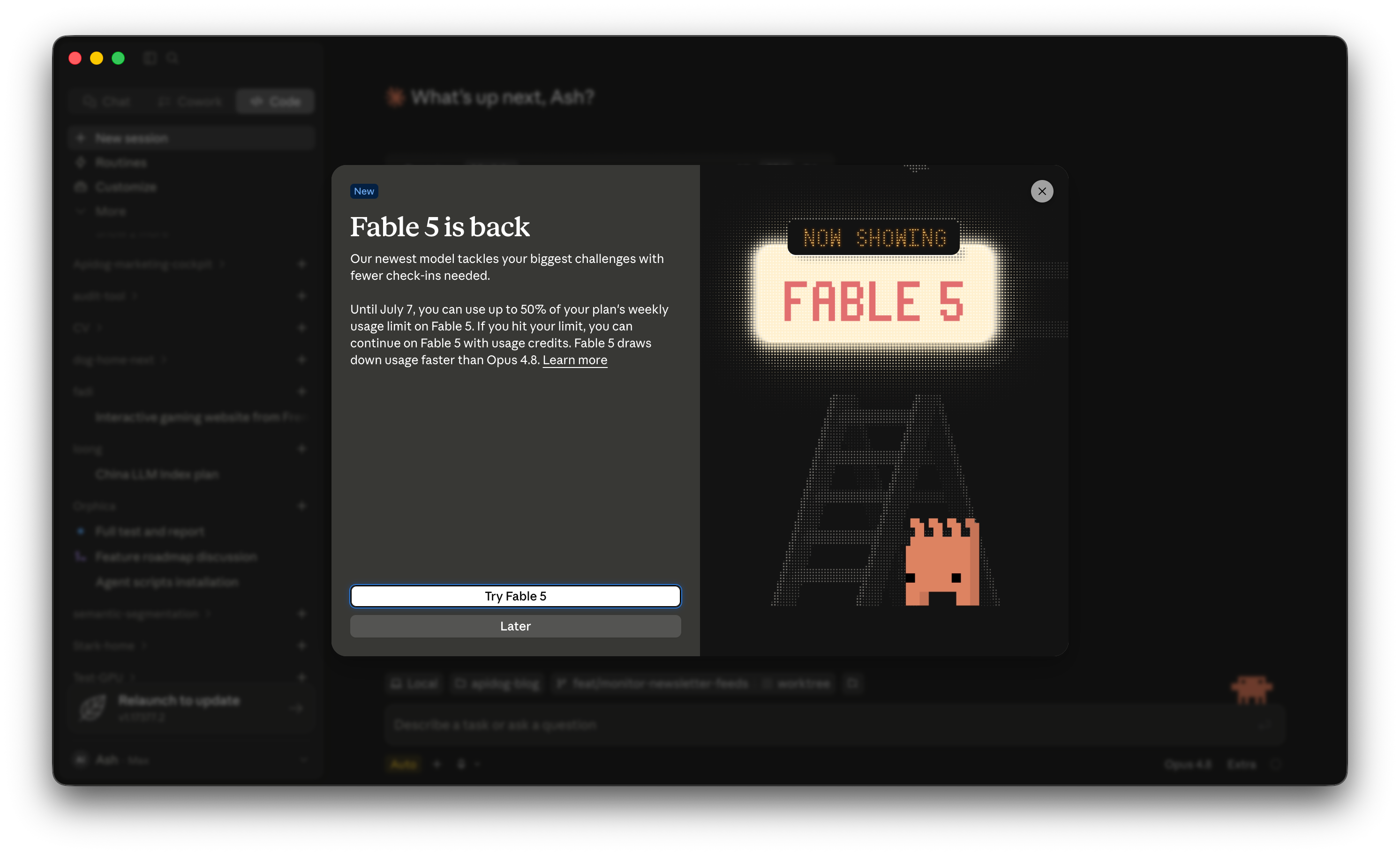
This July window is the second free-in-plan period, not the first. The original June promotion, which we covered in how to use Claude Fable 5 for free, was cut short by the suspension. The July 1 to July 7 window replaces it. Read it as a make-good for subscribers who lost access mid-promotion, with July 7 as the date normal economics begin.
The takeaway: this window closes on a fixed date. If you want to evaluate Fable 5 on real work without spending anything beyond your subscription, do it before July 7.
What you get before July 7, per plan
The offer is the same shape on every eligible tier: Fable 5 can consume up to half your weekly usage limits, included in your subscription price.
- Pro: up to half your weekly limit can go to Fable 5. Since Pro limits are the tightest, budget deliberately; a few long-context sessions can consume that half quickly.
- Max: same 50% ceiling against a much larger weekly pool. Max subscribers get the most practical headroom for multi-hour agentic sessions in this window.
- Team: the 50% ceiling applies per seat, which makes this a good week for teams to run side-by-side comparisons on shared workloads.
- Enterprise: select Enterprise customers are included. If you’re on Enterprise and don’t see Fable 5 in the model picker, ask your admin or account team whether your org is in scope.
The half-of-weekly-limits mechanic matters more than it sounds. Fable 5 thinks longer and produces longer outputs than Opus 4.8, so it burns through limits faster per conversation. If you’re unsure how the weekly buckets work in the first place, our breakdown of Claude Fable 5 rate limits covers how usage is metered across surfaces.
What usage credits mean after July 7
Here’s what’s known. From July 8 onward, Fable 5 access in Pro, Max, Team, and Enterprise plans moves to a usage-credits model. The model doesn’t leave subscriptions; the billing changes. Credits are a metered layer on top of your subscription, spent when you choose Fable 5 and untouched when you stick with Opus 4.8 or Sonnet 4.6.
Here’s what isn’t known. Anthropic hasn’t published credit rates, package sizes, or whether plans will include a monthly credit allotment as of this writing. It also hasn’t said whether unused credits roll over. Treat any specific number you see elsewhere with suspicion until it appears in official pricing documentation.
What you can do now is prepare. Measure what your typical Fable 5 sessions consume during the free window. When credit pricing lands, you’ll be able to multiply immediately instead of guessing.
Plan access vs API pricing compared
API pricing is separate from all of this and doesn’t change on July 7. The official pricing page lists Fable 5 at $10 per million input tokens and $50 per million output tokens, with a 90% prompt-caching discount that brings cache hits down to $1.00 per million tokens. That’s roughly 2x Opus 4.8 and 3x Sonnet 4.6 per token. The model ID is claude-fable-5, with a 1M-token context window by default and 128K max output.
| Surface | Cost model | When it makes sense |
|---|---|---|
| Claude plan, through July 7 | Included, up to half your weekly limits | Evaluation, interactive work, trying Fable 5 on real tasks at zero marginal cost |
| Claude plan, after July 7 | Usage credits; rates unpublished as of this writing | Occasional heavy sessions inside Claude.ai or Claude Code without API setup |
| Claude API | $10/M input, $50/M output, $1.00/M cache hits | Production workloads, automation, anything where you need predictable per-token costs |
We break down the full per-token economics, including how Fable 5 compares with the rest of the lineup, in our Claude Fable 5 pricing guide.
How to make the most of the window
You have until July 7. Spend the free capacity on work that plays to Fable 5’s strengths and would be expensive to run later.
Long-context jobs. The 1M-token window is the default, not an upgrade. Feed it an entire repository, a quarter of support transcripts, or a contract stack, and ask for analysis that shorter-context models would need chunking pipelines to attempt.
Agentic coding sessions. Fable 5 is built for long-horizon autonomous work. Point Claude Code at a gnarly migration or an overnight refactor. Single turns can run for many minutes on hard tasks; that behavior is normal and it’s exactly what you want to test while it’s included.
Evals against your own workloads. This is the highest-value use. Run the same tasks through Fable 5 and Opus 4.8 side by side and score the outputs. After July 7, the question “is Fable 5 worth credits or 2x API pricing for this task?” becomes answerable with your own data instead of benchmark charts.
One operational note: Anthropic applies safety classifiers to Fable 5 requests. Flagged requests reroute to Opus 4.8 with a notification, and more than 95% of sessions never see a fallback. If a response arrives from Opus 4.8 during your evals, it will be labeled; exclude it from your Fable 5 scoring.
How to estimate whether the API beats credits for your workload
Until credit rates publish, the API is the only Fable 5 price you can compute exactly. So compute it. The arithmetic gives you a per-session dollar figure to hold credit pricing against later.
Take a realistic agentic coding session: 25 requests, about 40,000 input tokens per request as context accumulates, and about 3,000 output tokens per response. That’s 1M input tokens and 75,000 output tokens total.
Without caching:
- Input: 1,000,000 tokens x $10/M = $10.00
- Output: 75,000 tokens x $50/M = $3.75
- Session total: $13.75
With prompt caching, most of that input is repeated context. Assume 90% of input tokens land as cache hits after the first request:
- Cached input: 900,000 tokens x $1.00/M = $0.90
- Fresh input: 100,000 tokens x $10/M = $1.00
- Output: 75,000 tokens x $50/M = $3.75
- Session total: $5.65
Caching cuts the session cost by nearly 60%, which is why any serious API cost estimate has to account for it. It also means the honest comparison isn’t “credits vs $13.75” but “credits vs $5.65” for a well-built integration.
Ground the estimate in measured numbers, not guesses. Send a few representative requests to the Messages API in Apidog and read the usage block in each response: input_tokens, cache_read_input_tokens, and output_tokens tell you exactly what a request of yours consumes. Multiply by your request volume and you have a real monthly figure. When Anthropic publishes credit rates, whichever side of that figure they land on makes your decision for you.
The decision rule is simple. High-volume, repeatable workloads with cacheable context favor the API. Sporadic, interactive, exploratory sessions favor staying inside the plan and paying credits, because you skip integration work and only pay when you reach for the top model.
FAQ
Is Claude Fable 5 free right now? Inside paid plans, yes, through July 7, 2026, for up to half your weekly usage limits. It isn’t available on the free tier, and API usage is billed normally at $10/M input and $50/M output.
Do API prices change on July 7? No. The July 7 switch affects subscription access only. API pricing stays at $10/M input, $50/M output, and $1.00/M cache hits, and if you want to skip plans entirely, our guide to using the Claude Fable 5 API walks through setup and your first request.
How much will Fable 5 usage credits cost? Anthropic hasn’t published credit rates as of this writing. What’s confirmed is the structure: after July 7, Fable 5 in subscriptions draws from a credit balance rather than your standard usage limits.
Could Fable 5 go offline again? The export controls that suspended it on June 12 were lifted on June 30, and Anthropic has announced no planned removal. July 7 changes how you pay inside plans, not whether the model is available.
Developers who want to put those plan credits to work in automated pipelines should look at setting up the Claude Agent SDK within their existing Claude plan, which gives direct API-level control over multi-step agent workflows.
What to do before July 7
Three moves this week. First, run your hardest real workload through Fable 5 while it costs nothing beyond your subscription. Second, record what those sessions consume so you can price the credit model the day rates publish. Third, benchmark the API path: measure token usage on representative requests, apply the $10/$50 rates with caching, and get your per-session baseline. Download Apidog to run those API tests and read token usage straight from the response. When July 7 arrives, you’ll know exactly which door to walk through, and what it costs on the other side.