
Claude Fable 5.1 is available in Claude Code from version 2.1.250, on every paid Claude plan. Max plans include it for up to 50% of the weekly usage limit at no extra cost. Pro and Team standard seats run it on usage credits from the first message. And the change most Claude Code users will feel before any benchmark is the safeguards: Anthropic reports around 60% fewer cyber interventions per Claude Code session than Fable 5, and the model can now find vulnerabilities in your own code.
This guide covers the version requirement, how to select the model, what each plan pays, the effort setting, what Fable 5.1 does differently in a long coding session, and the prompt lines Anthropic recommends for it. Sources are Anthropic’s Fable models on your plan help article and the Fable 5.1 prompting guide. For the model itself, see what Claude Fable 5.1 is.
Step 1: Update Claude Code
Fable 5.1 requires Claude Code 2.1.250 or later. Fable 5 needed 2.1.170. Check and update:
claude --version
npm install -g @anthropic-ai/claude-code@latest
On an older build the model simply does not appear in the picker, which is the most common reason people think they lack access.
Step 2: Select the model
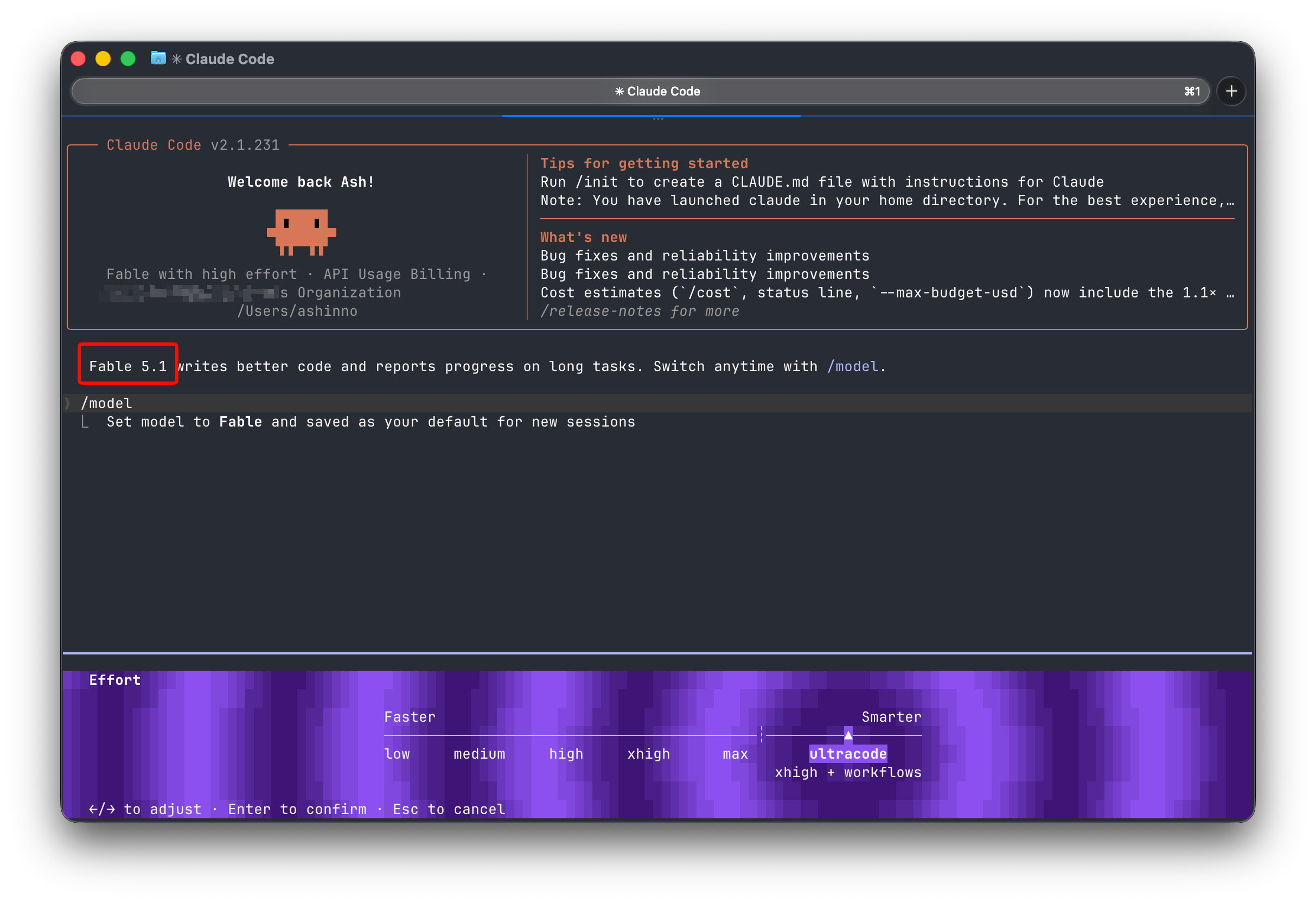
Inside a session, run /model and pick Claude Fable 5.1. To start a session on it directly:
claude --model claude-fable-5-1
Or set it as your default in settings so every session opens on it. The picker also shows how the model is metered on your plan, which is worth reading once, because it differs by plan.
Step 3: Know what your plan pays
Fable 5 and Fable 5.1 are metered identically. What differs is the plan.
| Plan | How Fable 5.1 is metered |
|---|---|
| Free | Not available |
| Pro | Usage credits from the first message; not part of the plan’s weekly limit |
| Max (5x and 20x) | Included for up to 50% of the weekly usage limit at no extra cost; after that, continue on usage credits or switch models |
| Team standard seat | Usage credits, same as Pro |
| Team premium seat | Same as Max |
| Enterprise standard seat | Usage credits must be enabled for use beyond plan limits |
| Enterprise usage-based | Standard API rates ($10 / $50 per million tokens) |
Two details matter for Claude Code specifically. First, the 50% Max allowance is a share of your weekly limit, not a separate pool, so a heavy Fable 5.1 week consumes Opus 5 headroom too. Second, requests the safeguards reroute to another model are not charged at Fable prices, so a session that triggers the classifier and falls back does not burn Fable credits for the fallback turn.
If you are on Pro and Claude Code shows a “usage credits required” prompt on Fable 5.1, that is the expected behavior since the July 20 change, not a bug. The usage-credits explainer covers how the switch happened. The Claude Code limits update covers the weekly-limit boost that Max users still have.
Step 4: Set effort
Every current model defaults to high effort in Claude Code, Fable 5.1 included. You can change it per session with /effort or in settings. Anthropic’s guidance for Fable 5.1 is specific enough to act on:
highis the recommended starting point for most coding work.mediumroughly matches Fable 5 quality at lower cost and is the right setting for routine edits and questions.xhighandmaxare where Fable 5.1’s gains over Fable 5 are largest, and they are the settings for hard, capability-sensitive tasks: large refactors, debugging sessions that run for hours, multi-file features. They also add thinking time before the first response.lowis worth trying on quick interactive work. Anthropic says Fable 5.1 atlowis often competitive with Opus and Sonnet on cost per task. One caveat: atlowthe model searches less and answers from memory more, so raise effort for anything that depends on reading current code or docs.
On a Max plan, effort is also the lever that stretches the 50% allowance, since lower effort means fewer output tokens per turn.
What Fable 5.1 does differently in a coding session
Claude Code manages the conversation prefix for you, so the history-editing check that trips custom harnesses does not apply here. What you will notice instead are behavior shifts.
Fewer parallel reads. In long loops where the next independent file reads are only implied, Fable 5.1 may read one file per turn where Fable 5 read several. Answers are the same; wall-clock is longer. Claude Code’s own scaffolding handles most of this, but if you see it, the one-line nudge in the next section helps.
Fewer progress messages. Fable 5.1 narrates less between tool calls, especially at higher effort, and its final summaries are shorter. A long turn can look quiet. That is the model working, not stalling.
Whole-file rewrites. Fable 5.1 is more likely than Fable 5 to rewrite an entire file for a small change. The result is usually identical; the cost is output tokens and time. A CLAUDE.md line fixes it.
Scope and test sprawl. Asked for a feature, Fable 5.1 sometimes fixes nearby code, extends behavior the task did not mention, or commits more test files than warranted. Explicit instructions about what to leave out reduce this substantially.
Fewer false refusals. Anthropic reports around 60% fewer cyber interventions per Claude Code session than Fable 5, and finding vulnerabilities in source code is now permitted. Three phrasings still raise the false-positive rate: asking “does this compile without errors” (ask “are there any bugs” instead), working in a lesser-known language without giving the model its docs, and tools that return base64 into context.
CLAUDE.md lines Anthropic recommends
These are from the official prompting guide and are safe to paste into a project’s CLAUDE.md.
For targeted edits instead of rewrites:
The number of tokens used to edit files is best minimized, all else being equal. Therefore, when it will not affect the end result, try to surgically edit a file rather than rewrite the entire thing.
For scope and test discipline:
If, while working or testing, you find a pre-existing bug, a performance concern, or behavior the task doesn't mention, don't fix, optimize or extend it in this change unless the requested behavior cannot work without it; report it as a follow-up in your summary. Commit tests only where the task asks for them or this repository already keeps tests for this kind of change, sized like the neighboring test files. This is about extras only: implement every behavior the task asks for, completely.
For unattended runs, where the model should not stop to ask permission for work you already requested:
You are operating autonomously. The user is not watching in real time and cannot answer questions mid-task, so asking 'Want me to...?' or 'Shall I...?' will block the work. For reversible actions that follow from the original request, proceed without asking. Stop only for destructive actions or genuine scope changes the user must decide.
Anthropic notes the opening sentence carries most of the effect and that this block can make the model less likely to ask about ambiguous requests, so add a line listing the confirmations you still want. One more difference from Opus 5: if your CLAUDE.md asks the model to test or check its work before reporting, keep it. The Opus 5 guidance to delete verification instructions does not carry over to Fable 5.1.
The full set of behavior shifts and snippets, including the batching nudge and the writing-density fix, is in the Fable 5.1 prompting guide.
Using Fable 5.1 with Apidog from Claude Code
For API work, the pairing that saves the most time is Fable 5.1 driving the Apidog CLI: the model designs or edits the OpenAPI spec, the CLI runs the Apidog test scenarios, and the model reads the results on the next turn. Fable 5.1’s longer autonomous runs suit that loop, since it can iterate spec, mock, and test for an hour without a check-in. If you are new to that setup, building APIs with Claude Code and Apidog is the walkthrough, and Apidog is free to start (Download Apidog).
Fable 5.1 vs Opus 5 in Claude Code
Anthropic’s own rule in the models overview is to start on Opus 5 and move up when Opus 5 at higher effort still falls short. In Claude Code that translates to: use Opus 5 for the day-to-day, and switch to Fable 5.1 for the sessions that are long, multi-file, and hard. On a Max plan that keeps the 50% Fable allowance for the work that needs it. The Fable 5.1 vs Opus 5 comparison has the benchmark and cost detail, and the Opus 5 in Claude Code guide covers that model’s setup.
FAQ
Which Claude Code version supports Fable 5.1? 2.1.250 or later. Fable 5 needs 2.1.170 or later. Older builds do not show the model.
Is Claude Fable 5.1 included in my Claude Code plan? On Max and Team premium seats, yes, for up to 50% of your weekly usage limit, then usage credits. On Pro and Team standard seats it runs on usage credits from the first message. Not available on Free.
What is the default effort for Fable 5.1 in Claude Code? high, the same as every current model. Change it with /effort.
Does Fable 5.1 refuse security work in Claude Code? Less than Fable 5. Anthropic reports around 60% fewer cyber interventions per session, and vulnerability discovery in your own code is allowed. Exploit development is still declined, and rerouted requests are not charged at Fable prices.
Should I keep my “verify your work” instructions? Yes. That guidance was for Opus 5, which over-verified. Anthropic indicates it does not apply to Fable 5.1.
Why does Fable 5.1 go quiet during long turns? It writes fewer progress messages between tool calls than Fable 5, more so at higher effort. The work is happening; the narration is thinner.