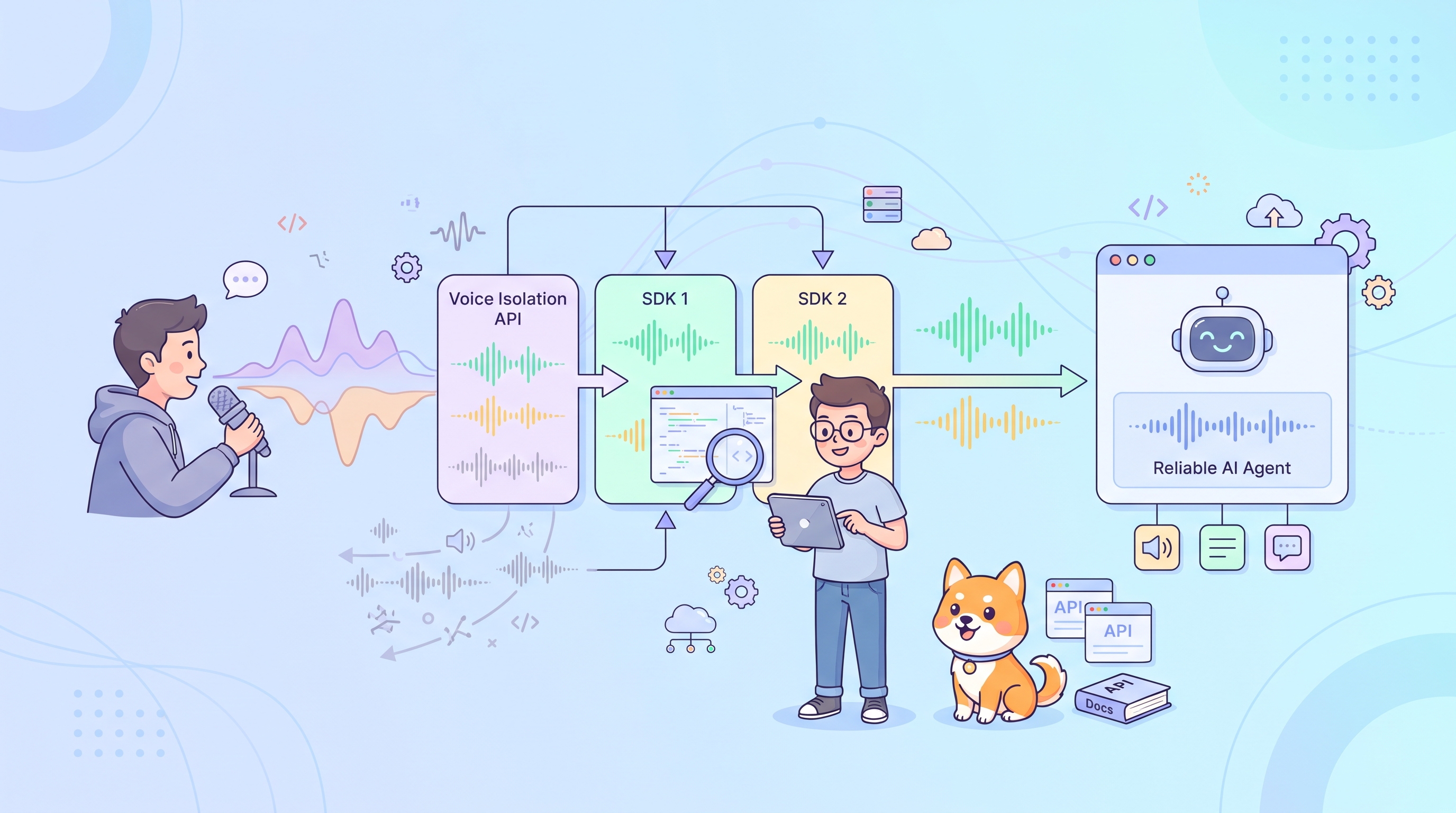
Voice agents rarely fail because of the LLM. They fail because of what they hear. A caller in an open office, a call center or a living room with the TV on brings other voices into the call. Speech-to-text transcribes those voices too, and the agent answers questions nobody asked, stops talking when a bystander speaks, or can't tell when the caller has finished.
Voice isolation fixes this before the audio reaches your agent. It keeps the main speaker's voice and removes other voices and noise. This guide compares five voice isolation APIs, SDKs and open-source models developers use for it in 2026:
- Krisp Voice Isolation: production-grade voice isolation for voice agents, as a cloud API or an on-server SDK
- NVIDIA Speaker Focus: GPU-accelerated primary-speaker isolation in the Maxine Audio Effects SDK
- Arctan: a speech enhancer for voice agents, with SDKs for Node, Python, Rust and C++
- VoxLock: an open-source voice isolation model that runs on CPU, with Pipecat and LiveKit plugins
- RNNoise: the classic open-source noise suppression library, for when noise is the only problem
Voice isolation vs. noise cancellation
Noise cancellation removes sounds that aren't speech: traffic, keyboards, air conditioning. Voice isolation also removes speech from anyone who isn't the main speaker. For a voice agent, that difference decides whether the fix works.
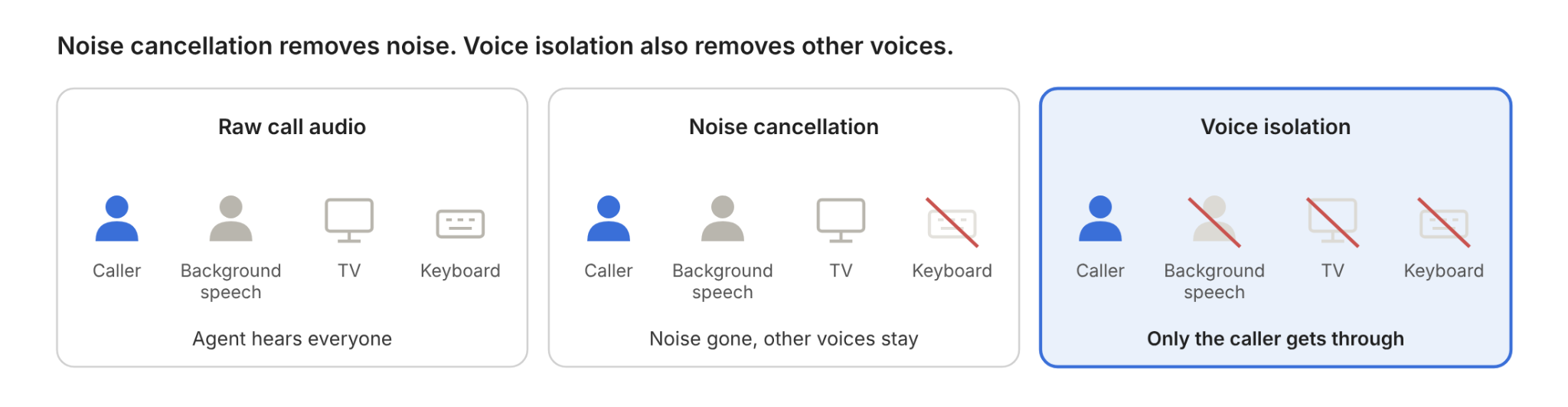
What each approach lets through to the agent
Modern STT already copes with noise. What it can't cope with is a second voice, because a second voice looks exactly like the speech it's trained to capture. In Krisp's Voice Isolation 2.5 release test, 10 STT systems averaged a 2.10% word error rate (WER) on clean single-speaker audio and 35.92% with a second person talking. With Voice Isolation 2.5 in front, the second-voice WER fell to 10.90%.
Voice isolation sits first in the pipeline, before voice activity detection (VAD), turn detection and STT, so every model after it hears one voice. It can also sit in front of a speech-to-speech model, which reacts to every sound it hears, though Krisp has not published results for that setup yet.
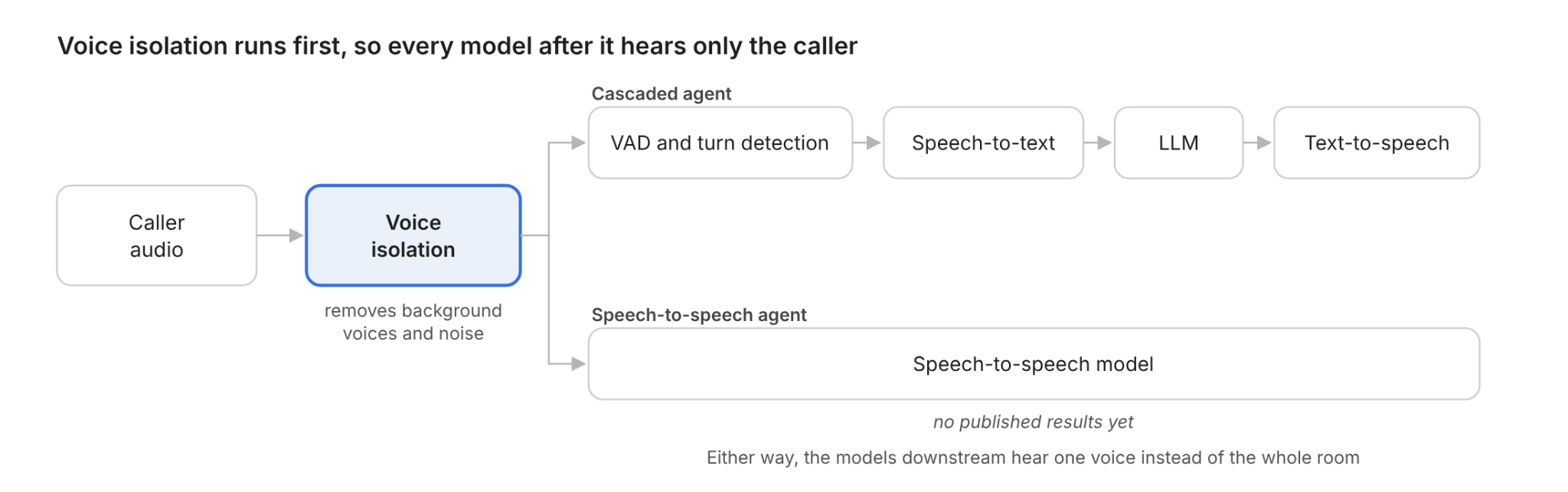
Where voice isolation sits in a voice agent pipeline
How we compared them
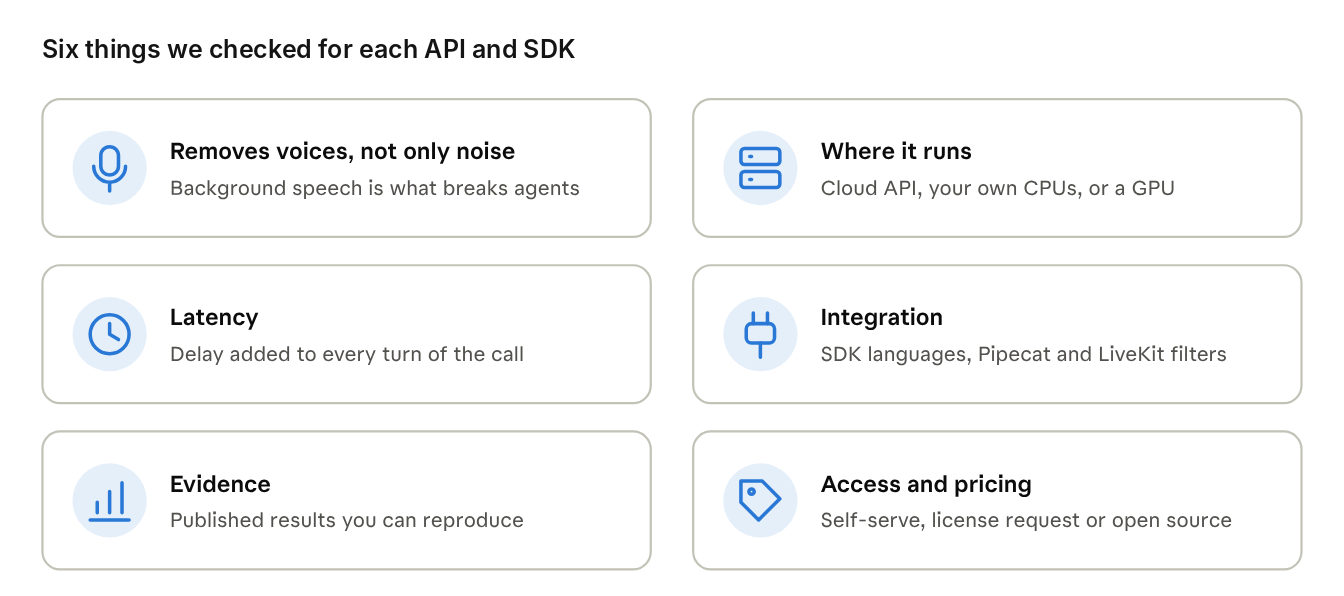
We looked at what matters when you put a model in front of a live voice agent:
Evaluation criteria
- Does it remove voices or only noise? Background speech is what breaks agents.
- Where does it run? Cloud API, your own CPU servers, or a GPU.
- Latency. The model sits in the live call path, so every millisecond is added to the response time.
- Integration. SDK languages, and ready-made filters for Pipecat and LiveKit.
- Evidence. Whether results are published, reproducible, and independent of the vendor.
- Access and pricing. Self-serve, license request, or open source.
1. Krisp Voice Isolation
Best for: production voice agents that need background voices removed, with a choice of cloud API or on-server SDK.
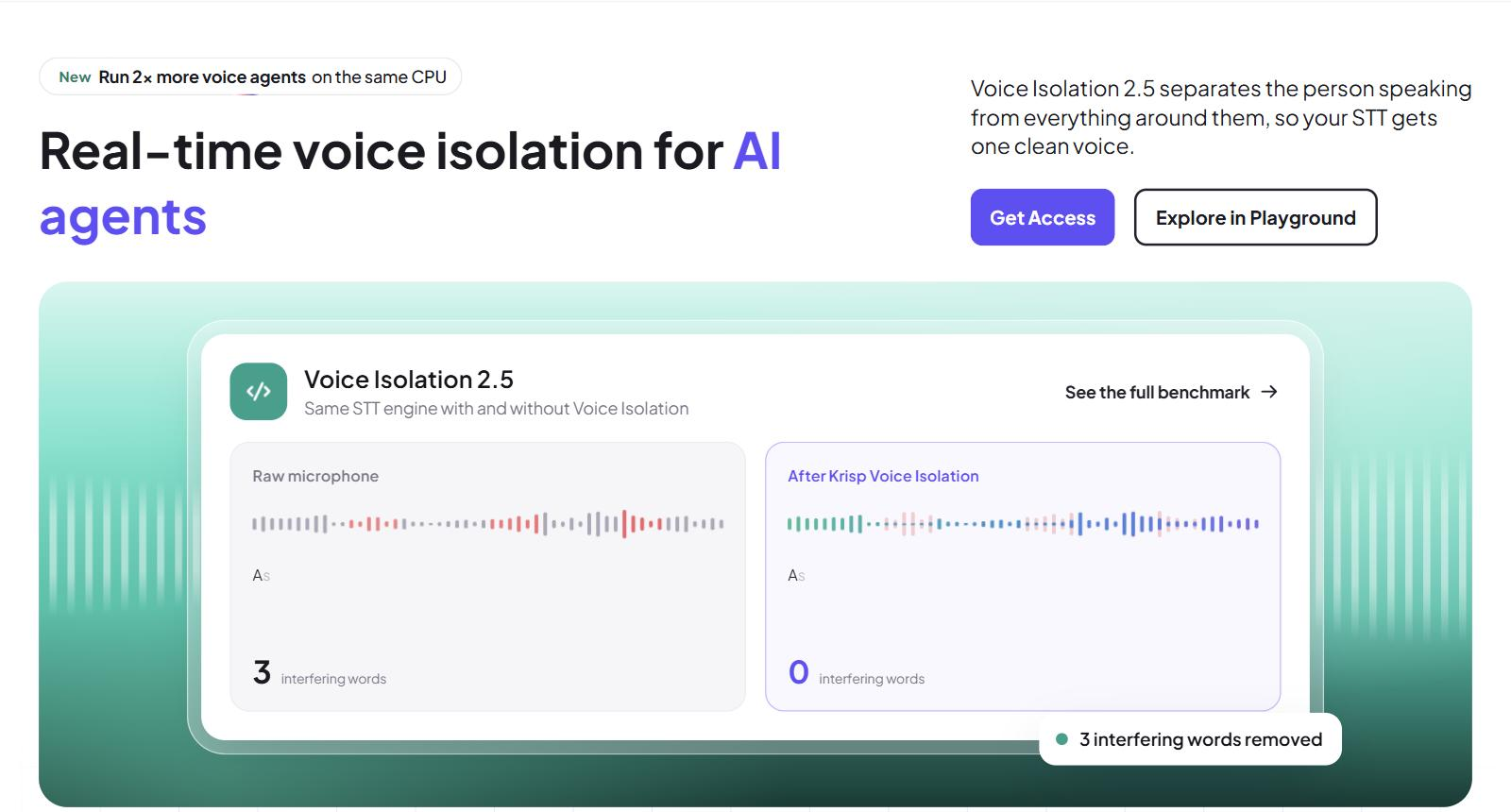
Krisp's Voice Isolation for developers page.
Krisp Voice Isolation API & SDK keeps the main speaker's voice and removes background voices and noise from a live audio stream. It's part of VIVA, Krisp's set of real-time models for voice agents, alongside Turn-Taking, Interruption Prediction and VAD. Krisp also provides a voice translation API for real-time speech-to-speech translation across 61 languages, with background voice cancellation built in. Krisp has worked on voice AI for about nine years and says it processes more than 1 trillion minutes of voice a year.
Key features
- Removes background voices as well as noise, with no voice enrollment
- Runs on CPU or GPU, with 15 ms of algorithmic latency (about 20 ms added in the SDK)
- Works in front of any STT engine, and can also sit in front of speech-to-speech models (no published results yet)
- Handles phone audio: narrowband telephony, G.711, G.722, G.729, Opus and Bluetooth headsets
- Four SDK models (Default, Balanced, Lite, HD); the API offers VIVA-tel for 8 or 16 kHz phone audio and VIVA-pro for 32 kHz wideband
- Pipecat Cloud filter, LiveKit plugin and Vapi Smart Denoising, and slots into WebRTC and telephony pipelines
Evidence: Krisp published a voice isolation benchmark of 265 real recordings from offices, homes, call centers and cars, with the dataset on Hugging Face. Across 11 STT configurations, average WER fell from 23.24% to 6.24%, and every engine improved.
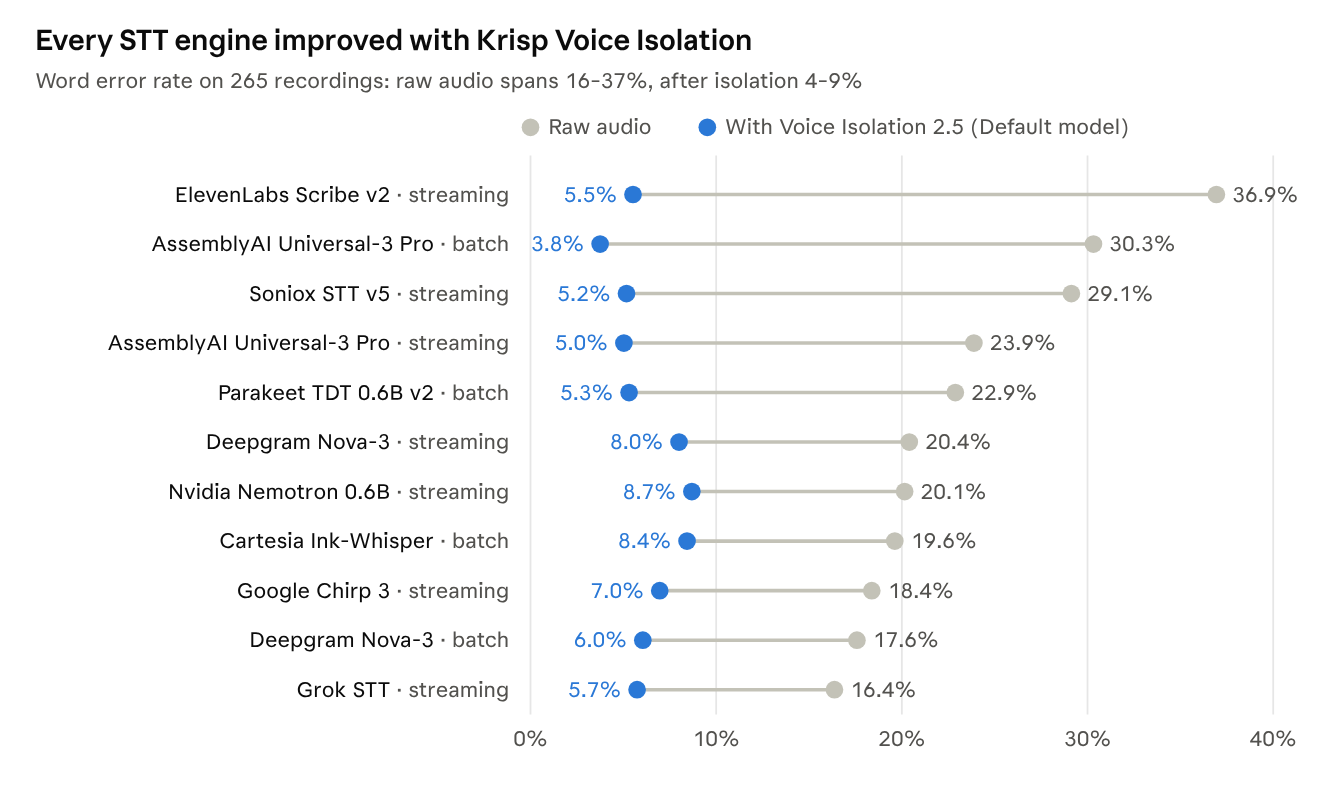
Data: Krisp voice isolation benchmark, Sep 2026 · 11 STT configurations, all scenarios pooled
Pricing: the API is self-serve, billed per hour of audio. It costs $0.18/hour pay-as-you-go with $30 in free credit, or $0.12/hour on the $400/month Growth plan. The SDK comes with the Enterprise plan. Prices as of November 2026, from the Krisp pricing page.
We tested the API hands-on in our Krisp Voice Isolation review.
2. NVIDIA Speaker Focus
Best for: teams already running NVIDIA GPUs who want primary-speaker isolation alongside other audio effects.
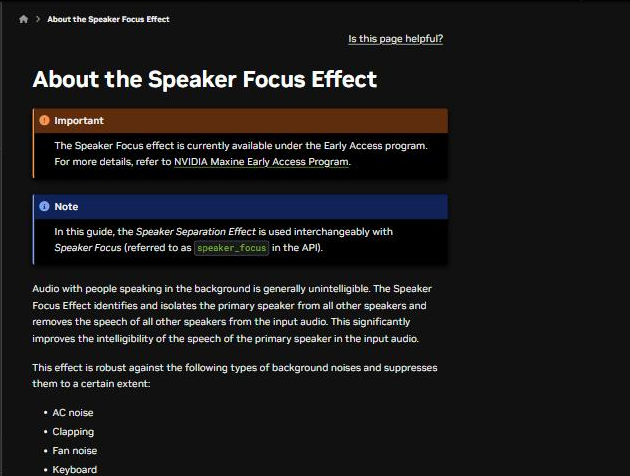
The Speaker Focus page in NVIDIA's Audio Effects SDK docs.
Speaker Focus is an effect in the NVIDIA Maxine Audio Effects (AFX) SDK. It identifies the primary speaker, removes the speech of all other speakers, and suppresses common noise such as fans, keyboards and AC hum to a certain extent. NVIDIA's docs also call it the Speaker Separation effect.
Key features
- Removes other speakers' voices, for audio with up to four speakers
- 16 kHz and 48 kHz models, mono in and out
- Built for very high throughput on data-center GPUs: NVIDIA lists a real-time throughput of 3,040 batches on a T4 and 25,030 on a B100 for the 16 kHz model on Linux
- Runs on Windows and Linux, in the same SDK as denoising, echo cancellation and super-resolution
Pricing and access: Speaker Focus is currently in NVIDIA's Maxine Early Access program, so you apply for access rather than signing up.
Limitations: it needs an NVIDIA GPU, which adds cost if the rest of your voice stack runs on CPU. NVIDIA doesn't publish latency figures or WER results for it, and there's no ready-made Pipecat or LiveKit filter.
3. Arctan
Best for: voice agent teams that want a licensed SDK in Node, Python, Rust or C++ with Pipecat and LiveKit support.

Arctan sells a speech enhancer for voice agents. Its SDK, Arctan Eigen, is described as a low-latency speech enhancer and noise canceller tuned for STT accuracy. It reduces background noise, side-talk and other degradation before the audio reaches VAD and STT, and Arctan says only the primary speaker gets through.
Key features
- Targets background noise, cross-talk, murmur and echo, with on-premise deployment on its paid plans
- First-party SDKs for Node, Python, Rust and C++
- A Pipecat audio filter (arctan-vi on PyPI) and a LiveKit noise-canceller option
- Can be toggled on and off at runtime in Pipecat
- SOC 2 Type 2 and ISO 27001
Evidence: Arctan reports 10 ms processing latency and shows WER improvements across five STT engines, for example Deepgram Nova 3 from 24.1% to 12.7%. These come from Arctan's own tests on real voice agent calls, and the full methodology is available only on request.
Pricing and access: usage-based plans start at $129/month for 100,000 minutes (Startup) and $499/month for 500,000 minutes (Pro), with custom Enterprise pricing. Every plan has a 14-day free trial with no credit card, and the SDK needs a license key that's validated against Arctan's servers.
Limitations: the Pipecat filter doesn't resample, so your transport must deliver audio at a stable rate. There's no public benchmark dataset to check the numbers against.
4. VoxLock
Best for: teams that want an open-source voice isolation model they can run and modify on their own CPUs.
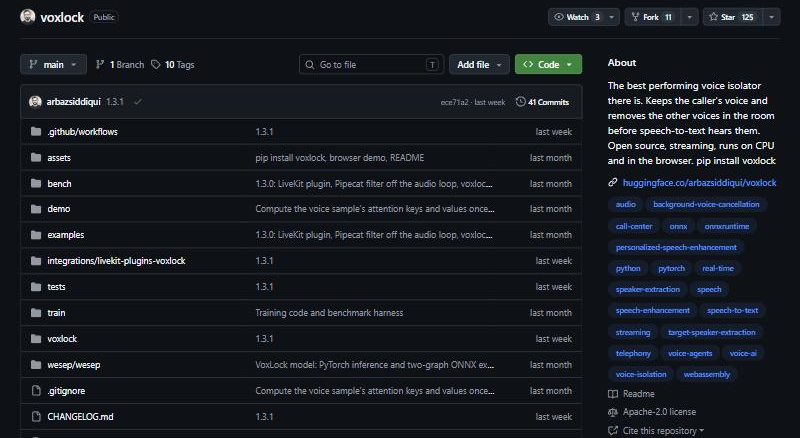
VoxLock's GitHub repository.
VoxLock is an open-source (Apache-2.0) voice isolation model by Arbaz Siddiqui. It keeps the caller's voice and removes the other voices in the room before STT hears them. It takes one input, the call audio, and picks out the caller by itself.
Key features
- Runs locally on CPU with onnxruntime: no API key and no network calls after the model download
- About 24 ms of algorithmic latency, plus the chunk size
- 27.3M parameters, with int8, fp16 and fp32 versions
- Pipecat filter and a LiveKit Agents plugin, installed with pip install voxlock
- Optional voice sample: by default it listens to 3 seconds of the caller, then starts isolating
Evidence: the author reports 10.12% WER on held-out AMI meeting recordings. The results are self-reported and haven't been independently checked.
Pricing: free and open source.
Limitations: it's a community project, with no commercial support or SLA. It needs 3 seconds of the caller's speech before isolating, unless you give it a voice sample. On one thread, a live call uses 61% to 110% of a CPU core depending on chunk size, so plan capacity carefully.
5. RNNoise
Best for: removing steady background noise cheaply when callers are usually alone.
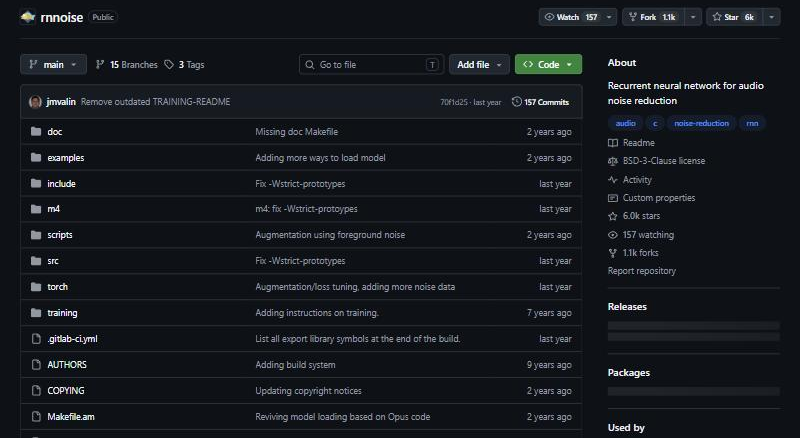
RNNoise's GitHub repository.
RNNoise is a long-standing open-source (BSD-3-Clause) noise suppression library from Xiph, based on a recurrent neural network. It uses a hybrid of traditional signal processing and deep learning, which keeps it small enough for real-time use on almost any CPU.
Key features
- Real-time, full-band noise suppression on 48 kHz, 16-bit mono audio
- A C library with AVX2 and SSE4.1 optimizations, no GPU and no internet connection needed
- You can retrain it on your own speech and noise data
- Widely embedded in VoIP and conferencing tools, including browser builds via WebAssembly
Pricing: free and open source.
Limitations: RNNoise removes noise, not voices. Background speech or a TV still reaches your STT, so it doesn't fix false interruptions or wrong transcripts caused by background speech. It also expects 48 kHz input, so phone audio at 8 or 16 kHz has to be resampled. It's best treated as a baseline, or as a light first stage in front of a voice isolation model.
Comparison
How to choose
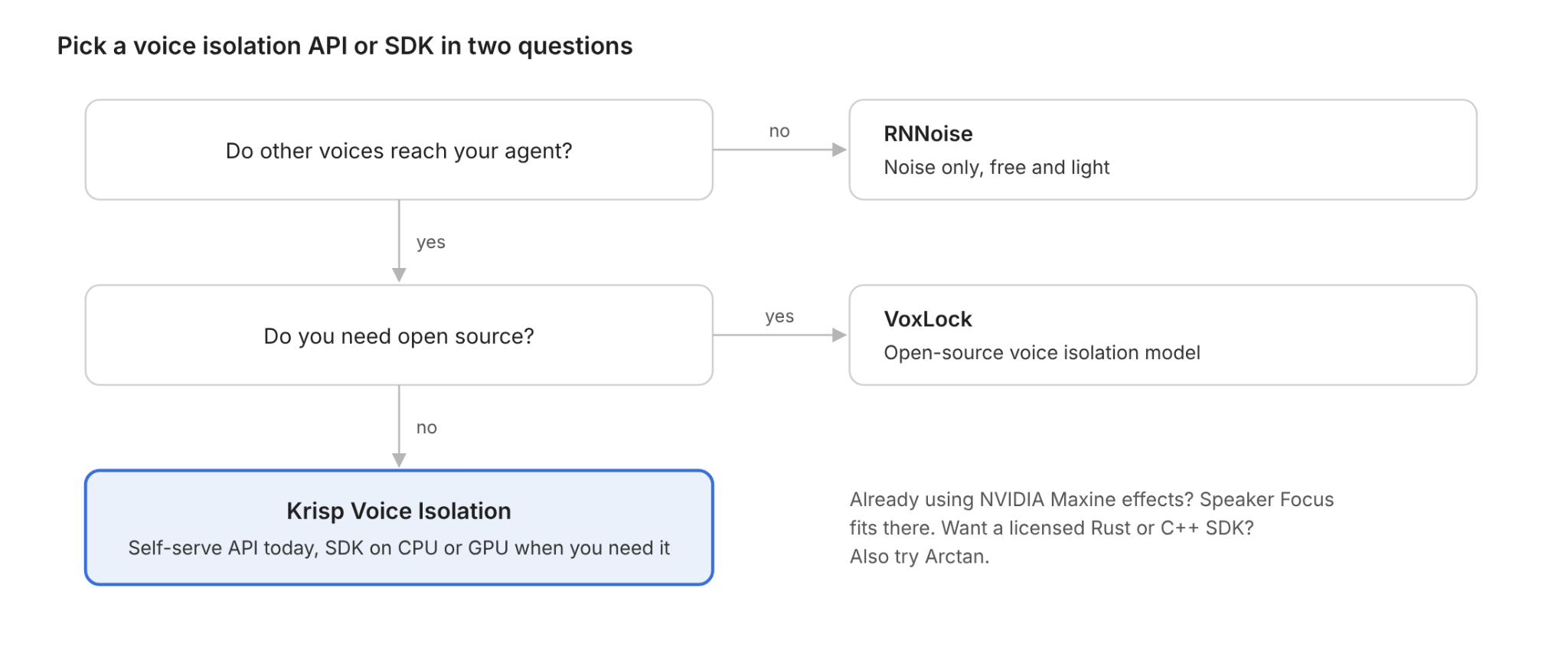
A quick way to narrow the list
- You run a production voice agent and want it working this week: start with Krisp Voice Isolation. The API is self-serve with free credit, the results are published on an open dataset, and you can move to the SDK later if you need audio to stay on your servers.
- Your stack already runs on NVIDIA GPUs: NVIDIA Speaker Focus fits next to Maxine's other effects, if you can get into the early access program. Krisp Voice Isolation also runs on GPU, so a GPU stack does not rule it out.
- You want a licensed SDK in Rust, C++, Node or Python with vendor support: Arctan is worth a trial. Ask for the methodology behind its numbers before you commit.
- You need open source and can support it yourself: VoxLock is the open model built for this job. Test it on your own calls before relying on the self-reported numbers.
- Your callers are usually alone and noise is the only issue: RNNoise is free and light, but it won't stop background voices.
Whichever you pick, test it on your own recordings, including calls with a second voice and clean calls with no one else in the room. A model that helps on crowded calls can cost a little accuracy on clean ones.
FAQ
What is voice isolation for AI agents? A model that keeps the main speaker's voice and removes other voices and noise from live audio, before the audio reaches the agent's VAD, turn detection and STT.
Is noise cancellation enough for a voice agent? Only if callers are alone. Noise cancellation leaves other people's voices in, and background speech is what causes wrong transcripts and false interruptions.
Does voice isolation add latency? A little. Krisp states 15 ms of algorithmic latency, with about 20 ms added in its SDK. VoxLock has about 24 ms of algorithmic latency plus the chunk, and its model card lists 104 to 184 ms of total added delay in Pipecat and about 124 ms in LiveKit. A cloud API also adds network time to its region.
Do I need a GPU? Not for most options. Krisp, VoxLock and RNNoise run on CPU (Krisp can also run on GPU), and Arctan doesn't publish hardware requirements. NVIDIA Speaker Focus needs an NVIDIA GPU.
Do users need to enroll their voice? No for Krisp. VoxLock works without enrollment but can take an optional voice sample to start isolating from the first frame.