
ReadyAPI is what happened when SmartBear bundled SoapUI Pro, LoadUI, and ServiceV into one commercial platform. It’s capable software with a capable price: licensing is quote-based, third-party trackers list entry pricing around $829 per license per year, and the functional, performance, and virtualization modules are packaged so that testing one API thoroughly can involve three line items. If you’re searching for a ReadyAPI alternative, the renewal quote is usually the trigger.
Here’s the direct answer: Apidog is the best ReadyAPI alternative for teams testing REST and modern APIs. It covers functional testing, performance testing, mocking, and CI automation in one product at $9 per user per month, with a free plan for up to 4 users, no per-module pricing and no sales call to find out what it costs. This article breaks down where the ReadyAPI model hurts, what Apidog covers, and the workloads where ReadyAPI keeps its edge.
Why teams look for a way out
The pricing is a negotiation, not a number
SmartBear’s ReadyAPI pricing page describes customizable plans and routes you to sales. Public trackers put the entry module around $829 per license per year, with realistic enterprise configurations running $1,000 to $6,000 per license once modules stack up. Per-seat licenses come in fixed and floating flavors, which means someone on your team maintains a spreadsheet about who can run tests this sprint. We tallied the whole SmartBear bill in SmartBear pricing and top alternatives.
Capabilities ship as modules
Functional testing, performance testing, and service virtualization are separate modules in ReadyAPI’s packaging. The result is a procurement question every time your testing needs grow: the load-testing conversation we covered in ReadyAPI load testing alternative for modern APIs usually starts with a team that owns API Test and discovers API Performance is another purchase.
It inherits SoapUI’s architecture
ReadyAPI is the commercial continuation of SoapUI Pro: a Java desktop application, XML project files, Groovy as the scripting language, SOAP-era abstractions under a newer UI. Teams hit the same collaboration friction (project files don’t merge well) and the same skills bottleneck (the person who knows Groovy owns the suite). The history is laid out in SoapUI Pro vs SoapUI Open Source.
CI works, but it’s work
Jenkins integration exists and functions; we wrote the setup guide in ReadyAPI Jenkins CI setup. It involves test runner plugins, license management on build agents, and Java on every runner. Modern pipelines expect a CLI you install with one command, and that’s not the ReadyAPI experience.
What a QA team actually pays
License math is where this comparison stops being abstract. Using the entry figure public trackers list for ReadyAPI (about $829 per license per year, before extra modules) against Apidog’s published pricing:
| Team size | ReadyAPI per year (entry, single module) | Apidog per year | Difference |
|---|---|---|---|
| 2 testers | ~$1,658 | $0 (free plan) | ~$1,658 |
| 4 testers | ~$3,316 | $0 (free plan) | ~$3,316 |
| 8 testers | ~$6,632 | $864 | ~$5,768 |
| 15 testers | ~$12,435 | $1,620 | ~$10,815 |
Three caveats keep this honest. ReadyAPI’s real quotes vary; some teams pay less through negotiation and many pay more once the performance or virtualization modules join the order. Floating licenses can cover more people per seat if your testers work in shifts, which narrows the gap. And Apidog seats past the 4 free users bill at $9 per user per month, which is where the 8- and 15-seat numbers come from. Even with generous assumptions on the ReadyAPI side, the gap is a hire’s worth of budget at department scale.
The answer: Apidog
Apidog is an API development platform used by over 500,000 developers, covering design, debugging, automated testing, performance testing, mocking, and documentation in a single workspace.
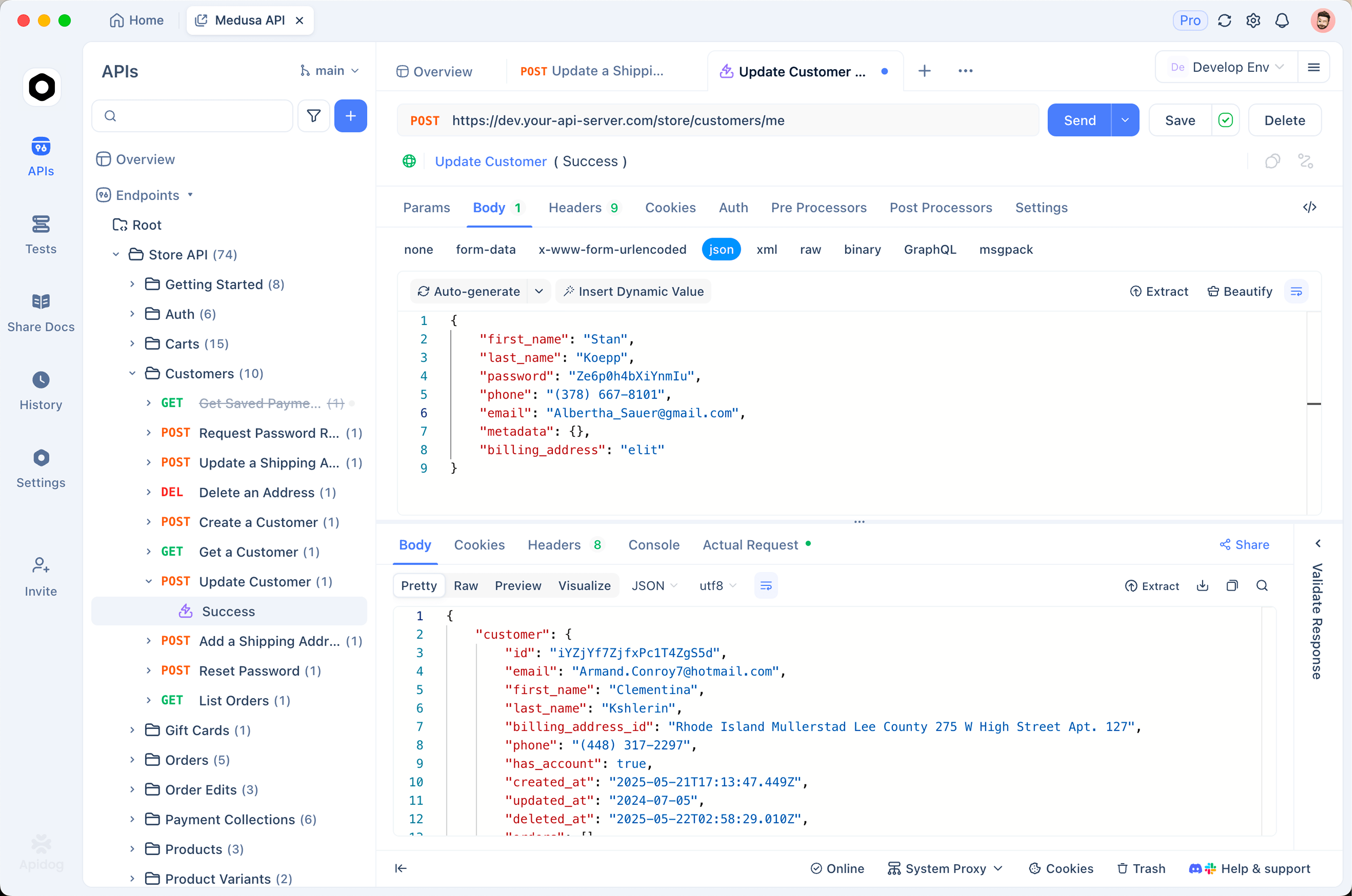
Against ReadyAPI specifically, four differences do the work:
- One price covers the platform. Free for up to 4 users, then $9 per user per month. Functional tests, performance tests, mocking, CI runs, and docs are all in that number. There is no module matrix and no floating-license spreadsheet.
- Tests are visual and collaborative. Scenarios chain endpoints, pass data between steps, run data-driven loops from CSV or JSON, and assert on anything in the response, all through a UI the whole team can read. Scripting exists for the edge cases, with Postman-compatible syntax instead of Groovy.
- The platform is real-time and cloud-synced, with desktop apps and a web client, so two testers editing a suite is normal work rather than an XML merge conflict.
- CI is a CLI.
npm install -g apidog-cli, run a scenario by ID, get an HTML report per build. It works identically in Jenkins, GitLab CI, and GitHub Actions.
What you keep, module by module
API Test module → visual scenarios
Everything the functional module does for REST APIs (chained requests, extractions, assertions, data-driven runs, scheduled executions) maps to Apidog’s test builder. Runs are unlimited on every plan, and results publish as shareable online reports without an export step.
API Performance module → built-in performance testing
Apidog reuses your functional scenarios for load testing: set virtual users and duration, run, and read throughput and latency results. It covers the load, stress, and spike patterns most API teams actually run. What it doesn’t replicate is LoadUI’s deep protocol-level tuning; if you’re modeling complex JMS traffic under load, that’s a genuine ReadyAPI strength.
Virtualization module → smart mocks
ReadyAPI’s ServiceV virtualizes services for isolated testing. Apidog’s smart mock engine covers the API-shaped part of that job with less setup: it reads your OpenAPI schema and serves realistic responses immediately, with custom mock expectations when you need fixed behaviors, and a self-hosted mock server when traffic can’t leave your network. Frontend and integration teams point at a URL and go.
Plus the parts ReadyAPI doesn’t do
The same spec that drives tests and mocks also generates interactive documentation on a custom domain, and an MCP server exposes your API definitions to AI coding agents; the details are in what is Apidog MCP Server. ReadyAPI is a testing product; Apidog is the API lifecycle, which is why switching often retires two or three tools at once.
ReadyAPI vs Apidog at a glance
| ReadyAPI | Apidog | |
|---|---|---|
| Pricing | Quote-based; trackers list ~$829+/license/yr, modules extra | Free up to 4 users, then $9 per user/mo |
| Packaging | Test, Performance, Virtualization sold as modules | One platform, all plans include testing + mocking |
| Test authoring | UI + Groovy scripting | Visual orchestration + optional Postman-syntax scripts |
| Data-driven testing | Yes | Yes, CSV/JSON, all plans |
| Load testing | API Performance module | Included |
| Service virtualization | ServiceV: REST, SOAP, JMS, JDBC | Smart mocks: REST/HTTP, schema-aware, self-hostable |
| SOAP, JMS, JDBC testing | Deep, contract-driven | Basic XML-over-HTTP only |
| CI integration | Plugins + Java test runners, licensed agents | npm CLI, HTML report per run |
| Collaboration | Desktop app, XML project files | Real-time workspaces, desktop + web |
| API docs output | No | Yes, hosted, custom domain |
Read the SOAP/JMS/JDBC row carefully; it decides the migration question for a lot of enterprises, and it’s the row where ReadyAPI wins honestly.
Migrating from ReadyAPI
ReadyAPI projects don’t export to a neutral test format, so plan a rebuild rather than a translation:
- Import your API definitions. OpenAPI specs import directly, bringing endpoints, schemas, and examples. If your definitions live as Postman collections or cURL commands, those import too.
- Rebuild suites as scenarios, worst-first. Start with the suite that costs the most Groovy maintenance. Extraction chains become visual steps; XPath assertion gymnastics become field-level checks. Teams report the rebuilt suites are smaller because years of dead tests don’t survive the review.
- Move CI last. Keep ReadyAPI running in the pipeline until the Apidog scenario for each service goes green in parallel, then swap the pipeline step for the CLI command and reclaim the licensed build agents. The command surface is documented in how to manage APIs with Apidog CLI.
A mid-sized suite is a one-to-two sprint effort. The forcing function is usually the renewal date: teams start ninety days out and arrive at the negotiation with the option to say no.
When ReadyAPI still makes sense
Be honest about three cases. If your estate includes WSDL-driven SOAP, JMS queues, or JDBC-level virtualization, ReadyAPI’s protocol depth has no equal in Apidog, and we’d point you at the SoapUI-lineage comparison before any migration decision. If compliance requires virtualizing exact legacy behaviors (mainframe-fronting middleware, message brokers), ServiceV is the specialist. And if your organization is committed to the SmartBear stack across TestComplete and friends, consolidation cuts the other way. The switch pays off when your testing is REST, GraphQL, and gRPC, and the module pricing plus Groovy maintenance outweigh the protocol depth you’re not using.
Frequently asked questions
How much does ReadyAPI cost compared to Apidog?
ReadyAPI pricing is quote-based; public trackers list entry pricing around $829 per license per year, with multi-module enterprise configurations commonly landing between $1,000 and $6,000 per license. Apidog is free for up to 4 users and $9 per user per month after, with testing, performance, mocking, and docs included.
Can Apidog replace ReadyAPI’s data-driven tests?
Yes. Apidog scenarios iterate over CSV or JSON data sets, pass values between steps, and assert per iteration, without Groovy. Data-driven testing is available on every plan, including free.
Does Apidog do load testing like ReadyAPI’s API Performance module?
Apidog includes performance testing that reuses your functional scenarios with configurable virtual users and duration, reporting throughput and latency. For protocol-level load modeling beyond HTTP APIs, ReadyAPI’s dedicated module goes deeper.
Can Apidog test SOAP services?
It can send XML bodies over HTTP, which covers simple SOAP endpoints. It doesn’t import WSDLs or virtualize JMS/JDBC. If those are core to your work, ReadyAPI remains the specialist tool.
What replaces the ReadyAPI test runner in Jenkins?
The Apidog CLI: apidog run scenario --scenario-id 12345 --env staging. No Java, no license check on the agent, and an HTML report per run you can archive as a build artifact.
Run the numbers before renewal
Take one licensed seat’s annual cost and compare it to a year of Apidog for your whole team. Then take one ReadyAPI suite and rebuild it as a scenario. Download Apidog; your team of 4 evaluates free, the CLI wires into the same pipeline, and the renewal conversation gets a lot shorter.