

Mintlify made developer docs beautiful, and a quarter of the recent YC batch runs on it. It also repriced for the AI era: the Pro plan now lists at $540 per month (or $450 per month billed annually) with 10,000 AI credits included and overages at $0.01 per credit, per Mintlify’s pricing page. SSO, RBAC, and audit logs sit in the custom-priced Enterprise tier. If you’re searching for a Mintlify alternative, it’s usually because the docs bill started looking like an engineering line item, or because your gorgeous API reference keeps describing endpoints that no longer behave that way.
Here’s the direct answer: for API documentation, Apidog is the best Mintlify alternative. It generates interactive docs from the same OpenAPI spec your team designs, tests, and mocks against, publishes them on your own domain, and its free plan covers 4 users with no flat platform fee. This article lays out where Mintlify’s model pinches, what Apidog does differently, and the cases where Mintlify is still the right buy.
Where the Mintlify model pinches
A flat fee plus a meter
Mintlify’s Starter tier is genuinely generous: free, with a custom domain, web editor, and API playground. The next step is the jump. Pro lists at $540 per month ($450 annual), and the AI features that define the product (Assistant, Agent, Automations) draw down a 10,000-credit monthly allowance with $0.01-per-credit overages. Costs scale with how much your docs get used by AI, which is precisely the axis growing fastest. Teams doing this math have kept our Mintlify review with pricing and alternatives in the top of the docs-category traffic for a year.
Enterprise basics live behind “contact us”
Dashboard SSO, SCIM, role-based permissions, audit logs, self-hosting, and EU hosting are all Enterprise-tier features. A 20-person company that needs SSO for compliance is negotiating a custom contract for a docs site.
The reference is a rendering, not a source of truth
This is the structural point, and it applies to every docs-first platform including Docusaurus and Scalar. Mintlify consumes your OpenAPI file and renders a playground from it. It has no idea whether the spec is true: nothing in Mintlify runs requests against your API in CI, serves mocks to your frontend team, or fails a build when a response schema drifts. The docs are only as accurate as the file someone remembered to regenerate, and the “docs say X, API does Y” ticket arrives eventually regardless of how beautiful the page is.
The bill at team scale
Because Mintlify charges a flat platform fee and Apidog charges per seat, the comparison depends on team size. Annual cost for a team on Mintlify Pro (at the $450 per month annual rate, before any AI credit overages) against Apidog:
| Team size | Mintlify Pro per year | Apidog per year | Difference |
|---|---|---|---|
| 3 people | $5,400 | $0 (free plan) | $5,400 |
| 5 people | $5,400 | $540 | $4,860 |
| 10 people | $5,400 | $1,080 | $4,320 |
| 25 people | $5,400 | $2,700 | $2,700 |
The honest caveats: Mintlify’s free Starter tier is unusually strong, so a small team that fits inside it pays nothing and this table doesn’t apply. The Mintlify column also assumes zero credit overages; heavy Assistant usage adds $0.01 per credit on top. And past roughly 50 seats the per-seat model catches up on paper, though teams that size are usually negotiating Mintlify Enterprise for SSO anyway, which is custom-priced. For API-focused teams under that bar, the gap funds real engineering time.
The answer: Apidog
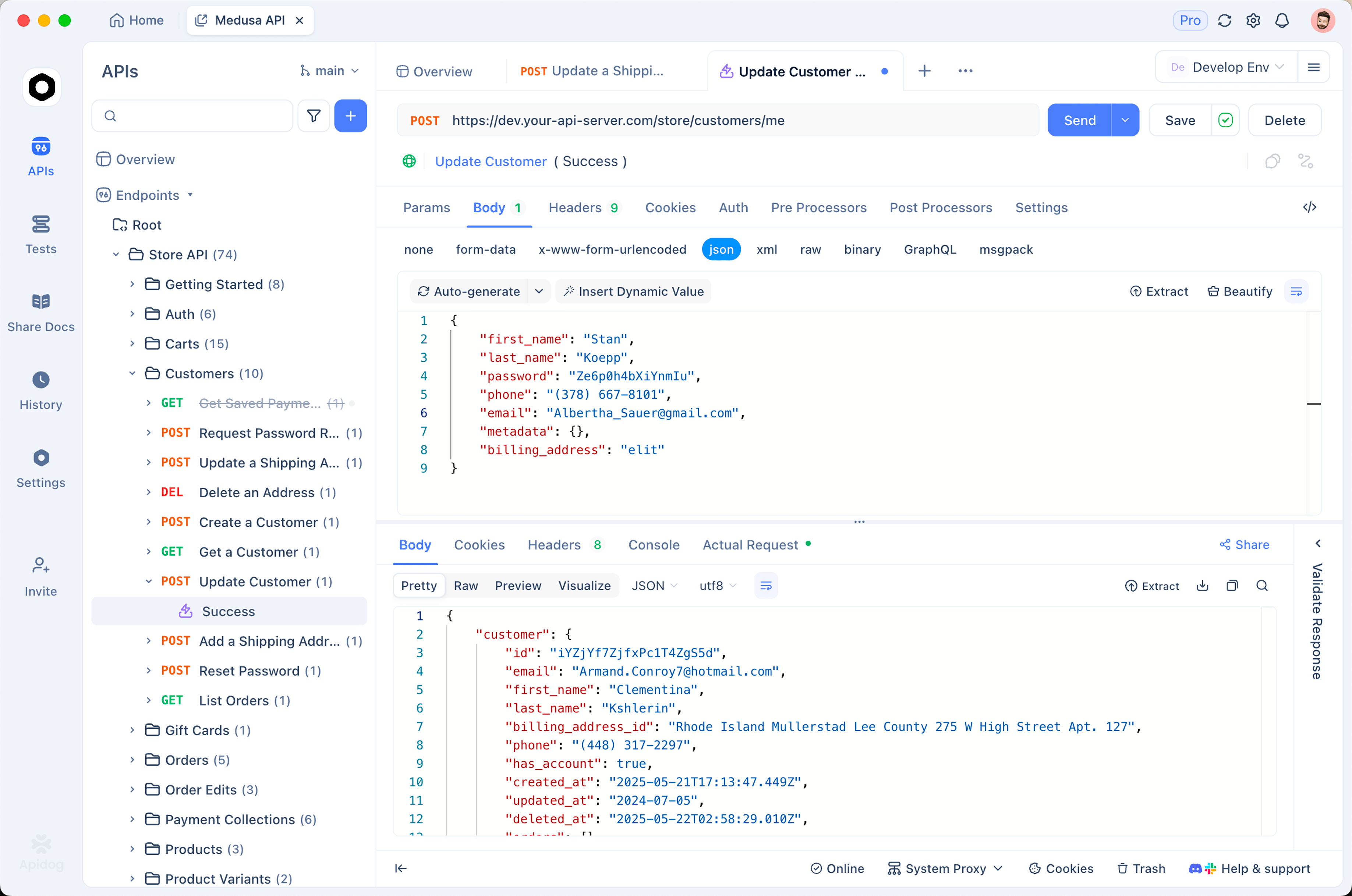
Apidog is an API development platform used by over 500,000 developers. Documentation is one of its outputs, generated from the spec your team actually works in, next to design, debugging, testing, and mocking.
Compared with Mintlify:
- Docs can’t drift from the API, because they’re generated from the spec your automated tests exercise. Change the spec and docs, mocks, and tests move together. There’s no regenerate-and-commit step to forget.
- Per-seat pricing, no meter. Free for up to 4 users, then $9 per user per month. A 5-person API team pays $45 a month against Mintlify Pro’s $450-540 flat.
- The playground has a mock behind it. The try-it console runs against real environments or Apidog’s schema-aware smart mock server, so consumers can explore an API that isn’t deployed yet, with realistic generated data.
- AI consumption is built in without credits. Specs publish through an MCP server so agents like Claude Code read the definition directly; see what is Apidog MCP Server.
What changes in practice
One source of truth instead of two repos
A Mintlify setup typically means a docs repo holding MDX and an OpenAPI file, maintained separately from the codebase that defines the API. Apidog collapses that: the spec lives in the platform, every teammate works against it, and the published docs are one of its outputs rather than a downstream copy.
The API reference writes itself
In Mintlify, the reference is MDX pages plus an imported OpenAPI file, maintained by whoever owns docs. In Apidog, endpoints documented in the designer are the reference; descriptions, examples, and schemas live once. Guides and non-reference pages are standard Markdown pages in the same published site, with versioning and custom domain included.
Docs consumers get a working API on day zero
Publish the docs and the smart mock is one toggle away: a field named email returns an email, created_at returns a timestamp. Frontend and partner teams build against the mock URL while the backend lands. Mintlify has no equivalent; its playground needs a live server to be more than a form.
The docs join the test loop
The same spec runs visual test scenarios on a schedule and in CI via the Apidog CLI, with unlimited runs on every plan. When a test catches a schema change, the fix updates the docs automatically. Docs accuracy stops being an editorial process and becomes a side effect of testing.
What you give up
Mintlify’s design polish is real and Apidog doesn’t match it for narrative content: no MDX components, no bespoke landing-page design system, no AI writing assistant embedded in a web editor. Apidog’s docs are clean, interactive, and correct, but they look like excellent API docs, not like a marketing site. Weigh that honestly against what the flat fee buys.
Mintlify vs Apidog at a glance
| Mintlify | Apidog | |
|---|---|---|
| Free tier | Starter: custom domain, playground, MCP server | 4 users, full platform incl. docs, tests, mocks |
| First paid tier | Pro, $540/mo ($450 annual) + AI credit overages | $9 per user/mo |
| SSO, SCIM, RBAC, audit logs | Enterprise (custom pricing) | Enterprise plan |
| Self-hosting / EU hosting | Enterprise | EU data residency available |
| API playground | Yes, against live API | Yes, against live API or built-in mock |
| Mock server | No | Yes, schema-aware, self-hostable |
| API testing / CI | No | Yes, unlimited runs, CLI |
| Spec editing | No (renders your file) | Yes, visual + code, branch review |
| MDX components, design system | Excellent | Markdown pages, standard layouts |
| AI assistant on docs | Yes, credit-metered | MCP server for agent consumption |
Migrating from Mintlify
- Import the OpenAPI spec into Apidog. The reference generates immediately: grouped endpoints, schemas, try-it console.
- Move guides. Mintlify content is MDX in a Git repo; standard Markdown pastes straight into Apidog doc pages, while custom components get flattened to plain Markdown. This is the manual part; budget it proportional to how much MDX you wrote.
- Repoint the custom domain and add redirects for changed paths.
- Turn on the parts Mintlify never had: enable the mock server, build one smoke-test scenario, and schedule it. Your docs are now downstream of a verified spec.
A reference-heavy site moves in a day. A content-heavy site is a content-migration project, and if that describes you, read the honest section below first.
When Mintlify still makes sense
If your docs are a product surface (polished guides, branded landing pages, an AI assistant answering user questions in-page) and a big share of pages aren’t API reference at all, Mintlify is built for exactly that and the free Starter tier is a gift. If your docs team lives in MDX and Git-based content workflows, Apidog’s Markdown pages will feel spartan. And if AI-assisted authoring matters more to you than spec accuracy, Mintlify’s Agent and Assistant have no Apidog counterpart. The switch pays off when the API reference is the heart of your docs, the flat fee plus credits outruns the value, and drift between spec and reality is generating support load. For the docs-platform field more broadly, our ReadMe comparison and GitBook alternatives map the same trade from different corners.
Frequently asked questions
How much does Mintlify cost in 2026?
Starter is free. Pro lists at $540 per month, or $450 per month billed annually, including 10,000 AI credits monthly with overages at $0.01 per credit. Enterprise (SSO, SCIM, RBAC, audit logs, self-hosting, EU hosting) is custom-priced.
Is Apidog free for publishing API docs?
Yes. The free plan covers 4 users and includes publishing interactive documentation with a try-it console. Paid plans start at $9 per user per month rather than a flat platform fee.
Can Apidog docs match Mintlify’s design?
Apidog docs are interactive, versioned, and publishable on your domain with custom layouts, but Mintlify’s MDX design system and narrative polish are stronger. Choose on whether reference accuracy or content design is your bottleneck.
What happens to my Mintlify MDX content?
Standard Markdown migrates directly into Apidog doc pages. Custom MDX components need rewriting as plain Markdown. The OpenAPI-driven reference, by contrast, regenerates automatically from the imported spec.
Does Apidog support AI features like Mintlify’s assistant?
Different model: instead of a credit-metered chat assistant on the docs page, Apidog exposes your API spec through an MCP server so coding agents consume the definition directly, without per-query credits.
Publish docs that stay true
Import your spec, publish the reference on your domain, and let your test suite keep it honest. Download Apidog; a team of 4 pays nothing, and the first time a scheduled test catches a schema change before your users do, the platform has paid for itself. The side-by-side is on the Apidog vs Mintlify comparison page.