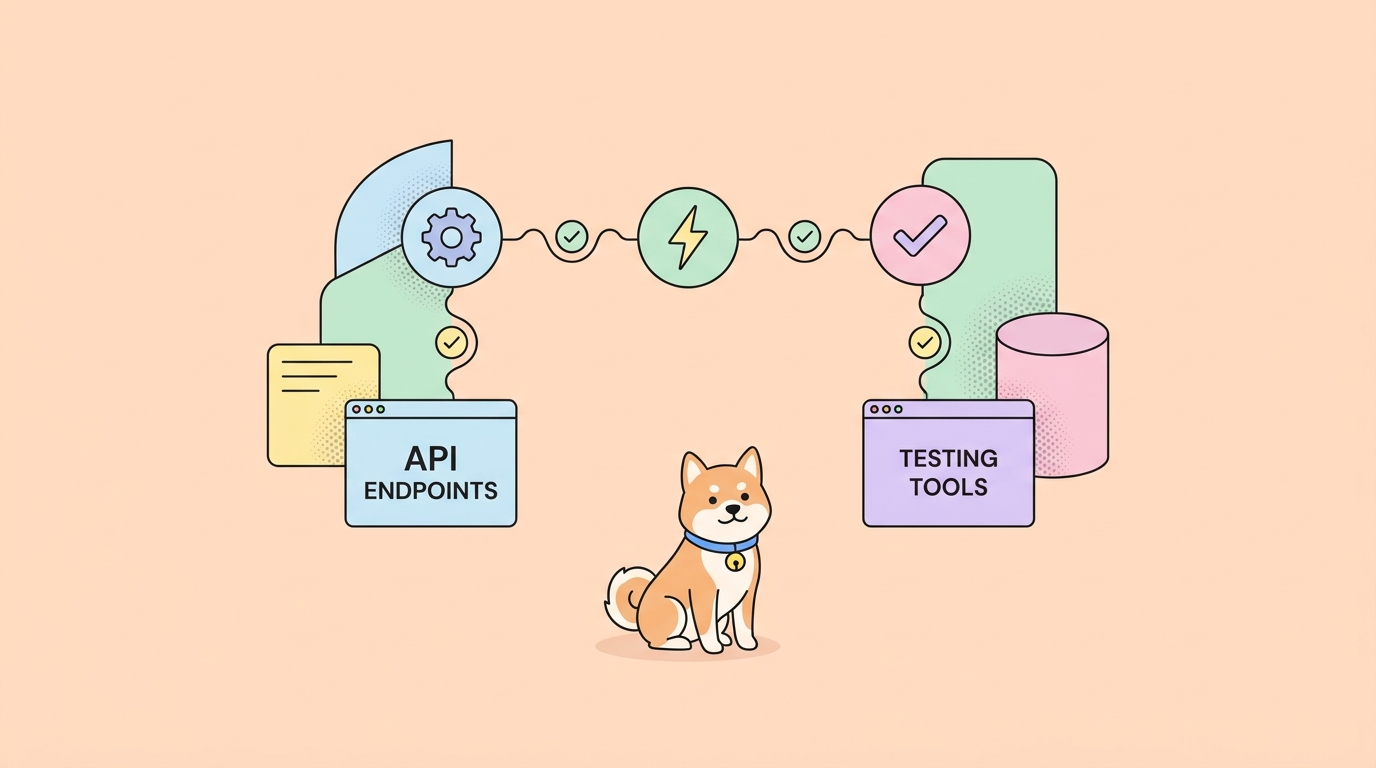
Insomnia is a good API client. That sentence is also the whole problem: it’s a client. It sends requests, debugs responses, and stops there. Documentation, mocking, automated testing, and team workflows all live somewhere else, and you’re the integration layer holding them together.
Why developers look beyond Insomnia
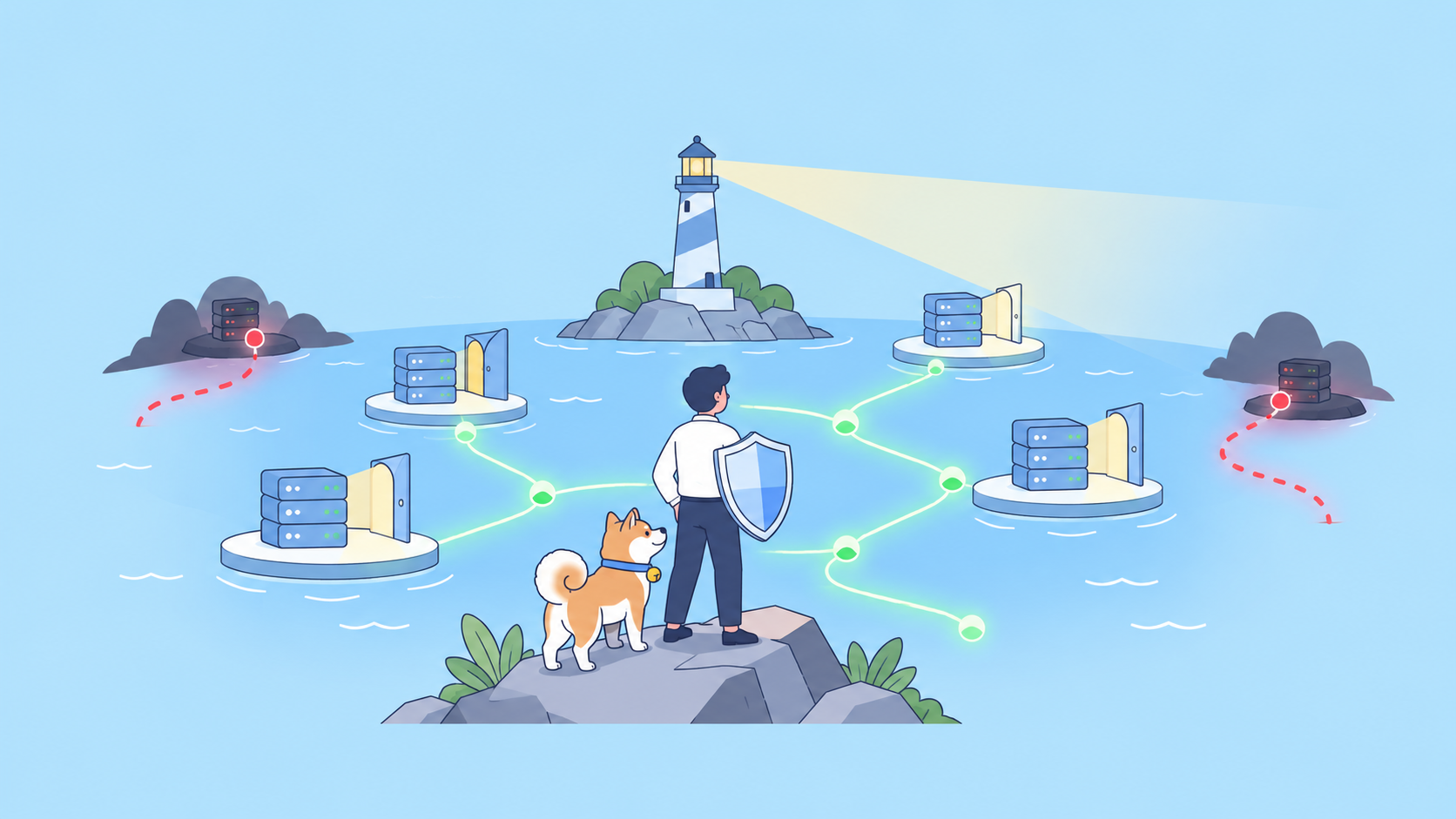
The trust wobble never fully healed
When Kong shipped Insomnia 8.0 in 2023, it required an account and pushed local data into cloud sync. The backlash was loud enough that Kong restored local-only storage in Insomnia 8.3, and today you can choose Local Vault, Git Sync, or Cloud Sync. Credit where due: the fix shipped. But plenty of developers used that 8.0 episode as the reason to survey the field, and many never came back. We wrote up the landscape they found in 17 best Insomnia alternatives.
The 8.0 storage episode, in order
The sequence matters, because it explains why “Insomnia alternative” became a search term in the first place:
- 2023: Insomnia 8.0 ships. The release required a Kong account to use the app, and data that had lived only on your machine started moving toward cloud sync. Developers opened their API client one morning and found the storage model changed underneath them.
- The backlash. The GitHub discussion Kong opened for the release filled with objections, most of them about one point: request collections often contain tokens, internal hostnames, and unreleased endpoints, and none of that should leave the machine without a deliberate choice.
- October 2023: Insomnia 8.3. Kong responded and restored local-only projects with Local Vault.
- Today. Insomnia offers three storage modes: Local Vault for local-only work, Git Sync for spec-in-repo teams, and Cloud Sync for hosted collaboration.
Read fairly, this is a story of a vendor making a mistake and correcting it within months. The problem is what happened in between. Once a developer exports their collections to evaluate the field, the switching cost they assumed was high turns out to be an afternoon. Kong fixed the storage model; it couldn’t fix the fact that thousands of users had already run the comparison.
Debugging is where Insomnia stops
Run through a normal API workflow and count the gaps:
- Documentation. Insomnia has no way to publish API docs. Teams pair it with a separate docs tool and keep the two in sync by hand.
- Mocking. No smart mock engine, no cloud mock server your frontend team can hit while the backend is in progress.
- Automated testing. Basic test suites exist, but there’s no visual orchestration, no scheduled runs, no performance testing, no online test reports, and no self-hosted runner. CI means wiring up the inso CLI, which has its own limits; we compared the best Insomnia CLI alternatives separately.
- Design sync. Insomnia can hold an OpenAPI spec, but the spec and your requests don’t stay linked. Change one, manually chase the other.
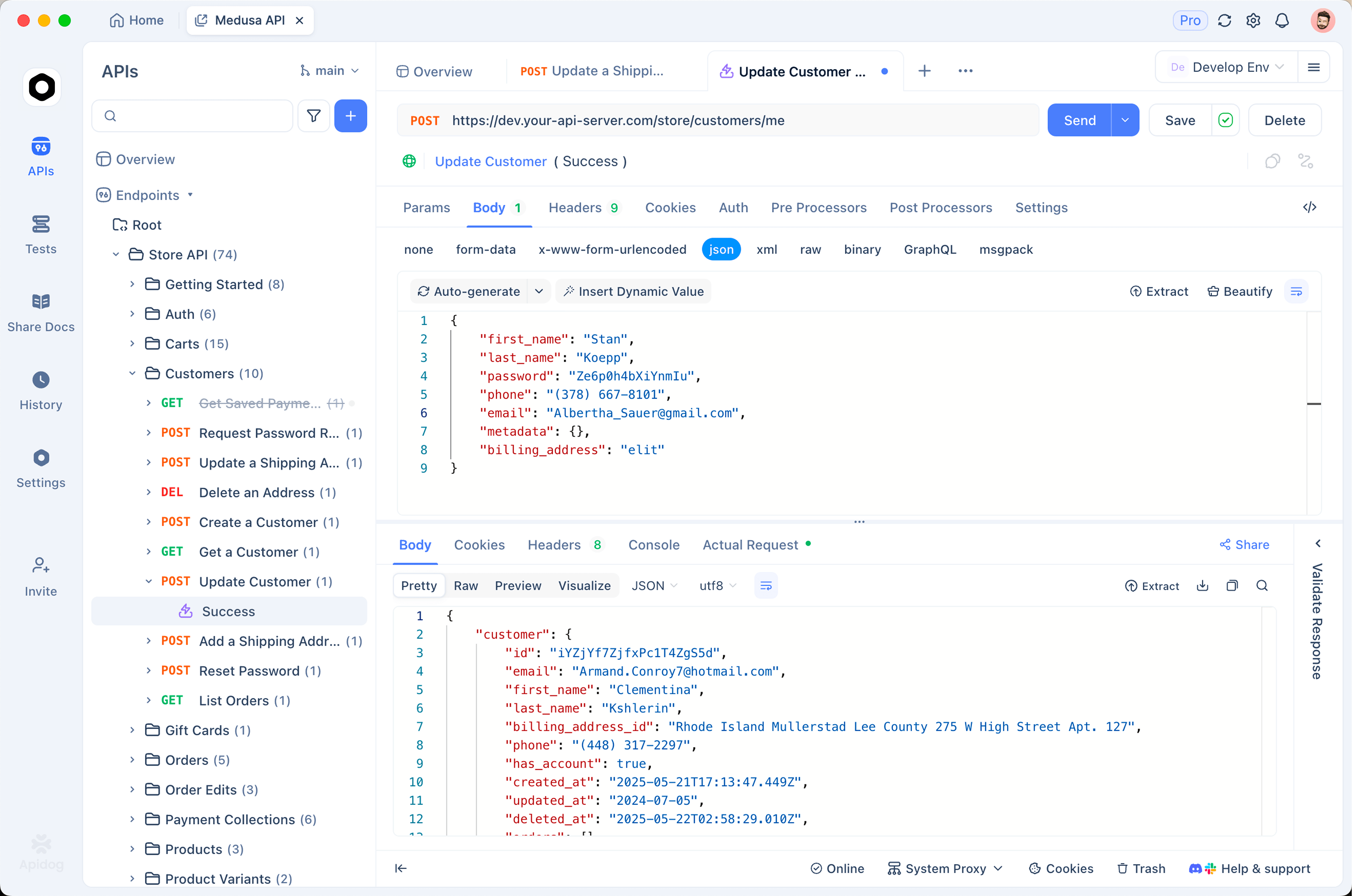
Each gap is another tool, another subscription, another sync problem.
The answer: Apidog
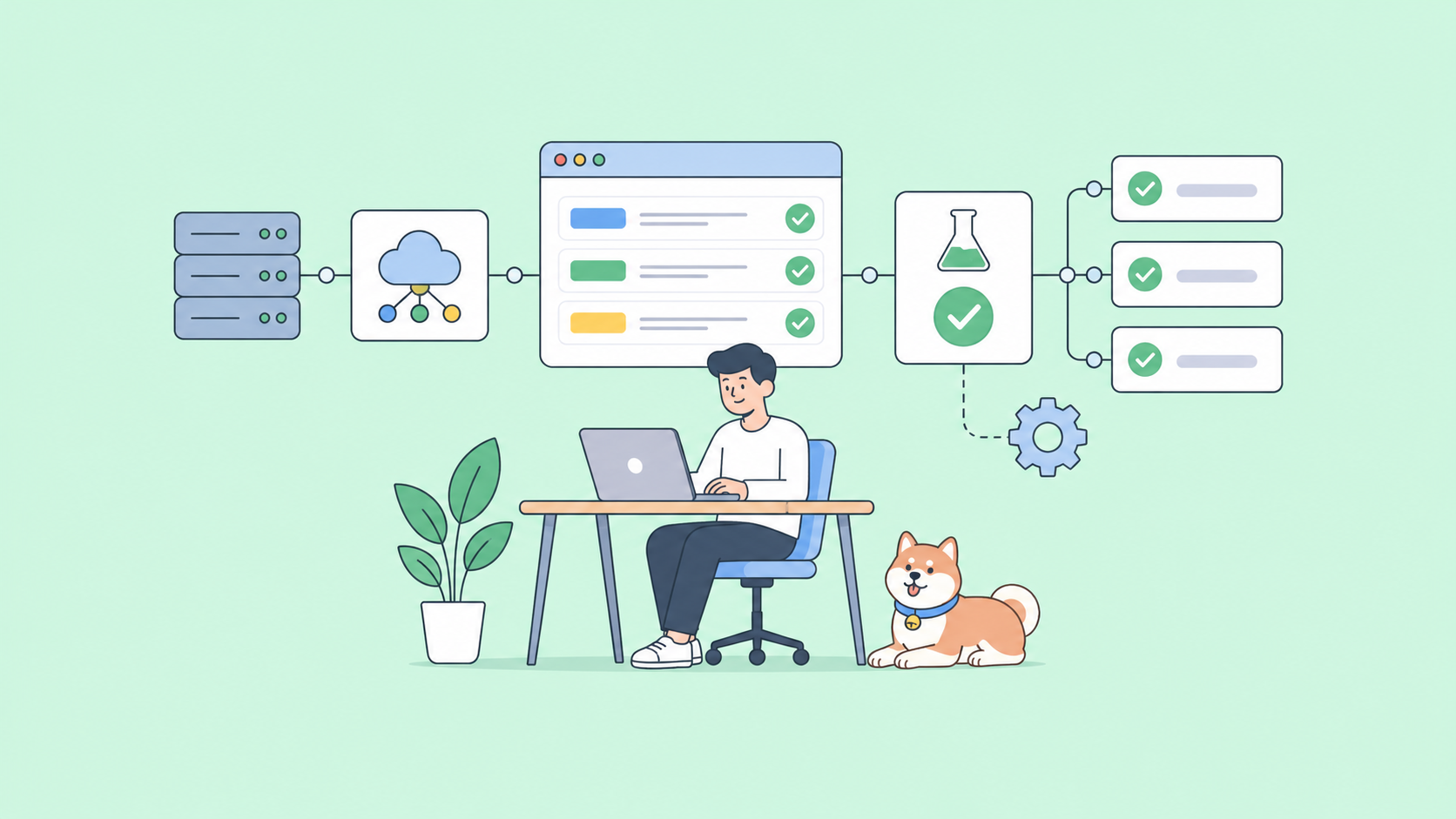
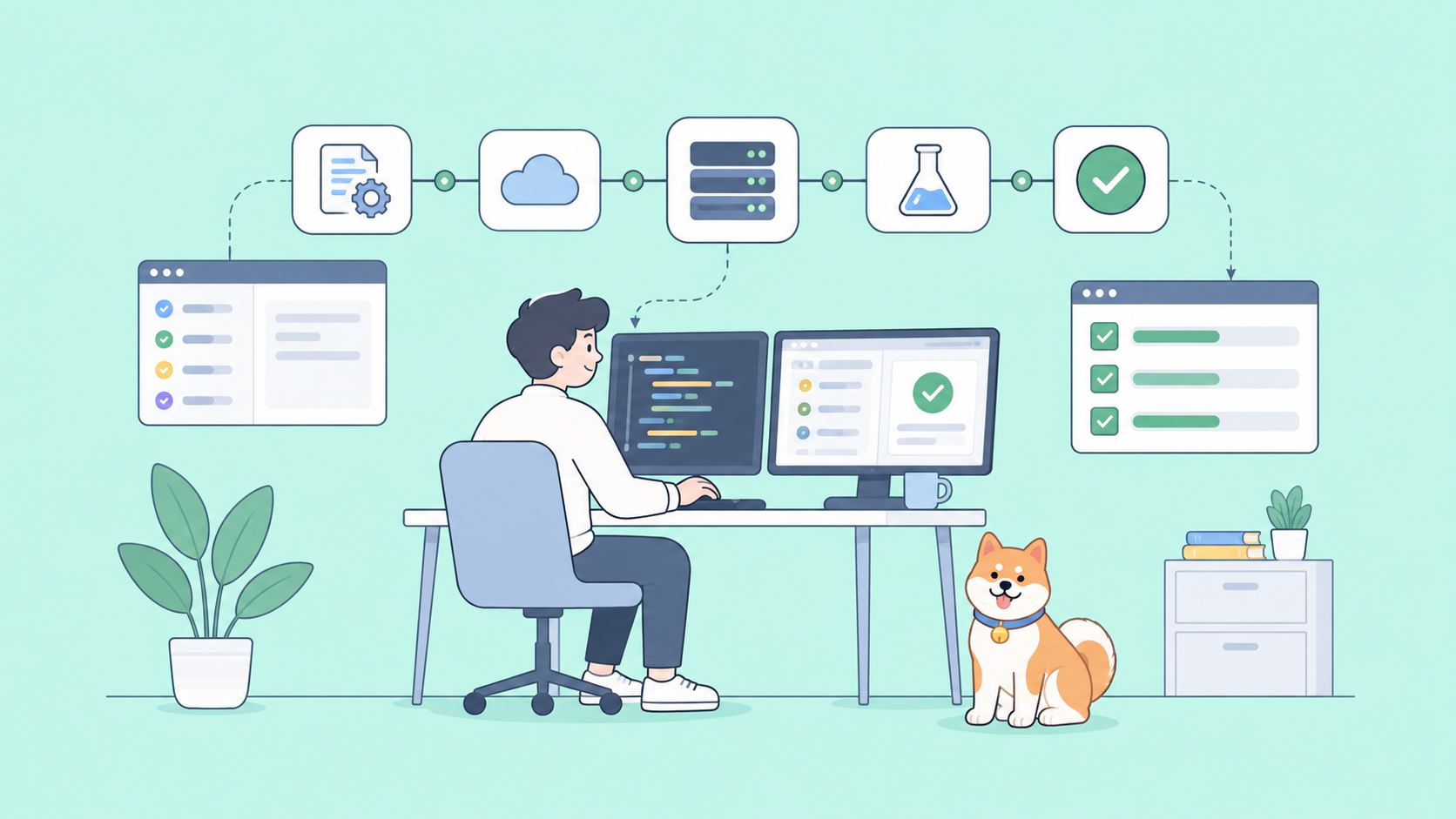
Apidog is an all-in-one API development platform used by over 500,000 developers. Design, debugging, testing, mocking, and documentation share one workspace and one source of truth: your API spec. Update the spec once and endpoints, docs, mocks, and tests stay aligned across the team.
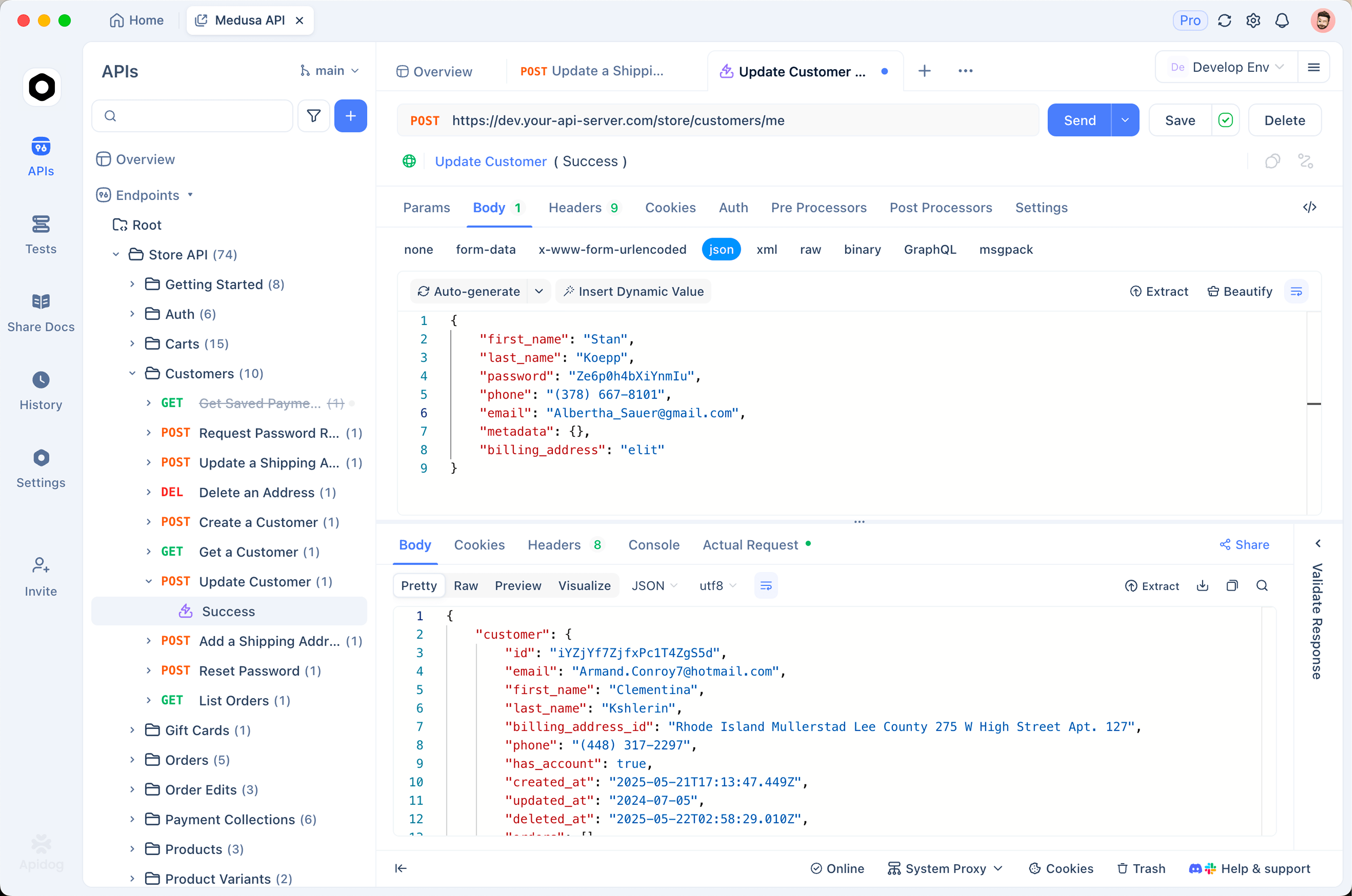
Everything your client does, plus the rest of the lifecycle
Apidog debugs HTTP, GraphQL, WebSocket, SSE, SOAP, and gRPC with pre/post-request scripts, response validation, and database connections. From there, the platform keeps going:
- Interactive documentation published from your spec, with custom domains, custom layouts, Markdown pages, versioning, and a live “try it” console for internal or public consumers.
- Zero-config smart mocking that generates realistic responses from your JSON Schemas automatically. Frontend development starts before the backend is ready, with no mock definitions to write.
- Visual automated testing with drag-and-drop scenarios, assertions, dynamic variables, and reusable steps, running in GitHub Actions, GitLab CI, or Jenkins, plus scheduled tasks, performance tests, and shareable reports.
Local-first privacy, without the history
If the 8.0 episode is what soured you, this matters: Apidog offers a local Offline Space for sensitive API data, alongside role-based permissions, team workspaces, and project-level access control when you collaborate. Privacy and teamwork are both first-class, not a trade-off.
Built for AI-assisted development
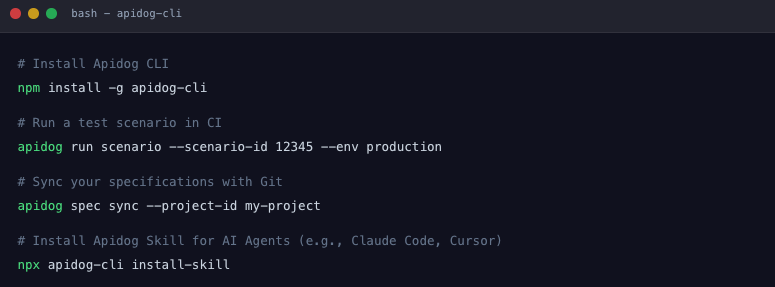
Apidog ships an MCP server that exposes your specs to AI assistants, a visual MCP client for debugging MCP servers over STDIO and streamable HTTP, and a CLI designed for agents like Claude Code and Cursor to run tests, update docs, and manage mocks from the terminal:
npm install -g apidog-cli
npx apidog-cli install-skill
Insomnia has nothing comparable. For agent-era workflows, see what is Apidog MCP Server.
Insomnia vs Apidog at a glance
| Insomnia | Apidog | |
|---|---|---|
| API debugging (REST, GraphQL, WebSocket, gRPC) | Yes | Yes |
| SOAP support | No | Yes |
| Spec-to-request sync | Manual | Automatic |
| Published API documentation | No | Custom domain, versioned |
| Smart schema-based mocking | No | Yes |
| Visual test orchestration | No | Yes |
| Scheduled runs and performance tests | No | Yes |
| Self-hosted runner | No | Yes |
| MCP client and AI-agent CLI | No | Yes |
| Free plan users | 3 | 4 |
| Paid entry price | $12/user/mo | $9/user/mo |
Migration takes one click
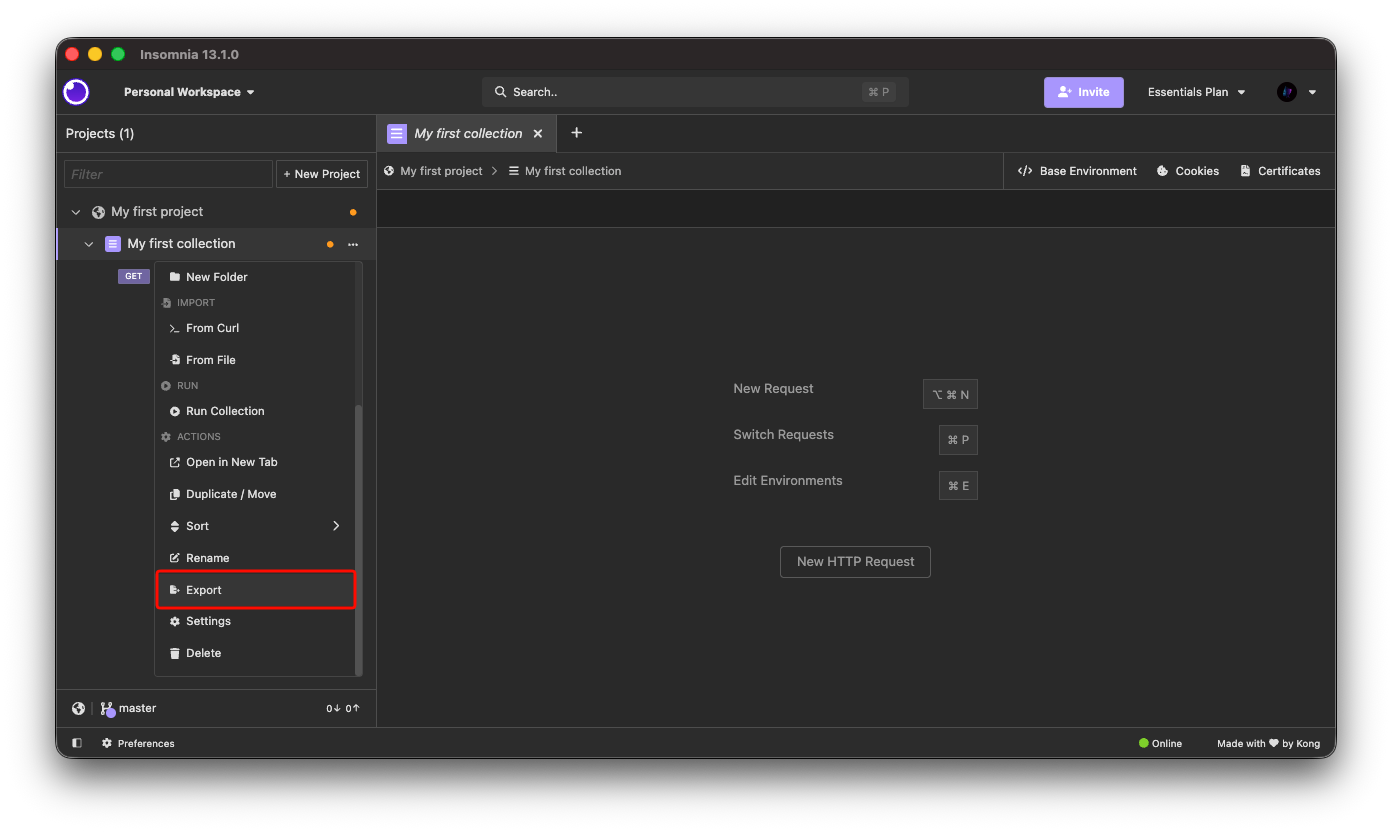
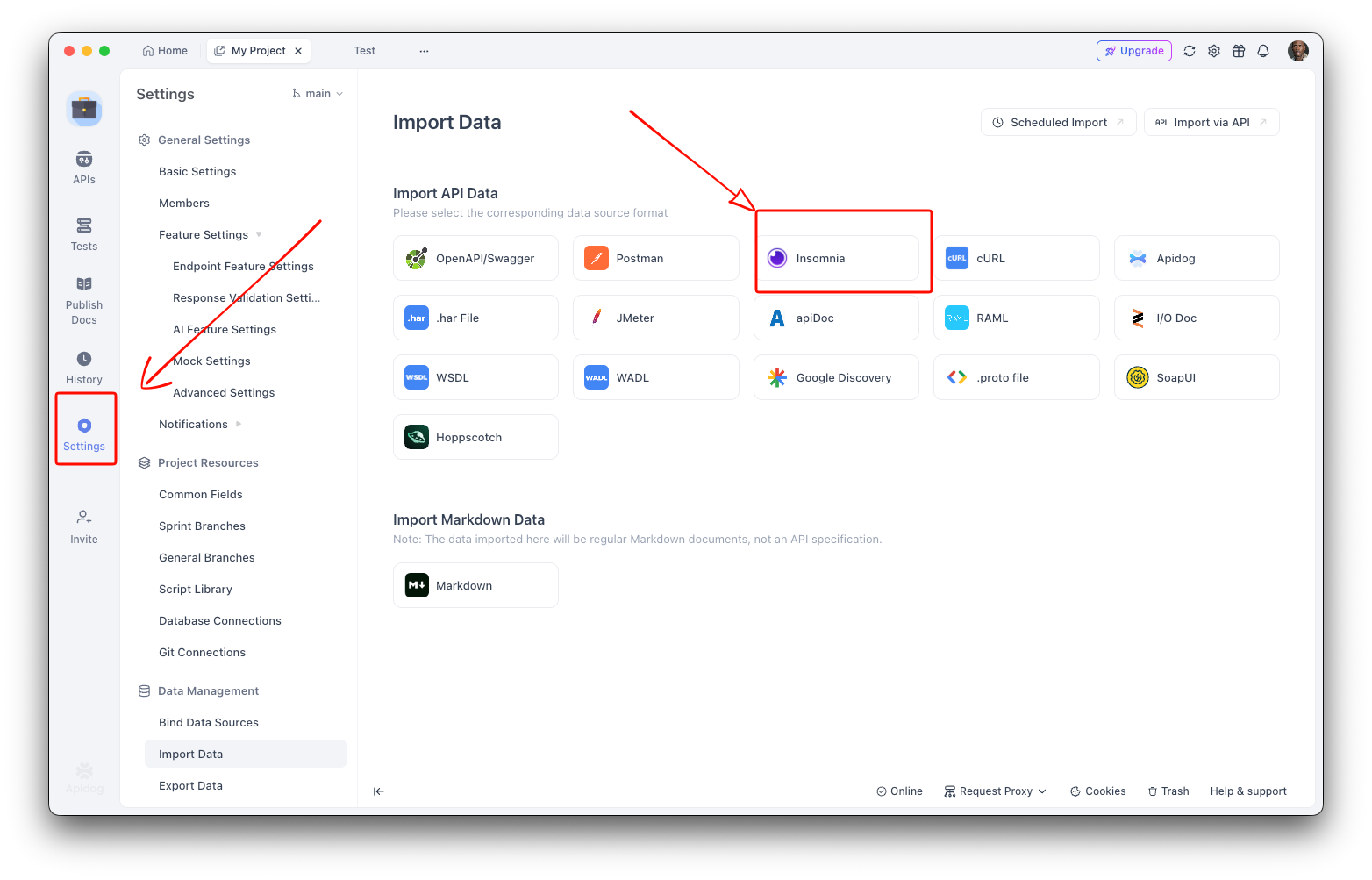
Apidog imports Insomnia collections and environments directly. Export from Insomnia, import into Apidog, and your requests, folders, and variables arrive intact.
From there, generate a spec from your existing requests to bootstrap the design-first workflow, then let docs and mocks build themselves from it.
From imported collection to full lifecycle in a day
Here’s what the first day on Apidog looks like for a team coming from Insomnia. None of it needs a script or a migration plan; this is the standard path.
Morning: import and verify. Export your Insomnia workspace and import it into Apidog with one click. Collections, folders, environments, and variables arrive as they were, and your requests run as-is. The team keeps debugging while the rest gets set up around them.
Mid-morning: generate the spec. Apidog generates an OpenAPI spec from the imported requests. This is the pivot point of the migration: instead of a pile of saved requests, you now hold a structured contract that the rest of the platform reads from.
Midday: docs and mocks light up. With the spec in place, publish interactive documentation: a try-it console, Markdown pages, versioning, and a custom domain if you want one. The smart mock engine reads the JSON Schemas in the same spec and starts returning realistic responses with zero configuration. Your frontend team gets working endpoints before the backend is finished, and nobody wrote a single mock definition.
Afternoon: one test scenario into CI. Pick a flow that matters (log in, create a resource, verify it, clean up) and build it as a visual test scenario: drag the requests into order, add assertions, and pass a value from one response into the next request. Run it locally, then wire the same scenario into GitHub Actions, GitLab CI, or Jenkins.
By the end of the day, the spec drives requests, docs, mocks, and one real test. Every endpoint you add afterward follows the same track: design it once, and the rest stays aligned on its own.
inso vs apidog-cli in CI
Both tools ship a CLI, and the gap between them mirrors the gap between the platforms.
inso, Insomnia’s CLI, runs collections and lints OpenAPI specs in CI. That covers the request-runner half of automation: your pipeline replays saved requests and fails the build when a contract check breaks. It does that job fine; we compared it against the field in the best inso alternatives.
apidog-cli automates the full test layer, not requests alone:
- It executes complete visual test scenarios, with assertions, dynamic variables, and data passing between steps, not flat collection runs.
- Every run produces an HTML report you can attach to the build or share with the team.
- Scheduled tasks run suites on a timer with no CI job at all.
- A self-hosted runner executes tests inside your own network, against services that never touch the public internet.
npx apidog-cli install-skilladds an agent skill, so Claude Code, Cursor, or Codex can run tests, update docs, and manage mocks from the terminal on your behalf.
The short version: inso automates requests, apidog-cli automates the API lifecycle. For the full command surface, see how to manage APIs with the Apidog CLI.
Built for teams, cleared for enterprises
Pricing first, since it’s the simple part. Apidog’s free plan covers 4 users to Insomnia’s 3, and paid plans start at $9 per user per month against Insomnia’s $12. The lower price buys more of the lifecycle, not less.
For organizations with compliance requirements, Apidog adds SSO with Okta and Microsoft Entra ID, SCIM provisioning so accounts are created and revoked from your identity provider, and role-based access control down to the project level. European teams can choose Apidog Europe, a GDPR-compliant deployment with data held in AWS Ireland and Germany. The self-hosted runner keeps test traffic inside your network, and Offline Space keeps designated projects on the developer’s machine entirely.
None of that comes at the cost of approachability. On G2, users rank Apidog #1 for ease of use, with a 9.4 usability score and a 4.8 out of 5 overall rating.
When Insomnia is still enough
If you’re a solo developer who debugs requests and nothing more, Insomnia with a Local Vault remains a clean, open-source client, and its Git-based storage suits spec-in-repo purists. The switch pays off when your work extends past debugging: the moment you need published docs, mocks for a frontend team, or automated tests in CI, staying on a pure client means buying and syncing other tools. That’s the moment browser-based and single-purpose clients stop scaling.
Frequently asked questions
How do I migrate from Insomnia to Apidog?
Export your Insomnia data and import it into Apidog in one click. Collections, folders, environments, and variables carry over, and you can generate an OpenAPI spec from the imported requests afterward.
Does Apidog have a free plan for teams?
Yes, up to 4 users free with unlimited APIs, requests, and test runs. Insomnia’s free tier covers 3 users, and its paid team plans start at $12 per user per month against Apidog’s $9.
Can Apidog keep my API data local like Insomnia’s Local Vault?
Yes. Apidog’s Offline Space keeps sensitive projects on your machine. You choose per project whether to work locally or collaborate in a shared workspace.
Does Apidog work in CI/CD pipelines?
Yes. The Apidog CLI runs test scenarios in Jenkins, GitLab CI, or GitHub Actions with HTML reports per build, plus scheduled runs and a self-hosted runner; see the overview of the Insomnia API and its best alternative for how the two CLIs differ.
Is my data safe during migration?
Yes. The import reads a file you export from Insomnia locally; nothing is pulled from Kong’s cloud. After the import you decide per project where data lives: Apidog’s Offline Space keeps sensitive projects on your machine, while shared workspaces handle team collaboration. An internal-only API and a public one don’t have to share a storage model.
Does Apidog support gRPC and GraphQL like Insomnia?
Yes. Apidog debugs HTTP, GraphQL, WebSocket, SSE, and gRPC, matching Insomnia’s protocol coverage, and adds SOAP, which Insomnia doesn’t support. Pre-request and post-request scripts, response validation, and database connections are available across the debugger.
Try it against your real workflow
Download Apidog, import your Insomnia workspace, and rebuild one full flow: debug an endpoint, publish its doc, mock it, and put a test on it. If that loop takes one tool instead of four, the argument settles itself. The complete matrix is on the Apidog vs Insomnia comparison page.