
Claude Opus 5 is Anthropic’s newest Opus-tier model, released on July 24, 2026. Anthropic positions it for complex agentic coding and enterprise work, and the docs now name it the default starting point: if you are unsure which model to use, start with Claude Opus 5. The headline number is the price. Opus 5 costs $5 per million input tokens and $25 per million output tokens, the same rate as Opus 4.8 and half of what Fable 5 charges.
This guide covers the specs, the price-performance story, Anthropic’s launch benchmarks and how much weight to give them, the two API changes that break existing Opus 4.8 code, where you can run the model, and the ceiling Anthropic is upfront about. If you call the model over HTTP, you can send and inspect those requests in Apidog as you go.
Claude Opus 5 at a glance
| Spec | Value |
|---|---|
| API model ID | claude-opus-5 (no date suffix) |
| Released | July 24, 2026 |
| Context window | 1,000,000 tokens, default and maximum |
| Max output | 128,000 tokens on the Messages API; 300,000 on the Batch API with the output-300k-2026-03-24 beta header |
| Base pricing | $5 per million input tokens, $25 per million output tokens |
| Knowledge cutoff | May 2026 |
| Adaptive thinking | On by default |
| Effort levels | low, medium, high, xhigh, max; defaults to high |
| Priority Tier | Not supported |
| Availability | Claude API, claude.ai, Claude Code, Claude Cowork, Amazon Bedrock, Claude Platform on AWS, Google Cloud, Microsoft Foundry, GitHub Copilot |
Three of those rows deserve a second look.
The 1M context window is both the default and the maximum, and it needs no beta header. There is also no long-context premium, so a 900,000-token prompt bills at the same per-token rate as a 900-token one.
The May 2026 knowledge cutoff is the freshest of any current Claude model. Fable 5 and Sonnet 5 both sit at January 2026, so Opus 5 knows about roughly four extra months of libraries, releases, and API changes without you having to paste them in.
Priority Tier is the one feature that moved backwards. Opus 4.8 supports it; Opus 5 does not. If your enterprise capacity planning depends on Priority Tier, that is a real constraint and it is covered in the migration guide.
For the full model table and every field verbatim, Anthropic’s models overview is the source of record.
What Claude Opus 5 is
Opus 5 is the successor to Claude Opus 4.8. The API model ID is the exact string claude-opus-5. On Amazon Bedrock the ID is anthropic.claude-opus-5, and on Google Cloud it is claude-opus-5 again. Claude Platform on AWS uses the first-party ID.
The Opus tier has always been Anthropic’s heavyweight line, sitting above Sonnet and below the Fable and Mythos research-frontier models. What changed with Opus 5 is that the tier stopped being the expensive option you escalate to. Anthropic’s docs now tell you to start here, which is a different posture from the 4.x generation, where Sonnet was the default and Opus was the upgrade.
The model is also becoming the default for Max subscribers and the highest-performing model available on Pro, which is the first time an Opus-class model has been the ceiling for a mid-priced consumer plan. The free and cheapest-paid paths piece walks through what that actually gets you.
The price-performance story
This is the part every launch-day article led with, and it holds up when you look at the pricing page.
| Rate | Input (per M tokens) | Output (per M tokens) |
|---|---|---|
| Standard | $5.00 | $25.00 |
| Batch API (50% off) | $2.50 | $12.50 |
| Fast mode (research preview) | $10.00 | $50.00 |
| Cache write, 5 minute TTL | $6.25 | n/a |
| Cache write, 1 hour TTL | $10.00 | n/a |
| Cache hits and refreshes | $0.50 | n/a |
Claude Fable 5 charges $10 and $50. Opus 5 charges $5 and $25 for a model Anthropic claims lands within half a percent of Fable 5 on agentic coding. That is the whole pitch: frontier-class output at half the frontier price.
A few less obvious levers sit inside that table. The prompt caching minimum dropped to 512 tokens, down from 1,024 on Opus 4.8, so system prompts that were previously too short to cache now cache with no code change at all. Cache hits cost $0.50 per million, a tenth of the base input rate. The Batch API halves everything for work that can wait. And the tool-use system prompt overhead is slightly cheaper than 4.8, at 286 tokens for auto or none tool choice versus 290 on Opus 4.8 and 675 on Opus 4.7.
Two cost details catch people out. Fast mode doubles the rate to $10 and $50 in exchange for roughly 2.5x output speed, and it only runs on the first-party API: not Bedrock, not Google Cloud, not Microsoft Foundry, and not with the Batch API. Separately, setting inference_geo: "us" applies a 1.1x multiplier across every token category, so US-pinned inference is a 10% surcharge on input, output, cache writes, and cache hits alike.
The full pricing breakdown works through cost-per-task examples, and if you are already trimming spend, the levers in cutting your Claude API bill still apply. Anthropic’s pricing page is the authoritative table.
What Anthropic says the benchmarks show
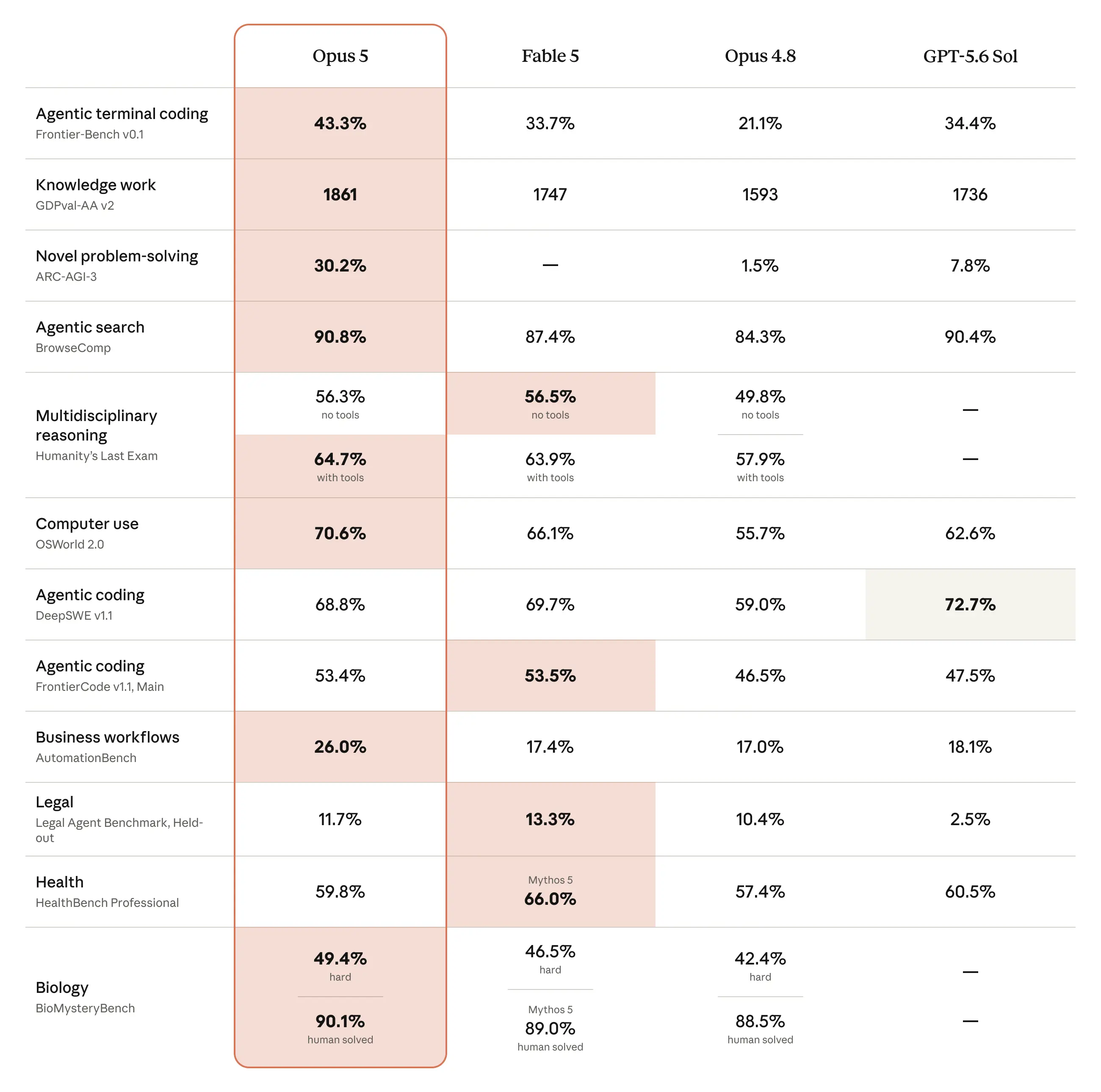
Every number below is Anthropic’s own, published with the launch. As of July 25, 2026, none of them have been independently reproduced. Read them as vendor claims, not neutral measurements, and plan to run your own evals before you commit a production workload.
| Benchmark | Anthropic’s claim |
|---|---|
| Frontier-Bench v0.1 | Surpasses all other models and more than doubles Opus 4.8’s score, at a lower cost per task |
| ARC-AGI 3 | Roughly 3x the next-best model’s score |
| OSWorld 2.0 (computer use) | Surpasses Fable 5 at one-third the cost |
| CursorBench 3.2 (agentic coding) | Within 0.5% of Fable 5’s peak, at half the price |
| Zapier AutomationBench | Pass rate roughly 1.5x the next-best model |
| Organic chemistry | +10.2 points over Opus 4.8 |
| Protein analysis | +7.7 points over Opus 4.8 |
The shape of the claims is consistent: large jumps on agentic and tool-driven evaluations, and a cost-per-task argument attached to nearly every one. The CursorBench and OSWorld results are the two that matter most for the buying decision, because they are the ones that say you can drop from Fable 5 to Opus 5 without losing much.
They are also the two that most need your own verification. A half-percent gap on a vendor’s chosen coding benchmark is well inside the range where your codebase, your prompt, and your tool definitions decide the outcome. The benchmarks deep dive covers what each evaluation actually measures and what to test yourself.
The honest ceiling
Opus 5 is not the top of the Claude stack, and Anthropic does not claim it is.
Fable 5 keeps the “most capable widely released model” designation. And on two specific research capabilities, cybersecurity exploitation and autonomous biology research, Opus 5 still trails Mythos 5. Anthropic states this directly in its own launch material, which is worth noting given how the mainstream coverage framed the release.
So the accurate summary is narrower than the headlines: frontier-class capability at half the frontier price, with two named capabilities where a model above it still wins. For most agentic coding and enterprise automation, that ceiling never comes up. For security research or autonomous scientific work, it does. Background on the research tier is in the Mythos-class model explainer and Fable 5 vs Mythos 5.
Two changes that break Opus 4.8 code
Swapping the model ID is not enough. Two changes will bite on your first request.
Thinking is on by default. On Opus 4.8, a request with no thinking field ran without thinking. On Opus 5, that same request runs adaptive thinking. Since max_tokens still caps thinking tokens plus response text together, a workload that sized max_tokens tightly around its expected output can now truncate mid-response. Nothing errors. The output just gets cut off, which is the worst kind of regression to debug.
Disabling thinking is capped at high effort. Sending thinking: {type: "disabled"} together with effort xhigh or max returns a 400 error, enforced per request. If you carried over a config that turned thinking off and cranked effort up, every call fails immediately.
There is more in the migration surface: effort levels were recalibrated so your old sweep results no longer transfer, the context-window beta header is gone, mid-conversation system messages are now accepted where 4.8 rejected them with a 400, and Priority Tier disappeared. The Opus 4.8 to Opus 5 migration guide has the before-and-after snippets for each one, and Anthropic’s migration guide is the primary reference. If you are still on the previous generation, the Opus 4.8 API walkthrough shows what you are migrating from.
The effort parameter, not a toggle
Most launch coverage described Opus 5 as letting users toggle between cost and capability. That framing points at a real API parameter: output_config.effort.
Effort has five levels, low through max, and it defaults to high. It controls how much the model thinks before answering, which in turn controls what you spend. The consumer surfaces expose it as an effort selector rather than a raw parameter, but it is the same control underneath.
Two things changed in this generation. The levels were recalibrated, so Anthropic explicitly recommends running a fresh effort sweep instead of carrying your Opus 4.8 settings across. And low and medium are meaningfully stronger on Opus 5 than on any prior Opus model, which makes them usable for real work for the first time rather than being the settings you avoid. For coding and agentic loops, xhigh remains the recommended starting point.
The effort parameter guide covers all five levels, how to run a sweep against your own evals, and the interaction with max_tokens.
How Opus 5 behaves differently
Anthropic’s prompting guide for Opus 5 documents behavior shifts that will change your results even when your code is byte-identical.
- It verifies its own work unprompted. Carried-over “double-check your answer” instructions now cause over-verification and burn tokens for nothing. Anthropic’s advice is to delete them.
- Default responses and written deliverables run longer than Opus 4.8’s. Lowering effort reduces thinking, not visible output length, so ask for conciseness explicitly if you need it.
- It delegates to subagents more readily. Cap or scope delegation on cost-sensitive workloads.
- It expands task scope and narrates its corrections more. Constrain narrow tasks in the prompt.
There is one failure mode worth knowing about. With thinking disabled, two artifacts show up occasionally: tool calls written out as plain text that never execute, and internal XML tags appearing in visible output. In an agentic loop the leaked text can poison later turns. Anthropic’s own mitigation is to keep thinking on and control cost with a lower effort level instead. The prompting deep dive has copy-paste snippets for each shift, and the Claude Code guide applies them to editor workflows.
Where you can run it
| Surface | Status |
|---|---|
| Claude API | Available, model ID claude-opus-5 |
| claude.ai | Available; default for Max, top model for Pro |
| Claude Code | Available |
| Claude Cowork | Available |
| Amazon Bedrock | Available as anthropic.claude-opus-5 |
| Claude Platform on AWS | Available, first-party ID |
| Google Cloud | Available as claude-opus-5 |
| Microsoft Foundry | Available |
| GitHub Copilot | Available |
Fast mode is the exception to that matrix. It runs on the first-party API only, so a Bedrock or Google Cloud deployment cannot reach it.
Testing Opus 5 requests in Apidog
Calling Opus 5 means hitting an HTTP endpoint with auth headers, a JSON body, streaming responses, and errors you need to reproduce. Apidog handles that lane: send the request, save it to a collection, keep your API key in an environment variable rather than pasted into a body, and read the response back field by field.
A practical setup for this model:
- Store
ANTHROPIC_API_KEYas an environment variable so the key never lands in a shared collection. - Save one baseline Messages request, then duplicate it per effort level so you can compare
low,high, andxhighside by side on the same prompt. - Watch the SSE stream directly when you enable streaming, so you can see where a truncated response actually stopped.
- Read the
usageblock on every response to confirm cache hits are landing and to see how many thinking tokens the request consumed.
Here is the baseline request:
curl https://api.anthropic.com/v1/messages \
  --header "x-api-key: $ANTHROPIC_API_KEY" \
  --header "anthropic-version: 2023-06-01" \
  --header "content-type: application/json" \
  --data '{
    "model": "claude-opus-5",
    "max_tokens": 8192,
    "messages": [
      {"role": "user", "content": "Refactor this handler and explain the tradeoffs."}
    ]
  }'
That request runs adaptive thinking, because thinking is on by default and no thinking field is present. Give max_tokens real room: 1,024 was fine on Opus 4.8 and will truncate here. To follow along, Download Apidog and import the request. The step-by-step API guide covers streaming, tool use, and reading usage in full.
Who should use Claude Opus 5
Reach for Opus 5 when:
- You build agents or tool-heavy workflows. This is the workload Anthropic optimized for and where its benchmark claims are strongest.
- You are running Fable 5 and the bill hurts. Half the price for a claimed half-percent gap on agentic coding is worth a real evaluation. The Opus 5 vs Fable 5 comparison frames that decision.
- You are on Opus 4.8 today. Same price, better claimed numbers, fresher knowledge cutoff. The only cost is the migration work.
- You need recent knowledge. May 2026 beats every other current Claude model by about four months.
Stay where you are when:
- Priority Tier is load-bearing. Opus 4.8 keeps it and Opus 5 does not, so check Opus 4.8 pricing and tiers before you move.
- Your workload is cheap and high volume. Sonnet 5 costs less and may be enough. The Opus 5 vs Sonnet 5 comparison covers where the 2.5x premium earns its keep.
- You do cybersecurity exploitation or autonomous biology research. Mythos 5 still leads there.
FAQ
What is the model ID for Claude Opus 5? It is the exact string claude-opus-5, with no date suffix. On Amazon Bedrock use anthropic.claude-opus-5; Google Cloud and Claude Platform on AWS use claude-opus-5.
How much does Claude Opus 5 cost? $5 per million input tokens and $25 per million output tokens, identical to Opus 4.8 and half of Fable 5’s $10 and $50. Batch API halves it again to $2.50 and $12.50. Fast mode doubles it to $10 and $50.
Is Claude Opus 5 better than Fable 5? By Anthropic’s own numbers it is close, not ahead. Anthropic reports Opus 5 within 0.5% of Fable 5 on CursorBench 3.2 and ahead on OSWorld 2.0 at a third the cost, but Fable 5 keeps the “most capable widely released model” designation. Those are vendor-run results with no independent reproduction yet.
What is the context window on Claude Opus 5? 1,000,000 tokens, as both the default and the maximum, with no beta header and no long-context price premium. Max output is 128,000 tokens on the Messages API, or 300,000 on the Batch API with the output-300k-2026-03-24 beta header.
Do I need to change my code to upgrade from Opus 4.8? Beyond the model ID, yes. Thinking now runs by default, so revisit max_tokens or risk silent truncation. And thinking: {type: "disabled"} combined with effort xhigh or max returns a 400. Re-run your effort sweep too, since the levels were recalibrated.
What is Claude Opus 5’s knowledge cutoff? May 2026 for both reliable knowledge and training data, the freshest of any current Claude model.