
Claude Sonnet 5 launched on June 30, 2026, and the price is the headline. You get performance close to Opus 4.8 on agentic and tool-use tasks at a fraction of the cost. This guide gives you the exact numbers: the introductory rate, the standard rate, the date they switch, and one tokenizer detail that quietly changes your real bill. You will also see how Sonnet 5 stacks up against Opus 4.8 and Fable 5 so you can pick the right model on cost, not just capability. When you start calling the API, Apidog is where you send those requests, save them, and track exactly what you are paying for.
Here is what you get: the per-token rate, a worked cost example, a model-by-model comparison table, and a short checklist for estimating and monitoring spend before it surprises you.
Claude Sonnet 5 pricing at a glance
Sonnet 5 uses the same per-token rate as its predecessor, Sonnet 4.6. Nothing changed on the sticker price. What changed is the introductory discount that runs for the first two months.
| Rate | Input (per 1M tokens) | Output (per 1M tokens) | In effect |
|---|---|---|---|
| Introductory | $2 | $10 | Through August 31, 2026 |
| Standard | $3 | $15 | From September 1, 2026 |
The model ID is claude-sonnet-5 with no date suffix. That single string is what you send in the API request, and it bills at these rates.
Two things worth locking in now:
- The introductory rate ($2 input / $10 output) is live through August 31, 2026. After that it moves to the standard $3 / $15.
- The standard rate is identical to Sonnet 4.6. If you were already running Sonnet 4.6, your per-token price does not go up when you migrate.
That last point sounds like a clean win. It mostly is. But there is a tokenizer detail that changes the math, and it is easy to miss.
The tokenizer catch: same rate, more tokens
Sonnet 5 ships with a new tokenizer. The same input text produces roughly 30% more tokens than it did on Sonnet 4.6, about 1.3x. This is not an API change. The request, response, and streaming shapes are identical, and you write no new code. But anything you measure or budget in tokens shifts.
Because you pay per token, more tokens for the same text means a higher cost for an equivalent request, even though the per-token rate never moved.
Here is a worked example. Say a prompt was 10,000 tokens on Sonnet 4.6.
- On Sonnet 4.6 at $3 per million input: 10,000 tokens costs about $0.030.
- On Sonnet 5, the same text is roughly 13,000 tokens. At the introductory $2 per million input: about $0.026.
- On Sonnet 5 at the standard $3 per million input (after Aug 31): about $0.039.
So during the introductory window, the discount roughly cancels out the extra tokens, and you may pay about the same or slightly less. Once the standard rate kicks in, the same text at 1.3x tokens costs more than it did on Sonnet 4.6 at the same per-token rate. The rate is flat. The bill is not.
This affects more than cost:
usagefields and token-counting results come back higher for the same text. Recount against Sonnet 5. Do not reuse your old Sonnet 4.6 counts.- The 1M-token context window holds less text on average, since each token now covers less text.
max_tokensbudgets you sized near your expected output may truncate. Revisit them.
The takeaway is simple: model your real workloads with token counting on Sonnet 5 before you assume flat parity. Anthropic’s token counting docs show how to measure a prompt against the current tokenizer. For a full walk-through of a first API call and where to read the usage block, see our Claude Sonnet 5 API guide.
How Sonnet 5 compares to Opus 4.8 and Fable 5
Sonnet 5 is priced to be the volume workhorse. The value case is clearest when you line it up against the models above it. All three share a 1M-token context window and 128K max output, so the difference here is price and where each model earns its keep.
| Model | Model ID | Input (per 1M) | Output (per 1M) |
|---|---|---|---|
| Sonnet 5 (introductory) | claude-sonnet-5 |
$2 | $10 |
| Sonnet 5 (standard) | claude-sonnet-5 |
$3 | $15 |
| Sonnet 4.6 | claude-sonnet-4-6 |
$3 | $15 |
| Opus 4.8 | claude-opus-4-8 |
$5 | $25 |
| Fable 5 | claude-fable-5 |
$10 | $50 |
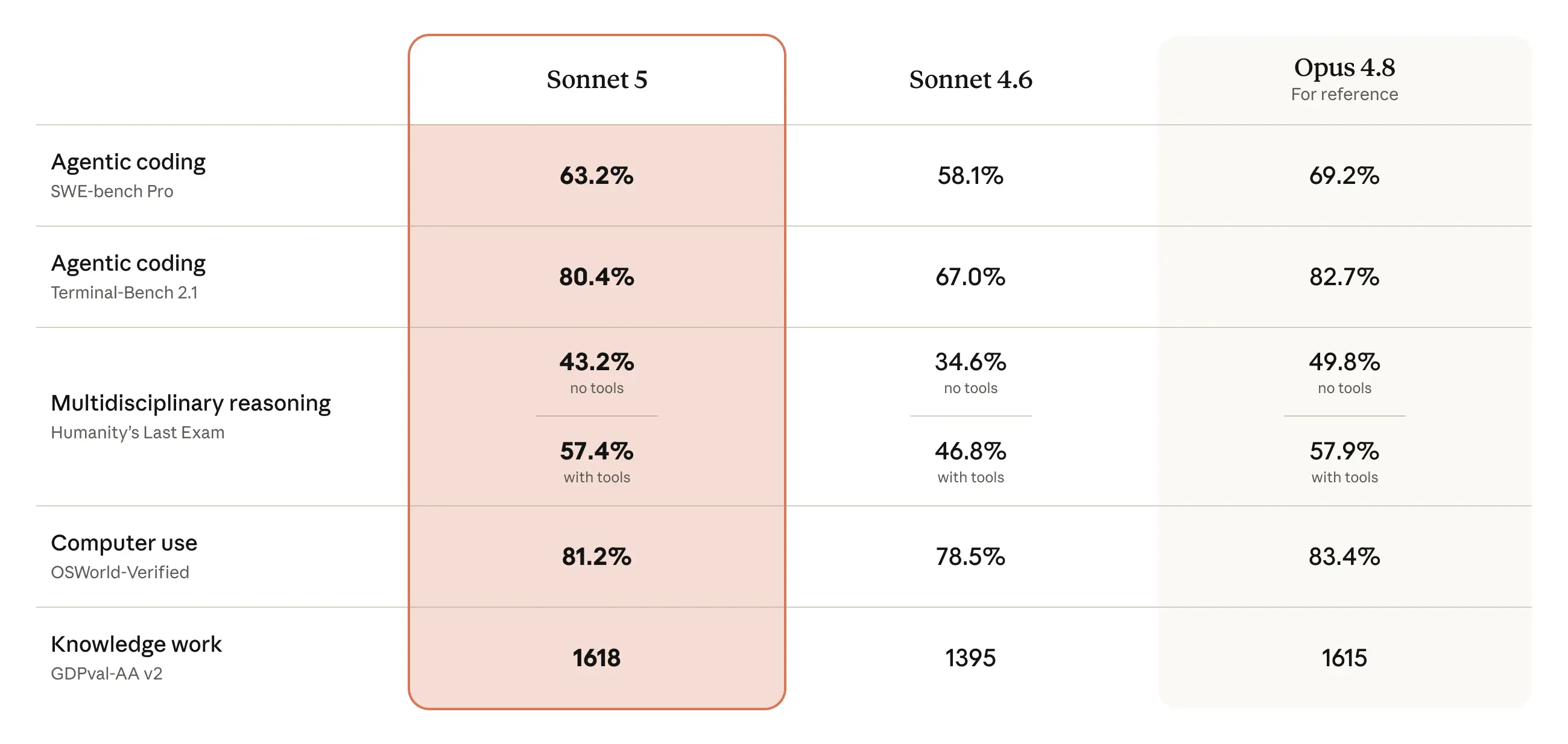
Read that table with the benchmarks in mind. On agentic and tool-use tasks, Anthropic’s launch figures put Sonnet 5 within roughly 1 to 3 points of Opus 4.8. Reported numbers include SWE-bench Pro at 63.2% for Sonnet 5 versus 69.2% for Opus 4.8, Terminal-Bench 2.1 at 80.4% versus 82.7%, and OSWorld-Verified at 81.2% versus 83.4%. Opus pulls ahead by about 6 points on pure reasoning with nothing to lean on.
So the cost decision comes down to this:
- At the standard rate, Sonnet 5 is 40% cheaper on input and 40% cheaper on output than Opus 4.8, for close-to-Opus performance on tool-heavy work.
- Fable 5 sits at $10 / $50, more than triple Sonnet 5’s standard input rate. You reach for it when you need Anthropic’s most capable widely released model, not for high-volume agent loops.
- Against Sonnet 4.6, you pay the same per token for better coding and agentic scores, with the tokenizer caveat above.
If you are weighing capability against price for a specific job, our Sonnet 5 vs Opus 4.8 breakdown works through the decision task by task. For the Fable 5 side of the ladder, see the Fable 5 pricing guide.
Test and track the requests you are paying for with Apidog
Every dollar on your Sonnet 5 bill maps to an HTTP request: a POST to the Messages API with a JSON body, an API key, and a response you pay for by the token. If you are guessing at those requests, you are guessing at your cost.
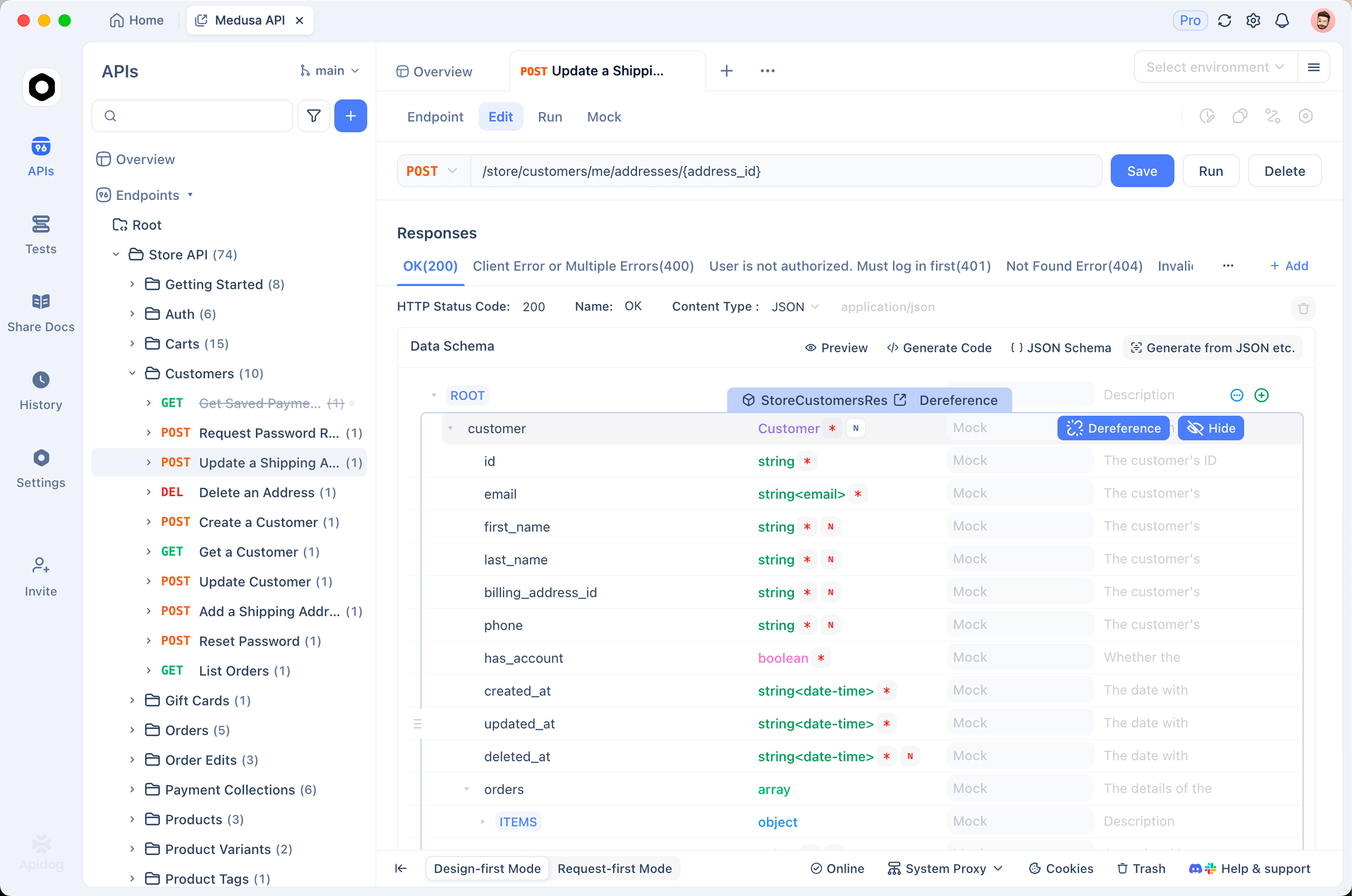
Apidog gives you a place to make those requests real and repeatable:
- Send a Sonnet 5 request and see the exact response, including the
usageblock that tells you input and output token counts per call. That is your cost, per request, before you scale it. - Save the request in a collection so your team runs the same call, not slightly different ones that bill differently.
- Store your API key as an environment variable and switch between test and production keys without editing the request.
- Add automated assertions so a prompt change that doubles output length gets caught in CI, not on the invoice.
- Mock the endpoint so you can build and test your integration without spending real tokens on every dev run.
Here is a first request in the Anthropic Messages API shape. Send it in Apidog, read the usage fields in the response, and you have a real per-call cost number to multiply.
curl https://api.anthropic.com/v1/messages \
  --header "x-api-key: $ANTHROPIC_API_KEY" \
  --header "anthropic-version: 2023-06-01" \
  --header "content-type: application/json" \
  --data '{
    "model": "claude-sonnet-5",
    "max_tokens": 1024,
    "messages": [
      {"role": "user", "content": "Summarize this changelog entry in two sentences."}
    ]
  }'
The response includes a usage object with input_tokens and output_tokens. Multiply those against the rates in the table above and you have the cost of that exact call. Do that for your real prompts and your estimate stops being a guess.
Download Apidog to send Sonnet 5 requests, inspect token usage, and organize the calls you are billing for in one workspace.
Frequently asked questions
How much does the Claude Sonnet 5 API cost?
During the introductory period through August 31, 2026, it costs $2 per million input tokens and $10 per million output tokens. From September 1, 2026, it moves to the standard rate of $3 per million input and $15 per million output.
Is Sonnet 5 cheaper than Sonnet 4.6?
The per-token rate is the same as Sonnet 4.6 at the standard tier ($3 / $15), and lower during the introductory window. But Sonnet 5’s new tokenizer produces about 30% more tokens for the same text, so the cost of an equivalent request can be higher at the standard rate. Count tokens on Sonnet 5 to see your real number. Our Sonnet 5 vs Sonnet 4.6 comparison covers the migration details.
Why does the same prompt cost more on Sonnet 5 than on Sonnet 4.6?
The per-token rate did not change, but the new tokenizer splits the same text into roughly 1.3x as many tokens. More tokens at the same rate means a higher cost for equivalent text, most visibly once the introductory discount ends.
How does Sonnet 5 pricing compare to Opus 4.8?
Opus 4.8 costs $5 per million input and $25 per million output, versus Sonnet 5’s standard $3 / $15. Sonnet 5 lands within about 1 to 3 points of Opus 4.8 on Anthropic’s reported agentic benchmarks, so you get close performance on tool-heavy tasks at a lower price.
Are there cheaper ways to run Sonnet 5?
Yes. Batch processing and prompt caching lower the effective rate for suitable workloads. The exact discounted rates are on Anthropic’s pricing page. Sizing max_tokens correctly and keeping prompts tight also cuts output cost, which is 5x the input rate.