If you build with AI tools every day, access to model credits can make a real difference. Xiaomi MiMo's Orbit 100T Token Grant for Builders is designed around exactly that idea: give serious builders free token resources so they can ship, test, and iterate faster.
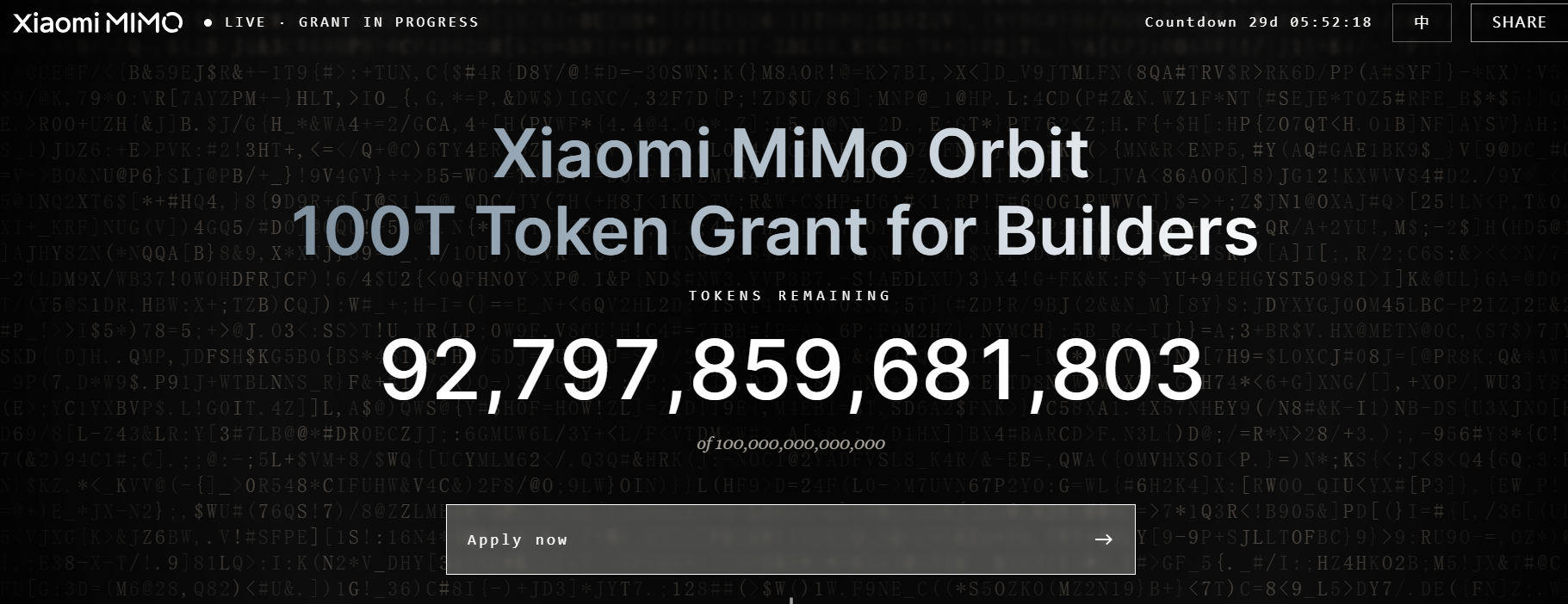
According to the program introduction, Xiaomi MiMo is distributing 100 trillion tokens over a 30-day window through a limited-time grant process. The campaign is open globally to individual developers, teams, and enterprises, and applications are reviewed rather than instantly approved. In other words, this is not just a giveaway page — it is positioned as a targeted program for people actively building with AI.
In this guide, we’ll break down what the grant is, who it is for, how the application process works, what applicants receive, and what you should prepare if you want the strongest chance of approval.
What is the Xiaomi MiMo Orbit 100T Token Grant for Builders?
The Xiaomi MiMo Orbit 100T Token Grant for Builders is a free, limited-time token grant for high-quality AI-driven users worldwide. Xiaomi says it is distributing 100 trillion tokens across 30 days, with each application reviewed individually.
The emphasis matters. This program is not framed as a random promotion for casual signups. It is presented as a grant meant to put compute resources in the hands of people who actually build with AI. That means your project description, your current tool stack, and the proof you submit all play a role in the outcome.
The grant is tied to Xiaomi MiMo, Xiaomi’s self-developed large language model family. The program describes MiMo V2.5 as the latest series, covering flagship reasoning, multimodal, and text-to-speech models for text, image, and voice scenarios.
For builders, the more practical part is the Xiaomi MiMo API Platform. That platform provides inference APIs and is described as compatible out of the box with tools such as Claude Code, Cursor, OpenClaw, and other coding tools. For teams evaluating model access, that compatibility lowers the switching cost because it suggests you can plug MiMo into workflows you may already use.
That is also where tools like Apidog can help in this AI-powered workflow. If you are evaluating MiMo as a model provider, Apidog can help you organize endpoint definitions, document authentication and request parameters, and create a cleaner testing flow while you compare MiMo against other AI APIs.
Why Apidog fits naturally into a MiMo builder workflow
If you are applying for this grant because you have already built with APIs, the easiest way to make the most of new model access is to treat MiMo like part of a broader API workflow rather than a one-off experiment. Apidog is particularly useful there because it can help you design requests, test API behavior across environments, and keep documentation aligned as your integration changes.
For example, if you are trying MiMo for reasoning, multimodal, or text-to-speech use cases, Apidog can help you keep sample requests, environment variables, response examples, and team-facing documentation in one place instead of scattering them across notes and ad hoc scripts.
When is the grant available?
The published grant window runs from April 28 at 00:00 to May 28 at 00:00 Beijing Time, which corresponds to April 27 at 16:00 to May 27 at 16:00 UTC. Xiaomi says the campaign lasts 30 days and may end early if all tokens are claimed before the deadline.
That early-close clause is important. Even though the page shows a full campaign window, builders who are interested should not assume the full period will remain available. If token inventory is exhausted, the opportunity could close before the listed end time.
Who can apply?
The program is open to everyone, including individual developers, teams, and enterprises. That broad eligibility makes the grant relevant across a wide range of use cases, such as solo AI prototyping, internal tool development, agent workflows, AI product demos, multimodal experiments, and enterprise proof-of-concept work.
Still, open eligibility does not mean equal approval probability. Xiaomi says the program is targeted at high-quality AI-driven users, and it reviews each application based on the full picture of what you are building.
How to apply
The process described on the grant page is relatively simple:
1. Submit the form
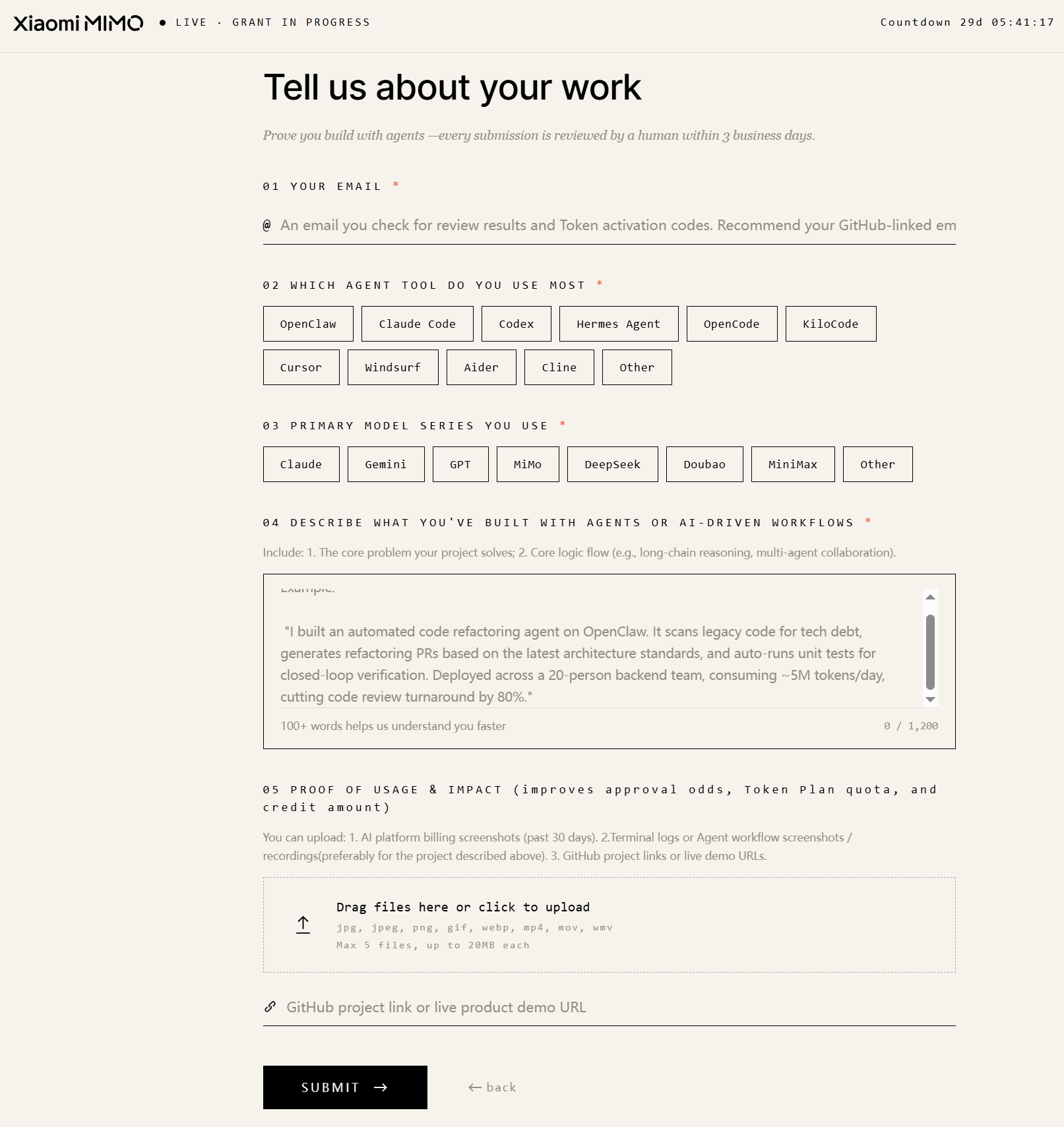
Complete the application form and click on "SUBMIT" button.
2. Wait for review
Applications are reviewed in roughly three business days.
3. Watch for the approval email
If your application is approved, Xiaomi says you will receive an email.
4. Sign in or register on the Xiaomi MiMo API Platform
Use the same email address you provided in the application. After that, the grant is expected to arrive within 24 hours of receiving the approval email.
The most important operational detail here is email consistency. The page repeatedly emphasizes that the grant is tied to the email used in the application process, so mismatched account information can disrupt delivery.
What do you actually get?
The grant page says approved applicants may receive one of two types of benefits: a Token Plan at a specific tier and quota, or bonus credits at a given amount. Both are described as completely free.
A Token Plan is presented as a subscription on the Xiaomi MiMo API Platform that you can plug directly into compatible tools such as Claude Code, Cursor, or other supported environments. Bonus credits, by contrast, are added to your platform balance for pay-per-use API calls.
The page does not promise a single fixed grant amount for everyone. Instead, the exact benefit is confirmed upon delivery. That means applicants should think less in terms of “How many tokens will I get?” and more in terms of “How strong is my case for a higher tier?”
How applications are reviewed
Xiaomi says it evaluates the full picture, including your AI tools, the models you use, your project description, and any proof you attach. The page also states that more specific and detailed applications improve your chances and may lead to a better grant tier.
That gives builders a useful signal about how to approach the form.
A weak application probably looks generic: vague goals, no clear project, no evidence of usage, and no explanation of why model access matters.
A stronger application likely includes:
- a clear description of what you are building
- the actual AI tools and models you already use
- a practical reason you need MiMo tokens
- screenshots, links, demos, or supporting proof when relevant
- a realistic explanation of how you plan to use the grant
If you want the best chance of approval, treat the form less like a giveaway entry and more like a lightweight builder grant application.
What builders should prepare before applying
If you are serious about this program, it is worth preparing your submission before you click the form. A good builder application should answer a few questions quickly and clearly.
First, what are you building? Be concrete. Instead of saying “an AI product,” explain whether it is a coding assistant workflow, an internal automation tool, a multimodal app, an agent-based product, or an experiment in speech or image features.
Second, why MiMo? If the platform offers reasoning, multimodal, and text-to-speech capabilities, explain which of those matter for your use case.
Third, what proof can you show? A GitHub repo, product screenshots, a short project description, a Loom demo, a landing page, or even structured notes can help turn your application from generic to credible.
Fourth, how will the grant be used? Reviewers are more likely to trust applicants who can explain exactly how the tokens will help them build, test, or deploy something concrete.
How to make sure your grant is actually delivered
One of the easiest ways to lose time with a grant program is to get approved and then miss delivery because of an account mismatch. Xiaomi explicitly calls this out.
If you already have a Xiaomi MiMo API Platform account, make sure it is registered with the same email you submit in the application. If your account was registered using a phone number, you may need to bind the correct email to that account first.
If you do not yet have a platform account, Xiaomi says you should register after receiving the approval email, following the instructions provided there.
For builders, the takeaway is straightforward: before you apply, make sure your identity on the platform matches the email on the application. That small administrative step could be the difference between a smooth grant delivery and a frustrating delay.
Things to keep in mind
There are a few limits and uncertainties worth noting.
Benefits do expire. Xiaomi says expiration varies by grant type, and unused benefits expire automatically. So even if you are approved, the program works best for builders who are ready to use the resources soon rather than someday.
Review is not guaranteed. The page makes it clear that applications are evaluated and that more detailed submissions perform better.
Delivery depends on correct account setup. If you submit one email and sign in with another, or if your platform account is not configured correctly, your grant may fail to arrive.
And finally, the exact grant details are determined on delivery, not up front. That means you should avoid building expectations around a fixed tier before approval.
Final thoughts
The Xiaomi MiMo Orbit 100T Token Grant for Builders looks like a practical opportunity for developers, teams, and enterprises that are actively building with AI and want free access to model resources. The strongest signal from the program is that Xiaomi wants serious applicants, not vague interest.
If you plan to apply, the best move is to be specific. Explain what you are building, show that you already use AI tools in a real workflow, match your platform email correctly, and include proof that makes your application easy to trust.
For builders who move quickly, that combination may be enough to turn a limited-time token grant into usable runway for real product work.