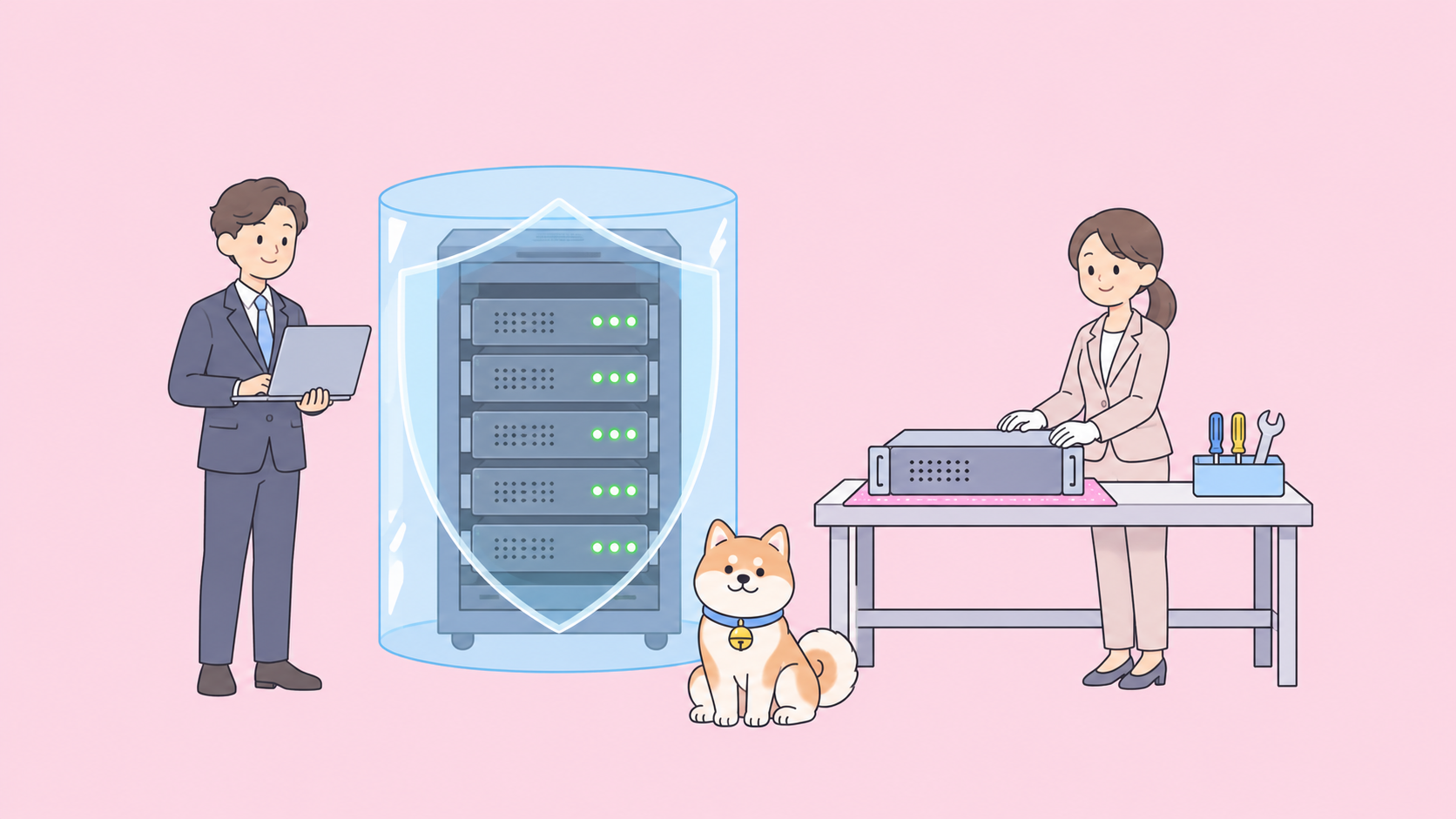
What is Shirudo? Shirudo is an open-source Linux security platform from Cisco and OpenAI, launched on November 23, 2026. It loads small signed eBPF programs, which the project calls upatches and the launch coverage calls shields, into a running kernel to block an exploit path without a reboot, until the real patch lands.
Shirudo also locks down who can load eBPF at all, records every change in a TPM, and lets an AI agent write the mitigation while a human keeps the signing key. It’s pre-release and needs a patched kernel.
Below: how a shield moves from code to a running kernel, how it relates to Tetragon, and how to check your API still behaves once a shield is loaded.
What is Shirudo?
Shirudo (Japanese for “shield”, pronounced “shee-roo-doh”) is a BPF-based security platform for Linux, published under the BSD-2-Clause license at shirudo-dev/shirudo on GitHub. It delivers signed BPF programs to running machines, restricts the bpf() system call to signed loaders, and measures every change into a TPM 2.0 register.
The official “What is shirudo” page frames the problem: a kernel fix protects a machine only once it boots a kernel carrying it, and the fix is often public weeks earlier.
Shirudo fills that gap with a temporary block, not a replacement for the patch.
Why Cisco and OpenAI built it
The Cisco newsroom announcement pitches Shirudo as a move from “human-paced policy updates to self-defending, agent-driven security.” Agents do the legwork, and people keep the keys and set the boundaries.
The reasoning is speed. The Isovalent engineering post argues that the mean time to exploitation has gone negative, while rolling a fix across a fleet still takes days to months.
If you read our breakdown of OpenAI’s 948 Linux root exploits, this is the defensive half of the same story. Finding bugs got faster. Shirudo is an attempt to make blocking them faster too.
How a Shirudo shield works, step by step
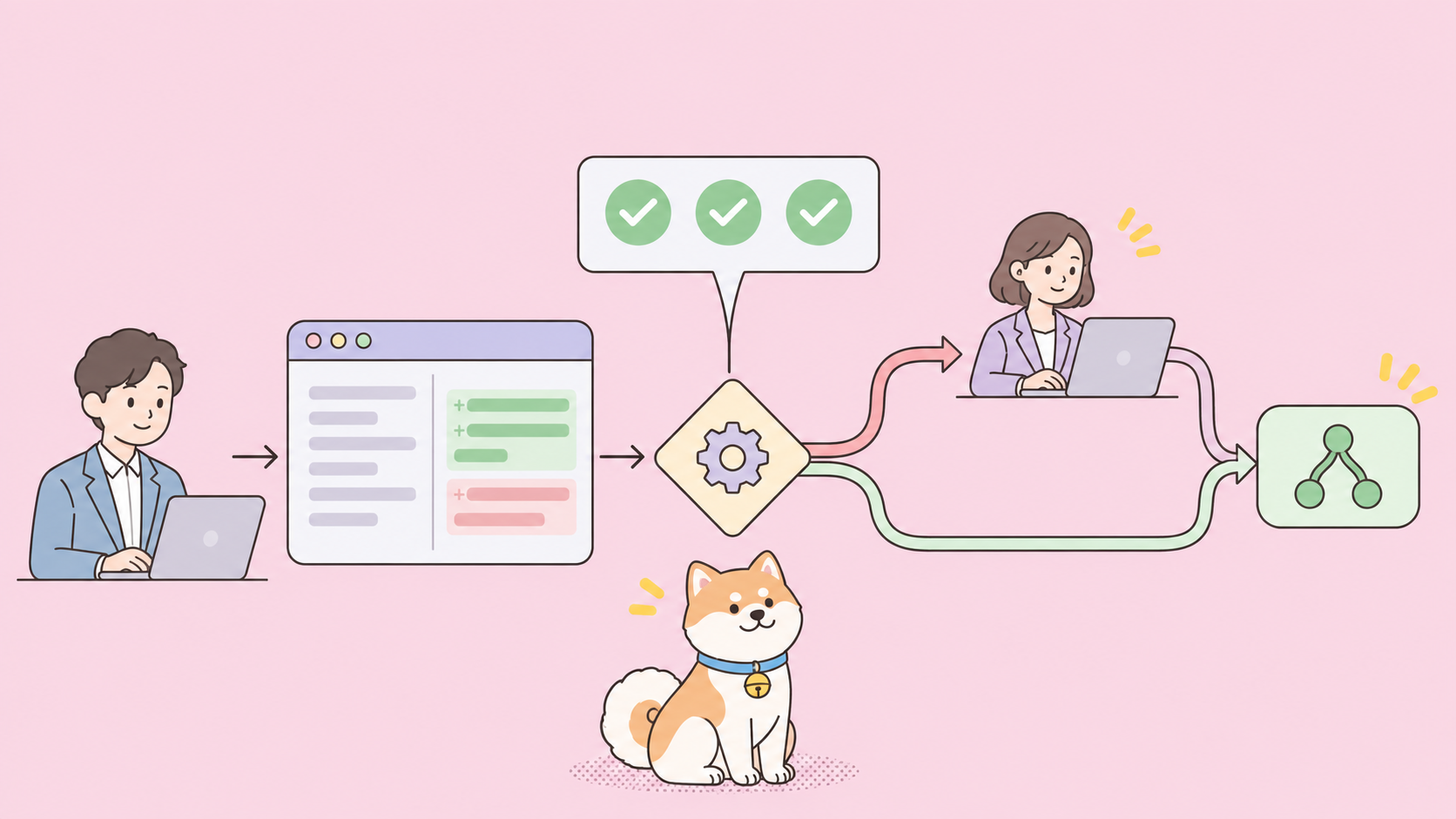
A shield follows a fixed path from source code to a measured load on the target machine. Here’s the sequence, condensed from the project’s How it works page:
- Write. A upatch starts as a few lines of BPF C that refuse the call a kernel fix closes. An agent or an engineer can write it.
- Build and sign.
shirudo buildcompiles the source with clang, wraps it in a loader, and signs it with the operator’s ML-DSA-87 key. The private key lives only on the operator host. - Package and publish.
shirudo bpm buildpacks upatches into a.beepackage, andshirudo bpm pushuploads it to an OCI registry with a signed index. - Pull. On each target, a systemd timer pulls updates about once a minute. There’s no daemon and no open port.
- Verify and load. The kernel checks the signature against its sealed
.bpfkeyring before the BPF verifier runs. Unsigned code is refused. - Measure. The TPM extends a per-boot register with the change, and
shirudo attestreturns signed evidence the operator verifies offline. - Remove. When the fixed kernel is in place, a signed unload directive takes the upatch out.
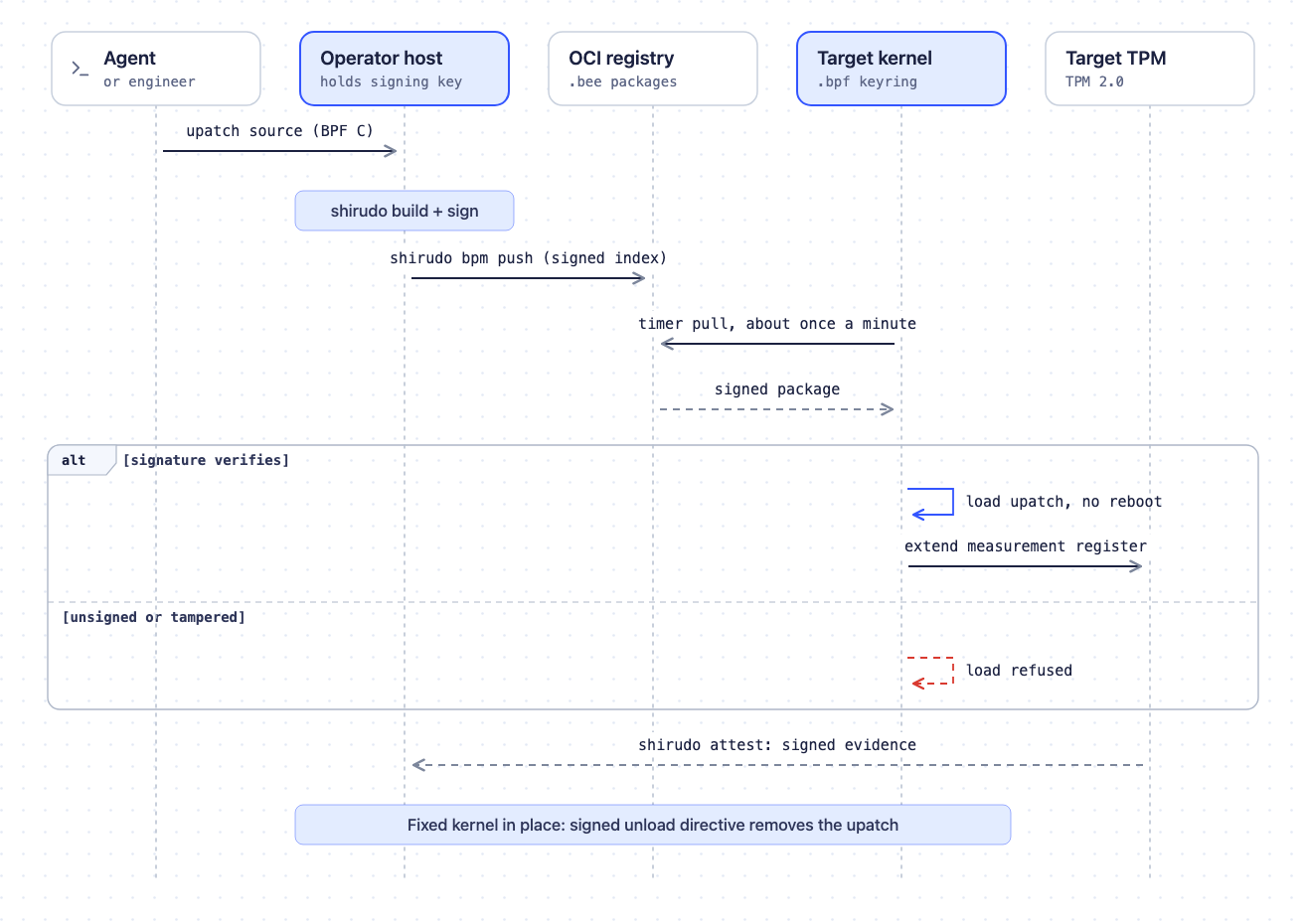
In the launch demo, Codex acted as the “agentic control plane”: it gathered vulnerability details, built a reproducer, validated the shield and handed it to signing and rollout. The signing key decides what actually loads.
What root can and can’t do on a Shirudo target
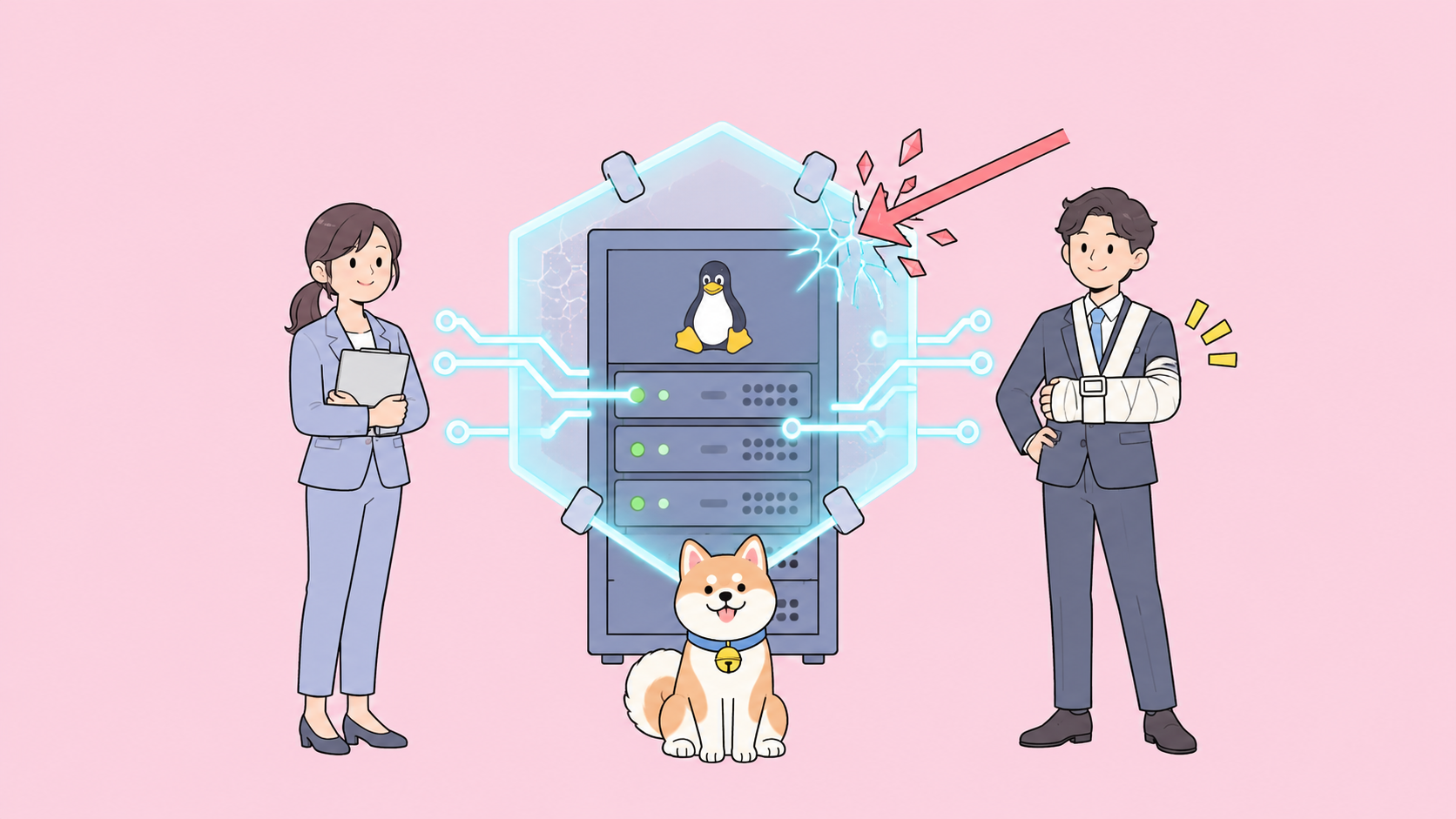
If root can load BPF, an attacker who gets root can load BPF too: to hide, to read kernel memory, or to detach your mitigation. So after shirudo init runs from the initrd at boot, the kernel only accepts BPF from userspace through a loader signed with the operator’s key. BPF LSM programs refuse attempts to detach or replace what’s loaded.
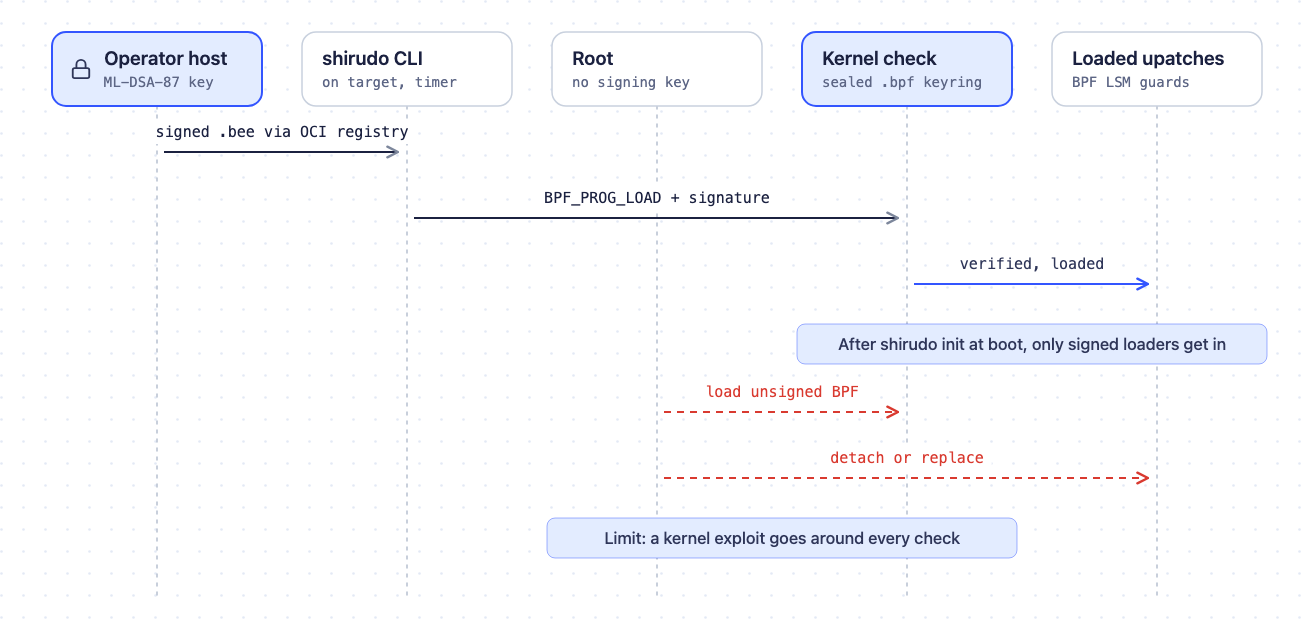
According to the Shirudo FAQ, root cannot load unsigned BPF, detach the enforcement or change Shirudo’s state without the signing key. The limit is equally clear: root that gets into the kernel itself, through a kernel exploit or a trusted signed module, goes around every check in that kernel.
Two more limits:
- The signature proves who built a upatch, not that it’s correct. The BPF verifier checks memory safety, but whether the program is a good mitigation is the author’s job.
- Other eBPF tools stop working. Cilium, Falco or bpftrace can’t load their own programs on an enforcing target. Their logic has to ship as signed upatches.
Shirudo vs Tetragon and kernel live patching
Isovalent says Shirudo “has its roots in Tetragon,” the eBPF security platform it open-sourced in 2022, and calls it “a rewrite of Tetragon designed for agents.” The key shift: instead of a policy language designed for humans, an agent writes the mitigation as code.
| Shirudo | Tetragon | Kernel live patching | |
|---|---|---|---|
| What it changes | Loads signed BPF (and Java) upatches | Applies tracing policies to eBPF hooks | Redirects a kernel function to a replacement |
| Policy changes | Only as signed artifacts | At runtime, via Kubernetes or CLI | New kernel modules |
| Can it replace a kernel function body? | No, it refuses calls before they run | No | Yes |
| Runtime daemon | None, one-shot commands | Agent process | None |
| Status (Nov 2026) | Pre-release | Stable releases (v1.8.0, Oct 30) | Mainline kernel feature |
The project’s own comparisons page says Shirudo complements live patching: a upatch blocks a vulnerable path until a live patch or a fixed kernel arrives. Tetragon remains the production choice for runtime observability and enforcement today.
What “pre-release” means for Shirudo today
Shirudo is honest about its state. The FAQ answers “Is shirudo ready for production?” with “Not yet.” There are no stable releases or supported release branches.
To run a production target you need:
- A bpf-next development kernel with the signed BPF loader interface and BPF LSM
- Shirudo’s own kernel patches (plus one more on x86-64)
- A TPM 2.0 on every target, with no mode that skips it
- Current clang on the operator host
CI covers x86-64, the test VM also boots on arm64, and no riscv64 target has booted yet. On a Mac (Apple M3 or later, macOS 15 or later), you can try the quickstart inside a Lima VM, which uses a software TPM.
The realistic move this week is the quickstart VM, not your fleet. The team presented the design at Linux Plumbers Conference 2026 in the talk shirudo: BPF live-patching infra for the agentic era, and Cisco has scheduled a deep-dive webinar for December 15.
Who should care about Shirudo
- Platform and kernel teams with reboot cycles of days or weeks.
- Teams running LLM agents in containers or Kubernetes. Shirudo can confine what a workload may run, write and reach, and root can’t detach those rules without the operator key.
- Embedded and edge operators whose devices update slowly.
- Security reviewers who need TPM-signed proof of what a machine runs.
- Java shops. The launch demo blocked the “Java4Shell” OpenJDK flaw with a Java bytecode upatch on a running Elasticsearch 9.5.5 instance.
The pushback: should agents write kernel-level controls?
The loudest reaction to the launch: letting an AI agent write code for a live kernel sounds risky. The design answers some of that. The BPF verifier rejects unsafe memory access before anything runs. A human holds the signing key. Every load is measured, and nothing loads unsigned. Shields are temporary by design.
It doesn’t answer everything. The docs say Shirudo “does not judge what a upatch does,” and Cisco’s call for contributors asks people to “show us where it breaks legitimate traffic.” That’s the gap your test suite has to close.
Check your API still works with a shield on, using Apidog CLI
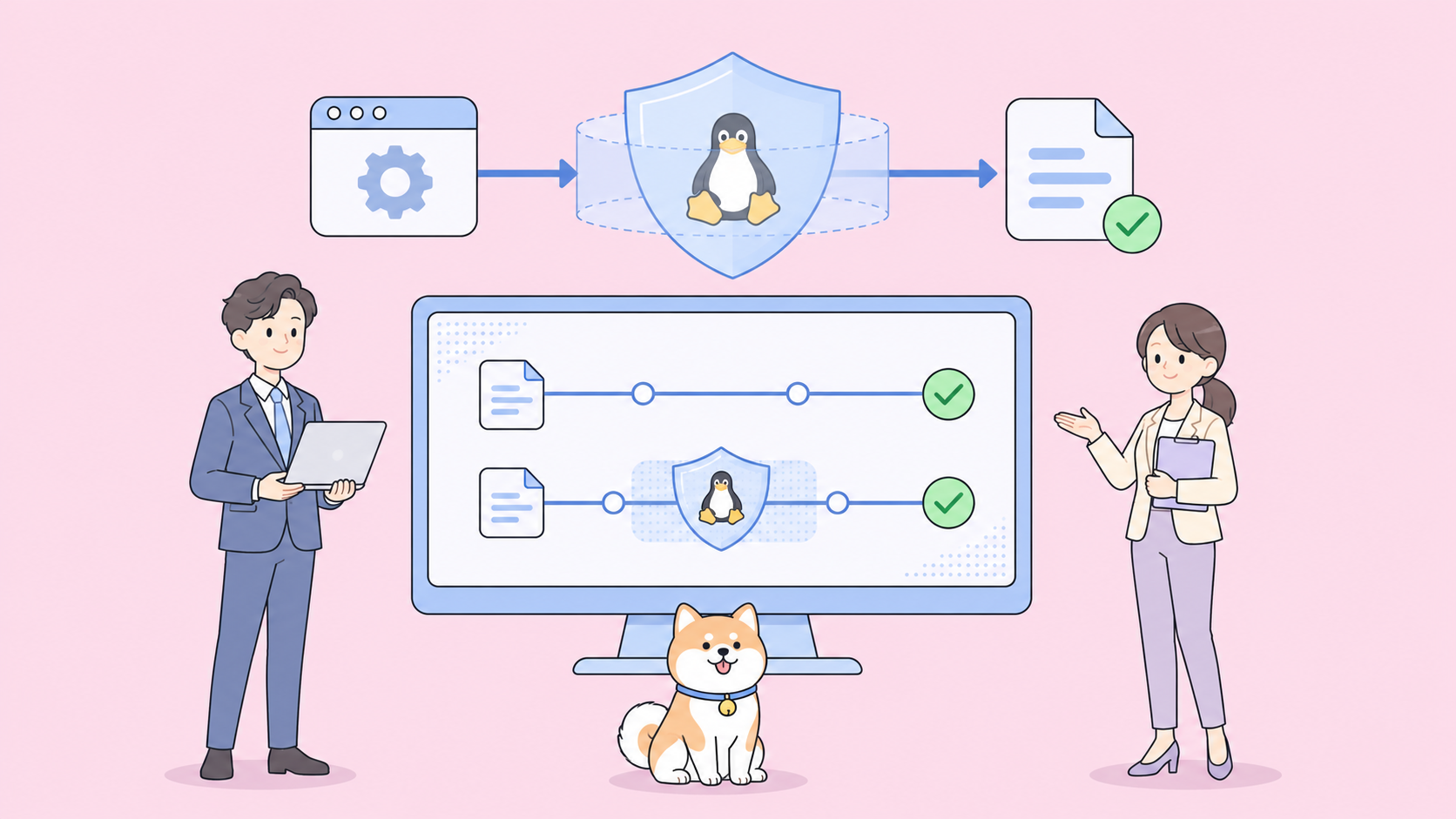
A shield that blocks the exploit but breaks your checkout endpoint isn’t a win. Run the same API regression tests before and after the upatch loads, and let your coding agent do the running.
Install Apidog CLI and the agent skill once:
npm install -g apidog-cli@latest
apidog login --with-token <YOUR_TOKEN>
npx -y skills add https://apidog.com   # pick your agent when prompted
Then give Codex, Claude Code or your agent of choice one prompt:
In Apidog project <projectId>, list the test scenarios and environments.
Run our regression scenario against staging now, before the Shirudo upatch
loads, and save reports to before/. After I confirm the upatch
is loaded, run it again into after/. Tell me every assertion
that passed before and fails after, with the endpoint and status code.
The agent finds the scenario and environment IDs, then runs the scenario twice:
apidog test-scenario list --project <projectId>
apidog environment list --project <projectId>
apidog run --test-scenario <id> --project <projectId> -e <envId> -r cli,json --out-dir before
apidog run --test-scenario <id> --project <projectId> -e <envId> -r cli,json --out-dir after
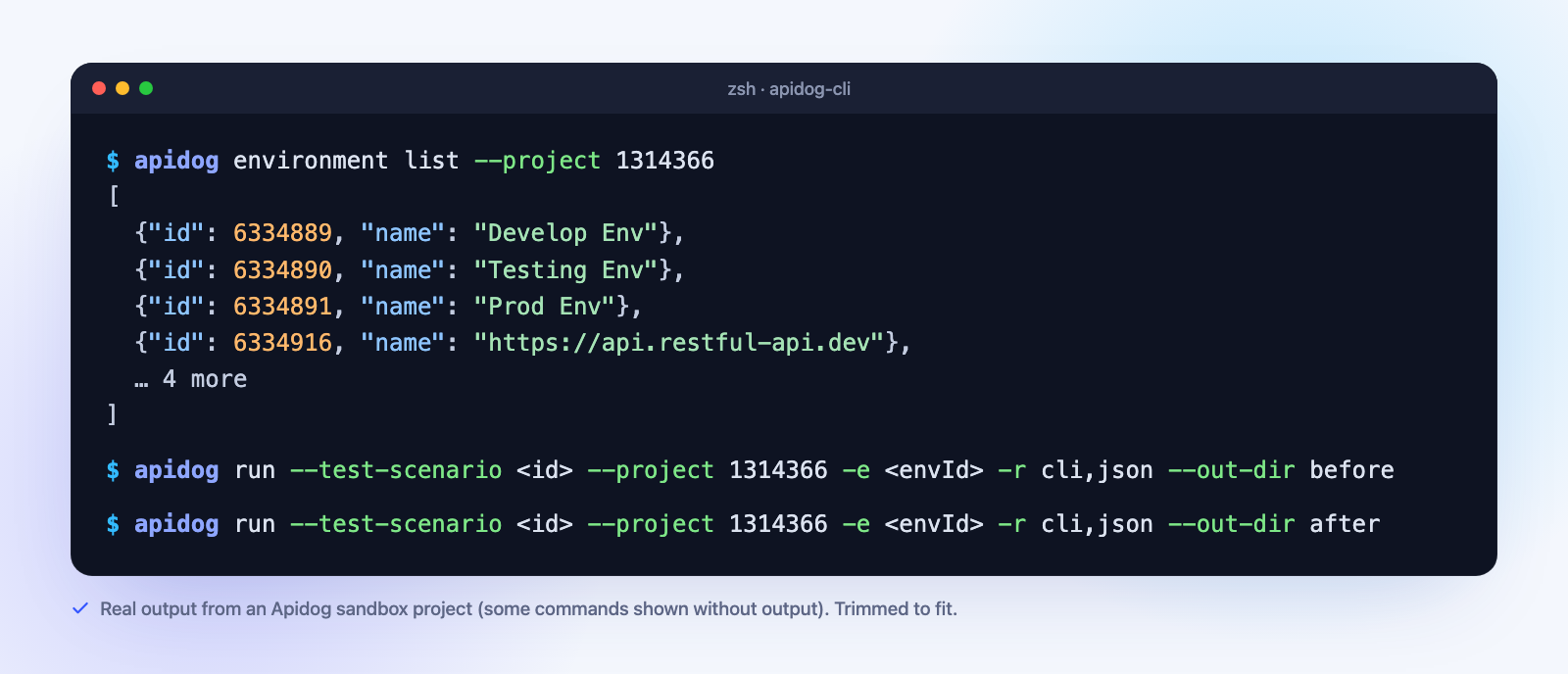
Check shirudo status on the target between runs. Any assertion that flips from pass to fail is traffic the shield blocks but shouldn’t: send it back to the agent that wrote the shield, then rebuild, re-sign and re-run.
Swap -r cli,json for -r junit and the same command becomes a gate in your pipeline; our Apidog CLI CI/CD guide shows the setup, and the Apidog CLI in Codex walkthrough covers the agent side. For more on what belongs in that suite, see API regression testing.
When one agent drafts the shield and another runs the before-and-after tests, Sharkly gives your team one board to hand those runs out as tasks and review what comes back, with each agent running on your own computers and your own Codex or Claude Code plan. It’s free to start.
FAQ
Is Shirudo free and open source? Yes. Shirudo is licensed under BSD-2-Clause, and its BPF programs are dual-licensed BSD/GPL. The source is on GitHub under shirudo-dev/shirudo.
Is Shirudo the same as a “shield”? Mostly a naming difference. The project’s docs call each mitigation a upatch: a signed BPF program, or a signed Java agent. Cisco and OpenAI’s launch material calls them shields.
Can I run Shirudo in production today? Not yet. It’s pre-release, needs a bpf-next kernel with Shirudo’s patches and a TPM 2.0, and has no stable release. Use the quickstart VM to evaluate it.
Is Shirudo a rewrite of Tetragon? Isovalent describes it as “a rewrite of Tetragon designed for agents.” Tetragon applies policies written in a human-oriented language. Shirudo has agents write the mitigation as signed code instead.
Does Shirudo need an AI agent to work? No. A upatch is plain BPF C that any engineer can write and sign. The agent workflow is what Cisco and OpenAI are building toward, with Codex used as the control plane in the launch demo.