Grok 4.6 is xAI’s frontier language model, released on August 12, 2026. It builds on Grok 4.5 with a focus on long-running agents, agentic coding, and interactive or visual work, offering a 500,000-token context window at $2 per million input tokens and $6 per million output. On the Artificial Analysis Intelligence Index it scores 61, matching OpenAI’s GPT-5.6 Sol and sitting one point behind Anthropic’s Claude Fable 5, making it the cheapest model currently at the intelligence frontier.
That’s the one-paragraph answer. The rest of this post covers what actually changed from Grok 4.5, what the benchmark numbers mean, where you can use the model today, and what it means for you if you’re building against LLM APIs. If that last part is you, Apidog gives you a free workspace to design, test, and mock LLM API calls, handy for kicking Grok 4.6’s tires without writing a client first.
TL;DR
- Released: August 12, 2026, by xAI.
- Focus: long-horizon agents, multi-step coding, interactive and visual work. xAI says the model self-tests and verifies its own work more often before proceeding.
- Specs: 500K context window, knowledge cutoff February 1, 2026.
- Pricing: $2 / 1M input, $6 / 1M output. A faster variant costs 2x. First week comes with 2x included usage in Grok Build and Cursor.
- Benchmarks: Intelligence Index 61 (ties GPT-5.6 Sol), big jumps over 4.5 on DeepSWE (54 → 65.9) and APEX-Agents (47.1 → 57.5).
- Where to use it: xAI API, Grok Build, Cursor, OpenRouter, Vercel, and Cloudflare.
Grok 4.6 at a glance
| Spec | Grok 4.6 |
|---|---|
| Developer | xAI |
| Release date | August 12, 2026 |
| Context window | 500,000 tokens |
| Knowledge cutoff | February 1, 2026 |
| Input / output price | $2 / $6 per 1M tokens |
| Fast variant | 2x price |
| Intelligence Index | 61 (GPT-5.6 Sol: 61, Claude Fable 5: 62) |
| Availability | xAI API, Cursor, Grok Build, OpenRouter, Vercel, Cloudflare |
What’s actually new compared to Grok 4.5
Grok 4.6 isn’t an architecture reveal, it’s a training story. According to xAI, the model went through a longer supplemental training run than Grok 4.5, with three ingredients doing the heavy lifting:
- Curated model-generated data targeting reasoning and advanced technical concepts.
- High-quality engineering datasets, continuing the coding-heavy diet that started when xAI began training on real development sessions.
- An improved optimizer and training recipe, with supervised fine-tuning trajectories regenerated across reasoning and domain-specific areas.
The behavioral change developers will notice is self-verification. During long agentic runs, Grok 4.6 checks its own work before moving to the next step, running the test it just wrote, re-reading the file it just edited, rather than barreling forward on an unverified assumption. xAI also reports stronger first attempts on interactive and visual projects: dashboards, small apps, and UI work come out closer to usable on the first pass.
If Grok 4.5’s training approach interested you, our breakdown of what Cursor session training meant for developers covers the lineage this model builds on.
The benchmarks, with deltas that matter
Vendor launch numbers deserve skepticism, but the deltas from 4.5 to 4.6 are large enough to be meaningful. Here’s the picture, including where the competition stands:
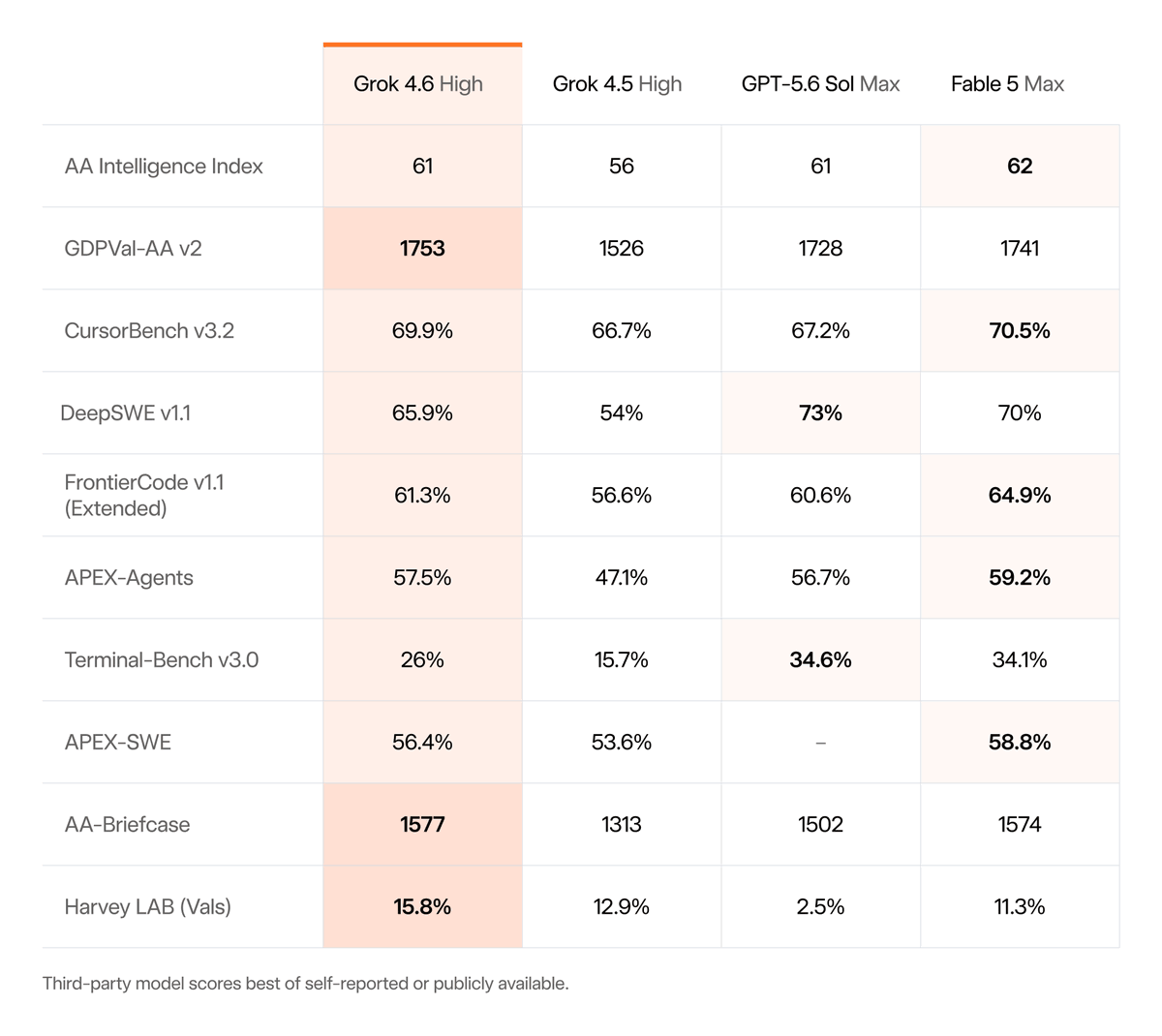
Three takeaways:
- The agent gap closed. The 10.4-point jump on APEX-Agents moves Grok from “clearly behind” to within 1.7 points of Fable 5 Max, and slightly ahead of GPT-5.6 Sol Max (56.7%).
- Repository-scale coding improved most. DeepSWE rising almost 12 points is the difference between a model that stumbles on multi-file changes and one that competes, though Sol Max still leads that bench by a wide margin.
- Independent numbers back the story. Artificial Analysis measured an average cost of $0.84 per task in its agentic evaluations, the lowest among frontier-tier models, and an Elo of 1753 on GDPval-AA v2 for professional knowledge work.
For context on how to read xAI’s benchmark releases, and the caveats that applied last generation too, see our Grok 4.5 benchmarks analysis.
Pricing: the frontier’s value play
Grok 4.6 kept Grok 4.5’s pricing: $2 per million input tokens, $6 per million output. Against the models it now benchmarks alongside, that’s a stark spread:
| Model | Output price / 1M tokens |
|---|---|
| Grok 4.6 | $6 |
| Claude Opus 4.8 | $25 |
| GPT-5.6 Sol | $30 |
That’s a 5x difference at the output end against GPT-5.6 Sol for a model that ties it on the composite intelligence index. Cheap tokens don’t automatically mean cheap tasks, a weaker run that needs review and repair costs more than its token bill, but the independent cost-per-task data suggests the efficiency is real, not just a low sticker price.
The faster variant at 2x price ($4/$12) is aimed at latency-sensitive interactive use. And through August 19, Grok Build and Cursor users get 2x included usage to test the model.
Where you can use Grok 4.6 today
- xAI API via console.x.ai, OpenAI-compatible. Our Grok 4.5 API guide applies directly; just change the model name.
- Cursor, available as a model option; Cursor published its own launch notes alongside xAI’s.
- Grok Build, xAI’s own agentic workspace, with the 2x launch-week usage bonus.
- OpenRouter, Vercel, and Cloudflare, for teams that route multiple models through one gateway; listed as
x-ai/grok-4.6on OpenRouter.
There’s no separate consumer rollout to untangle here: this is a developer-first release, and the fastest way to evaluate it is through the API or an IDE that already carries it.
Limitations and open questions
A launch-week assessment owes you the caveats alongside the headline numbers:
- The benchmarks are mostly vendor-reported. Artificial Analysis has published independent scores that broadly agree, but the specific coding numbers (DeepSWE, FrontierCode, CursorBench) come from xAI’s own launch table. Grok 4.5’s launch figures held up only partially under independent testing; assume some regression to the mean here too.
- The context window is the smallest at the frontier. 500K tokens covers most real workloads, but GPT-5.6 Sol offers 1.05M and Claude Fable 5 offers 1M. If you process entire monorepos or huge document sets in one call, that gap is material.
- Sol still leads where it’s hardest. The 7-point DeepSWE deficit means fully autonomous work across large existing codebases remains stronger on GPT-5.6 Sol Max, and that’s the most economically valuable agent workload.
- Ecosystem maturity lags. Batch processing, prompt caching tiers, and usage controls on the xAI platform are younger than OpenAI’s and Anthropic’s equivalents. OpenAI compatibility papers over most of it, not all of it.
None of these are disqualifying. They define where Grok 4.6 fits: the price-performance option you evaluate seriously, not the default you adopt on reputation.
What it means for API developers
The strategic read: the frontier now has a genuine price competitor. Until this release, matching GPT-5.6 Sol-level output meant paying $25–30 per million output tokens. Grok 4.6 does it for $6, which changes the math on agent loops especially, an agent that makes 40 model calls per task feels a 5x output-price difference immediately.
Practically, the OpenAI-compatible API means evaluating it costs an afternoon, not a sprint. Point your existing client at https://api.x.ai/v1, run your real workload against it, and compare. Set that comparison up in Apidog and you can keep GPT-5.6, Claude, and Grok 4.6 requests side by side in one project, with environments per provider and assertions checking output quality, token usage, and latency across all three, useful evidence before you commit a production workload to any of them.
The model’s agent focus also raises the stakes on tool-call correctness. If your Grok integration involves function calling, test the payloads it generates, not just the text it writes.
FAQ
What is Grok 4.6 in one sentence? xAI’s August 2026 frontier model, tuned for long-running agents and coding, with a 500K context window and frontier-tier benchmark scores at roughly a fifth of competitors’ output price.
Is Grok 4.6 better than GPT-5.6? They tie on the Artificial Analysis Intelligence Index at 61. GPT-5.6 Sol Max leads on repository-scale coding (DeepSWE); Grok 4.6 edges ahead on APEX-Agents and costs about 5x less per output token.
What’s the difference between Grok 4.5 and 4.6? Same price, same API, meaningfully better model: +11.9 points on DeepSWE, +10.4 on APEX-Agents, and a new tendency to self-verify during long tasks.
Can I try Grok 4.6 for free? Grok Build and Cursor include 2x usage during launch week, and the methods in our guide to using Grok 4.5 for free largely carry over to 4.6.