OpenAI shipped GPT-5.5 on April 23, 2026, only six weeks after GPT-5.4. The company calls it “a new class of intelligence for real work”; the press is already calling it “Spud,” after the potato emoji OpenAI used to tease the release. Under the marketing, it is a frontier model built for multi-step coding, computer use, and deep research, and it ships today inside ChatGPT and Codex with the API “coming very soon.”
If you are deciding whether GPT-5.5 is worth switching to, this guide covers what the model actually is, what changed from 5.4, the benchmarks that matter, how to use it today, and the gotchas that are not in the headline post.
For the matching developer walkthroughs, we already have a GPT-5.5 API guide, a free-access guide, a Codex free path, and a dedicated GPT-5.5 pricing breakdown. If you want to test it the minute the public API opens, grab Apidog and pre-build the collection now.
TL;DR
- GPT-5.5 is OpenAI’s frontier coding and reasoning model released April 23, 2026.
- It scores 88.7 % on SWE-bench and 92.4 % on MMLU, with a 60 % drop in hallucinations versus GPT-5.4.
- Three variants ship: GPT-5.5 standard, GPT-5.5 Thinking (extended reasoning), and GPT-5.5 Pro (highest accuracy).
- It runs today in ChatGPT Plus, Pro, Business, Enterprise, Edu, and in Codex across every plan including a temporary free window on Free and Go.
- API access is staged; for now developers can call it through the Codex sign-in path while waiting for the full Responses and Chat Completions rollout.
- API pricing lands at $5 per million input tokens and $30 per million output tokens; double GPT-5.4’s rate, offset by tighter token usage.
What GPT-5.5 actually is
GPT-5.5 is the top of OpenAI’s current GPT-5 line, sitting above GPT-5.4, GPT-5.4-mini, and the older 5.3 family. The internal codename “Spud” shows up in OpenAI’s tease post; the official name is GPT-5.5.
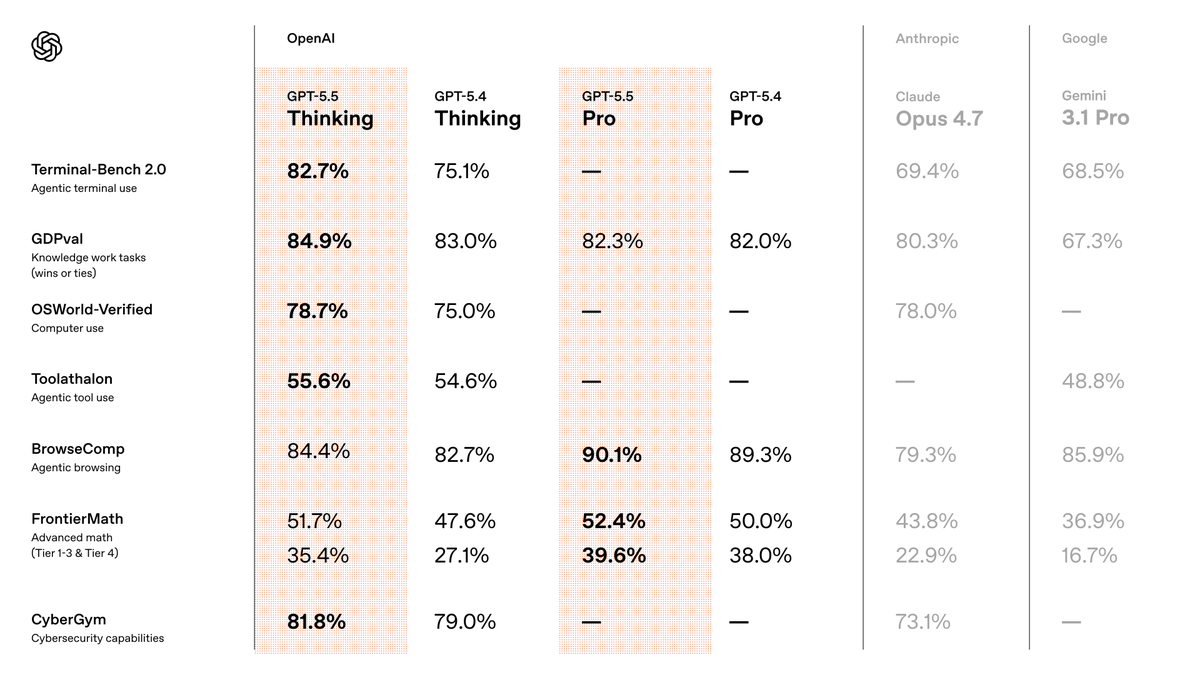
Three variants ship at launch:
- GPT-5.5 — the default, a “faster, sharper thinker” tuned for fewer tokens per task. This is the one most people will use.
- GPT-5.5 Thinking — same model with an extended reasoning budget. Built for harder real-world work: spreadsheets with heavy logic, dense research briefs, and multi-file debugging. Capped at roughly 3,000 messages per week in ChatGPT.
- GPT-5.5 Pro — the high-accuracy variant aimed at correctness-critical work. Pro, Business, and Enterprise only.
Under the hood, OpenAI describes it as a model trained to plan, pick tools, and check its own output before handing anything back. In practice that means fewer prompts to get a report finished, fewer wrong object counts in generated tables, and more willingness to stop and ask a clarifying question instead of guessing.
What changed from GPT-5.4
The six-week gap makes this less of a generational leap and more of a targeted upgrade. Here is the diff that matters.
| Capability | GPT-5.4 | GPT-5.5 |
|---|---|---|
| SWE-bench | ~74 % | 88.7 % |
| MMLU | 91.1 % | 92.4 % |
| Hallucination rate | baseline | −60 % |
| Context window (API) | 1.05 M | 1 M (Codex: 400 K) |
| API input price | $2.50 / M | $5.00 / M |
| API output price | $15.00 / M | $30.00 / M |
| Computer use | Improving | Production-grade |
| Multi-step tool chains | Single-shot preferred | Full autonomous loops |
The SWE-bench jump is the headline. An 88.7 % score on SWE-bench Verified means GPT-5.5 closes real GitHub issues at a rate that, by OpenAI’s framing, matches a senior engineer’s productivity for the same task set. That is the claim on paper; your mileage with your own codebase will vary and is worth measuring before budget moves shift.
The price doubling is real, but OpenAI’s pitch is that the token efficiency offsets it. Independent testing by The Decoder put the net Intelligence-Index cost increase at roughly 20 % once you account for the fewer tokens the model burns per task. On short-prompt workloads, the difference compresses to nearly flat.
What it is good at
OpenAI positions GPT-5.5 as a “real work” model, which in practice means four workloads:
- Agentic coding. Reads the repo, opens files, runs tests, iterates. This is the workload the SWE-bench score points at, and it is why Codex got the upgrade first.
- Computer use. The model can drive a browser or a shell, fill forms, scrape structured data, and recover from intermediate errors..
- Deep research. Longer reasoning chains, more aggressive web search when wired up, and better summarization of conflicting sources. Thinking mode is tuned specifically for this.
- Document and spreadsheet generation. Fewer layout mistakes, better formula correctness, cleaner slide structure. Plus and Business users get this in the default ChatGPT flow.
What it is not: a cheap workhorse. If you are doing high-volume classification, embedding-backed retrieval, or bulk summarization, GPT-5.4-mini or even GPT-5.3 still wins on cost per task. GPT-5.5’s value shows up when the alternative is a senior human reviewing the output.
Availability today
Access is tiered and changes fast. Here is the snapshot as of April 23, 2026.
| Surface | Plan | Access |
|---|---|---|
| ChatGPT | Free | GPT-5.3 default, no GPT-5.5 |
| ChatGPT | Go | GPT-5.3 default, no GPT-5.5 |
| ChatGPT | Plus | GPT-5.5 standard + Thinking (3,000/week) |
| ChatGPT | Pro | Standard + Thinking + Pro |
| ChatGPT | Business | Standard + Thinking + Pro |
| ChatGPT | Enterprise / Edu | Standard + Thinking + Pro |
| Codex | All plans (Free, Go, Plus, Pro, Business, Enterprise, Edu) | GPT-5.5 with 400 K context; Free and Go on a limited-time trial |
| API | Responses / Chat Completions | “Very soon”; not GA at launch |
The Codex path is the quiet headline. Because GPT-5.5 is already live in Codex, developers can drive it from the CLI today even without direct API keys.
Pricing in one line
If you are budgeting:
- GPT-5.5 API: $5 / M input, $30 / M output.
- GPT-5.5 Pro API: $30 / M input, $180 / M output (unchanged from 5.4 Pro).
- Batch and Flex: half the standard rate.
- Priority: 2.5× the standard rate.
- Codex CLI: free on Plus, Pro, Business, Enterprise, Edu, Go, and temporarily Free, subject to per-plan weekly caps.
Full breakdown, including per-workload cost estimates, in our GPT-5.5 pricing article.
How to try it today
The fastest paths, in order of friction:
- Open ChatGPT on a paid plan. Pick GPT-5.5 from the model picker. Done.
- Install Codex CLI.
npm install -g @openai/codexorbrew install codex, thencodexand sign in with a ChatGPT account. Use/model gpt-5.5to switch. Free and Go plans are included for a limited time. Full walkthrough in How to use GPT-5.5 for free with Codex. - Wait for the API rollout and pre-build. The API is coming “very soon.” Build your request collection now in Apidog so the minute the model ID flips live you can swap it in. The GPT-5.5 API guide shows the exact endpoint shape we expect based on the 5.4 contract.
Safety and red-teaming
OpenAI ran GPT-5.5 through third-party safeguard testing for cyber and bio risks before release. The company has been iterating on cyber-specific safeguards for months as each model generation has grown more capable at offensive security tasks.
For most developers this matters in two places: refusal behavior on dual-use code, which tightened on 5.5, and the API rollout timeline, which OpenAI explicitly linked to “different safeguards” for at-scale serving. If you are building a consumer-facing agent that touches the browser, plan for stricter default policies than on 5.4.
Should you switch?
Three heuristics:
- If you run a coding agent — yes, switch now. The SWE-bench jump compounds fast once you let the model loop, and Codex access is already live.
- If you run high-volume inference — keep GPT-5.4-mini as the default, reach for GPT-5.5 only on the hard tasks.
- If you are consumer-facing — wait for the API rollout, then A/B test. The price doubling is real, and the hallucination drop only matters if your users were hitting the hallucinations.
The full decision flow lives in the pricing breakdown; use it before you flip the default model in a production app.
FAQ
Is GPT-5.5 available on the API yet?Not for direct key-based calls on April 23, 2026. OpenAI says “very soon.” Today the model runs inside Codex after ChatGPT sign-in, which gives early testers a working path.
What is the context window?One million tokens in ChatGPT and the upcoming API. In Codex CLI the window is set to 400 K across every plan.
How does GPT-5.5 Thinking differ from GPT-5.5 Pro?Thinking extends the reasoning budget on the standard model; Pro is a separate, higher-accuracy variant trained for correctness-critical tasks. Pro is Pro, Business, and Enterprise only.
Is GPT-5.5 free?On ChatGPT, no, paid plans only. On Codex, temporarily yes for Free and Go users, subject to rate limits. The free guide covers every no-cost path.
Can I still use GPT-5.4?Yes. OpenAI has not deprecated 5.4, and it stays cheaper at $2.50 / $15 per million tokens. For cost-sensitive pipelines it remains the default choice.