
If your team relies on Stoplight for OpenAPI design and docs, then switches to Postman for collections and testing, you already know the core frustration: the spec and the tests drift apart. Your stoplight postman alternative search probably landed here because you’re tired of maintaining two tools, two billing lines, and two sources of truth for the same API contract. Apidog addresses this by treating the OpenAPI spec as the single source of truth for design, docs, mocks, and automated tests, all from the same Git-connected workspace.
This post walks through what each tool does well, where the two-tool stack creates friction, and whether consolidating on Apidog makes sense for your team. It’s a stack-replacement evaluation, not a generic alternatives list. For a deeper look at the spec-first workflow philosophy, see What Is Spec-First API Development?.
The two-tool problem
Stoplight and Postman solve different parts of the API lifecycle well. Stoplight Studio gives you a visual OpenAPI editor, a Git-backed spec store, and auto-generated reference docs. Postman gives you a collection runner, environment variables, pre-request scripts, and a test report dashboard. Together they cover design-to-test. Apart, they create three concrete problems.
Spec-test drift. Your OpenAPI spec lives in a Git repo managed by Stoplight. Your Postman collection lives in Postman’s cloud. When a developer changes a request body schema in the spec, nothing automatically updates the Postman tests. A QA engineer running the old collection against the new endpoint gets a test failure that isn’t a product bug; it’s a tooling gap.
Duplicate maintenance. Path parameters, environment base URLs, and auth schemes are defined in the spec and then redefined by hand in Postman. Every new environment (staging, production, EU region) means updating both places. Teams at organizations like Inventis Korea describe their workflow as generate OpenAPI, view it in Swagger, import it to Postman to test, and then patch two documents when anything changes. That import-patch loop is the problem this comparison addresses directly.
Two billing lines, one job. Stoplight’s platform tier covers teams; Postman’s team plan covers collections and monitor runs. If your org manages both, that’s two budget line items for tooling that serves one API contract.
What Stoplight does well
Stoplight’s strongest capability is the visual OpenAPI editor. It validates your YAML/JSON as you type, enforces a style guide via Spectral, and gives non-technical stakeholders a readable form view. The Git integration is Git-native: every save is a commit to your GitHub or GitLab repo, and branch protection rules apply normally.
Stoplight’s auto-generated docs (Stoplight Docs) are clean and deploy with a custom domain. The table of contents is controlled by a toc.json file in the repo. You can mark paths as internal-only, set access control per environment, and embed try-it-now API explorers.
Where Stoplight stops is execution. It has no test runner, no assertion engine, no CI test report. Once you’ve designed the spec, you export it or hand it off. Testing is someone else’s problem.
What Postman does well
Postman’s collection model is familiar to nearly every developer who has touched an API. Collections group requests logically, environments handle variable substitution, and the test tab accepts JavaScript assertions via the pm.test() API. The Collection Runner and Newman CLI let you drive those tests in CI pipelines.
Postman’s monitoring feature schedules collection runs against live endpoints and alerts on failures. For teams that need to verify production uptime, that’s useful. Postman also has a basic API design tab, but it’s not the tool’s strength; it’s a bridge feature, not a first-class workflow.
Postman’s weakness is the distance from the spec. Collections are import-and-diverge by default. Keeping a Postman collection synchronized with an OpenAPI spec requires either manual re-import or a custom sync script. Neither scales well across large teams.
Platform comparison: Stoplight vs Postman vs Apidog
The table below maps each capability to the tool that covers it. “Native” means the feature is a first-class part of the core workflow. “Partial” means the feature exists but requires workarounds or manual steps. “No” means the tool does not cover it.
| Capability | Stoplight | Postman | Apidog |
|---|---|---|---|
| Visual OpenAPI editor | Native | Partial | Native |
| Spectral / lint rules | Native | No | Native |
| Git repo sync (GitHub, GitLab) | Native | No | Native (Spec-First Mode, beta) |
| Branch-based spec workflows | Native | No | Native |
| Auto-generated reference docs | Native | Partial | Native |
| Interactive docs (try-it-now) | Native | No | Native |
| Private docs access control | Native | No | Worth verifying in a trial |
| Mock server from spec | Partial (Prism) | Partial | Native |
| Request collection runner | No | Native | Native |
| JavaScript test scripts | No | Native | Native |
| Visual assertion editor | No | No | Native |
| Environment variable management | No | Native | Native |
| CI/CD integration (Newman / CLI) | No | Native | Native |
| Contract test from spec | No | No | Native |
| Cross-project schema reuse | Partial | No | Worth verifying in a trial |
| SSO / SCIM | Yes (Enterprise) | Yes (Enterprise) | Check against your requirements |
| Audit logs | Yes | Yes | Check against your requirements |
A few notes on the “worth verifying” cells: Apidog’s cross-project component reuse and report-visibility permissions are capabilities worth testing in a proof of concept against your specific org structure. Don’t take marketing pages as confirmation; run a trial with a real multi-team setup.
Where Apidog’s spec-first mode changes the equation
Apidog’s Spec-First Mode connects your existing GitHub or GitLab repo as the authoritative spec store. Unlike a one-time OpenAPI import, it keeps the Apidog workspace synchronized with commits to your repo. When a developer merges a PR that updates a path parameter, Apidog picks up the change and your mocks and tests reflect the new schema automatically.
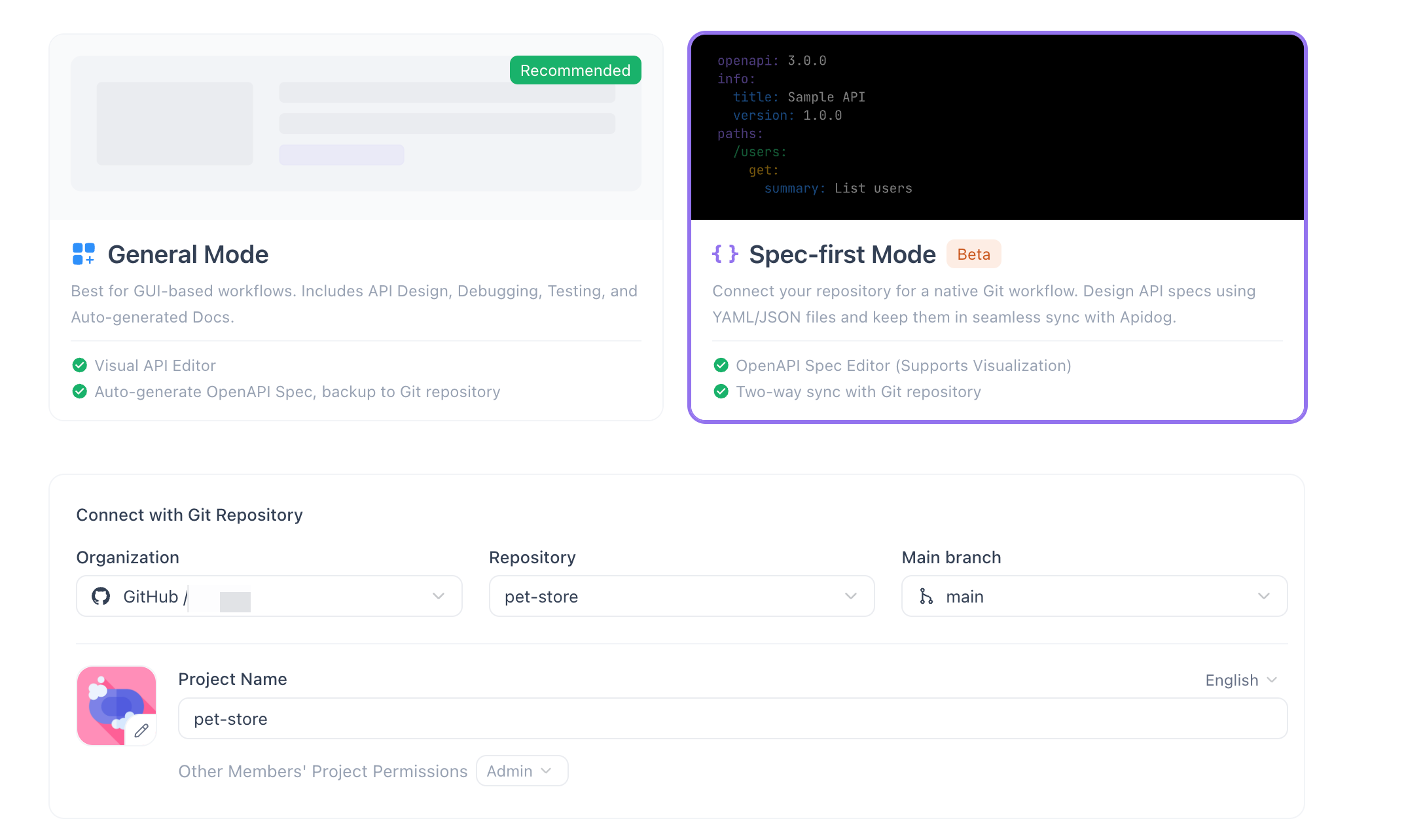
For a team coming from Stoplight plus Postman, the practical implication is:
- Your existing spec repo stays in place. No migration of YAML files.
- Apidog generates a mock server from the spec. Frontend teams get realistic responses without a running backend.
- Apidog generates test cases from the spec schema. You add assertions, save them as scenarios, and run them via the CLI in CI.
- Docs are generated from the same spec and stay current without a separate publishing step.
The guide to Spec-First Mode covers the setup process in detail. For context on how spec-first compares to a design-first approach, Spec-First or Design-First: Which Apidog Mode Should You Use? walks through the trade-offs.
A worked example: contract test from an OpenAPI spec
Suppose your spec defines a GET /orders/{orderId} endpoint with a 200 response schema. In Postman, you’d write that test by hand:
// Postman test tab: written manually, maintained separately from spec
pm.test("Status is 200", function () {
  pm.response.to.have.status(200);
});

pm.test("Response has orderId", function () {
  const json = pm.response.json();
  pm.expect(json).to.have.property("orderId");
  pm.expect(json.orderId).to.be.a("string");
});
That script is a copy of information already in your OpenAPI spec. It will silently diverge the moment someone adds a required field to the schema without touching the Postman collection.
In Apidog with Spec-First Mode, the 200 response schema drives auto-generated assertions. You can extend them, but the base validation comes from the spec:
# OpenAPI snippet in your Git repo (e.g., openapi/orders.yaml)
paths:
  /orders/{orderId}:
    get:
      summary: Get an order by ID
      parameters:
        - name: orderId
          in: path
          required: true
          schema:
            type: string
      responses:
        "200":
          description: Order found
          content:
            application/json:
              schema:
                $ref: "#/components/schemas/Order"

components:
  schemas:
    Order:
      type: object
      required:
        - orderId
        - status
        - createdAt
      properties:
        orderId:
          type: string
        status:
          type: string
          enum: [pending, processing, shipped, delivered]
        createdAt:
          type: string
          format: date-time
When this YAML is committed, Apidog syncs the schema and applies it as a contract assertion on the test case. If status is ever missing from a response, the test fails automatically. No manual test update needed.
For more on the relationship between the spec and Git, see How Do You Version-Control an OpenAPI Spec With Git?.
Governance: what to verify before committing
If your team is evaluating a platform switch at enterprise scale, several governance questions deserve a real trial, not a trust-the-docs answer:
Report visibility permissions. Can you scope CI test reports to specific teams or projects? Verify this against your org chart.
SSO and SCIM provisioning. Apidog supports SSO. SCIM auto-provisioning behavior, group sync, and deprovisioning are worth testing against your identity provider before committing. The SCIM RFC defines what compliant behavior should look like; compare it against Apidog’s implementation in a trial.
Cross-project schema reuse. If you have shared $ref schemas across multiple API projects, verify that Apidog’s workspace model handles cross-project references the way your team expects. This is a known point of friction in any platform migration.
Audit logs. If your compliance posture requires immutable audit trails of spec changes and API access, confirm Apidog’s audit log format and retention before decommissioning Stoplight.
These are not reasons to avoid Apidog. They’re the right questions for any platform consolidation, and Apidog’s trial should be able to answer them with your real data.
When to keep two tools
Consolidating on one platform makes sense when the spec-test drift and duplicate maintenance costs exceed the switching and retraining cost. That’s a calculation your team has to run.
There are cases where the two-tool setup stays rational:
- Your Stoplight docs deployment is deeply customized with a
toc.jsonconfig that your technical writers own. Migrating the docs workflow has a real cost. - Your Postman collection has hundreds of pre-request scripts and dynamic variable chains that would take significant effort to port.
- Your team uses Postman monitors for production uptime checks. Apidog’s scheduled test runs are worth evaluating, but verify the alerting and on-call integration before switching.
If you decide to explore alternatives specifically for Postman, Best Postman Alternatives for API Testing covers the broader landscape including open-source options.
FAQ
Does Apidog replace Stoplight Studio’s visual OpenAPI editor?
Yes. Apidog includes a visual form editor for OpenAPI schemas, with real-time validation and lint rules. It doesn’t use Spectral natively, but it applies comparable schema validation. If your team relies on custom Spectral rules defined in a .spectral.yaml file in your repo, verify that Apidog’s linting covers the same rules before switching.
Can Apidog sync with an existing GitHub repo without re-importing the spec?
Apidog’s Spec-First Mode (currently in beta) connects to a GitHub or GitLab repo and keeps the workspace synchronized with commits. You don’t discard your existing repo. For the philosophy behind keeping the spec in Git, see API Spec as Code. Then check the Apidog documentation for the exact connection steps and current beta limitations.
Does Apidog support Newman-style CLI test runs in CI?
Apidog has its own CLI that runs test scenarios and outputs reports. If your CI pipeline currently calls newman run, you’d replace that command with the Apidog CLI equivalent. The output format differs, so factor in any dashboard or reporting integrations you’ve built around Newman’s JSON output.
What about Postman’s pre-request scripts and dynamic variables?
Apidog supports pre-request scripts and dynamic variables, including built-in mock data generators. If your Postman collection uses pm.variables.set() and custom JavaScript, those scripts will need to be ported. The logic is usually transferable, but the syntax differs in places.
Is Apidog’s Spec-First Mode production-ready?
Spec-First Mode is currently in beta. That means the core functionality works, but edge cases around large mono-repo specs, nested $ref resolution across files, and CI status reporting are actively being refined. Run a proof of concept with a realistic spec before planning a full rollout.
Conclusion
The Stoplight-plus-Postman stack solves real problems, but it solves them in two separate places. When the spec and the tests live in different tools, drift is the default outcome, not an exception. Apidog’s Spec-First Mode offers a practical path to a single platform: Git stays the source of truth, and Apidog becomes the collaboration and execution layer that connects your docs, mocks, tests, and CI reports to the spec your team already commits.
The evaluation questions above, particularly around SSO, report permissions, and cross-project schema reuse, are the right things to test in a proof of concept before making a commitment.
Try Apidog’s Spec-First Mode free: connect your OpenAPI repo from GitHub or GitLab and generate live docs and a mock server from the same spec your team already commits. Download Apidog to start the proof of concept, or visit the Spec-First Mode page for setup details.