
Sakana Fugu pricing is built on two confirmed structures: subscription tiers for everyday use, and a pay-as-you-go plan for heavier and enterprise workloads. The genuinely new mechanic is passthrough billing, which lets multiple agents fire in one request without stacking a separate fee per agent. Every dollar figure below is reported from secondary sources, because Sakana’s own release page describes the structure but does not surface the numbers directly. Note that Fugu is an orchestration system presented as a single model, which is what makes that billing mechanic possible.
How Fugu pricing is structured
Fugu is not priced like a normal chat model. It is a conductor: a trained language model specialized in delegation that decides whether to answer your prompt directly or assemble a team of worker models, including recursive instances of itself. That design choice shapes the billing.
Sakana confirms two purchase paths on the release page:
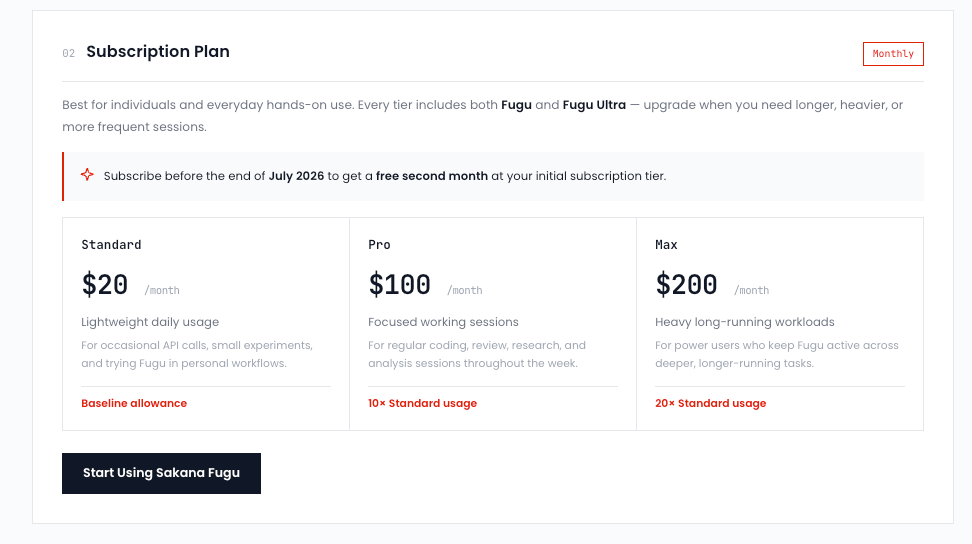
- Subscription tiers for everyday work. You pay a flat monthly fee and run the model for coding, code review, chatbots, and interactive services.
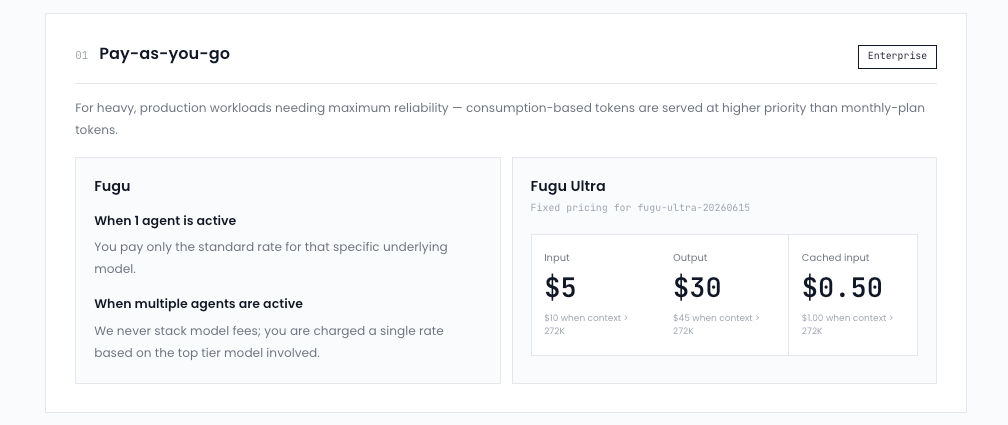
- Pay-as-you-go (PAYG) for heavier and enterprise workloads. You pay per token, which suits batch jobs, research runs, and spiky traffic.
Both the balanced “Fugu” variant and the higher-quality “Fugu Ultra” variant sit behind one OpenAI-compatible endpoint. You pick the variant with a model id string; Fugu then decides internally how much horsepower to spend.
There is no standalone free tier reported. The closest thing is a launch promotion, covered below.
If you want to test the economics before committing, point an existing OpenAI client at Fugu and watch your token spend in real time. Apidog gives you a request-by-request view, which matters more here than with a single-model API, because one Fugu call can fan out into several model calls under the hood.
Reported pricing: verify live before you budget
Reported subscription tiers
| Plan | Reported monthly price | Who it targets |
|---|---|---|
| Entry | reported $20 / month | Individual developers, light daily use |
| Mid | reported $100 / month | Teams, steady coding and review workloads |
| Top | reported $200 / month | Power users, high-volume interactive services |
The same tier ladder reportedly applies to both Fugu and Fugu Ultra. A launch promotion reportedly gives you a free second month if you subscribe before the end of July 2026. If that promo matters to your decision, verify it in the console first, because launch offers change fast and this one is not confirmed on the release page.
Reported pay-as-you-go rates
| Token type | Reported rate (per 1M tokens) | Reported surcharge above 272K context |
|---|---|---|
| Input | reported $5 | reported $10 |
| Output | reported $30 | reported $45 |
| Cached input | reported $0.50 | reported $1.00 |
The surcharge column is the part to watch. Long-context requests above roughly 272K tokens reportedly cost about double per million. Orchestration prompts tend to grow, because the conductor passes context between worker agents, so a research-grade Fugu Ultra run can drift into that band faster than you expect.
For a sense of where these PAYG rates sit, compare against models you can already buy. If you have priced Claude Fable 5, you already know the shape of frontier billing.
You still pay a Sakana margin on top of worker-model costs
Read the passthrough claim carefully. The base Fugu variant rides the underlying model’s rate, but the premium Fugu Ultra variant and the PAYG rates sit higher than the cheapest worker models for a reason. You are paying Sakana to run the conductor: the routing decision, the agent-to-agent communication, and the synthesis of the final answer.
The honest framing is this:
- The orchestrator itself is cheap. The Trinity paper describes a sub-20,000-parameter coordinator optimized by evolution, and the Conductor paper describes a 7B model trained with reinforcement learning that claims to beat Mixture-of-Agents at lower cost. Running one of those is not where your bill comes from.
- The models the conductor calls are not cheap. When Fugu decides a hard problem needs a frontier model, it calls one, and you pay frontier rates for those tokens plus Sakana’s margin for orchestrating them.
Put plainly: a cheap conductor that hires expensive labor still hands you an expensive invoice. Fugu’s savings argument is that it only hires the expensive labor when the problem needs it, and answers easy prompts cheaply itself. Whether that nets out cheaper than calling one frontier model directly depends entirely on your traffic mix.
Anchoring against real frontier prices
You cannot judge Fugu’s reported numbers in a vacuum. Anchor them against models with published, sourced pricing. These figures come from Anthropic’s 2026-06-09 pricing and are not reported or hedged:
| Model | Input (per 1M) | Output (per 1M) | What it is |
|---|---|---|---|
| Fable 5 | $10 | $50 | Anthropic’s most powerful generally available model, a tier above Opus 4.8 |
| Mythos 5 | $10 | $50 | Same price band as Fable 5 |
| Mythos Preview | $25 | $125 | The April 2026 frontier model held back as “too dangerous to release” |
Now line that up against Fugu’s reported PAYG of about $5 input and $30 output per million tokens. On paper, the Fugu base rate looks cheaper than Fable 5 per token, but that comparison is misleading if you stop there.
Sakana claims Fugu Ultra “stands shoulder-to-shoulder with leading models like Fable 5 and Mythos Preview” across engineering, scientific, and reasoning benchmarks. Per Sakana, that is a parity claim, not a “beats” claim. And remember the architecture: Fugu is an orchestrator that calls other vendors’ frontier models, recursively including itself. So when a Fugu run produces a frontier-grade answer, it may have done so by calling a frontier model and synthesizing the result. The headline per-token number is for the conductor; the conductor’s calls bill on top.
If you are weighing Fugu against the models it sits next to, our guide on how to access Sakana Fugu walks through the sign-up wall, and the model-of-models versus single-model distinction matters here. Fable 5 and Mythos are single Anthropic models with one published rate. Fugu is a system whose effective cost depends on which models it decides to wake up.
Calling Fugu through an OpenAI-compatible client
Fugu exposes one OpenAI-compatible endpoint, so you point an existing OpenAI client at it with your key and skip any SDK migration. The base URL is not published on any public page, so copy the real one from your console and never hardcode a guessed host.
from openai import OpenAI

# Copy the real base URL from console.sakana.ai after you log in.
client = OpenAI(
    api_key="YOUR_SAKANA_API_KEY",
    base_url="<YOUR_FUGU_BASE_URL_FROM_CONSOLE>",
)

# "fugu" routes the balanced, passthrough-billed variant.
# "fugu-ultra" routes the maximum-quality variant.
response = client.chat.completions.create(
    model="fugu",
    messages=[
        {"role": "user", "content": "Review this function for security issues."},
    ],
)

print(response.choices[0].message.content)
print(response.usage)  # watch token counts; this is where cost shows up
The model id strings (fugu and fugu-ultra, possibly with a dated suffix) are reported and worth confirming in your console. Log the response.usage field: with an orchestrator, usage is the only honest signal of what a request cost, because the conductor’s internal calls roll up into that count. The request and response shape follows the standard OpenAI chat completions contract, so anything that speaks that protocol works without changes. For a full setup walkthrough, see our guide on how to use the Sakana Fugu API.
Frequently Asked Questions
Does Fugu have a free tier?
No standalone free tier has been reported. The closest offer is a launch promotion that reportedly gives you a free second month if you subscribe before the end of July 2026. That promo is not confirmed on the release page, so check it live in your console at console.sakana.ai before counting on it.
Why does Fugu look cheaper per token but might cost more?
The reported per-token rate is for the conductor, not the frontier models it calls. Fugu is an orchestrator that delegates hard problems to other vendors’ models and bills those on top. A single frontier model has one published rate with no hidden fan-out, which is why our Claude Fable 5 pricing breakdown is a cleaner cost comparison.
What is passthrough billing in Fugu?
The base Fugu variant is reportedly billed at the standard rate of the underlying model it calls, with no separate per-agent orchestration fee stacked on top. You still pay a Sakana margin on the premium variant and on the per-token plan.
Should I pick a subscription or pay-as-you-go?
Pick a subscription for steady everyday work like coding, review, and chatbots, where flat monthly pricing is predictable. Pick pay-as-you-go for spiky, heavy, or research-grade workloads, and budget for the reported long-context surcharge above roughly 272K tokens.
How do I track what a Fugu request costs?
Log the usage field on every response, since that rolls up the conductor’s internal model calls into one token count. Routing requests through a tool that records per-call usage makes escalation visible. If you are comparing Fugu against routing aggregators, our best OpenRouter alternatives guide covers how to measure routing-versus-orchestration cost.
Fugu’s pricing rewards traffic that is mostly easy with occasional hard problems, and punishes traffic that is uniformly frontier-grade. Meter your real requests before you commit to a tier, confirm every reported number in your console, and you will know which side of that line your workload falls on. To watch your Fugu token spend request by request as you test, download Apidog and route your OpenAI-compatible calls through it.