
If you’re searching for a Mockaroo alternative, you probably want realistic test data without the login wall, the row caps, or the export-only workflow. Mockaroo is a solid bulk data generator, but it’s not the only way to produce believable fake records, and it’s not always the fastest path when your data needs to live inside an API. This guide compares Mockaroo to Faker.js, JSON Generator, and Apidog, so you can pick the right tool for your case. For a hands-on primer on the broader problem, see our guide to creating realistic API test data.
What Mockaroo is and what it does well
Mockaroo is a web-based random data generator. You define a schema column by column, pick from a large library of field types (names, emails, addresses, credit card numbers, lat/long pairs), set a row count, and export the result as CSV, JSON, SQL, or Excel. The official Mockaroo docs list well over a hundred built-in types, and that breadth is its real strength.
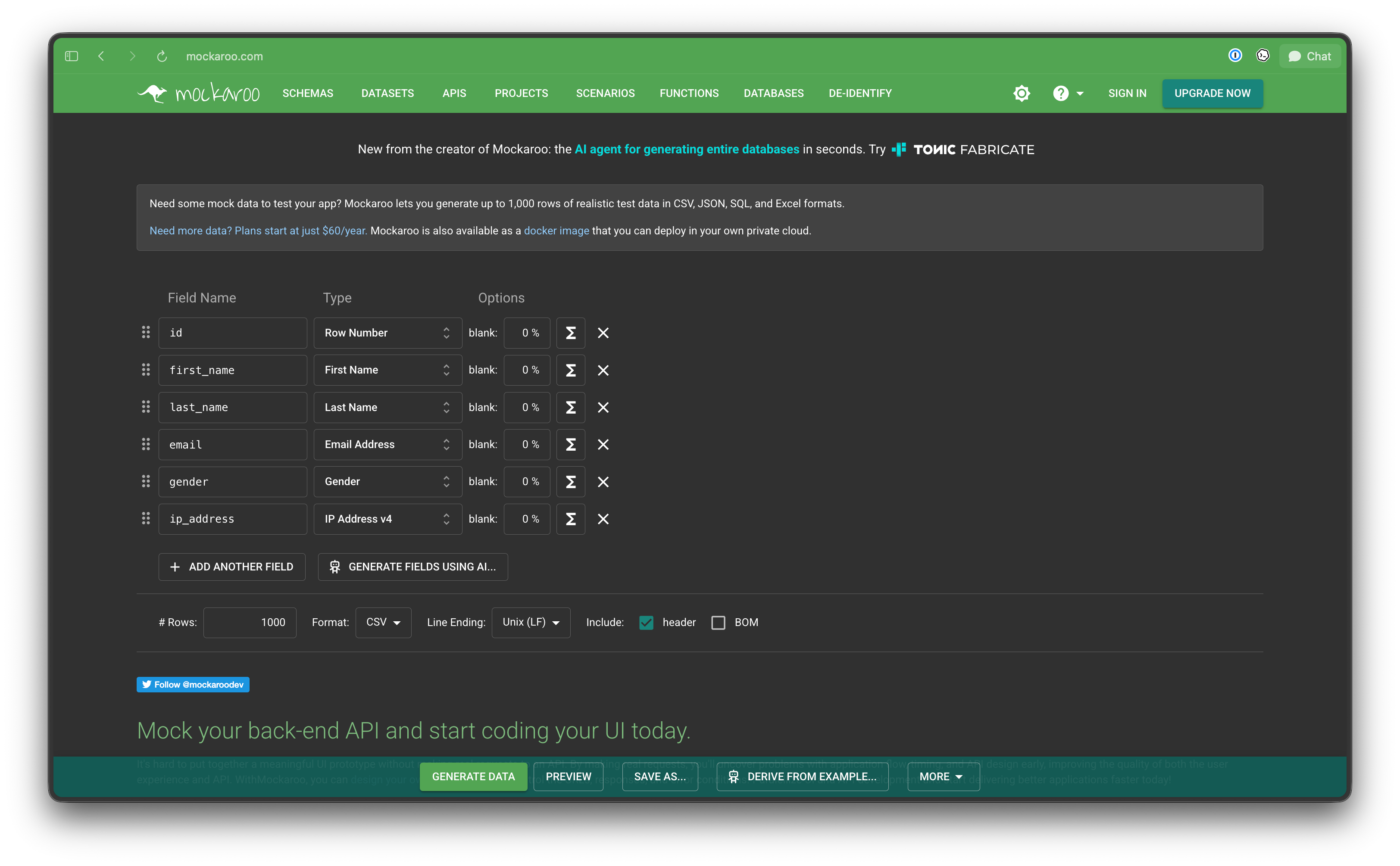
Where Mockaroo shines is bulk one-shot export. If you need 50,000 rows of plausible customer records dumped into a SQL file to seed a database, few tools match it for sheer volume and field variety. It also has a formula language for derived fields, so you can compute one column from another.
So the strengths are genuine. The friction shows up in three places:
- It’s login-gated. You need an account to use most of the schema features.
- The free tier caps you at 1,000 rows per dataset and 200 API calls per day, with paid plans unlocking higher volumes (around $50/year for 100,000 rows at the time of writing). Check the Mockaroo pricing page for current numbers, since they change.
- It’s export-first. You generate a file or hit a static mock URL, but the data isn’t wired into a live, schema-aware API workflow by default.
That last point matters most for front-end and QA teams. A CSV dump is great for seeding. It’s less great when you want an endpoint that returns fresh, realistic data on every call while the backend is still being built.
How to choose a Mockaroo alternative
Before the list, decide what you’re optimizing for:
- Raw export volume. You want millions of rows in a file. Stay close to Mockaroo or a code library.
- In-code generation. You want fake data inside your test suite or seed script. A library wins.
- A live mock endpoint. You want a running API that serves realistic responses now. A platform with smart mocking wins.
Keep that in mind as you read. The best tool depends on where the data needs to end up.
The best Mockaroo alternatives in 2026
1. Apidog (best for live, schema-aware mock data)
Apidog is an all-in-one API platform that designs, tests, documents, and mocks APIs in one workspace. For the mock-data job specifically, it does something Mockaroo doesn’t: it serves realistic data from a live mock endpoint that’s driven by your API schema, not just a one-shot file you download.
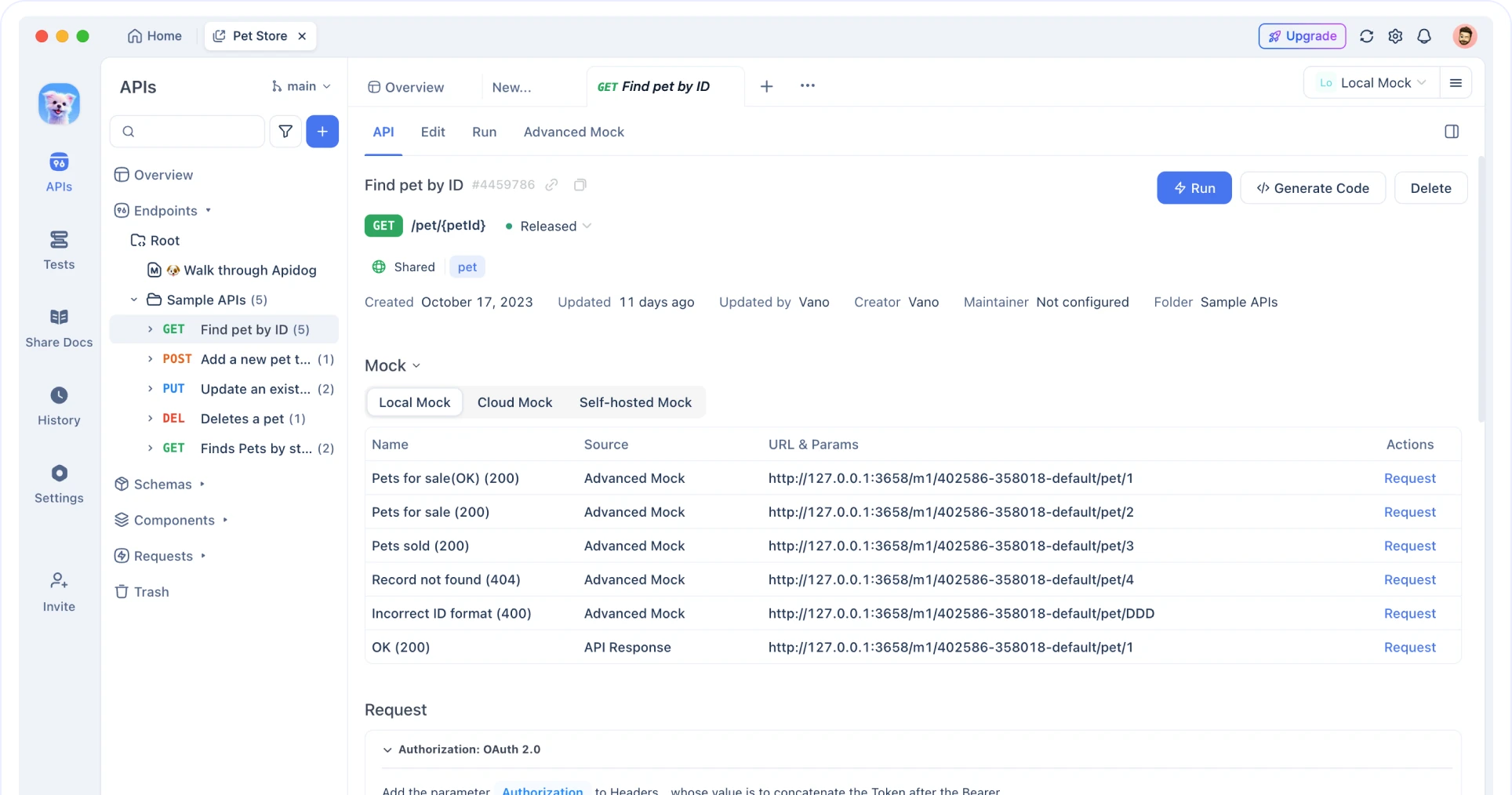
Here’s the honest edge. When you define an endpoint in Apidog, its smart mock reads the field names and types and returns believable values automatically. A field named
email returns an email. A field named created_at returns a date. You don’t hand-wire every value. Under the hood, Apidog supports Faker.js syntax for fine-grained control, so you can attach rules like @firstName, @city, or a regex pattern to any field. We cover that in detail in using Faker.js inside Apidog.
The practical difference: your front-end team gets a running URL that returns fresh, varied data on every request, matched to the contract the backend will ship. Change the schema, the mock updates. That’s a different shape of value than a static export, and it’s why front-end developers tend to prefer it when the backend isn’t ready yet.
Apidog can also generate mock data straight from an OpenAPI spec, which is handy if you already design API-first. See generating mock data from OpenAPI schemas.
Where Mockaroo still wins: if your only goal is a huge SQL seed file, Mockaroo’s bulk export is more direct. Apidog is built around the API, not around dumping flat files.
You can download Apidog and have a smart mock endpoint running in a few minutes, no row cap on the responses your mock serves.
2. Faker.js (best for in-code generation)
Faker.js is an open-source JavaScript library that produces fake data in code. You import it, call functions like faker.person.fullName() or faker.internet.email(), and get realistic values back. It’s the standard choice when you want data generated inside a test, a seed script, or a Storybook fixture.
The upside is full control and zero external service. No login, no caps, no network call. You generate exactly the shape you want, in a loop, as part of your build. It’s also free and runs anywhere Node runs.
The trade-off is that it’s a library, not a tool. There’s no UI, no one-click export, and no hosted endpoint. You write code. If your team isn’t comfortable in JavaScript, or you just want a quick CSV, this is more setup than Mockaroo. Note that the original faker.js was deprecated and the community continues it as @faker-js/faker, so install that package.
3. JSON Generator (best for quick browser-based JSON)
JSON Generator is a free web tool for producing structured JSON from a template. You write a template using its tag syntax ({{firstName()}}, {{integer(1,100)}}), set a repeat count, and it spits out JSON instantly in the browser.
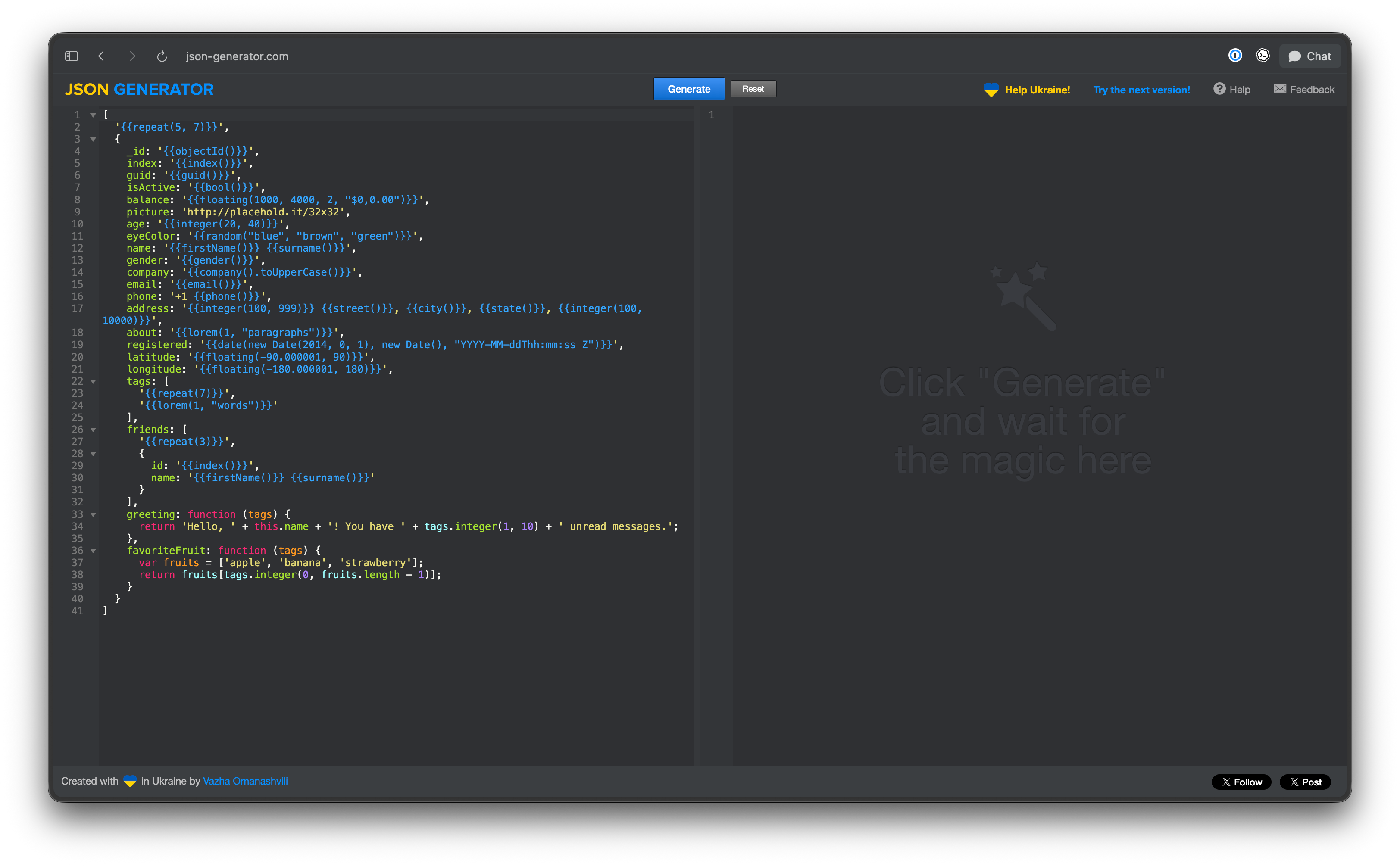
It’s fast and frictionless for small-to-medium JSON payloads, and you don’t need an account for basic use. For mocking a single API response shape during front-end work, it’s often quicker than spinning up anything heavier.
The limits are scope. It’s JSON-only (no CSV or SQL), the field library is smaller than Mockaroo’s, and like Mockaroo it’s export-first, you copy the output and paste it somewhere. There’s no live endpoint and no schema awareness tied to a real API contract.
4. Mockoon (best for a local mock server with fake data)
Mockoon is a desktop app that runs a local mock API server. It includes a templating system based on Faker.js, so your mock responses can return realistic, varied data rather than static strings. That makes it a closer Mockaroo alternative for teams who want a running endpoint instead of a file.
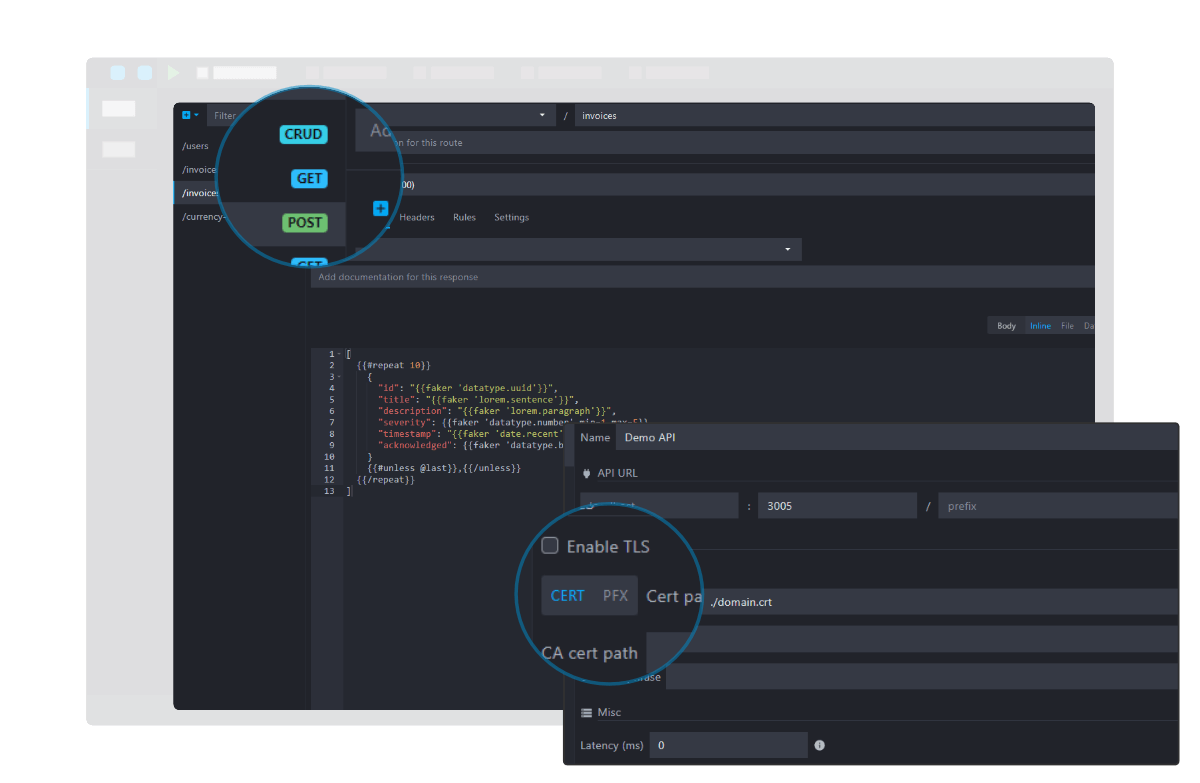
It’s free, open-source, and works offline, which suits developers who don’t want a cloud account. The main constraints are that it’s locally hosted by default (sharing a mock with a remote teammate takes extra work) and it’s focused on mocking rather than the full API lifecycle. If you’re weighing it specifically, read our roundup of Mockoon alternatives.
5. json-server (best for a fake REST API from a JSON file)
json-server turns a plain JSON file into a full fake REST API with zero coding. Point it at a db.json file and you instantly get GET, POST, PUT, and DELETE routes with real persistence in memory.
It’s the lightest way to stand up a working REST API for front-end prototyping. Combine it with Faker.js to seed the JSON file and you get realistic data behind real routes. The catch is that the realism comes from whatever you put in the file, json-server itself doesn’t generate data. It’s a server, not a generator. Our walkthrough on building a fake REST API with json-server shows the full setup.
Comparison: Mockaroo vs the alternatives
| Tool | Type | Live endpoint | Login required | Realistic data | Best for |
|---|---|---|---|---|---|
| Mockaroo | Web generator | Static mock only | Yes | Yes (huge field library) | Bulk one-shot export |
| Apidog | API platform | Yes (smart mock) | Account, free tier | Yes (schema + Faker.js) | Live, schema-aware mock data |
| Faker.js | Code library | No | No | Yes | In-code generation |
| JSON Generator | Web tool | No | No (basic) | Yes (smaller set) | Quick browser JSON |
| Mockoon | Desktop app | Yes (local) | No | Yes (Faker.js) | Local mock server |
| json-server | CLI tool | Yes (local) | No | Only what you seed | Fake REST API from JSON |
The pattern is clear. Mockaroo and JSON Generator are export-first. Faker.js is code-first. Apidog, Mockoon, and json-server give you a running endpoint, and of those, Apidog is the one tied to a real API schema with both smart mock and Faker.js rules.
Frequently asked questions
Is Mockaroo free to use?
Mockaroo has a free tier, but it caps you at 1,000 rows per dataset and 200 API requests per day, and it requires an account. Paid plans raise those limits. If you need higher volume or a live endpoint without per-row caps, an alternative like Apidog or a code library such as Faker.js avoids those ceilings. Pricing changes, so confirm on Mockaroo’s site.
What’s the difference between a data generator and a mock server?
A data generator produces records you export (a CSV, a JSON blob, a SQL file). A mock server runs an endpoint that returns data when called. Mockaroo is mainly a generator. Tools like Apidog and Mockoon are mock servers that also generate realistic data on the fly. If you want the full picture, our guide to mocking an API for testing breaks down both.
Can I generate mock data from an OpenAPI schema?
Yes. If you design API-first, Apidog reads your OpenAPI definition and produces a smart mock endpoint that returns data matching each field’s type. That keeps your fake data aligned with the real contract, which static generators can’t guarantee.
Which Mockaroo alternative is best for front-end developers?
Front-end developers usually want a running endpoint that returns fresh, realistic data while the backend is still in progress. Apidog’s smart mock fits that well because the endpoint is live and schema-aware. For a quick local option with no cloud account, json-server plus Faker.js also works.
Conclusion
Mockaroo is good at what it’s built for: bulk, one-shot export with a deep field library. If you need a million rows in a SQL file, it’s hard to beat. But if your mock data needs to live inside an API, served from a live endpoint that matches your schema and updates as the contract changes, that’s a different job, and a generator that hands you a static file isn’t the cleanest fit.
That’s where Apidog stands out. You get Faker.js-powered field rules, OpenAPI-driven smart mocking, and a running endpoint your team can call today, all inside one API workspace. Download Apidog and spin up a realistic mock endpoint in a few minutes to see the difference for yourself.