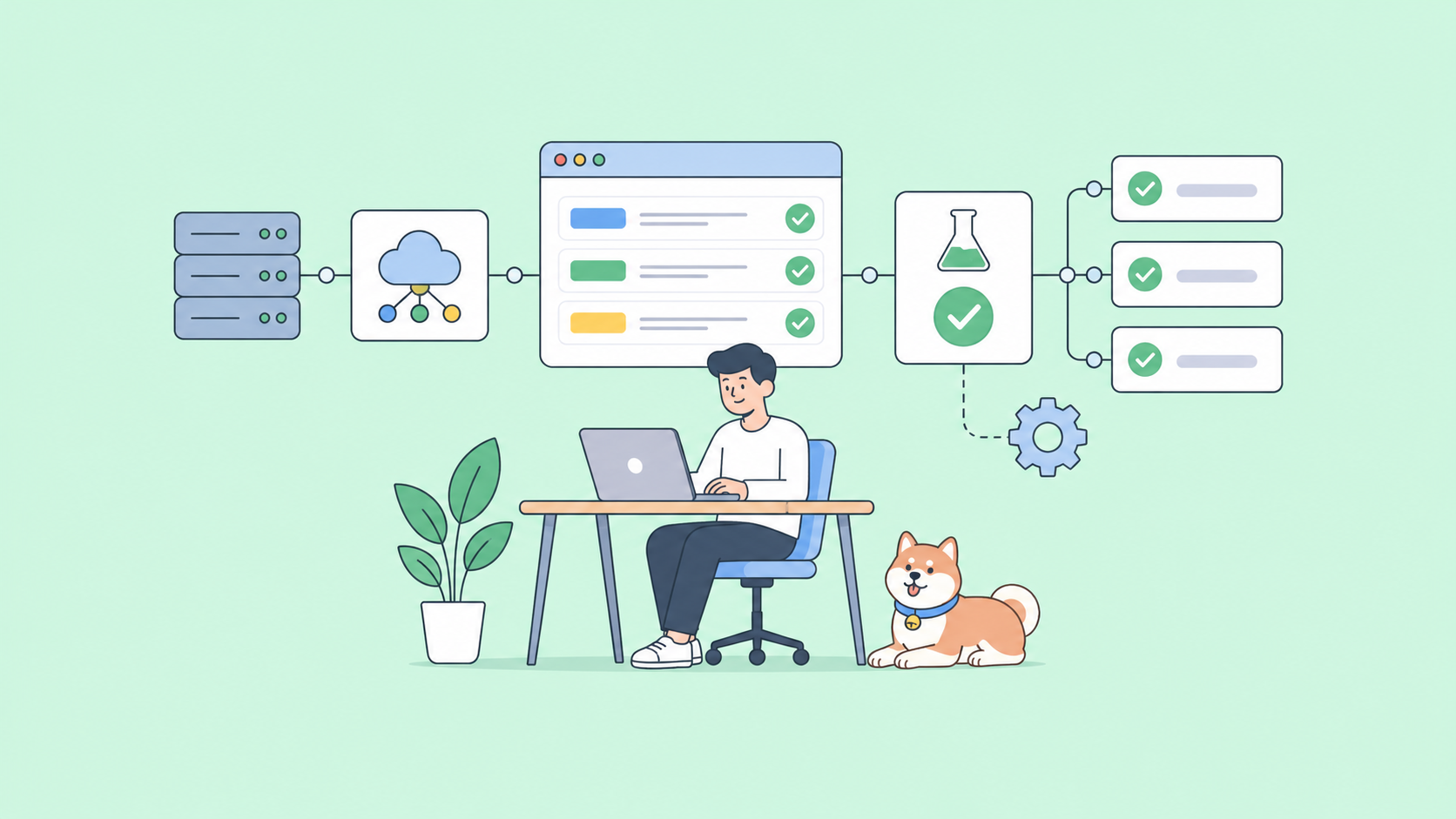
API management sounds like it should live in a heavy control plane. For a lot of teams, it does: a dashboard, a database, a couple of Kubernetes pods, and a login page you check twice a day. But the daily work of managing an API, syncing config, promoting changes across environments, wiring routes, keeping a mock or a spec in sync, is scriptable. And once it’s scriptable, a small CLI beats a browser tab.
This is a roundup of lightweight command-line tools that do real API-management work without dragging a full platform onto your laptop. Most are a single Go binary you drop in your PATH, or an npm package you install once. They start fast, take little or no config to try, and slot cleanly into CI. If you’re picking a full control plane, start with our guide to the best API management tools for 2026 and the broader API management overview. This piece is narrower: terminal-first tools you can install in a minute.
One thing to get straight up front, because it changes how you read the list. “API management” means two different things depending on who’s talking. To a platform team it means the gateway layer: routing, auth, rate limits, quotas, the stuff that sits in front of production traffic (Kong, Tyk, Apigee, KrakenD). To an API team building the product, it means managing the API itself: the spec, the endpoints, environments, variables, mocks, and docs. Both are “API management.” The CLIs below cover both scopes, and we’ve labeled which is which so you don’t reach for a gateway tool when you needed a project tool.
You’ll get seven tools, each with a real install command and the one command that shows it working, plus honest notes on where each stops.
What makes a CLI tool “lightweight” for API management
Lightweight is not the same as underpowered. For this list, a tool qualifies when it:
- Ships as one binary or one package. A single Go binary you
curlinto place, or a global npm install. No cluster to stand up just to try it. - Starts fast and runs local. You can run it against a config file or a spec on your machine and see output in a second, not after a deploy.
- Needs little config to be useful. A first useful command works with a flag or two, not a 200-line YAML file.
- Fits CI cleanly. Deterministic exit codes, a
check/validate/dry-runmode, and machine-readable output.
Notice what’s missing: a GUI. Every tool here is terminal-first. Some have a paid cloud service behind them, but the CLI itself is small and does one job well. We’ve ordered roughly from the smallest single-purpose binaries up to the fuller project CLIs.
deck (Kong): declarative config for Kong Gateway
decK is Kong’s declarative configuration tool. You export your Kong Gateway’s routes, services, plugins, and consumers to a YAML file, edit that file in Git, and sync it back. It also does drift detection, so you can tell when someone changed the live gateway out of band. This is gateway-scope API management, and decK is the reference tool for it.
It’s a single Go binary under the Apache 2.0 license. Install on macOS with Homebrew:
brew install kong/deck/deck
deck gateway sync kong.yaml
deck gateway sync reconciles your Kong instance to match the YAML file; run deck gateway diff first to preview the changes without applying them. Best at: GitOps for Kong. If your gateway is Kong, decK is how you stop clicking around Kong Manager. Honest limit: it only manages Kong. It’s not a general API tool, and Kong recently split out kongctl as a broader developer CLI, so check which one matches your Kong version.
Tyk CLI: bundle and manage a Tyk gateway
Tyk is an open-source API gateway, and its CLI handles the pieces you script around a Tyk deployment, most notably plugin bundles. If you write custom middleware (Go, Python, or JavaScript plugins), you package it into a signed bundle the gateway loads at runtime.
Worth knowing: since Tyk Gateway v2.8 the bundler is built into the gateway binary, so you usually don’t install a separate tyk-cli. You call it through the gateway:
tyk bundle build -output bundle.zip
Best at: managing a self-hosted Tyk gateway’s plugins and config from the terminal. Honest limit: Tyk’s CLI surface is narrower than decK’s; a lot of Tyk management still happens through its Dashboard API or Gateway API rather than a rich CLI. It’s gateway-scope, and it assumes you’re already running Tyk.
apigeecli: script Google Apigee from the terminal
apigeecli is the official command-line tool for Google’s Apigee platform. Apigee’s console is heavy; apigeecli lets you manage proxies, API products, environments, developers, and apps as commands, which is what you want in a pipeline. It’s a Go binary maintained by the Apigee team under Apache 2.0.
Install with the official script, then list your orgs:
curl -L https://raw.githubusercontent.com/apigee/apigeecli/main/downloadLatest.sh | sh -
token=$(gcloud auth print-access-token)
apigeecli organizations list -t "$token"
Best at: automating Apigee, importing and deploying API proxy bundles, wiring Apigee into CI without touching the UI. Honest limit: it’s Apigee-only and expects Google Cloud auth (a gcloud access token). If you’re not on Apigee, it does nothing for you. This is firmly gateway/platform-scope management.
KrakenD: a stateless gateway you configure as a file
KrakenD is a stateless API gateway written in Go. The management story is different from the others: there’s no database and no admin UI to manage state, the gateway is its configuration file. So “managing” a KrakenD gateway means validating and templating that file, which the krakend binary does directly. The Community Edition is Apache 2.0 and free to self-host.
Validate a config before you ship it:
krakend check -c krakend.json --lint
For larger setups, KrakenD’s flexible configuration lets you split config into templates and partials and render them per environment, enabled with an environment variable:
FC_ENABLE=1 FC_SETTINGS="config/prod" krakend check -c krakend.tmpl
Best at: config-as-code gateways where you want the whole gateway defined in files you can lint in CI. Honest limit: it’s stateless by design, so there’s no runtime state to manage and no built-in developer portal; features like SSO and audit logging are Enterprise-only. Gateway-scope.
Speakeasy: manage the SDK and client side of your API
Speakeasy comes at API management from a different angle: managing what consumers get. From one OpenAPI spec it generates type-safe SDKs, Terraform providers, and contract tests, and it keeps them regenerated as the spec changes. If part of “managing” your API is shipping and versioning client libraries, this is the CLI for that slice. The CLI is open source (Apache 2.0); the generation platform has usage tiers.
Install and scaffold with the interactive quickstart:
brew install speakeasy-api/tap/speakeasy
speakeasy quickstart
After setup, speakeasy run validates the spec, generates the SDKs, and compiles them in one pass, which is what you drop into CI. Best at: turning a spec into maintained client SDKs without hand-writing them. Honest limit: it manages the consumer artifacts, not your gateway or your runtime traffic, and the polished multi-language output beyond the basics is where the paid tiers come in.
apidog-cli: manage your API project, environments, and specs
Here’s the other scope. The tools above manage gateways and clients; apidog-cli manages the API project itself, the design source of truth that everything downstream depends on. It’s the command-line companion to Apidog, and it’s genuinely lightweight: a global npm install, not the desktop app.
npm install -g apidog-cli
apidog login --with-token <YOUR_TOKEN>
apidog project list
Once you’re authenticated, the CLI exposes command groups that map to real project resources. apidog environment and apidog variables manage runtime environments and the variables inside them, so you can promote an endpoint from staging to production config without opening the app. apidog endpoint and apidog schema manage the API design (endpoints and data models). There’s also import and export (OpenAPI, Postman, Markdown, HTML), mock, doc, and run for test scenarios. Output is structured JSON with agentHints.nextSteps, which makes it easy to script or drive from an AI agent; see how to manage APIs without leaving your AI agents.
Best at: managing the API project, its environments, variables, endpoints, and specs, from the terminal or CI as a single integrated tool instead of stitching separate binaries together. Honest note on scope and licensing: Apidog isn’t a gateway, so it doesn’t replace Kong or Apigee at the traffic layer, and it isn’t open source; it’s a commercial product with a free tier. What it gives you is one CLI across design, mock, test, and docs so you’re not gluing five tools together. If a headless, API-first setup is what you’re after, see the headless API management tool breakdown.
How to choose
The fastest filter is scope: are you managing traffic at a gateway, or managing the API project and its lifecycle?
| Tool | Best for | Install | Open source? | Scope |
|---|---|---|---|---|
| deck (Kong) | GitOps + drift detection for Kong | brew install kong/deck/deck |
Yes (Apache 2.0) | Gateway (Kong) |
| Tyk CLI | Bundling plugins for a Tyk gateway | Built into tyk binary (v2.8+) |
Yes (MPL) | Gateway (Tyk) |
| apigeecli | Automating Google Apigee | curl .../downloadLatest.sh | sh - |
Yes (Apache 2.0) | Gateway (Apigee) |
| KrakenD | Config-as-code stateless gateway | Binary / Docker | Yes (CE, Apache 2.0) | Gateway (any) |
| Speakeasy | Generating + versioning client SDKs | brew install speakeasy-api/tap/speakeasy |
CLI yes (Apache 2.0) | Client/SDK side |
| apidog-cli | Managing the API project, envs, specs | npm install -g apidog-cli |
No (free tier) | Project/lifecycle |
Pick by what you’re actually running. On Kong, use decK. On Apigee, use apigeecli. On Tyk or KrakenD, use their own tooling. If you want the gateway defined entirely as files, KrakenD fits that model best. If your problem is client SDKs, Speakeasy. And if the thing you keep managing is the API design, environments, and variables, apidog-cli covers that scope as one tool. Many teams run a gateway CLI and a project CLI, because they solve different halves of the word “management.” If open-source is a hard requirement across the board, our open-source API management tools roundup goes deeper on licenses and self-hosting.
The lightweight takeaway
You don’t need a control plane open in a browser to manage an API. A gateway CLI keeps your routing and policies in Git. A generation CLI keeps your SDKs in sync with the spec. And a project CLI keeps your endpoints, environments, and variables under version control instead of buried in a UI. Each one is small, fast, and scriptable, which is the whole point of doing this from the terminal.
If your daily work is on the project side, design, mock, test, and docs in one place, Apidog unifies it and the apidog-cli takes it into CI and agent workflows. Download Apidog to try the platform, then reach for the CLI when you want to script it. Start with one binary, wire it into your pipeline, and grow from there.