
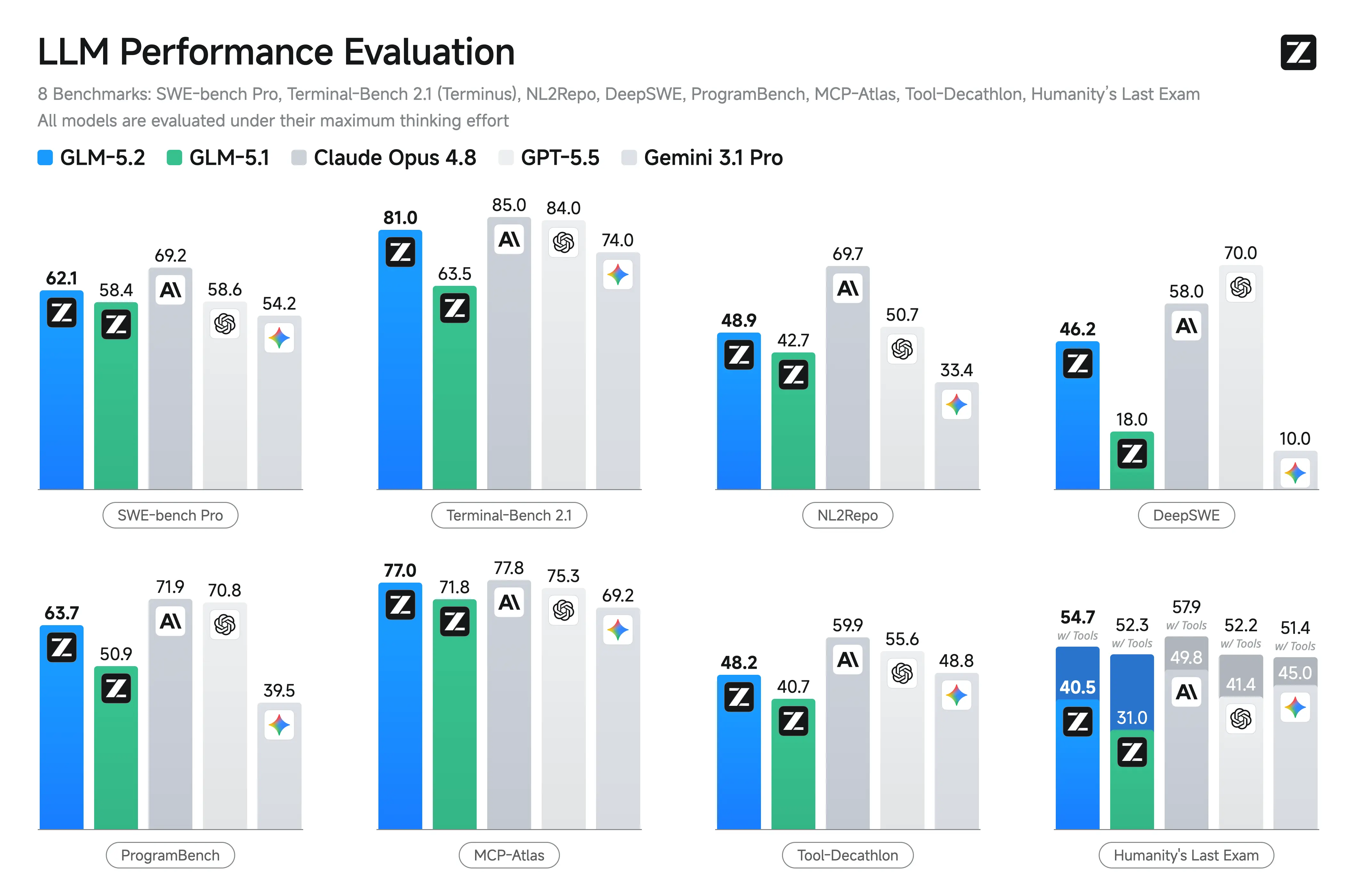
GLM-5.2 from Z.ai (Zhipu AI) landed with a stack of benchmark numbers, and a few of them are genuinely loud. The headline is SWE-bench Pro at 62.1, edging past GPT-5.5. The bigger story is buried one row down: Terminal-Bench jumped from 62.0 to 81.0 in a single generation. This post walks each GLM-5.2 benchmark score, explains what the test actually measures, and flags where the lead is real versus where it’s a rounding error.
All launch numbers here are Z.ai’s published results unless noted otherwise. When a model claims to beat the field on its own scorecards, you read it with one eyebrow up. So we’ll be specific about what each benchmark proves and what it doesn’t.
The short version: GLM-5.2 benchmark scores at a glance
Here’s the full GLM-5.2 benchmark table, with the closest rivals for context. Treat the comparison columns as Z.ai’s reported figures for those models, not independent re-runs.
| Benchmark | What it measures | GLM-5.2 | GLM-5.1 | GPT-5.5 | Claude Opus 4.8 |
|---|---|---|---|---|---|
| SWE-bench Pro | Real-world repo bug fixes | 62.1 | 58.4 | 58.6 | n/a |
| Terminal-Bench 2.1 | Multi-step shell/agent tasks | 81.0 | 62.0 | n/a | n/a |
| MCP-Atlas | Tool-use over MCP servers | 77.0 | n/a | 75.3 | 77.8 |
| Humanity’s Last Exam (w/ tools) | Hard expert reasoning | 54.7 | n/a | 52.2 | n/a |
| AIME 2026 | Competition math | 99.2 | n/a | n/a | n/a |
| GPQA-Diamond | Graduate-level science | 91.2 | n/a | n/a | n/a |
Z.ai also reports GLM-5.2 as the highest-scoring open-source model on FrontierSWE, PostTrainBench, and SWE-Marathon. We’ll get to what that qualifier (“open-source”) is doing.
For the plain-language version of what this model is, see the GLM-5.2 overview. For how it stacks against the proprietary field head to head, there’s a dedicated GLM-5.2 vs GPT-5.5, Opus, and Gemini breakdown.
SWE-bench Pro: 62.1 and what it really tells you
SWE-bench Pro is the harder, curated cousin of the original SWE-bench. It hands a model a real GitHub issue plus the full repository, and asks it to produce a patch that makes the project’s hidden test suite pass. No multiple choice, no toy functions. You either fix the bug across real files or you don’t.
GLM-5.2 scores 62.1. GPT-5.5 sits at 58.6 and GLM-5.1 at 58.4, per Z.ai. So two honest takeaways:
- The 3.5-point lead over GPT-5.5 is meaningful but not a chasm. On a benchmark this noisy, a few points can swing on test-harness details, retry budgets, and prompt scaffolding. Call it “competitive at the top,” not “dominant.”
- The 3.7-point gain over GLM-5.1 is the more reliable signal, because it’s the same lab measuring the same way across two of its own models. Generation-over-generation deltas are the cleanest read you get.
Why care about SWE-bench Pro at all? Because it’s the closest public proxy for “can this model do my actual job.” Fixing a bug in a sprawling codebase requires reading unfamiliar code, locating the right file, and editing without breaking three other things. That’s the daily reality of software work, which is why coding-first models are scored on it first.
Terminal-Bench 2.1: 81.0 is the hero number
If you read one row in the table, read this one. Terminal-Bench evaluates a model as an agent in a real shell: install dependencies, run commands, parse output, recover from errors, and complete a multi-step task end to end. It rewards persistence and tool discipline, not one-shot cleverness.
GLM-5.1 scored 62.0. GLM-5.2 scores 81.0. That’s a 19-point jump in one generation, and it’s the standout GLM-5.2 performance stat for a reason. Going from “fails about four in ten tasks” to “completes about four in five” is the difference between a model you babysit and one you can hand a terminal.
This is also where the architecture story connects to the benchmark story. Z.ai credits GLM-5.2’s “IndexShare” sparse attention, which reuses one indexer across every four sparse-attention layers to keep attention costs down at long context. Long-horizon agent tasks generate long transcripts: command, output, command, output, for dozens of turns. A model that holds that context cheaply and accurately is a model that doesn’t lose the plot halfway through a build. The Terminal-Bench leap is the practical payoff of that design. For the full generational comparison, see GLM-5.2 vs GLM-5.1.
One honest caveat: Terminal-Bench is a Z.ai-reported figure, and agentic benchmarks are sensitive to the scaffolding around the model (timeout limits, allowed retries, the harness prompt). The jump is large enough that scaffolding alone is unlikely to explain it, but verify on your own workload before betting a pipeline on it.
MCP-Atlas: 77.0, and an honest tie at the top
MCP-Atlas measures tool use through the Model Context Protocol, the standard way models call external tools and servers. It’s the benchmark that maps most directly to agent and API work: can the model pick the right tool, format the call correctly, read the result, and keep going.
GLM-5.2 lands at 77.0. GPT-5.5 is at 75.3, and Claude Opus 4.8 is at 77.8, per Z.ai. This is the row where you should resist the urge to declare a winner. GLM-5.2 beats GPT-5.5 by 1.7 and trails Opus 4.8 by 0.8. Those are rounding-error margins. The fair statement is that on MCP-style tool use, the three sit in a dead heat, and GLM-5.2 has earned its place in that group.
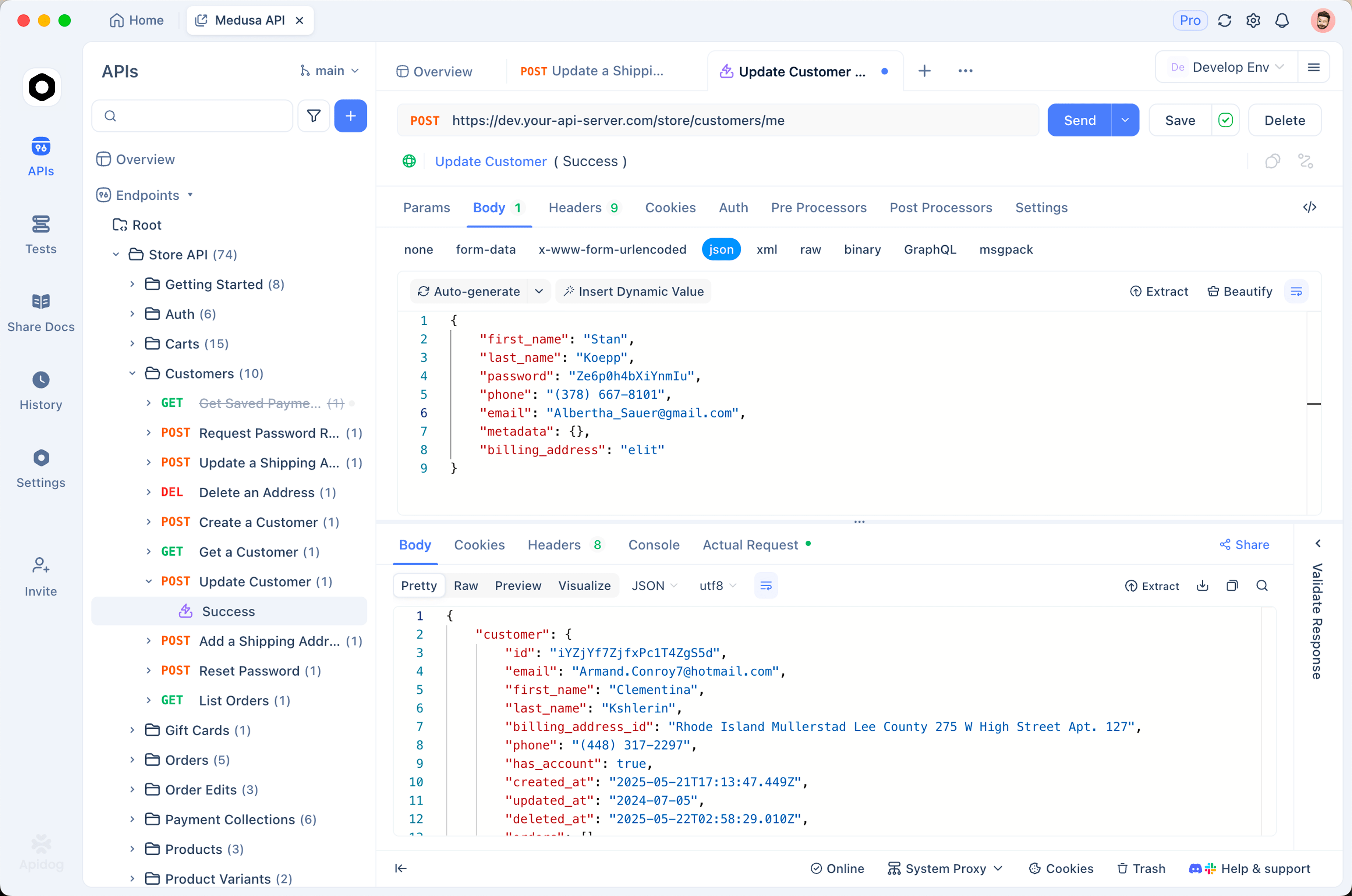
That matters because tool use is where a coding model meets your stack. Every MCP call is, functionally, an API interaction: a structured request, a response to parse, an error to handle. If you’re wiring a model into real services, you want the same hygiene you’d apply to any integration. This is exactly where Apidog fits. You can define and mock the endpoints an agent will hit, then debug the actual request and response payloads the model generates, before you let it loose on production. Download Apidog if you want to test those tool calls the same way you’d test any other API.
Reasoning and math: HLE 54.7, AIME 99.2, GPQA-Diamond 91.2
Coding isn’t the whole story. GLM-5.2 also posts strong reasoning numbers.
- Humanity’s Last Exam (with tools): 54.7. HLE is a deliberately brutal exam spanning expert-level questions across many fields, built to resist easy saturation. The “with tools” setting lets the model search and compute rather than answer cold. GLM-5.2’s 54.7 edges GPT-5.5’s 52.2 (per Z.ai). On a benchmark this hard, anything in the 50s is a serious result.
- AIME 2026: 99.2. AIME is competition math for strong high-schoolers. A 99.2 is effectively a ceiling score, which mostly tells you the test no longer separates frontier models. It’s a “no weaknesses here” signal more than a differentiator.
- GPQA-Diamond: 91.2. GPQA-Diamond is the hardest slice of a graduate-level science Q&A set, filtered so non-experts can’t brute-force it even with web access. A 91.2 puts GLM-5.2 firmly in frontier territory on technical reasoning.
The pattern across these: GLM-5.2 isn’t a narrow code specialist that falls apart on math or science. The two thinking-effort levels (High and Max, with Max recommended for coding) let you trade latency for depth on the harder problems. If you want the deeper math-and-reasoning angle alongside coding, the GLM-5.2 benchmarks vs the field piece carries that comparison further.
The “highest open-source” claim, unpacked
Z.ai reports GLM-5.2 as the top open-source model on FrontierSWE, PostTrainBench, and SWE-Marathon. Read that qualifier carefully, because it’s doing real work.
“Highest open-source” is a narrower claim than “highest, full stop.” The open-weights field is the relevant frame here: GLM-5.2 ships under an MIT license with open weights and no regional restrictions, which is a different proposition from a closed API model you rent. Against other open-weights models, being top of FrontierSWE (frontier-difficulty software tasks), PostTrainBench (post-training capability), and SWE-Marathon (long, sustained software work) is a strong claim, and it’s the claim that matters if your constraint is “must be self-hostable.”
It’s not the same as out-scoring every proprietary model on those tests. Where GLM-5.2 actually beats GPT-5.5, like SWE-bench Pro and HLE, Z.ai says so directly without the open-source hedge. So the mental model is: at or near the frontier overall, and clearly first among models you can download and run yourself. VentureBeat framed the value bluntly, reporting that GLM-5.2 “beats GPT-5.5 on long-horizon coding at roughly one-sixth the cost.” That’s VentureBeat’s characterization, worth attributing rather than asserting as a measured fact.
GLM-5.2 specs at a glance
Benchmarks only mean something against the hardware and licensing reality. Here are the GLM-5.2 specs that shape how the scores translate to your setup.
| Spec | Value |
|---|---|
| Parameters | ~753B total, mixture-of-experts (MoE) |
| Precision | BF16 |
| Attention | IndexShare sparse attention (one indexer shared per 4 sparse layers) |
| Context window | 1M tokens (1,048,576) |
| Max output | Up to 128K per z.ai docs (verify live; OpenRouter does not list a figure) |
| Modality | Text in, text out (no confirmed vision variant) |
| Thinking effort | High and Max; can be disabled |
| License | MIT, open weights, no regional restrictions |
| Model ids | HF zai-org/GLM-5.2, API glm-5.2, Ollama glm-5.2, OpenRouter z-ai/glm-5.2 |
A few notes on reading this sidebar. The ~753B parameter count is the total MoE size, not the active-per-token count, so don’t read it as “needs 753B worth of dense compute per forward pass,” that’s the point of MoE. The 1M-token context is the spec that makes the Terminal-Bench result believable: long agent runs need somewhere to put all that history. On max output, be careful. Z.ai’s docs cite up to 128K (as of June 2026, verify the current limit at z.ai), but it’s not consistently listed across providers, so treat it as a documented ceiling rather than a guaranteed one. And there is no GLM-5.2 vision model. If you see “GLM-5.2V” somewhere, it isn’t a thing Z.ai has confirmed.
Pricing follows the open-weights logic: OpenRouter lists $1.40 per 1M input tokens and $4.40 per 1M output, with cached input around $0.26 per 1M (VentureBeat’s figure). That cost profile is the backbone of the “one-sixth the cost” line. For the full cost breakdown including the GLM Coding Plan tiers, see the GLM-5.2 pricing page, and if you want to run it without paying per token, how to use GLM-5.2 for free covers the self-host route.
How to verify these benchmarks yourself
Vendor scorecards are a starting point, not a verdict. Three things to do before trusting any of these numbers for a real decision:
- Read the primary sources. The Z.ai GLM-5.2 blog and the Z.ai docs carry the official methodology. The Hugging Face model card has the weights and config if you want to inspect the architecture directly.
- Check third-party listings. The OpenRouter page confirms pricing and the model id, and the Ollama library entry confirms the local-run path. VentureBeat’s coverage adds outside framing on the cost story.
- Run your own eval. The only benchmark that fully counts is your workload. Wire GLM-5.2 into a real task, ideally an agentic one with tool calls, and watch how it does over many turns. For prior-generation context on this exact exercise, the GLM-5.1 writeup and the GLM-5 vs DeepSeek vs GPT-5 speed and cost comparison are useful baselines.
When you run that own-workload eval, the tool calls are where models quietly fall down, malformed JSON, wrong tool selection, dropped error handling. Mocking those endpoints in Apidog lets you watch the model’s actual requests and responses without hammering live services, which is the fastest way to tell a benchmark hero from a model that works in your stack.
The takeaway
GLM-5.2’s benchmark sheet holds up to scrutiny better than most launch scorecards. The Terminal-Bench leap from 62.0 to 81.0 is the genuinely big number, the SWE-bench Pro lead over GPT-5.5 is real if modest, and the MCP-Atlas result is an honest three-way tie at the top. Pair those scores with open weights, an MIT license, a 1M-token context, and roughly one-sixth-the-cost economics, and you get a model that earns a serious evaluation rather than a polite glance.
The benchmarks point you at the right model. Your own workload confirms it. When you run that test and it involves real API and tool calls, set up the endpoints in Apidog so you can see exactly what the model sends and receives, then decide based on what it does in your stack, not what it scored on someone else’s.