Google engineers crafted Gemini 3.1 Pro to resolve the most demanding computational challenges that earlier models handle inefficiently. This preview model, released on February 19, 2026, elevates multimodal understanding and reasoning to new heights. Consequently, organizations now deploy AI systems that process vast contexts, orchestrate autonomous workflows, and generate production-ready code artifacts from natural-language instructions.
Gemini 3.1 Pro builds directly on the Gemini 3 foundation while introducing refined intelligence layers optimized for agentic behaviors and creative synthesis. Developers utilize this model to bridge abstract requirements with executable implementations across domains such as software engineering, scientific simulation, and enterprise data orchestration. Moreover, the architecture supports native tool use, structured outputs, and persistent reasoning chains through thought signatures, which maintain context integrity across multi-turn interactions.
Engineers designed Gemini 3.1 Pro with a 1,048,576-token input context window and up to 65,536 output tokens. This capacity enables single-pass analysis of entire repositories, research corpora spanning thousands of pages, or high-resolution video streams combined with telemetry data. Furthermore, the model processes text, images, audio, video, PDFs (up to 1,000 pages), and code natively without external preprocessing pipelines.
This guide examines the model’s technical architecture, quantifies its benchmark dominance, details every access vector with production-ready code, and demonstrates advanced patterns including agentic orchestration and multimodal function calling. Readers acquire the precise knowledge required to incorporate Gemini 3.1 Pro into production systems today.
Technical Architecture and Core Innovations of Gemini 3.1 Pro
Google DeepMind engineers engineered Gemini 3.1 Pro around a hybrid transformer-decoder backbone augmented with adaptive compute pathways. These pathways dynamically allocate reasoning depth via the thinking_level parameter (low, medium, high). The high setting triggers deeper internal simulation chains for problems that demand multi-hop logic or constraint satisfaction.
Furthermore, the model introduces thought signatures—encrypted, tamper-evident representations of intermediate reasoning states. Developers return these signatures verbatim in subsequent API calls to preserve agentic continuity. This mechanism prevents context drift in long-running autonomous agents and enables verifiable audit trails for regulated industries.
Media resolution controls add another layer of efficiency. Engineers specify media_resolution_high (1,120 tokens per image) for detailed diagrams or media_resolution_low (70 tokens per frame) for video overviews. Consequently, token budgets remain predictable even when ingesting mixed-modality payloads.
Gemini 3.1 Pro also natively supports parallel tool invocation and multimodal function responses. A single inference step can call Google Search, execute Python code that manipulates images, and return both JSON results and generated visuals. This tight integration reduces round-trip latency compared with external orchestration layers.
In practice, developers leverage these primitives to build systems that reason about physical simulations, financial models, or UI prototypes without intermediate human validation. The model’s knowledge cutoff rests in January 2025, yet real-time grounding tools (Google Search, URL Context) extend effective knowledge indefinitely.
Benchmark Dominance: How Gemini 3.1 Pro Outperforms Prior Frontiers
Independent evaluations confirm Gemini 3.1 Pro establishes new records across reasoning, coding, and agentic benchmarks. On ARC-AGI-2, the model achieves 77.1 %—more than double the previous best public score. This result demonstrates genuine abstraction capability rather than memorization.
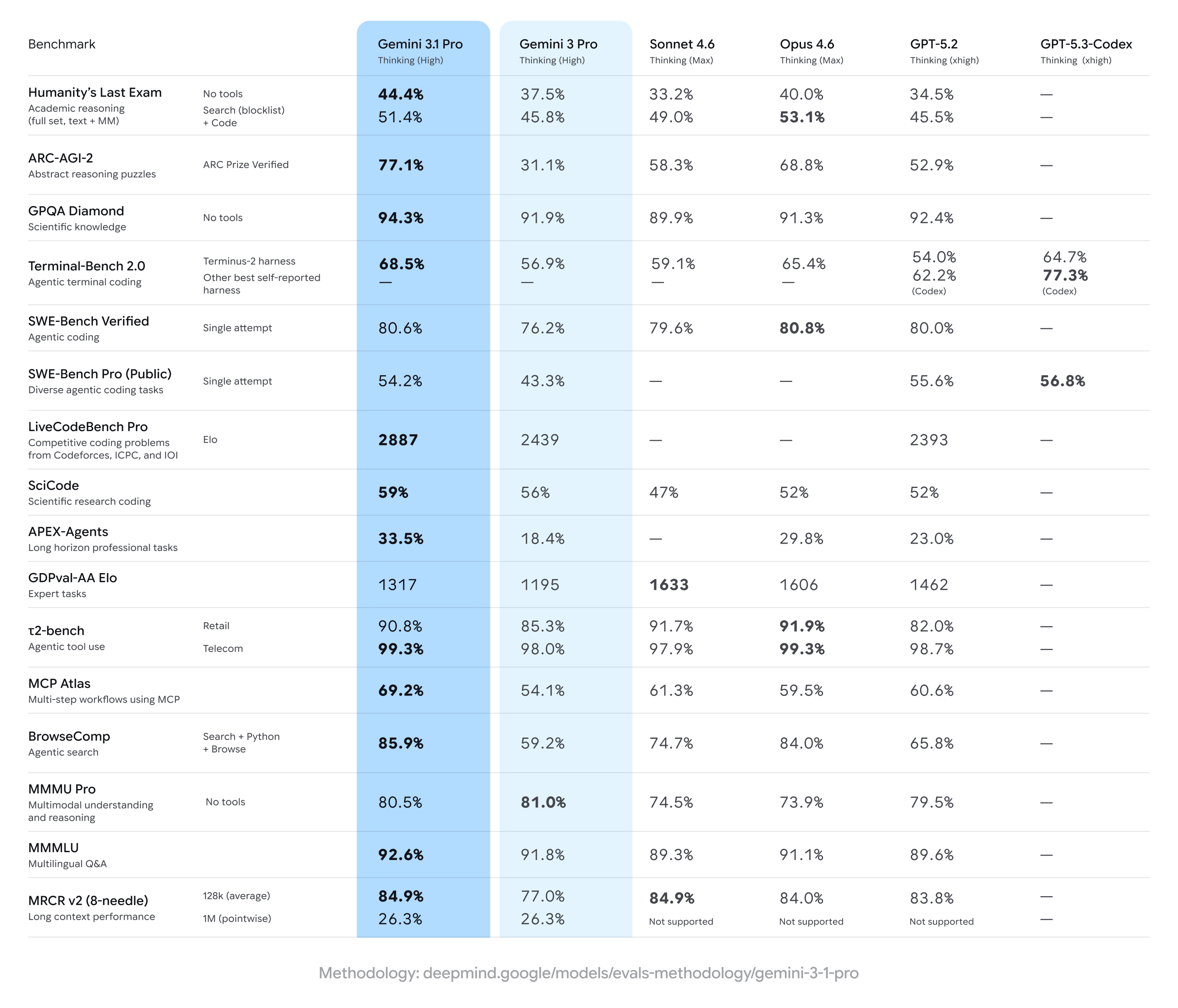
GPQA Diamond reaches 94.3 %, indicating expert-level performance on graduate-level science questions that require cross-domain synthesis. Terminal-Bench scores 68.5 %, reflecting robust shell interaction and system administration skills. SWE-Bench Verified hits 80.6 %, placing the model among the top autonomous coding agents available.
Engineers also report superior results on internal agentic suites that measure tool-use correctness over 50+ sequential steps. These gains stem from the combination of high thinking_level, thought signatures, and native code execution tooling.
Compared with Gemini 2.5 Pro, Gemini 3.1 Pro delivers 40–60 % relative improvement on complex planning tasks while maintaining comparable latency at the high thinking setting. Developers therefore migrate workloads that previously required ensemble methods or human-in-the-loop supervision.
Breakthrough Capabilities That Define Gemini 3.1 Pro
Advanced Agentic Workflows
Gemini 3.1 Pro orchestrates multi-agent systems through sequential and parallel function calls. Developers define custom tools via OpenAPI schemas; the model then invokes them autonomously while maintaining state via thought signatures. Consequently, applications evolve from reactive chatbots into proactive problem solvers that plan, execute, verify, and iterate without external scaffolding.
Vibe Coding and Creative Synthesis
The model translates high-level aesthetic or thematic instructions into functional code. For instance, engineers prompt Gemini 3.1 Pro to “build a modern portfolio site that captures the brooding atmosphere of Emily Brontë’s Wuthering Heights.” The model reasons through literary motifs, selects color palettes, typography, and interactive elements, then outputs complete, responsive HTML/CSS/JS with Tailwind and Framer Motion integration. Developers receive production-grade assets ready for deployment.
Dynamic Asset Generation
Gemini 3.1 Pro produces pure SVG code for animated visualizations that scale infinitely and weigh kilobytes rather than megabytes. Examples include real-time aerospace dashboards that ingest ISS telemetry streams and render orbital paths with predictive overlays. Similarly, the model generates immersive 3D murmuration simulations with WebGL, complete with hand-tracking controls via MediaPipe and procedurally shifting audio scores.
Long-Context Multimodal Understanding
With its million-token window, Gemini 3.1 Pro ingests full video transcripts, associated slides, code repositories, and research papers simultaneously. The model then answers cross-referenced questions or generates synthesis reports with inline citations and diagrams. This capability transforms knowledge work in legal review, academic research, and technical due diligence.
Step-by-Step: How to Access Gemini 3.1 Pro
Access via Google AI Studio (Free Preview)
- Navigate to aistudio.google.com.
- Sign in with a Google account.
- Select the model dropdown and choose gemini-3.1-pro-preview.
- Begin prompting immediately. The interface supports file uploads for multimodal testing and exports conversations as JSON for replication in code.
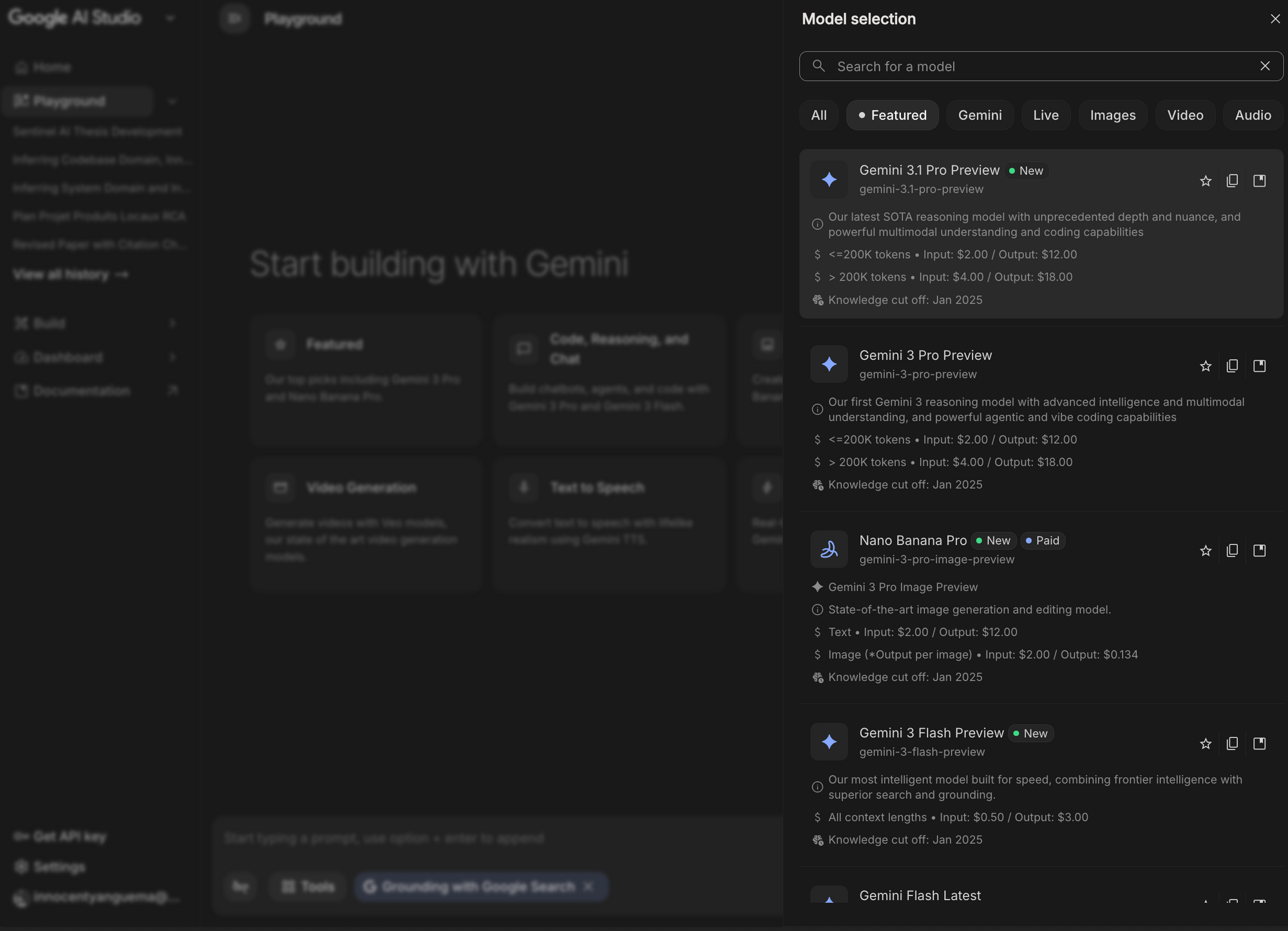
This method provides rate-limited but fully functional access ideal for exploration and prompt engineering.
Obtain and Use the Gemini API Key
Developers generate a key at makersuite.google.com/app/apikey. They then install the official SDK:
pip install -U google-generativeai
A minimal Python client looks like this:
import google.generativeai as genai

genai.configure(api_key="YOUR_API_KEY")
model = genai.GenerativeModel("gemini-3.1-pro-preview")

response = model.generate_content(
    contents="Explain quantum entanglement with a live SVG diagram.",
    generation_config={
        "thinking_level": "high",
        "temperature": 1.0
    }
)
print(response.text)
The same pattern extends to multimodal inputs by passing Part objects containing inline_data or file_data URIs.
For JavaScript environments:
import { GoogleGenerativeAI } from "@google/generative-ai";

const genAI = new GoogleGenerativeAI("YOUR_API_KEY");
const model = genAI.getGenerativeModel({ model: "gemini-3.1-pro-preview" });

const result = await model.generateContent("Your prompt here");
console.log(result.response.text());
Enterprise Access with Vertex AI
Organizations provision Gemini 3.1 Pro through Google Cloud Vertex AI. Admins enable the Gemini API, select the gemini-3-pro-preview endpoint, and apply IAM roles. Vertex AI adds enterprise features including VPC-SC, customer-managed encryption keys, and audit logging required for compliance frameworks.
Consumer Access via Gemini App
Individual users subscribe to Google AI Pro or Ultra plans to unlock higher quotas and priority access to Gemini 3.1 Pro within the Gemini mobile and web applications. Ultra tier additionally enables Deep Research and Gemini Agent features that leverage the model’s full agentic stack.
Accelerate Gemini 3.1 Pro Integration with Apidog
Professionals who download Apidog for free gain a visual workspace tailored for AI API workflows. After installation, users create a new project named “Gemini 3.1 Pro Experiments.”
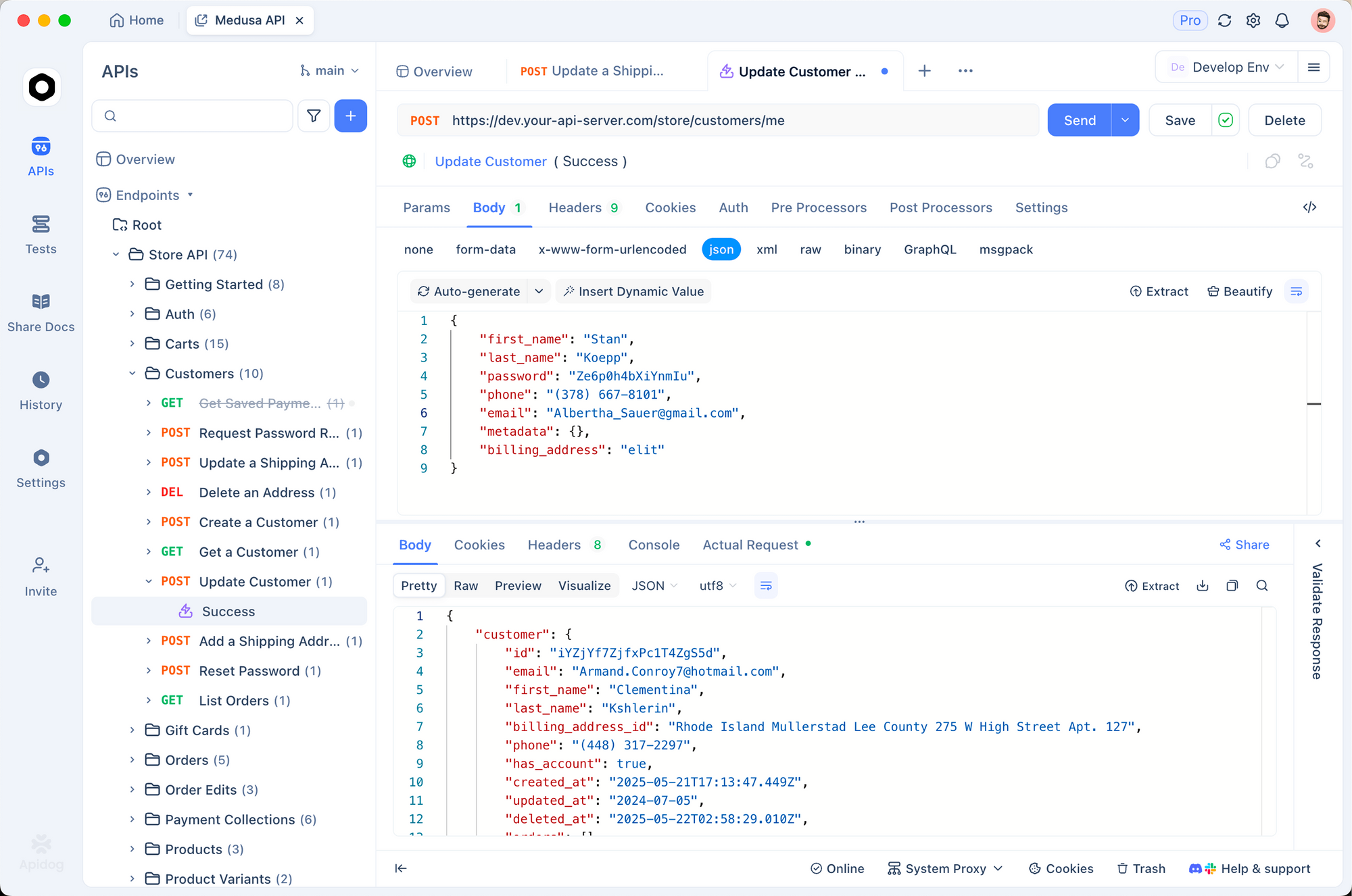
They import the official cURL example from AI Studio or manually configure the endpoint:
- Method: POST
- URL: https://generativelanguage.googleapis.com/v1beta/models/gemini-3.1-pro-preview:generateContent
- Query param: key={{gemini_api_key}} (stored securely in environment variables)
Inside the request body, Apidog renders a JSON editor pre-populated with the standard contents array. Users toggle between raw JSON, form view, and schema validation. They save common prompts as presets and reuse them across test suites.
Furthermore, Apidog automatically generates client code in 20+ languages after successful requests. Teams export OpenAPI specifications that include Gemini 3.1 Pro as a data source for downstream microservices. Mock servers simulate model responses during frontend development, ensuring UI teams progress independently of rate limits.
Consequently, organizations reduce integration time by 70 % compared with manual scripting. The free tier supports unlimited local projects and sufficient cloud collaboration for most development teams.
Advanced Prompting and Integration Patterns
Controlling Reasoning Depth
Set thinking_level: "high" for novel research problems and "low" for high-throughput classification tasks. This parameter directly influences token consumption and latency, enabling cost-optimized deployments.
Building Stateful Agents
Maintain conversation history as an array of Content objects. Insert thought signatures returned in functionCall responses to preserve the model’s internal state across turns. This technique supports reliable multi-hour autonomous agents that debug codebases or orchestrate cloud resources.
Multimodal Function Calling
Combine image inputs with custom tools that return binary data. Gemini 3.1 Pro processes the image, decides on tool invocation, executes the tool, and incorporates the resulting image into its next reasoning step—all within a single API response cycle.
Structured Outputs with JSON Schema
Supply a Pydantic or JSON Schema definition in the generation_config. The model returns strictly conforming objects, eliminating post-processing parsers and enabling type-safe integration with TypeScript or Python type checkers.
Pricing Considerations for Production Deployments
Google prices Gemini 3.1 Pro (preview) at approximately $2 per million input tokens and $12 per million output tokens for contexts under 200k tokens, scaling to $4/$18 beyond that threshold. Flash variants offer significantly lower rates for volume workloads. Organizations calculate ROI by comparing inference costs against developer hours saved through automation.
Vertex AI committed-use discounts and sustained-use pricing further optimize large-scale deployments. Teams monitor usage via Cloud Billing dashboards and implement token-budget guards in application code.
Comparison with Competing Frontier Models
Gemini 3.1 Pro leads in long-context multimodal reasoning and native tool orchestration. While competitors match or exceed isolated benchmark scores, the combination of 1M-token context, thought signatures, and integrated code execution gives Gemini 3.1 Pro an edge in sustained agentic performance.
Developers report higher success rates on SWE-Bench and real-world planning tasks compared with Claude 4 Opus or GPT-5-class models when tool use exceeds five sequential steps. Additionally, Google’s ecosystem integration (Search grounding, Maps, YouTube) provides immediate real-world data access unavailable elsewhere.
Limitations and Best Practices
Current preview status implies occasional instability and rate-limit variability. Engineers therefore implement retry logic with exponential backoff and fallback to Gemini 3 Flash for non-critical paths.
The model still occasionally hallucinates on edge-case physics or highly specialized domain knowledge. Developers mitigate this through retrieval-augmented generation and explicit verification steps using the code execution tool.
Best practices include:
- Place system instructions at the end of long contexts.
- Use explicit JSON schemas for all structured responses.
- Monitor thought signature length to avoid quota exhaustion.
- Test media resolution settings empirically for each modality.
The Road Ahead for Gemini Models
Google has signaled rapid iteration on the Gemini 3 family. Subsequent stable releases will incorporate production hardening, expanded context windows, and deeper robotics integration via Gemini Robotics. Organizations that build familiarity with Gemini 3.1 Pro today position themselves to adopt these advancements seamlessly.
Reasoning models are just one branch of Google DeepMind's research; Genie 3, its world model for interactive environments, shows what the same lab is building beyond text and code.
For teams whose workloads skew heavily toward code generation rather than broad reasoning,Kimi-Dev-72B, Moonshot AI's dedicated coding model,represents a contrasting architecture worth evaluating alongside Gemini.
Conclusion: Start Building with Gemini 3.1 Pro Today
Gemini 3.1 Pro represents a genuine leap in usable intelligence. Its combination of massive context, native multimodality, and agentic primitives empowers developers to solve previously intractable problems with concise prompts and minimal scaffolding.
Whether you explore creative coding, enterprise automation, or scientific discovery, the access paths outlined above—Google AI Studio for experimentation, the Gemini API for production, Vertex AI for scale, and Apidog for frictionless development—equip you to begin immediately.
Download Apidog for free, obtain your API key, and experiment with the code samples provided. The difference between observing AI progress and actively shaping it often hinges on the tools and models you integrate first. Gemini 3.1 Pro stands ready; the only remaining step is implementation.