
It looks that way, but not alone and not yet in a form humans can read. On November 20, 2026, Anthropic mathematician Levent Alpöge posted a claimed proof of the Riemann Hypothesis that he says he found “working with Claude.” The Claude Riemann hypothesis proof exists only as Lean code, roughly 17 million lines of it. On November 21, the Lean and Mathlib communities certified that the code proves the classical statement. No human has yet read and explained the full argument, and it hasn’t been peer reviewed.
Below: what was claimed, what a machine check settles, and why the “AI solved math” headlines run ahead of the facts.
What happened: the timeline
Built from Alpöge’s note and the coverage that followed:
| Date (2026) | Event |
|---|---|
| Aug | Anthropic reports that an unreleased Claude model raised the share of Riemann zeta zeros proven to lie on the critical line from 41.6% to 67.2% |
| Oct 6 | First step in the timeline Alpöge’s note lists for the new work |
| Nov 20 | Alpöge posts a 4-page note and a 14-part Lean archive on his website |
| Nov 21 | Lean and Mathlib communities publish a joint statement certifying the proof |
| Nov 21 onward | Mathematicians start reading; Andrew Sutherland (MIT) runs independent checks |
The announcement landed a day after Anthropic’s stock market debut, as Scientific American noted; Alpöge’s note addresses the timing directly. For the listing itself, see what the Anthropic S-1 means for Claude API developers.
What did Alpöge and Claude actually claim?
Alpöge claims a complete, machine-checked proof of the Riemann Hypothesis, plus the Generalized Riemann Hypothesis for Dirichlet L-functions. He says he found it in collaboration with Claude, which did much of the work in the final stretch. He published the proof as Lean 4 code, not as a written paper.
Key lines from his 4-page note:
- “I believe I have, working with Claude, discovered a proof of the Riemann Hypothesis.”
- “The method easily extends much further, resolving the so-called Generalized Riemann Hypothesis, and I expect, with more time, the Extended Riemann Hypothesis too.”
- “I guided us to the right situation analogous to that toy setting, and then Claude began to leave me in awe.”
- “This time Claude far outpaced me near the finish line.”
The scope matters. The verified result covers the Generalized Riemann Hypothesis over Dirichlet L-functions, for all moduli and all Dirichlet characters, according to the community summary reported by BigGo. The classical Riemann Hypothesis is the simplest case of that family. Other L-functions, such as Dedekind zeta functions and general automorphic L-functions, aren’t covered. The Extended Riemann Hypothesis is still described as future work.
Two more details people keep getting wrong:
- No Claude model is named. Neither Alpöge’s note nor any report says which model he used. Treat any article that names one as a guess.
- There is no written proof yet. Alpöge says it would be “inappropriate to attempt to post some massive unreadable travesty of ‘slop’,” so he “decided to only present Lean.” He plans to write it up properly later.
What is the Riemann Hypothesis?
The Riemann Hypothesis says every nontrivial zero of the Riemann zeta function has real part exactly 1/2, so the zeros all sit on one vertical line, the “critical line.” If it’s true, mathematicians get the tightest possible control over how prime numbers are spread out. It’s one of the seven Clay Millennium Prize Problems, with a $1 million prize.
Bernhard Riemann stated it in 1859. Many number theory results assume it holds, so a proof firms up a large body of existing work at once.
How the proof was checked
Lean is a proof assistant: a programming language where a proof is code, and a small trusted program called the kernel checks that every step follows from the last. If the kernel accepts the file, the proof is correct relative to the statement and the axioms, with no human judgment involved.
Within about a day, the community:
- Compiled the 14-part archive, 175,187 Lean modules, with zero errors.
- Ran the proof export through four independent checkers: the official Lean kernel, nanoda, con-leche and con-ron. All four accepted it.
- Used comparison tools to confirm that the proved theorem is exactly Mathlib’s existing
RiemannHypothesisdefinition, not a look-alike. - Published a joint statement, endorsed by the Lean FRO and the Mathlib Initiative: “We hereby certify that both the statement and the proof of the Riemann Hypothesis are correct.”
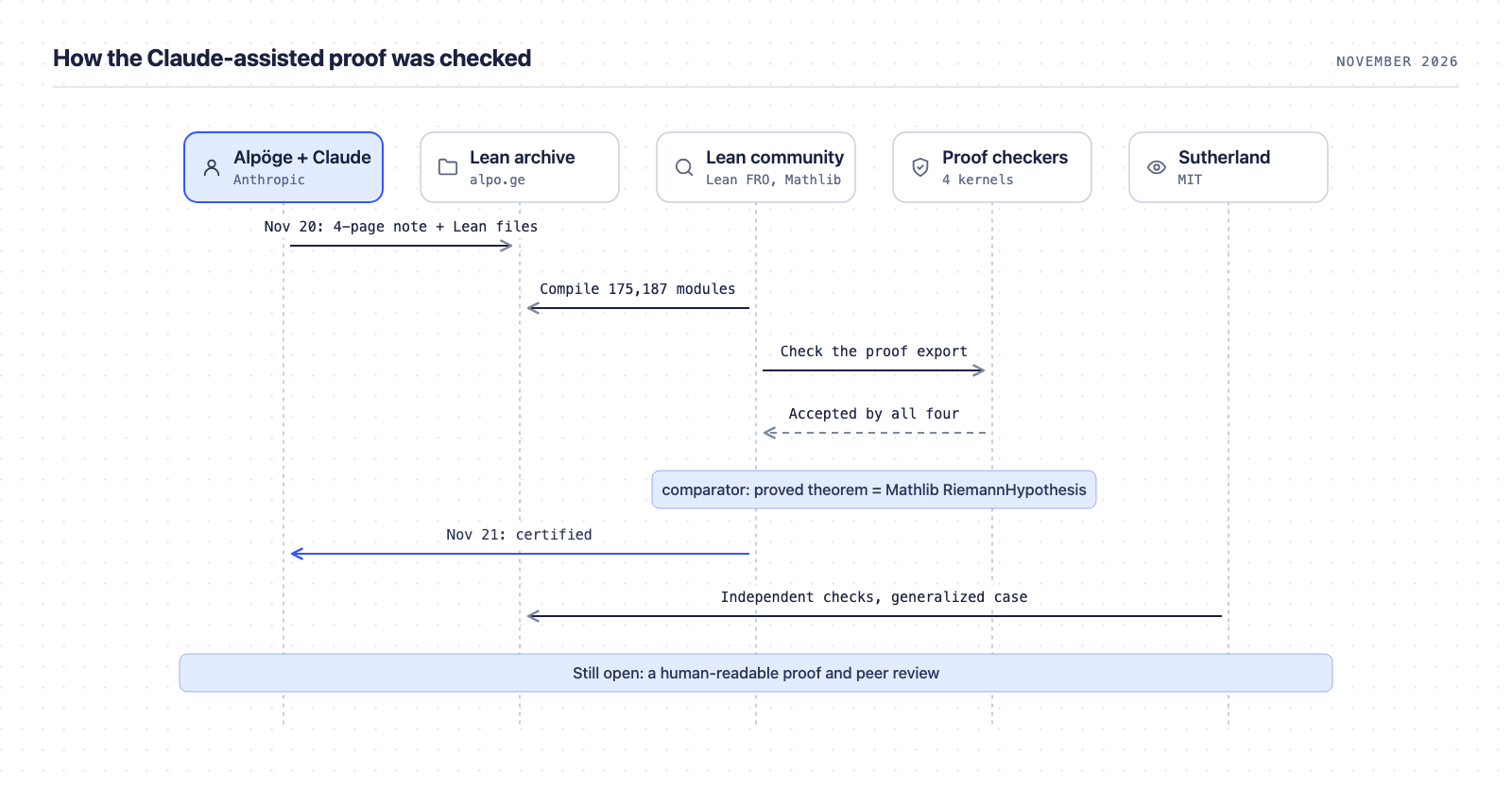
Step 3 is the one that matters most. With formal proofs, the risk isn’t a wrong step; the kernel catches those. The risk is a theorem statement that quietly says something weaker than you think. Matching the result against a definition that existed in Mathlib before the announcement closes that gap.
MIT’s Andrew Sutherland checked the generalized case independently and reported that the proof relies on “only three standard axioms.” His summary: “the chance that anything is fishy here is approximately zero.”
What Lean verification proves, and what it doesn’t
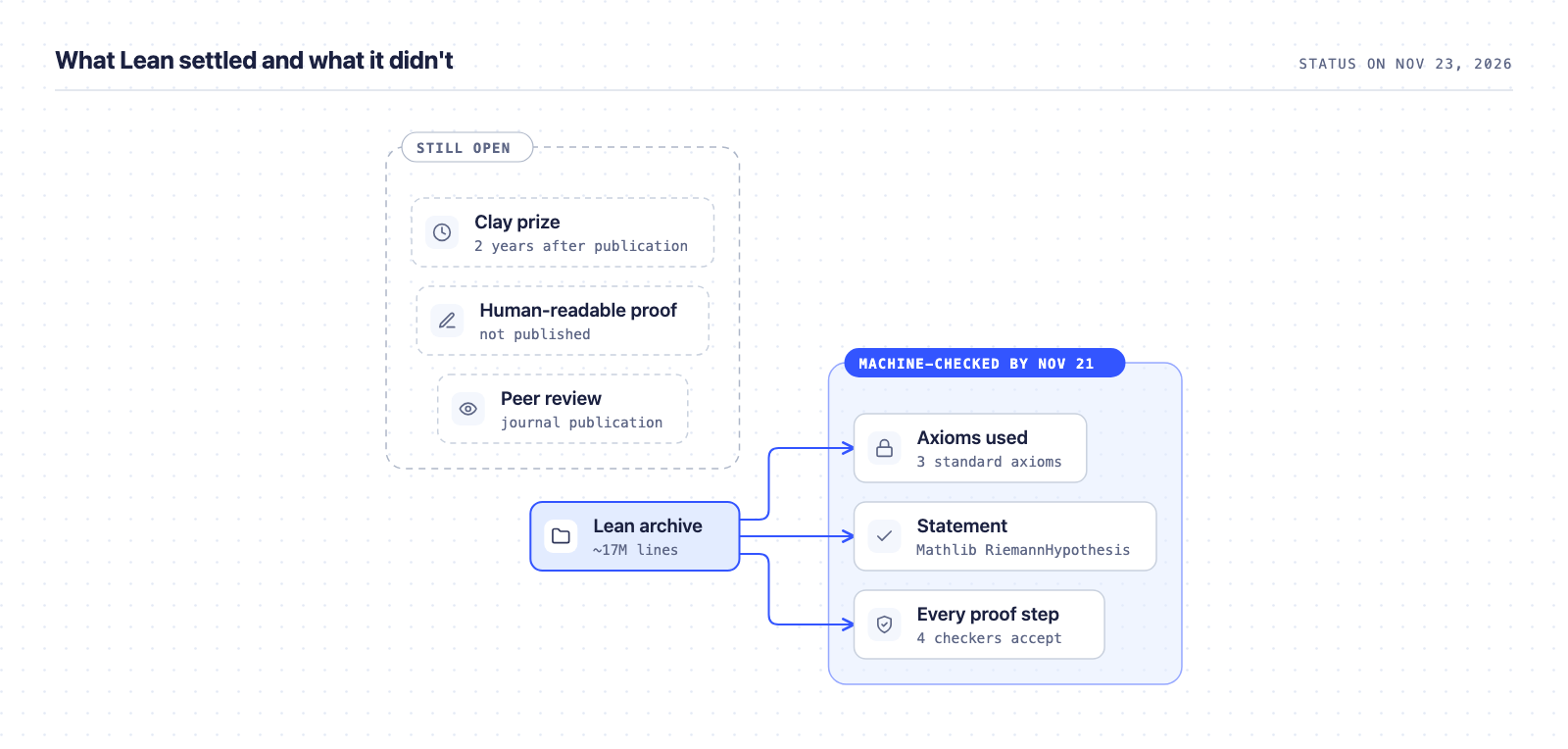
A Lean check settles correctness, not understanding, credit or prize eligibility. Status as of November 23:
| Question | Status |
|---|---|
| Is the Lean proof correct? | Machine-checked by four independent checkers |
| Does it prove the real statement? | Matched to Mathlib’s RiemannHypothesis definition |
| Can a mathematician read it? | Not yet; no written proof is published |
| Has it been peer reviewed? | No |
| Is it eligible for the Clay prize? | Not yet: Clay requires journal publication and two years of scrutiny |
Kevin Buzzard of Imperial College London put the gap bluntly to Al Jazeera: “we don’t even know why the theorem is true.” He estimates 17 million lines of Lean “might correspond to tens of thousands of pages,” and expects mathematicians to start understanding the argument within weeks. Sutherland called the result “a human triumph,” and added that working through the details “is going to take some time.”
Who gets the credit: Alpöge or Claude?
Both, and the split is still argued. Alpöge says he guided the strategy from a toy setting, then Claude carried the argument through areas where he admits “little mastery,” including automorphic forms on higher rank groups.
Abhishek Saha of Queen Mary University of London told Al Jazeera the credit belongs to Alpöge and that he “should get a Fields Medal.” Brian Conrey called it “a major moment in human history,” though he had only seen the posts. Kit Yates of the University of Bath said it “will be subject to intense scrutiny.”
What’s clear: a human chose the problem and the attack; the model did much of the technical work and the formalization.
How this compares with earlier AI math results
AI systems have produced Lean-checked math for a while:
| Result | What it showed |
|---|---|
| DeepSeek Prover V2 | An open model that writes Lean 4 proofs for competition-level problems |
| DeepSeekMath-V2 | A math model that checks its own proofs |
| Anthropic, Aug 2026 | An unreleased Claude model raised the proven share of zeros on the critical line from 41.6% to 67.2%, with a Lean formalization |
| Alpöge and Claude, Nov 2026 | A full Lean proof of the Riemann Hypothesis and Dirichlet GRH |
Anthropic’s August research post is worth rereading now. Alpöge and Furman reviewed that work too, and Anthropic said at the time that the techniques Claude used wouldn’t likely lead to a proof of the hypothesis itself. Three months later, a different line of attack apparently did.
What this means if you build with the Claude API
You can’t reproduce this from the API: there’s no published prompt, no named model and months of expert guidance behind it. The lesson is narrower. Models now do long technical work when a human steers and a checker verifies every step. In API work, your tests are that checker: let the agent do the work, then check every response against a contract.
Call the Claude API from your coding agent with Apidog CLI
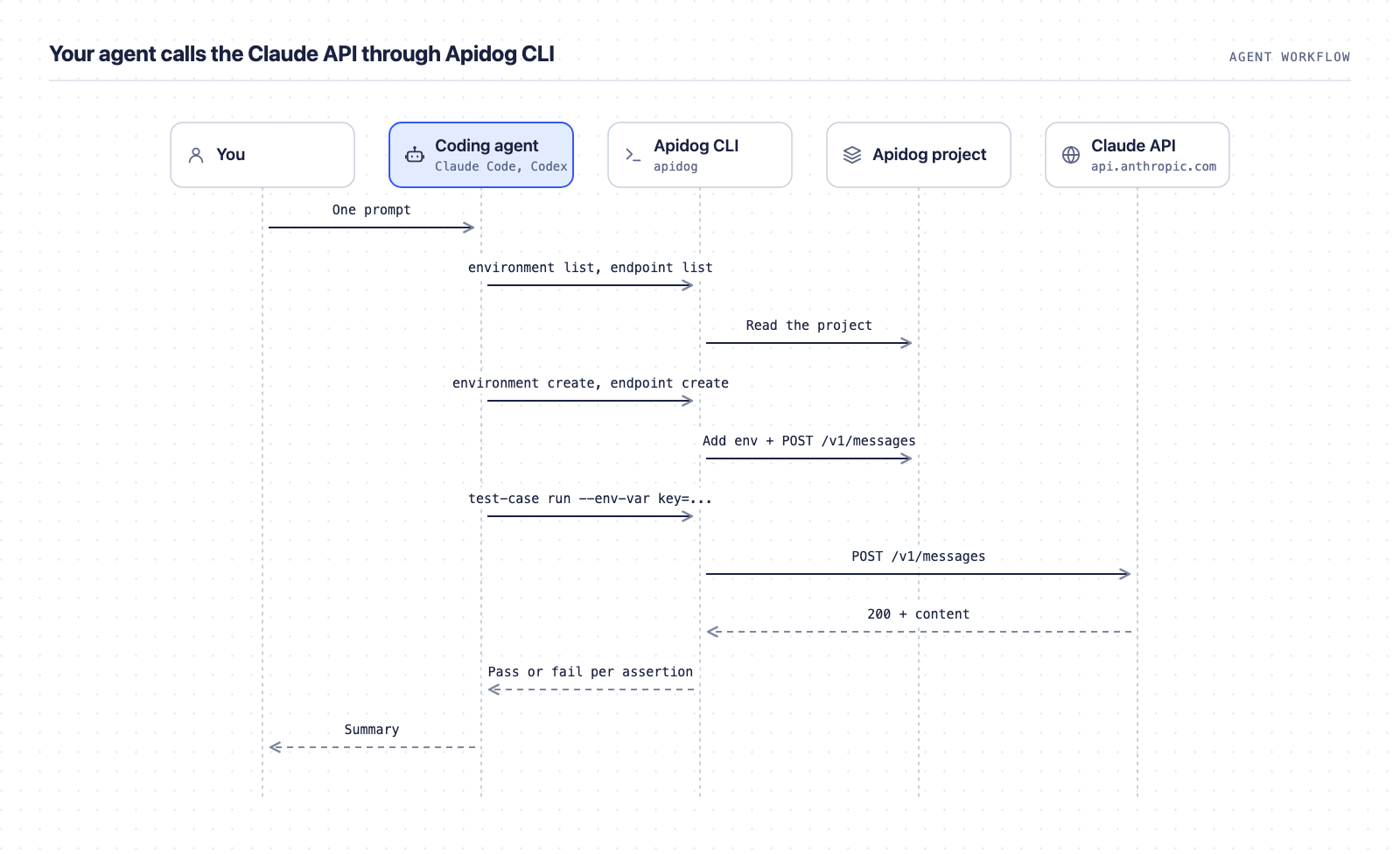
If you’re wiring Claude into your product, let your coding agent set up and test the integration. Apidog CLI gives Claude Code, Codex or Cursor a command line into your Apidog project: environments, endpoints, test cases and runs.
Set it up once:
npm install -g apidog-cli@latest
apidog auth login --with-token <YOUR_TOKEN>
apidog skill install
Then give your agent one prompt:
In Apidog project <projectId>, add a "Claude API" environment with base URL
https://api.anthropic.com, add POST /v1/messages with the x-api-key and
anthropic-version headers, write one test case that asserts a 200 and a
non-empty content array, run it with my key from $ANTHROPIC_API_KEY, and
show me the result.
The agent reads the project first, then writes and runs:
apidog environment list --project <projectId>
apidog endpoint list --project <projectId>
apidog environment create "Claude API" --project <projectId> --base-url https://api.anthropic.com
apidog cli-schema get endpoint-create
apidog endpoint create --project <projectId> --file ./claude-messages.json
apidog cli-schema get test-case-create
apidog test-case create --project <projectId> --file ./claude-messages-case.json
apidog test-case run --project <projectId> --endpoint <endpointId> --env-var "key=$ANTHROPIC_API_KEY"
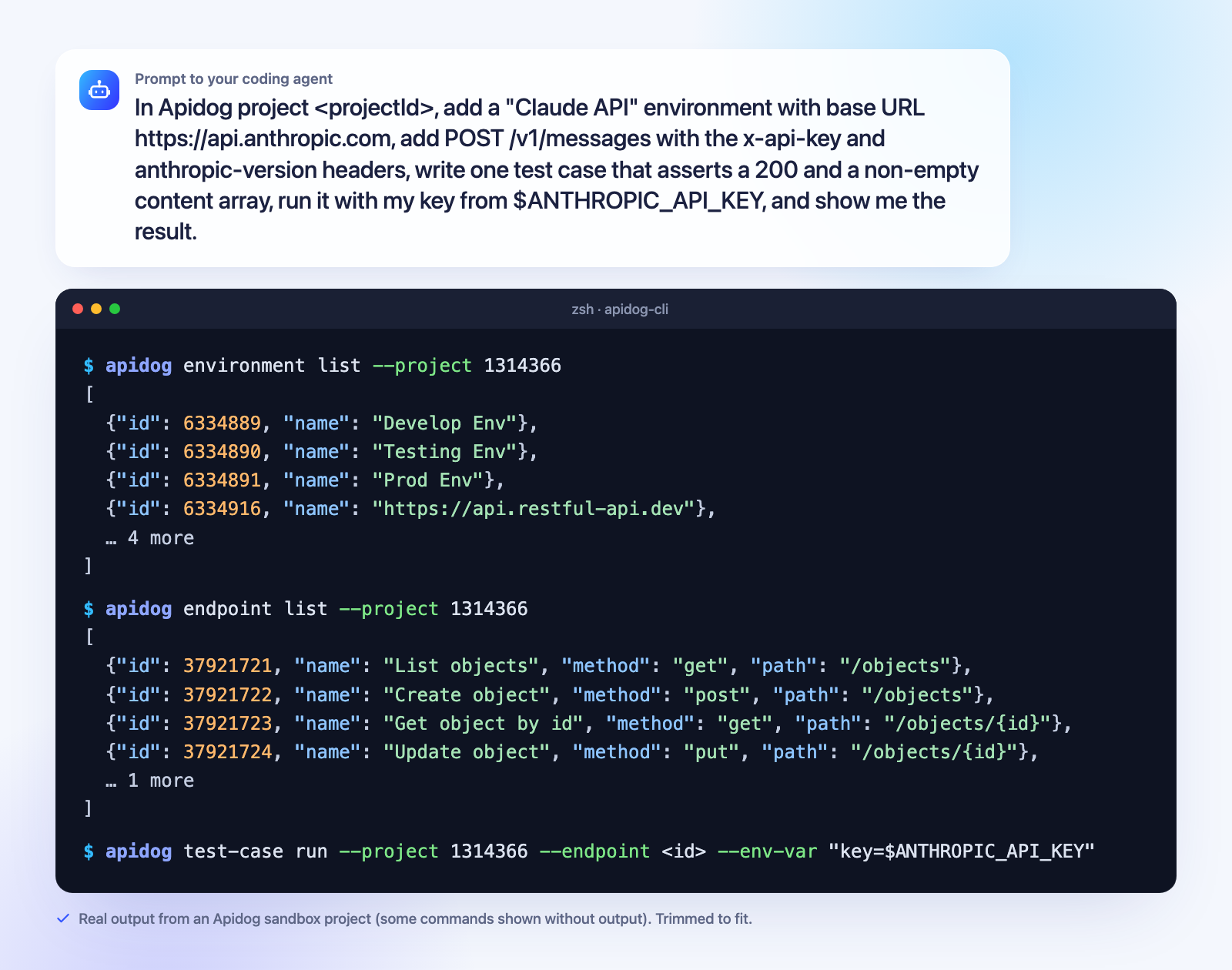
The cli-schema get calls give the agent the exact JSON shape for each payload, so it doesn’t guess. --env-var passes your key at run time instead of storing it in the project.
Pin the anthropic-version header in the endpoint so a later SDK upgrade can’t change the request shape under you; our guide to Claude API version 2026-10-21 explains why. For the agent side, see how to use Apidog CLI in Claude Code. Apidog’s Free plan covers up to 4 users.
Conclusion
Claude helped Levent Alpöge produce what looks like a correct proof of the Riemann Hypothesis and Dirichlet GRH, backed by four independent checkers. Still missing: a readable proof, peer review and the scrutiny a Millennium Prize demands. Watch for Alpöge’s promised write-up. If you build on Claude yourself, download Apidog and let your agent test your integration the same way the proof was checked: every step, against a contract.
FAQ
Did Claude prove the Riemann Hypothesis by itself? No. Levent Alpöge, an Anthropic mathematician, says he found the proof “working with Claude.” He set the strategy; Claude did much of the technical work near the end and helped formalize it in Lean.
Is the Riemann Hypothesis proof verified? The Lean code is. On November 21, 2026, the Lean and Mathlib communities certified the statement and proof, and four independent checkers accepted it. Human review of the argument has just started.
Which Claude model was used? No source names one. Alpöge’s note says only “Claude.”
Did it prove the Generalized Riemann Hypothesis too? For Dirichlet L-functions, yes, per the reported verification. Other L-function families and the Extended Riemann Hypothesis aren’t covered yet.
Will Alpöge get the $1 million Clay prize? Not soon. Clay requires publication in a qualifying journal and two years of scrutiny, and no written proof exists yet.
Can I use the Claude API for math proofs? You can ask Claude for proofs and Lean code, but treat any output as a draft until a checker like Lean verifies it.