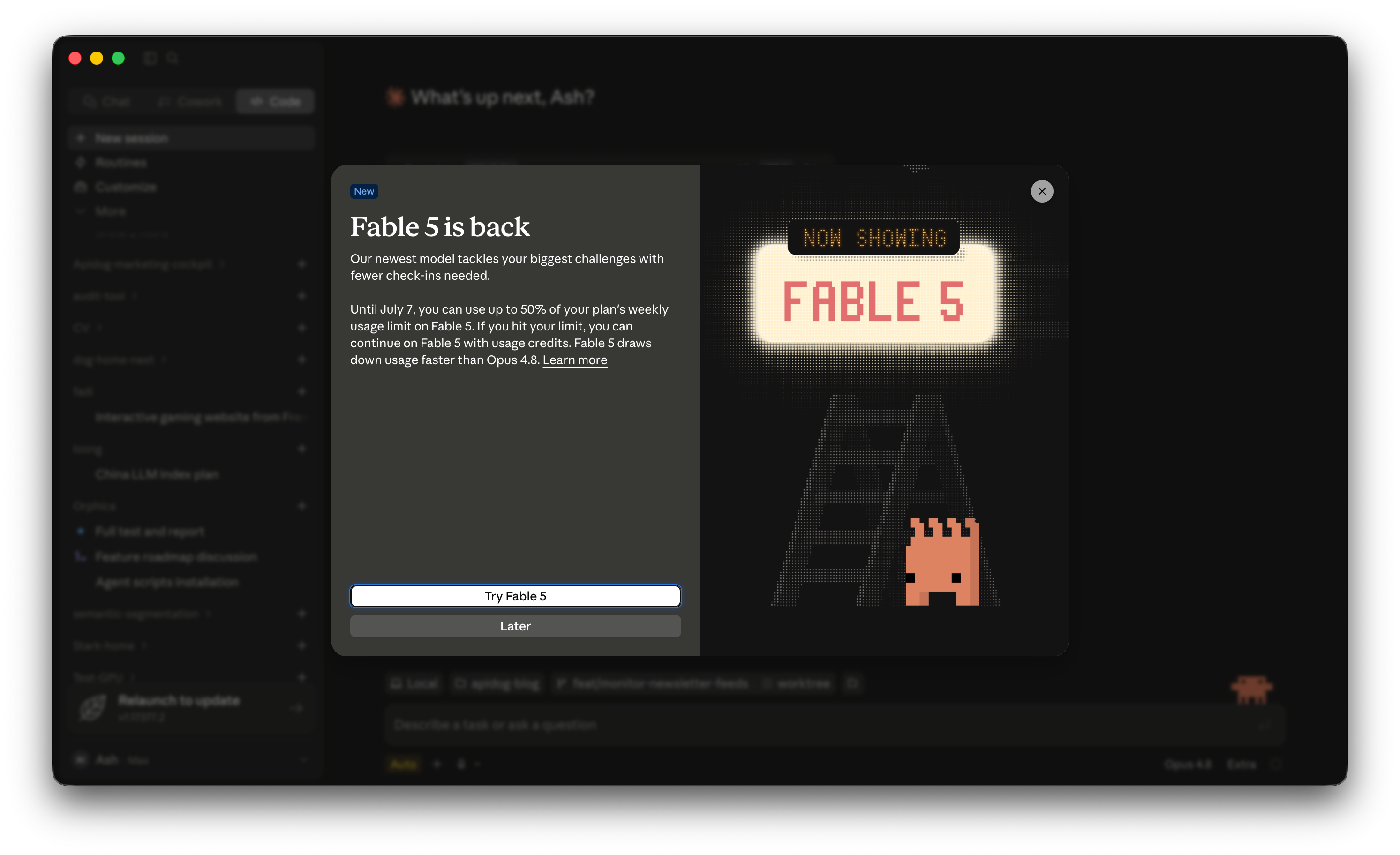
Claude Fable 5 came back on July 1, 2026, after the U.S. Commerce Department lifted the export controls that had kept it offline since June 12. Anthropic restored its own surfaces first: Claude.ai, the Claude API, Claude Code, and Claude Cowork all got the model back on day one. Cloud platforms were promised “as quickly as possible.” If your team consumes Claude through AWS, Google Cloud, or Microsoft Foundry rather than the native API, “as quickly as possible” is doing a lot of work in that sentence. Here is where each platform stands as of July 2, 2026, and what to do if yours is still waiting. For the full story of the suspension and return, see our hub post on what changed when Fable 5 came back.
Status at a glance
| Platform | Status (July 2, 2026) | Source |
|---|---|---|
| AWS Bedrock | Restored July 1, alongside Anthropic’s native surfaces | Amazon announcement |
| Google Cloud (Vertex AI / Agent Platform) | Listed as generally available in the model garden; confirm restoration date for your region | Model garden listing |
| Microsoft Foundry | Served via “Hosted on Anthropic (Preview)”; some docs still carry the suspension notice | Microsoft Learn |
The rest of this post walks through each platform in detail, then covers what to do while you wait.
AWS Bedrock: back since July 1
AWS moved fastest. Amazon confirmed that Claude Fable 5 is available again on Amazon Bedrock starting July 1, with what it describes as even stronger guardrails against misuse. That matches the model Anthropic redeployed everywhere else: the returned Fable 5 carries a retrained safety classifier, and flagged requests get rerouted to Claude Opus 4.8 with a notification.
Practically, Bedrock consumption works the way it did before the suspension. You call the model through Bedrock’s Anthropic Messages API compatibility or through the Bedrock console Playground, inside your existing AWS account, IAM policies, and VPC setup. AWS’s launch post for Fable 5 on Bedrock covers the invocation details, and independent engineers have already confirmed the re-released model responds in production regions.
Two caveats before you flip production back on. First, check your region: frontier models on Bedrock typically roll out via cross-region inference profiles (IDs prefixed like us.anthropic.), and region coverage can lag the headline announcement. Second, Bedrock pricing is set by AWS and can differ from the native API’s $10 per million input tokens and $50 per million output. Check the Bedrock pricing page against Anthropic’s own rates before you assume parity.
Google Cloud: listed as GA, confirm your region
Google lists Claude Fable 5 as generally available in its Claude model garden, with the 1M-token context window intact and pricing that mirrors the native API at $10 and $50 per million tokens. Google’s documentation now brands this surface as the Agent Platform (the successor naming around Vertex AI), so you may see both names depending on which console page you land on.
What Google has not published as clearly is a restoration timeline. The GA listing and the launch announcements date to early June, before the June 12 suspension took everything offline globally. As of this writing we could not find a Google statement pinning the exact date Fable 5 was re-enabled after July 1.
The test is cheap: send one request from your project. If you get a 403 or a model-not-found error, the model garden listing hasn’t caught up with reality in your region yet, and the native Claude API is your interim path.
Microsoft Foundry: check the hosting configuration
Foundry is the most nuanced of the three. Claude models arrive there under two hosting configurations, and they matter. “Hosted on Azure” currently carries Claude Opus 4.8 and Claude Haiku 4.5. Claude Fable 5 and the Sonnet family run under “Hosted on Anthropic (Preview)”, where the requests are served from Anthropic’s infrastructure with Foundry handling billing and governance.
That distinction shaped the outage. Because Fable 5 requests route to Anthropic’s infrastructure, the June 12 shutdown hit Foundry the moment Anthropic went dark, and some Microsoft documentation pages still carry the compliance notice about the export-control directive. Microsoft announced Fable 5 in Foundry, Foundry Agent Service, and GitHub Copilot on June 9, so the integration exists; the question is whether the post-return restoration has reached your tenant.
If you’re building on the Foundry Agent Service or GitHub Copilot with Fable 5 underneath, test with a small request before you re-enable anything user-facing.
Why the clouds lag the native API
The sequencing isn’t random. When the export controls lifted on June 30, Anthropic controlled its own stack end to end and could redeploy within a day; the redeployment post describes shipping a retrained classifier that blocks the reported jailbreak technique in more than 99% of attempts. Cloud platforms add layers Anthropic doesn’t control: partner review of the updated model, per-region capacity, compliance sign-off, and in Foundry’s case a hosting-configuration split. Each layer adds days.
The same thing happened at launch in reverse. Native surfaces got Fable 5 first in early June, and the clouds followed within days. Expect the same pattern here, measured in days rather than weeks.
What to do while you wait
If your cloud still errors on claude-fable-5, you have a working option today: the native Claude API. It’s been serving Fable 5 since July 1, and the Messages API integration is small enough to stand up in an afternoon.
The smart move is to prepare the cutover now so it’s a config change later. Build the Fable 5 request in Apidog against the native API endpoint: define the request once, store the API key and base URL as environment variables, and write assertions on the response schema and the model field. When your cloud platform restores access, you duplicate the environment, swap the base URL and auth header for Bedrock, Vertex, or Foundry, and re-run the same suite. The tests prove the two paths behave identically before any production traffic moves; if they don’t, you find out in a test run instead of an incident. Our companion guide on re-pointing workloads back to Fable 5 safely covers the full regression checklist.
One more thing worth checking during the gap: your limits. Native API rate limits differ from what Bedrock or Vertex provisioned for you, so a temporary migration can hit different throughput ceilings than you’re used to.
FAQ
Is Claude Fable 5 available on AWS Bedrock right now? Yes. Amazon confirmed the model returned to Bedrock on July 1, 2026, the same day Anthropic restored its native surfaces. Check your specific region’s model access page, since cross-region inference profiles can roll out unevenly.
Does Fable 5 cost the same on cloud platforms as on the Claude API? Google’s listing mirrors the native $10/$50 per-million-token rates, and AWS prices Bedrock models independently. Cloud invoicing, committed-use discounts, and caching behavior all differ per platform, so compare against the native rate limits and pricing before committing a workload.
Is the cloud version the same model that was suspended in June? It’s the redeployed build. The returned Fable 5 includes a retrained safety classifier, and requests that trip it are answered by Claude Opus 4.8 with a notification. More than 95% of sessions never see a fallback, but if your prompts touch security tooling, retest rather than assume June behavior.
Where this leaves you
AWS users can move today. Google Cloud users are probably fine but should send a test request before trusting the listing. Foundry users need to check their hosting configuration and tenant status. Everyone else has the native Claude API as a bridge, and if you set your integration up properly during the gap, with the requests and assertions saved in a shared workspace, the eventual cloud cutover becomes a five-minute environment swap. Download Apidog if you want that bridge tested rather than assumed.