
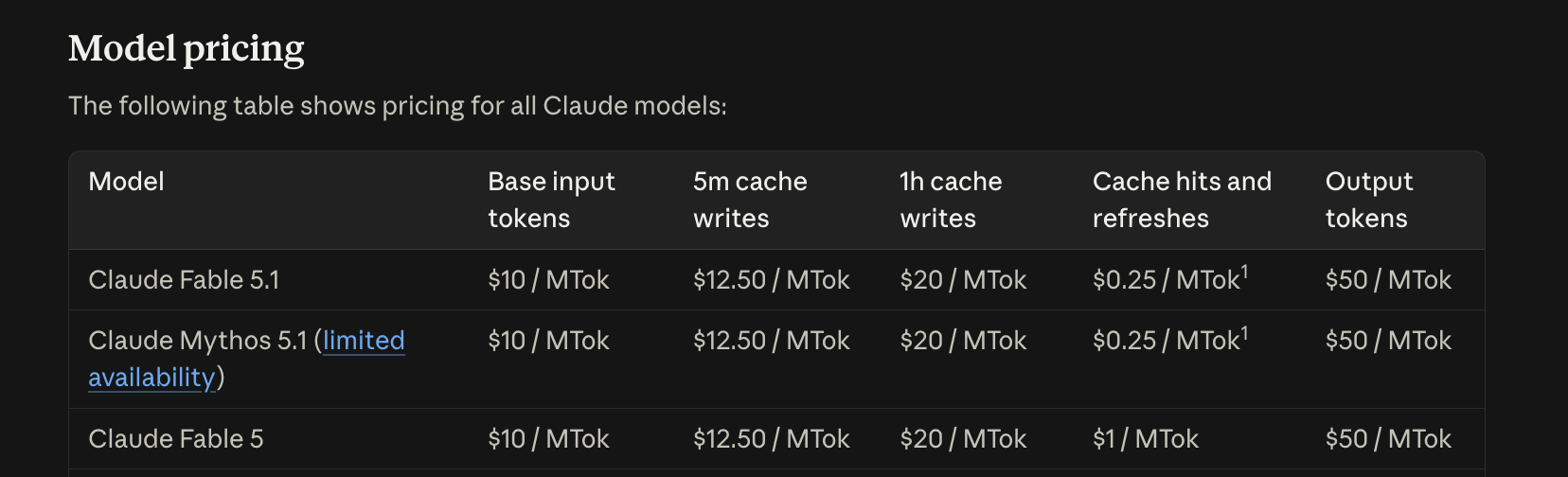
Claude Fable 5.1 costs $10 per million input tokens and $50 per million output tokens, exactly what Fable 5 charged. The number that changed is prompt cache reads: $0.25 per million tokens, down from $1 on Fable 5 and half of Opus 5’s $0.50. Anthropic estimates that makes typical workloads about 25% cheaper than Fable 5 and highly agentic ones up to about 45% cheaper.
This guide lays out every rate on the official pricing page, reproduces the 25% and 45% claims so you can plug in your own cache-hit ratio, works three real cost-per-task examples, and lists the levers that move the bill. If you want the model overview first, read what Claude Fable 5.1 is.
Claude Fable 5.1 pricing table
| Rate | Claude Fable 5.1 |
|---|---|
| Base input | $10 per million tokens |
| Output | $50 per million tokens |
| 5-minute cache write | $12.50 per million (1.25x input) |
| 1-hour cache write | $20 per million (2x input) |
| Cache read (hit or refresh) | $0.25 per million (0.025x input) |
| Batch API input | $5 per million |
| Batch API output | $25 per million |
| Long-context premium | None; the full 1M window bills at standard rates |
inference_geo: "us" |
1.1x on every token category |
| Fast mode | Not available (Opus 5 and Opus 4.8 only) |
| Priority Tier | Not supported |
| Web search | $10 per 1,000 searches, plus tokens |
Claude Mythos 5.1 has the same rates. The Batch discount and cache multipliers stack, so a batched cache read costs $0.125 per million.
How the cache-read price compares
| Model | Base input | Cache read | Cache read as share of input |
|---|---|---|---|
| Claude Fable 5.1 | $10 | $0.25 | 2.5% |
| Claude Fable 5 | $10 | $1.00 | 10% |
| Claude Opus 5 | $5 | $0.50 | 10% |
| Claude Opus 4.8 | $5 | $0.50 | 10% |
| Claude Sonnet 5 | $2 | $0.20 | 10% |
| Claude Haiku 4.5 | $1 | $0.10 | 10% |
Every other Claude model prices a cache hit at 10% of base input. Fable 5.1 prices it at 2.5%. The practical effect: a Fable 5.1 cache hit is cheaper than an Opus 5 cache hit, even though Fable 5.1’s uncached input is twice the price. For a workload where most input tokens are cached prefix, the effective input rate on Fable 5.1 can drop below Opus 5’s.
One Sonnet 5 note, since the Opus 5 vs Sonnet 5 comparison flagged a September price rise: Anthropic cancelled it. Sonnet 5 stays at $2 and $10.
Reproducing the 25% and 45% claims
Anthropic did not publish the workload mix behind those estimates, so treat this as a reconstruction that shows what cache-hit ratio they imply, not as their exact model.
Let a request have U uncached input tokens, C cached input tokens, and O output tokens. Cost per million on Fable 5 is 10U + 1.0C + 50O; on Fable 5.1 it is 10U + 0.25C + 50O. The saving is 0.75C, and the percentage saving is 0.75C / (10U + C + 50O).
A typical chat-style workload. Say 20,000 cached tokens, 2,000 uncached input tokens, and 1,500 output tokens per request. Fable 5: 10(0.002) + 1.0(0.02) + 50(0.0015) = $0.02 + $0.02 + $0.075 = $0.115. Fable 5.1: $0.02 + $0.005 + $0.075 = $0.100. Saving: 13%. To hit Anthropic’s 25%, the cached share has to be larger relative to output, for example 60,000 cached tokens against the same 1,500 output tokens, which gives $0.155 vs $0.110, a 29% saving.
An agentic loop. An agent that re-reads a 150,000-token cached prefix on each of 40 tool-call turns, adds 1,000 uncached tokens per turn, and produces 800 output tokens per turn. Per turn on Fable 5: 10(0.001) + 1.0(0.15) + 50(0.0008) = $0.01 + $0.15 + $0.04 = $0.20. On Fable 5.1: $0.01 + $0.0375 + $0.04 = $0.0875. Saving: 56% per turn, before the one-time cache write. Over 40 turns that is $8.00 vs $3.50. Anthropic’s “up to 45%” sits comfortably inside this range once you add the cache writes and the uncached turns every real agent has.
The rule that falls out: the saving scales with the ratio of cached input to output. Workloads that are output-heavy (long generations from short prompts) barely notice the change. Workloads that are prefix-heavy (agents, RAG with big stable context, multi-turn support bots) see the full effect.
Three worked cost-per-task examples
All three assume Fable 5.1 at the standard rates, with the 5-minute cache write paid once.
1. A single code review. 30,000 input tokens (the diff plus a system prompt), 4,000 output tokens, no cache. Input $0.30, output $0.20. Total: $0.50. The same review on Opus 5 is $0.25. This is the case where Fable 5.1 is simply twice the price, because nothing is cached.
2. A 25-turn support conversation. A 12,000-token stable system prompt cached once ($0.15 for the write), then 25 turns each adding 300 uncached input tokens and 250 output tokens, with the prefix served from cache. Uncached input across the conversation: 7,500 tokens = $0.075. Cache reads: 25 x 12,000 = 300,000 tokens = $0.075. Output: 6,250 tokens = $0.3125. Total: about $0.61. On Fable 5 the cache reads alone would be $0.30, for a total near $0.84.
3. A two-hour agentic build. 120 tool-call turns against a prefix that grows from 20,000 to 200,000 tokens (average 110,000 cached), 1,500 uncached tokens per turn, 1,200 output tokens per turn, and about six cache refreshes as the prefix grows. Cache reads: 120 x 110,000 = 13.2M tokens = $3.30. Uncached input: 180,000 tokens = $1.80. Output: 144,000 tokens = $7.20. Cache writes: roughly 660,000 tokens at $12.50 = $8.25. Total: about $20.55. On Fable 5 the cache reads would be $13.20 instead of $3.30, for a total near $30.45. That is a 33% saving on a run where output is still the largest line item.
Notice in example 3 that cache writes are now the second-biggest cost. That is the flip side of cheap reads: a miss is 40x a hit, so anything that resets the cache mid-session (rebuilding the system prompt, editing an earlier turn, changing the tools array) costs far more relative to steady state than it did on Fable 5.
The levers that move the bill
Effort. output_config.effort is the biggest single lever on output tokens, and output is $50 per million. Anthropic’s guidance for Fable 5.1 is to start at high, and their claim is that medium roughly matches Fable 5 quality at lower cost while low is often competitive with Opus and Sonnet on cost per task. Run the sweep on your own evals. The per-message effort beta lets you drop to low for routine turns and raise it for hard ones without a cache reset.
Keep the cache warm. Prompt caching is the discount. With reads at $0.25 and writes at $12.50, the break-even on the 5-minute TTL is one hit. For idle gaps between five and sixty minutes, a max_tokens: 0 keep-alive re-send on the 5-minute TTL is usually cheaper than paying the 2x write for the 1-hour TTL. And the same append-only discipline that preserves thinking blocks on this model preserves the cache: never rebuild system or tools mid-session, use mid-conversation system messages for changes, and use turn-scoped messages for per-turn reminders.
Batch what can wait. The Batch API halves everything, so a Fable 5.1 batch request is $5 and $25, the same as Opus 5’s synchronous price. Evals, backfills, and nightly document processing belong there. Note that fallbacks is rejected on batches, so refused items need a manual resubmit.
Choose the tier per route. Anthropic’s own docs say to start with Opus 5 and move to Fable 5.1 when Opus 5 at higher effort still falls short. For routes where Opus 5 passes your evals, you are paying double for nothing. The Fable 5.1 vs Opus 5 comparison works through the decision by workload.
Watch tool overhead. Every request with tools carries a hidden tool-use system prompt. Anthropic publishes the count for Opus 5 (286 tokens) but has not published a Fable 5.1 figure yet, so measure it with the token-counting endpoint. A browser toolset adds around 6,600 tokens per request and the computer toolset about 4,500, all cached after the first send.
Refusals are free, retries are not. A classifier refusal before any output is not billed. A server-side fallback bills the fallback model’s rates for the retry, and Anthropic’s fallback credit refunds the cache cost of switching. Instrument refusals as their own metric so you know how much of your Fable 5.1 spend is being served by Opus 5.
Most of the general techniques in our guide to cutting a Claude API bill still apply, with the cache-read math shifted in Fable 5.1’s favor.
What you cannot buy on Fable 5.1
Fast mode is Opus 5 and Opus 4.8 only, at $10 and $50. There is no way to pay for faster Fable 5.1 output. Priority Tier is not supported on Fable 5.1 or Mythos 5.1, while Fable 5 keeps it, so enterprise capacity planning that depends on it has to stay on Fable 5 or move to Opus 5. And zero data retention is not available unless Anthropic expressly authorizes it; a ZDR org gets a 400 on every request.
Checking your actual spend in Apidog
The only reliable way to know what a request costs is the usage object, and the fastest way to read it is a test collection. In Apidog, save your production system prompt as a request with cache_control on it, send it twice, and add assertions on usage.cache_creation_input_tokens for the first send and usage.cache_read_input_tokens for the second. Then add a post-response script that multiplies each field by its rate and logs a cost per request. Run the collection whenever you change a prompt or a tool definition, and you will catch a cache-busting edit before it hits the bill. Download Apidog to build it; the API walkthrough shows the exact requests.
Fable 5.1 pricing in the Claude apps
API pricing is per token. In the Claude apps, Fable 5.1 is metered by plan. Max plans include Fable models for up to 50% of the weekly usage limit at no extra cost, then continue on usage credits. Pro and standard Team seats meter Fable 5.1 through usage credits from the first message. Enterprise standard seats need usage credits enabled for use beyond plan limits, and usage-based Enterprise bills at standard API rates. Requests that the safeguards reroute to another model are not charged at Fable prices. The free and cheapest paths guide covers what that means in practice.
FAQ
How much does Claude Fable 5.1 cost per million tokens? $10 input and $50 output, unchanged from Fable 5. Cache reads are $0.25 per million, cache writes are $12.50 (5-minute) and $20 (1-hour), and the Batch API is $5 and $25.
Is Claude Fable 5.1 cheaper than Fable 5? Per token, no. In practice, yes for anything that uses prompt caching, because cache reads dropped from $1 to $0.25 per million. Anthropic estimates 25% cheaper on typical workloads and up to 45% on agentic ones. Output-heavy workloads see little change.
Is Claude Fable 5.1 cheaper than Opus 5? Uncached, no: it is exactly twice the price. Cached, the picture flips: a Fable 5.1 cache hit ($0.25) costs half an Opus 5 cache hit ($0.50). Output is still $50 vs $25, so Opus 5 wins on any output-heavy route.
Does Claude Fable 5.1 have fast mode or Priority Tier? No to both. Fast mode is Opus 5 and Opus 4.8 only. Priority Tier is supported on Fable 5 but not on Fable 5.1.
Is there a long-context premium on Claude Fable 5.1? No. The full 1M-token window bills at standard rates, and cache and batch discounts apply across it.
What does Claude Fable 5.1 cost on Bedrock or Google Cloud? Those platforms set their own prices and add a 10% premium for regional endpoints. Claude Platform on AWS and Microsoft Foundry bill at the standard API rates through Claude Consumption Units. Our cloud availability guide covers the setup on each.