
MuleSoft’s Anypoint Platform is what happens when an integration company builds everything: an ESB-descended runtime, a managed cloud (CloudHub), a container platform (Runtime Fabric), message queues, B2B partner management, and, on top of all that, an API lifecycle suite with a designer, a marketplace, a gateway, and a governance engine. It’s comprehensive, and it’s priced like it. Per MuleSoft’s pricing page, every edition (Integration Starter, Integration Advanced, and the API Management Solution) is “Contact for pricing,” billed annually, and metered on Mule Flows and Mule Messages for integration, or on volumes of API requests, APIs managed, and APIs governed for API management. There are no public list prices at all.
Here’s the direct answer, with the scoping that makes it honest: if what your team actually uses is the API lifecycle slice (designing specs, testing endpoints, mocking, publishing docs, governing API definitions), Apidog replaces that slice outright, on a free plan for up to 4 users and paid plans from $9 per user per month. If you also run integration workloads on the Mule runtime, no API platform replaces that; you’d pair Apidog with a gateway or integration layer (Kong, Apigee, Boomi, WSO2, Tyk), and this article names where each fits. Apidog is not an ESB and we won’t pretend it is. But plenty of teams discovered they were paying enterprise iPaaS prices mostly for the part an ESB doesn’t do.
What you’re actually buying with Anypoint Platform
It helps to lay the platform out, because “MuleSoft” is not one product. Per the Anypoint Platform overview, the suite includes:
- The integration core. The Mule runtime, Anypoint Studio and Code Builder (IDEs), DataWeave transformations, hundreds of prebuilt connectors, Anypoint MQ, and Partner Manager for B2B/EDI. This is the ESB-descended heart of the platform.
- Deployment and operations. CloudHub (managed PaaS), Runtime Fabric (containers on your own infrastructure), Runtime Manager, and Anypoint Monitoring.
- The API lifecycle layer. Anypoint API Designer (spec design and testing), Anypoint Exchange (internal API marketplace), API Manager (policies, via Omni Gateway, the successor to Flex Gateway), API Governance (standards enforcement), and API Experience Hub (developer portals, sold as an add-on).
That third bucket is the one this article is about. It maps almost one-to-one onto what a dedicated API development platform does: design, catalog, test, document, govern. The difference is that MuleSoft sells it welded to the other two buckets, and the welding is where the money goes.
How the pricing works, as far as anyone can tell
MuleSoft publishes packaging, not prices. The pricing page lists three editions, each with a “Contact for pricing” button. The page’s FAQ explains the meters: Integration packages are “measured by the amount of Mule Flow and Mule Message capacity needed,” while the API Management Solution prices Omni Gateway “by volume of API requests,” API Manager “by volume of APIs managed,” and API Governance “by volume of APIs governed.” API Experience Hub, the developer portal, costs extra on top.
Read that list from a buyer’s chair. Every axis of growth (more APIs, more traffic, more governance coverage, more flows) is an axis of spend, and none of the rates are printed. You’ll get a number after a sales cycle, sized by MuleSoft’s “team of use case and sizing experts,” and you’ll renegotiate it at renewal. Industry write-ups describe six-figure annual contracts as normal territory, but we won’t put a number on your invoice; the point is that MuleSoft won’t either, not publicly.
Now consider the slice most API teams live in. Designing an OpenAPI spec, running test scenarios, standing up a mock server, publishing docs: none of that consumes Mule Flows. If your Mule usage is thin and your API lifecycle usage is heavy, you’re metering the wrong thing, and the wrong meter is quote-based. That mismatch is what sends people searching for a MuleSoft alternative among its competitors in the first place.
The answer: Apidog
Apidog is an API development platform used by over 500,000 developers. It covers design, debugging, testing, mocking, and documentation in one app, driven by one spec, and its prices are on a public page.
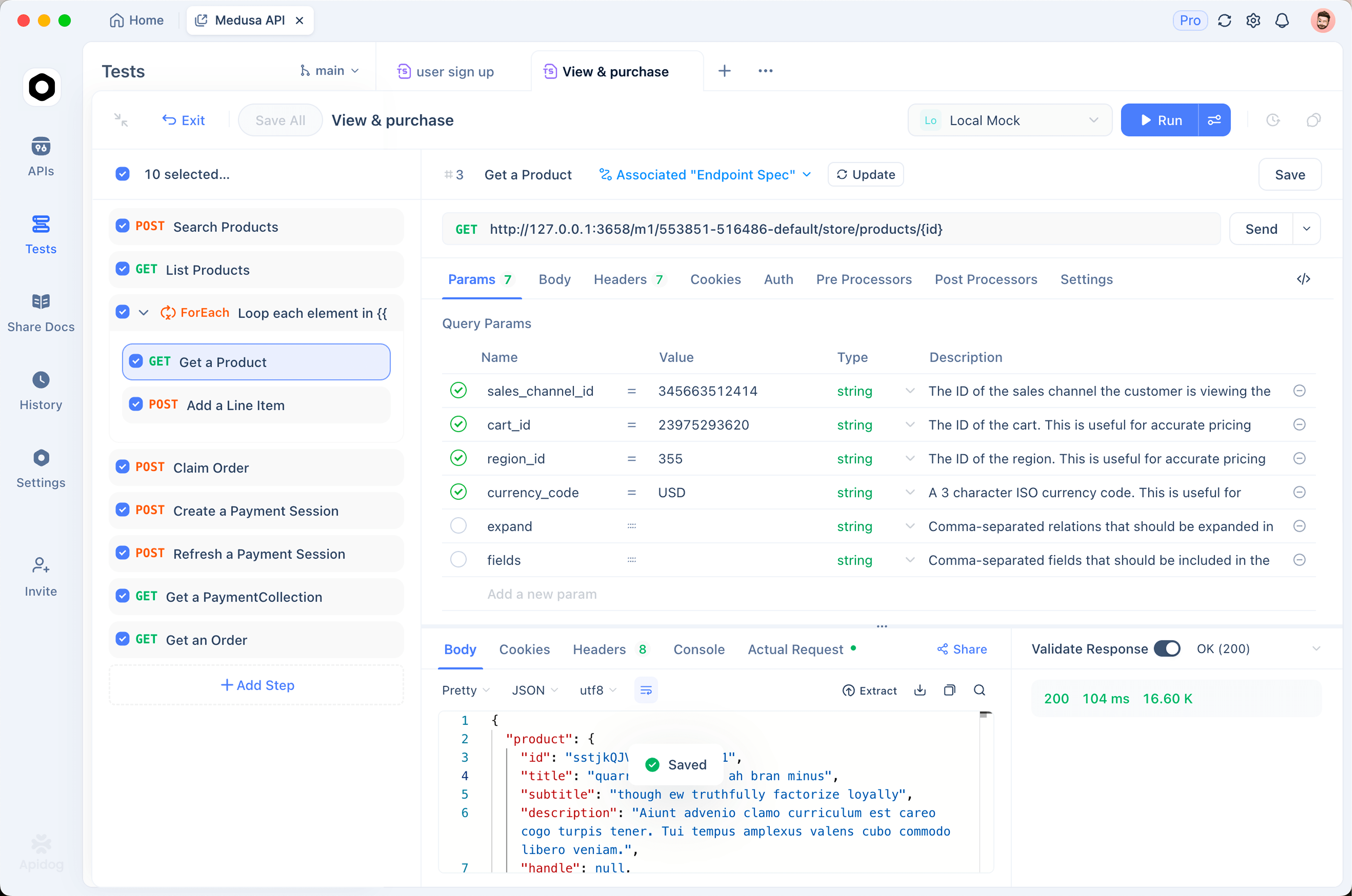
For a team weighing it against Anypoint’s API layer specifically:
- It replaces Design Center and Exchange for spec work. Visual and code OpenAPI editors, branch-based versioning, and a shared workspace where endpoints are the source of truth. Schemas defined once generate docs, mocks, and test assertions.
- It replaces the testing you were doing in Studio or Postman alongside MuleSoft. Visual test scenarios chain requests, assert on responses, validate against schemas, run data-driven cases, and run in CI via the Apidog CLI. Unlimited runs on the free plan.
- It gives consumers a mock before any runtime exists. The smart mock serves schema-based responses the moment an endpoint is defined. In MuleSoft terms: API Designer’s mocking service, without the platform attached.
- It replaces API Experience Hub for docs, without the add-on invoice. Interactive published docs on your own domain, generated from the spec, with an MCP server alongside so AI agents can read it too.
- Governance of the spec layer. Component libraries, schema reuse, branch review, and role-based permissions keep teams on one standard; see how that compares to gateway-level governance in API governance tools.
What Apidog does not do: run integrations. There’s no ESB, no DataWeave, no connectors moving data between Salesforce and SAP at 2 a.m. That’s a different product category, covered next.
If you need the runtime: pair Apidog with one of these
The honest architecture for most MuleSoft leavers is two tools with a spec in between: Apidog owns the API lifecycle, and a gateway or integration layer owns traffic and data movement. (If those two jobs blur together, our explainer on API management vs API gateways draws the line.) The real candidates:
- Kong. Open-source gateway with a deep plugin ecosystem; the default for self-hosted policy enforcement and traffic management. We’ve mapped the field in Kong alternatives.
- Apigee. Google Cloud’s API management platform; the closest like-for-like swap for API Manager if you’re on GCP. See MuleSoft vs Apigee for that head-to-head.
- Boomi. The nearest iPaaS-for-iPaaS trade for actual integration workloads, generally cited as cheaper to enter than MuleSoft; we compared its API side in Apigee vs Boomi.
- WSO2. Open-source API management plus integration in one stack; the pick when self-hosting everything is a requirement, at the cost of operating it yourself.
- Tyk. A leaner open-source gateway with commercial support; gateway capability without a platform’s weight. See Tyk vs Kong.
Any of these under Apidog costs a fraction of an Anypoint contract, and each piece is replaceable on its own schedule instead of at one giant renewal.
MuleSoft vs Apidog at a glance
| MuleSoft Anypoint Platform | Apidog | |
|---|---|---|
| Category | iPaaS + ESB + API management | API development platform |
| Pricing | Quote-based, annual; no public list prices | Public: free for 4 users, from $9/user/month |
| Metering | Mule Flows/Messages; API request, APIs-managed, APIs-governed volumes | Per seat |
| API design | Anypoint API Designer | Visual + code OpenAPI editors, branching |
| API testing | Basic in Designer; most teams add a client | Test scenarios, assertions, data-driven, CI via CLI |
| Mocking | Designer mocking service | Schema-aware smart mocks, free |
| API docs / portal | API Experience Hub (paid add-on) | Published interactive docs, custom domain |
| Integration runtime / ESB | Yes: Mule runtime, CloudHub, Runtime Fabric | No; pair with a gateway or iPaaS |
| Gateway | Omni Gateway (metered per request) | No; pair with Kong, Apigee, Tyk |
| Enterprise access control | Yes | SSO (SAML 2.0, OIDC), SCIM, RBAC on enterprise plans |
| Audit logs | Yes | Yes, Enterprise plan, 180-day retention |
| Time to a price | Sales cycle | Pricing page |
The cost math, honestly
We can’t print a MuleSoft number, because MuleSoft doesn’t. What we can do is bound the comparison. A 20-person API team on Apidog costs a few thousand dollars a year, on a public price list, with no usage meters on runs, mocks, or docs. An Anypoint contract is quote-based, annual, and metered along every axis listed above. If your quote for the API lifecycle portion lands anywhere near typical enterprise-iPaaS territory, the Apidog line item rounds to noise next to it.
The math only flips if the runtime is doing heavy, irreplaceable work. If dozens of production Mule flows move data between core systems daily, you’re using the expensive part, and the contract buys something Apidog doesn’t sell. Then the honest move isn’t switching; it’s scoping. Stop paying platform add-on rates for docs portals and design seats that a $9 seat covers, and spend the contract on flows.
Enterprise controls no longer decide this either way. Apidog’s enterprise plan covers SSO (SAML 2.0, OIDC, Okta, Microsoft Entra ID), SCIM provisioning, and RBAC, with audit logs documented at 180-day retention and a self-hosted option for regulated environments. If that’s your evaluation axis, we went deep in enterprise-ready API testing platforms with SSO.
Migrating the API lifecycle off MuleSoft
The API layer is the portable part. Specs are specs.
- Export your API specifications from Anypoint. Design Center and Exchange assets export as RAML or OAS. If you’re on RAML, convert to OpenAPI first (MuleSoft tooling and several converters handle this).
- Import into Apidog. Project Settings, Import, select the OpenAPI files. Endpoints arrive with schemas, generated docs, and live smart mocks immediately.
- Rebuild your catalog structure. Exchange’s asset organization becomes Apidog projects and folders; shared schemas go into the component library so reuse survives the move.
- Point consumers at new docs and mocks. Publish docs on your domain and hand frontend and partner teams mock URLs. This is the visible cutover, so do it API by API.
- Wire tests into CI. Recreate critical-path tests as Apidog scenarios and run them with the CLI in your pipeline.
- Decide the runtime’s fate separately. Keep Mule for the flows that earn their meter, or plan a runtime move on its own timeline. Don’t let the runtime question hold the API layer hostage.
A team with a few dozen APIs typically moves the spec-and-docs layer in days, not quarters; nothing about it is proprietary.
When MuleSoft still makes sense
If your organization runs deep Salesforce-centric integration, hundreds of connectors’ worth of data movement, B2B/EDI partner flows, and a platform team that lives in DataWeave, Anypoint is the category leader for a reason, and no API development tool replaces it. The same goes if procurement wants one contract for runtime, gateway, and lifecycle, and the budget supports it. MuleSoft’s problem was never capability. It’s that the platform is priced as a whole while many teams use a slice, and the slice they use most (design, test, mock, document) has excellent, cheap, spec-standard alternatives. If you’re mostly in that slice, you’re not a MuleSoft customer; you’re an API team paying iPaaS rent. Many Postman teams reach the same conclusion from the opposite direction, as we covered in the best Postman alternative.
Frequently asked questions
Is Apidog an ESB or iPaaS like MuleSoft?
No. Apidog covers the API lifecycle: design, debugging, testing, mocking, documentation, and spec governance. It doesn’t run integration flows or transform data between systems. For that, pair it with a gateway or integration layer; see the candidates in Kong alternatives.
What’s the cheapest way to replace MuleSoft’s API management?
Split the job. Apidog handles design, testing, mocks, and docs from $0 to $9 per user per month; an open-source gateway (Kong or Tyk) handles traffic policy. The trade-offs are laid out in API management vs API gateway.
Can I import RAML specs from Anypoint into Apidog?
Convert RAML to OpenAPI first (MuleSoft tooling supports OAS export, and standalone converters exist), then import the OpenAPI file into Apidog. Endpoints, schemas, docs, and mocks generate from it directly. OAS-based projects skip the conversion step.
Does Apidog meet enterprise security requirements?
Apidog’s enterprise plan includes SSO (SAML 2.0, OIDC, Okta, Microsoft Entra ID), SCIM provisioning, and RBAC, plus audit logs with 180-day retention and a self-hosted option. We compared the field on exactly this axis in enterprise-ready API testing platforms.
Why is MuleSoft so expensive?
Structurally: it’s quote-based, annual, and metered on Mule Flows, Mule Messages, API request volume, APIs managed, and APIs governed, with the developer portal as a paid add-on. You’re buying an integration runtime, a deployment platform, and an API suite as one contract; teams that need one slice fund the other two. The broader field is mapped in MuleSoft competitors.
Stop paying iPaaS rent on your API lifecycle
Export a spec from Anypoint, import it into Apidog, and you’ll have docs, mocks, and runnable tests before a sales rep returns your pricing call. Download Apidog or start in the browser: free for teams of 4, $9 per user after that, and the price is on a page you can read.