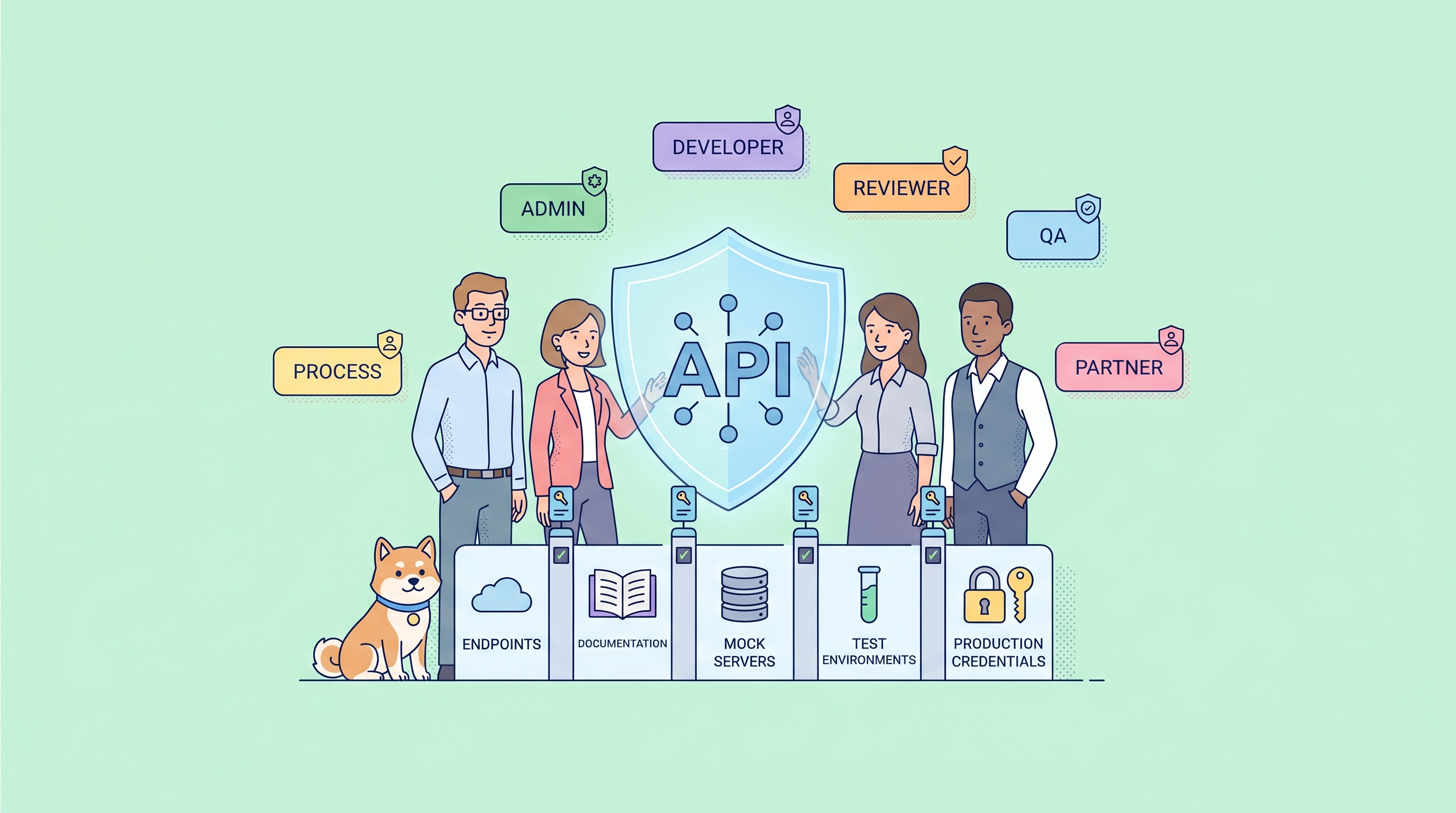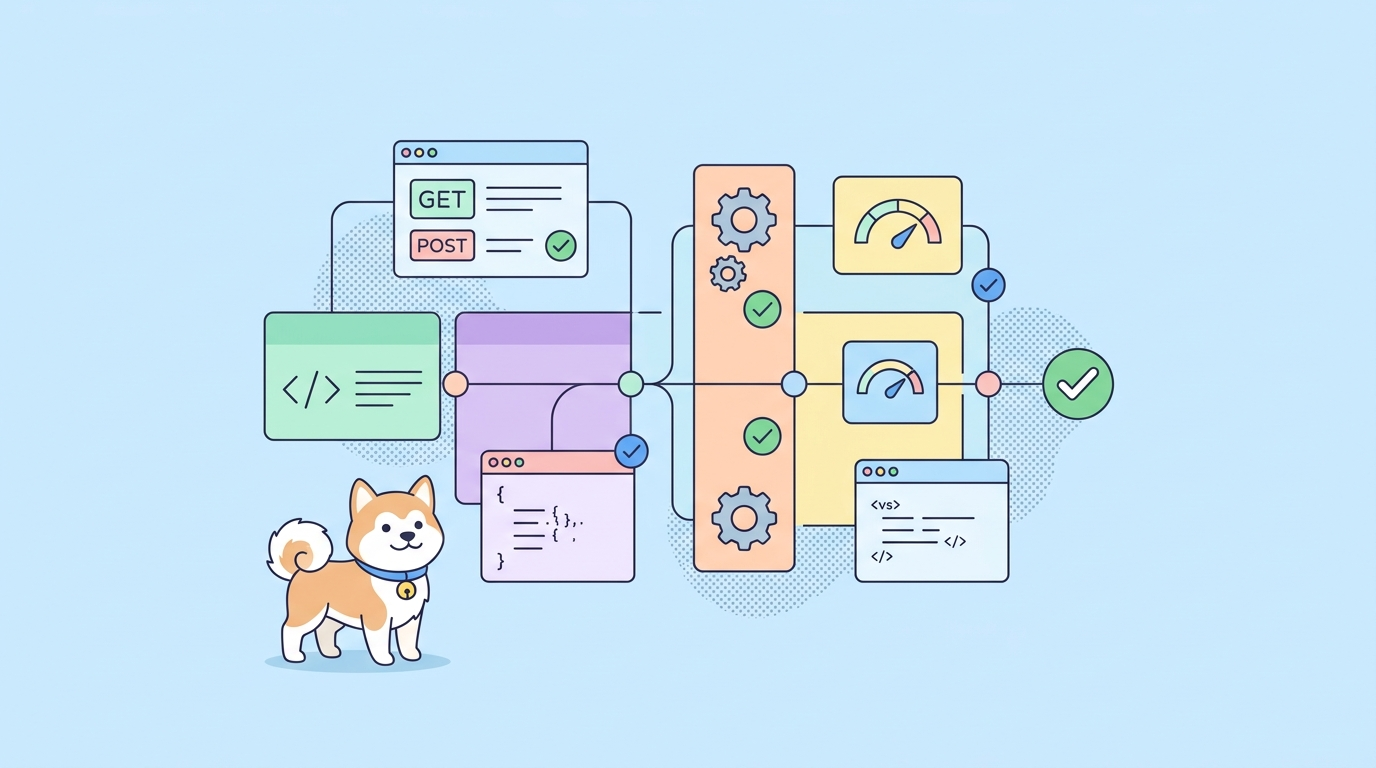
You shouldn’t be prompting coding agents anymore. You should be designing loops that prompt your agents. It sounds like a throwaway line, but it points at the single biggest shift in how good engineers work with AI right now. The people getting real leverage out of AI coding agents stopped treating the agent as a chat partner. They treat it as a worker inside a loop they built.
TL;DR
A coding agent loop is a control structure that runs an agent repeatedly: generate a change, run it, check the result against a hard signal, feed the failure back, repeat until the check passes or a limit is hit. The agent isn’t the hard part. The verification gate is. A loop with a vague gate (“looks fine, try again”) drifts and hallucinates “done.” A loop with a deterministic gate (a failing test, a schema mismatch, a broken contract) converges. For API and backend work, your automated test suite and contract checks are that gate, which is why API testing belongs at the center of an agentic workflow, not bolted on at the end.
From prompting to designing loops
Most people meet AI coding through a chat box. You type a request, read the answer, copy what works, and type again. That’s prompting. It’s fine for a one-off function or a quick explanation. It falls apart the moment the task takes more than one round of feedback to get right, which is most real work.
Here’s the problem with prompting by hand. You are the loop. You read the output, you spot the bug, you decide what to say next, you paste the error back. Every iteration waits on a human. The agent can generate code in seconds, then sits idle for minutes while you context-switch, scroll, and type. You become the slow part of a fast system.
Designing a loop flips that. Instead of being the thing that reads output and decides the next prompt, you build a harness that does it automatically. The agent writes code. A script runs it. The result gets captured. If it failed, the failure goes straight back to the agent as the next prompt. No human in the inner loop. You step in only at the edges: to set the task, to approve the result, to kill the run if it goes sideways. Anthropic’s own writeup on building effective agents makes the same point in different words. The win comes from the environment you wire around the model, not from a cleverer single prompt.
The mental model shift is small but total. Stop asking “what should I tell the agent?” Start asking “what loop would make the agent tell itself?”
What a coding agent loop actually is
Strip away the hype and a coding agent loop has five parts. Miss one and the loop either never terminates or terminates wrong.
- A task spec. A clear, written description of what done looks like. Not “make it work,” but “the POST /orders endpoint returns 201 with the created order, validates the body against the schema, and rejects missing fields with 422.”
- The agent. The model plus its tools: read files, write files, run shell commands. This is the part everyone fixates on and the part you control least.
- An action step. The agent makes a change, then something actually runs it. Tests, a build, a type check, a request against a live endpoint.
- A verification gate. A deterministic check that returns pass or fail with a concrete reason. This is the steering wheel. We’ll spend most of this post here.
- A termination condition. When does the loop stop? Gate passes, or you hit a max iteration count, or you blow a cost budget. A loop with no exit is a runaway, not a workflow.
In pseudocode the whole pattern fits in a few lines:
task = load_spec("orders-endpoint.md")
for attempt in range(MAX_ITERATIONS):
    agent.run(task, feedback=last_result)   # generate
    result = run_verification()             # run + check the gate
    if result.passed:
        break                               # terminate: success
    last_result = result.failures           # feed failure back
else:
    escalate_to_human(last_result)          # terminate: gave up
That loop is the entire idea. The agent generates, the gate judges, the failure becomes the next prompt, and the whole thing runs until green or out of tries. The variant people share online as the “Ralph” technique is this with MAX_ITERATIONS set high and the spec written tight. If you’ve read our breakdown of agent harness architecture, this is the harness in its smallest honest form.
Why one-shot prompting hits a wall
A single prompt assumes the model gets it right the first time, or that you’ll catch what it got wrong. Both assumptions break at scale.
Models are strong at generating plausible code and weak at knowing whether that code is correct. They’ll write an endpoint that looks right, compiles, and quietly returns the wrong status code on an edge case. In a chat, you might not notice until production does. The model has no feedback telling it the edge case broke, so it confidently reports success. That gap between “looks done” and “is done” is exactly where loops earn their keep.
A loop closes the gap by refusing to accept the model’s own opinion of its work. The agent doesn’t get to say it’s finished. The gate says so. Run the tests; if they’re red, the task isn’t done, full stop, and the red output is the next thing the agent reads. The model’s confidence stops mattering. Only the signal matters.
There’s a productivity angle too. Hand-prompting caps your throughput at one agent you’re actively watching. Loops let you run several at once, each grinding on its own task against its own gate, because none of them needs you in the inner cycle. That’s the leap our piece on dynamic, parallel agent workflows gets into: once the loop is automated, you scale by adding loops, not by typing faster.
The part everyone underbuilds: the verification gate
Here’s the uncomfortable truth. Most failed agent workflows don’t fail because the model was too weak. They fail because the feedback signal was too soft.
Think about what the gate does. Every iteration, it tells the agent one of two things: you passed, stop; or you failed, here’s exactly why. The quality of “here’s exactly why” determines whether the next iteration improves or wanders. Feed the agent a precise stack trace pointing at line 42 and the assertion that blew up, and it patches the right thing. Feed it “something seems off, please review,” and it guesses, often making the code worse while sounding more confident.
Deterministic gates converge. Fuzzy gates drift. That’s the whole game.
What makes a good gate?
- It’s binary and reproducible. Same input, same verdict, every time. No “depends how the model feels today.”
- It fails loudly with a reason. A test name, an expected-vs-actual diff, a line number, an error code. The reason is the next prompt, so it has to be specific.
- The agent can’t quietly edit it. If the agent can change the test to make it pass, the gate is theater. Protect the gate. Treat it as the spec, not as code the agent owns.
- It runs fast enough to loop on. A gate that takes 20 minutes caps your iteration speed. Tight loops need fast checks.
Good gates already exist in every mature codebase. Unit tests. Type checkers. Linters. Compilers. Schema validators. Contract tests. These are deterministic oracles. They were built to tell humans “this is wrong and here’s why,” which is precisely the signal an agent loop needs. You don’t have to invent the gate. You have to point the loop at the gates you already trust, and write new ones where coverage is thin. If you’ve never formalized that layer, our guide on what automated testing actually is is a good grounding before you wire it into a loop.
For API and backend work, your test suite is the loop
This is where the abstract idea gets concrete for anyone building services. When an agent writes an API endpoint, what is the ground truth that says it works? Not the model’s summary. The actual behavior of the endpoint under test: right status codes, response body matching the schema, auth enforced, bad input rejected, the contract honored.
Every one of those is checkable, automatically, with a deterministic result. Which means your API test suite is already shaped exactly like the verification gate an agent loop needs. You were building the gate all along; you just called it testing.
A concrete loop for endpoint work looks like this:
- The agent reads the task spec and the OpenAPI definition, then writes or edits the endpoint.
- The harness runs the API test suite against the running service: status assertions, JSON schema validation on every response, contract checks against the spec.
- Failures come back structured. “Expected 422 on missing
customer_id, got 500.” “Response fieldtotalis a string, schema says number.” “Endpoint/orders/{id}in the spec has no implementation.” - That structured failure becomes the agent’s next prompt. It patches the specific gap.
- Repeat until the suite is green, then hand off to a human for review.
The key is that the feedback in step 3 is precise and machine-generated, not a vibe. That’s what keeps the loop converging instead of wandering. Schema-first and contract testing matter more than ever here, because the OpenAPI spec becomes the shared source of truth that both the agent and the gate read from. Drift between code and spec stops being a slow documentation problem and becomes an instant red gate.
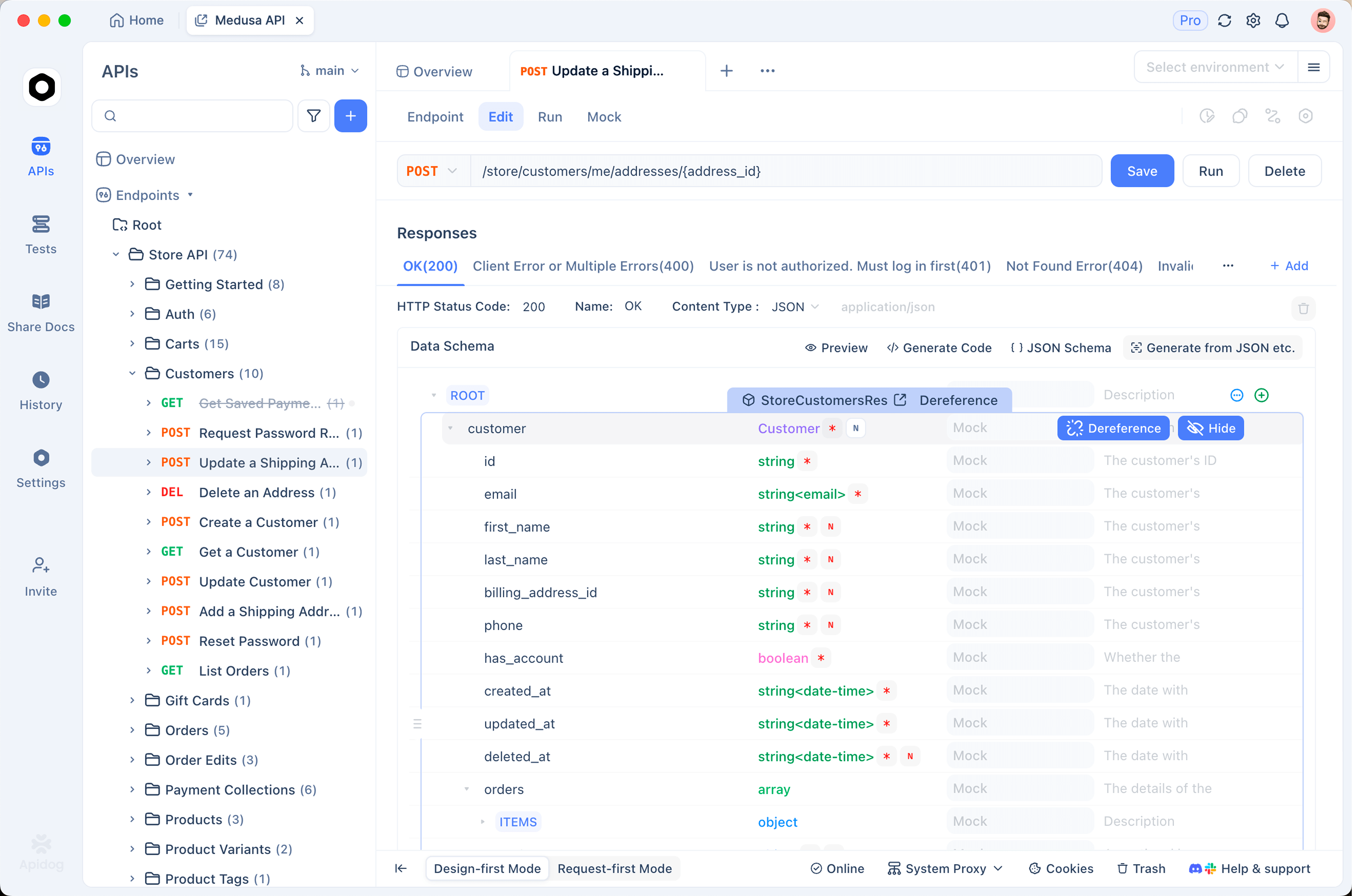
This is the role Apidog plays in an agentic workflow. It’s an all-in-one API platform where the design, the schema, the mock server, and the automated tests live in one place, which means the gate and the spec stay in sync by default. You point the loop at an Apidog test scenario, the agent gets schema-validated pass/fail on every iteration, and the mock server stands in for dependencies that aren’t built yet so the agent can work against a stable target. Teams already running this pattern wire the agent’s tool access through something like the Apidog AI agent debugger so the agent can hit and inspect endpoints the same way a human tester would. Download Apidog if you want to build the gate visually instead of hand-rolling a test runner.
Build a minimal self-correcting API loop today
You don’t need a framework to start. You need a spec, a test command, and a few lines of glue. Here’s the smallest version that does real work.
Step 1: write the spec as the gate’s intent. Put the contract in an OpenAPI file and the behavior in test cases. The agent reads both. This doubles as documentation, so it’s not throwaway work.
Step 2: pick a test command that exits non-zero on failure. Anything works as long as the exit code is honest. A pytest suite, a Newman run, an Apidog CLI test scenario. The loop only cares about pass/fail plus the captured output.
# the gate, as one command
apidog run ./tests/orders-suite --reporter json > result.json
Step 3: wire the loop. Run the agent, run the gate, branch on the result.
MAX_ITERATIONS = 8
feedback = None
for attempt in range(MAX_ITERATIONS):
    run_agent(task="implement orders API per spec", feedback=feedback)
    gate = subprocess.run(["apidog", "run", "./tests/orders-suite",
                           "--reporter", "json"], capture_output=True)
    if gate.returncode == 0:
        print(f"green on attempt {attempt + 1}")
        break
    feedback = parse_failures(gate.stdout)   # the next prompt writes itself
else:
    print("8 attempts, still red; escalating to a human")
Step 4: protect the gate. Keep the test files and the spec out of the set of files the agent is allowed to edit. If it can rewrite the test to pass, you’ve built a machine for faking progress.
Step 5: bound the cost. Cap iterations. Cap spend. Log every attempt so you can see whether the loop is converging or thrashing. If you’re watching token spend, our notes on reducing agent token costs apply directly, because a loop that doesn’t converge burns budget fast.
That’s a working self-correcting loop. The agent writes, the suite judges, the failures steer, and you get a green endpoint or a clean escalation instead of a confident lie.
Designing good loops: the mistakes that bite
A few patterns separate loops that work from loops that quietly waste money.
- Letting the agent grade its own homework. If the only check is “agent, did you finish?” you have no loop, you have a chatbot with extra steps. The gate must be external to the agent.
- A gate that’s too coarse. “Tests pass” with three shallow tests means the agent satisfies three tests and ships bugs in everything uncovered. Loop quality is capped by gate coverage. Thin tests, thin results.
- No termination guard. Loops without a max-iteration count and a cost ceiling can spin forever on a task the model can’t solve. Always set an exit, and always escalate to a human when it trips.
- Slow gates. A 15-minute integration suite is a fine nightly check and a terrible inner loop. Keep a fast gate for the loop and a thorough gate for the merge. Mock external dependencies so the loop isn’t waiting on a flaky third party.
- Mutable specs. If the agent edits the OpenAPI file to match its buggy code, the contract test goes green for the wrong reason. The spec is the constitution. The agent works under it, not on it.
- One giant task. A loop chewing on “build the whole service” rarely converges. Decompose into endpoint-sized tasks, each with its own gate. Small loops finish; big ones thrash.
Most of these come down to the same discipline: invest in the signal, not the prompt. The wiring patterns and failure modes here line up with what we covered in agentic workflow tool wiring, and they hold whether your agent is Claude Code, Cursor, Codex, or something you built yourself.
Where this is heading
The “stop prompting, start looping” line is a snapshot of a longer trend. The skill that’s becoming valuable isn’t prompt-craft. It’s loop-craft: writing crisp specs, building deterministic gates, choosing termination conditions, and deciding what the agent is and isn’t allowed to touch. That’s closer to systems design than to prompt engineering, and it rewards engineers who already think in terms of tests, contracts, and CI.
It also changes what good test infrastructure is worth. For years, automated tests were insurance you hoped you’d never need. In an agentic workflow they become the steering mechanism, the thing that turns a fast-but-unreliable generator into a system that converges on correct. Teams that already have strong automated test coverage and clean contracts are the ones who plug agents in and get leverage immediately. Teams without it get a fast way to generate confident, untested code.
So the practical move isn’t to chase a better model or a cleverer prompt. It’s to build the gate. Tighten your specs. Make your API tests deterministic and fast. Keep your schema as the source of truth. Then wrap a loop around it and let the agent run laps until the gate turns green.
The takeaway
The shift is simple to state and hard to internalize. Don’t get better at prompting your coding agent. Get better at designing the loop that prompts it, and at the feedback signal that loop runs on. The agent is a fast generator with no reliable sense of whether it’s right. The loop, through a deterministic gate, supplies that sense. For anyone building APIs, you already own the gate. Your test suite, your schema, and your contracts are the ground truth that turns an eager generator into a system that converges on correct.
Start small. Write one tight spec, point a loop at one fast API test suite, protect the gate, cap the iterations, and watch an agent grind a red endpoint to green without you in the inner loop. Then build the next loop. If you want the gate to be visual, schema-aware, and shareable across your team, Apidog gives you the design, mocking, and automated testing in one workspace; download it and make your tests the thing that drives your agents.