TL;DR: The Github Copilot pricing change starts on June 1, 2026. GitHub Copilot is moving from premium request-based billing to usage-based billing with GitHub AI Credits. Instead of every premium interaction being counted as a request unit, Copilot usage will be calculated from token consumption, including input tokens, output tokens, and cached tokens, with pricing varying by model.
The base Copilot plan prices are not changing, but paid users may pay more if they exceed the credits included in their plan. GitHub is also introducing a preview bill experience before the transition so users and admins can estimate future costs.
This guide explains the Github Copilot pricing change in practical terms: what changes, why GitHub is doing it, who is most affected, how costs may shift, and what individual developers, engineering managers, finance teams, and enterprise admins should do before June 1, 2026.
Github Copilot Pricing Change: From Flat-Rate to AI Credits
The Github Copilot pricing change is GitHub’s move from a request-based Copilot billing model to a usage-based billing model.
Before the change, Copilot relied on premium request units for many paid-model interactions. That meant a relatively small chat request and a long, multi-step agentic coding session could be treated similarly from a billing-unit perspective, even though they created very different compute costs behind the scenes.
Starting June 1, 2026, premium request units will be replaced by GitHub AI Credits.
Under the new system:
- Copilot usage consumes GitHub AI Credits
- AI Credits are based on token usage
- Token usage includes input, output, and cached tokens
- Different models can consume credits at different rates
- Paid plans can buy additional usage beyond included credits
- Business and Enterprise plans receive pooled credits at the billing entity level
- GitHub says 1 AI Credit equals $0.01 USD
In short, the Github Copilot pricing change makes Copilot billing behave more like API-based AI billing: the more model work you ask for, the more usage you consume.
Testing Agent Token Consumption Before It Hits Your Bill
The Github Copilot pricing change makes token visibility essential. But you don't have to guess how many tokens your agentic workflows consume—you can measure and optimize them before costs accumulate.
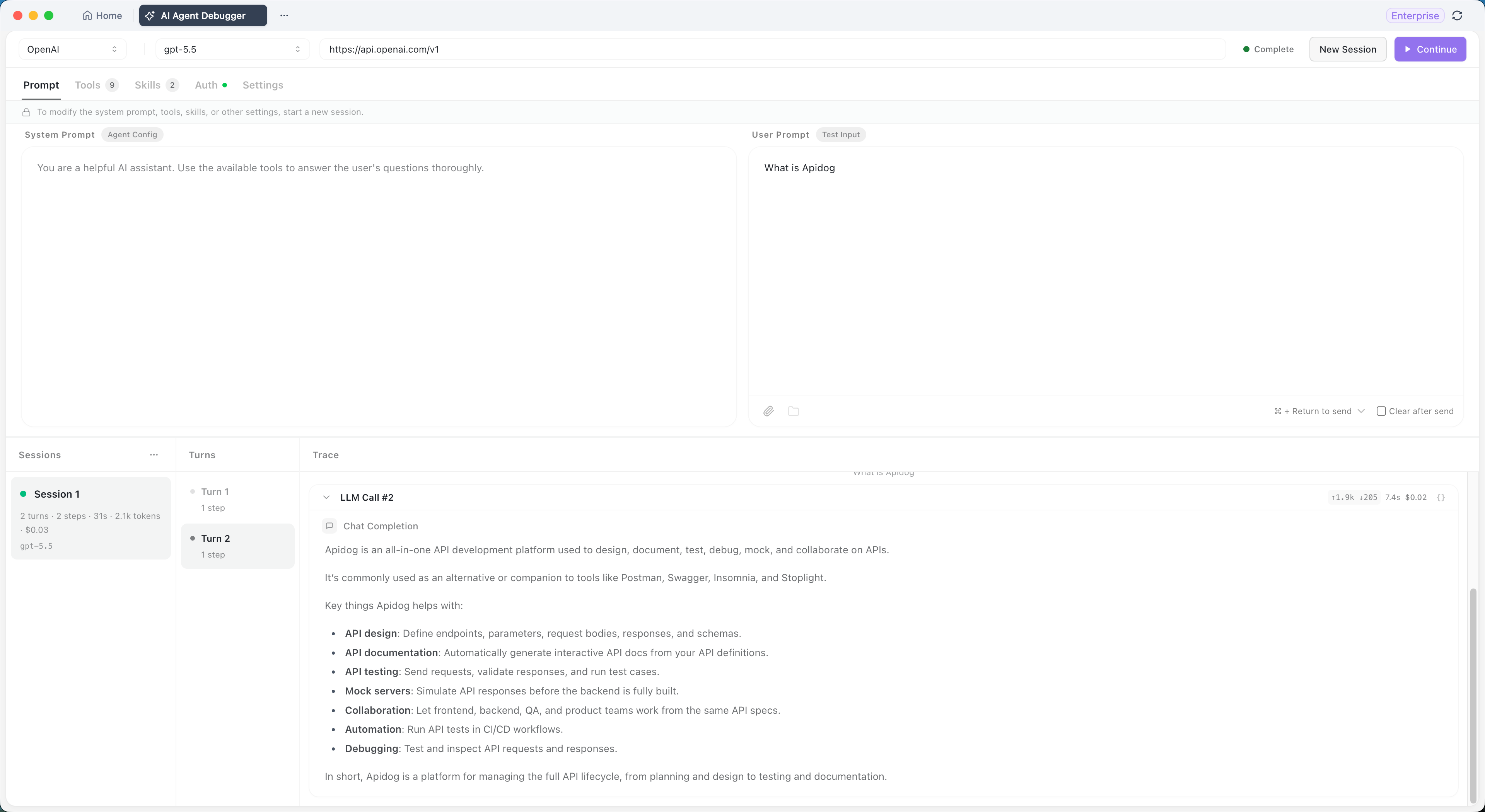
Use an AI Agent Debugger to inspect real usage. Tools like Apidog's AI Agent Debugger show you exactly what's happening inside your agent sessions:
- Input tokens: See how much context each prompt sends (repository files, error logs, open tabs)
- Output tokens: Track response lengths and identify verbose outputs
- Tool call chains: Monitor every MCP tool call, Skill execution, and its token cost
- Session metrics: Compare rounds, steps, response time, and estimated cost per session
The workflow for cost optimization:
- Run your typical agentic task (e.g., "Refactor this module and update tests") in the debugger
- Check the trace panel for token counts at each step—especially input tokens from repository context
- Identify bloat: Are you sending unnecessary files? Getting 2000-word explanations when you need 200?
- Iterate on prompts: Refine your instructions, then re-run and compare session metrics
- Compare models: Run the same task across different models to find the best cost-effectiveness balance
Github Copilot Pricing Change: Old VS New
The most important date in the Github Copilot pricing change is June 1, 2026.
That is when GitHub says Copilot plans transition to usage-based billing.
Here is the before-and-after view:
| Area | Before June 1, 2026 | Starting June 1, 2026 |
|---|---|---|
| Billing unit | Premium request units | GitHub AI Credits |
| Usage basis | Requests/interactions | Token consumption |
| Cost drivers | Number of premium requests, model multipliers | Input tokens, output tokens, cached tokens, model pricing |
| Heavy agentic tasks | Could be counted similarly to smaller requests | More likely to consume more credits because of token usage |
| Base plan prices | Existing plan pricing | GitHub says base plan pricing is not changing |
| Extra usage | Based on request model | Paid plans can purchase additional usage |
| Admin visibility | Existing billing tools | Preview bill and usage visibility before transition |
This is why the Github Copilot pricing change matters even if your monthly subscription price stays the same. The headline subscription fee may not change, but your effective cost can change depending on how you and your team use Copilot.
Why GitHub Is Changing Copilot Pricing
GitHub's explanation is straightforward: Copilot has become much more expensive to operate.
The product is no longer just an in-editor autocomplete assistant. It now supports chat, multiple models, agentic workflows, repository-level tasks, CLI assistance, and longer coding sessions. A developer can ask Copilot to do something simple, such as explain a function, or something much heavier, such as inspect a repository, propose a refactor, edit files, test changes, and iterate through errors.
Those two workflows are not equal in compute cost.
That difference is central to the Github Copilot pricing change. GitHub has said the old premium request model is less sustainable because a quick prompt and a long autonomous coding session can consume very different inference resources while previously being represented too similarly in billing.
Usage-based billing is intended to align price with actual usage.
That does not automatically mean every developer will pay more. But it does mean heavy users, agentic users, and teams that send large amounts of repository context to Copilot need to pay closer attention.
Key Terms in the Github Copilot Pricing Change
To understand the Github Copilot pricing change, you need to understand four terms: premium request units, GitHub AI Credits, tokens, and cached tokens.
Premium Request Units
Premium request units were the old way of measuring many paid Copilot interactions.
They were easier to understand than token billing because users could think in terms of requests. But the weakness was obvious: not every request is equal.
A short “What does this error mean?” prompt and a long “refactor this module and update tests” agentic task can differ dramatically in model work.
GitHub AI Credits
GitHub AI Credits are the new billing unit.
Starting June 1, 2026, Copilot usage consumes AI Credits instead of premium request units. GitHub describes AI Credits as the way usage is converted into cost, with 1 AI Credit equal to $0.01 USD.
Each Copilot plan includes a monthly allotment of AI Credits. If a paid user or organization exceeds the included amount, additional usage may create additional costs.
Input Tokens
Input tokens are the text sent to the model.
For Copilot, input tokens can include:
- Your prompt
- Selected code
- Open files
- Relevant repository context
- Error messages
- Test output
- API schemas or documentation pasted into chat
- Agent instructions
A short prompt uses fewer input tokens. A broad prompt that includes multiple files, logs, and specifications uses more.
Output Tokens
Output tokens are what the model generates.
Examples include:
- Code suggestions
- Chat explanations
- Test cases
- Refactoring plans
- Generated files
- Debugging instructions
- API client code
- Documentation drafts
The longer and more detailed Copilot’s response, the more output tokens it uses.
Cached Tokens
Cached tokens refer to context the model reuses or stores.
Caching can make repeated context more efficient, but cached tokens still matter in the new pricing structure. GitHub’s pricing documentation separates token types because input, output, and cached tokens may be priced differently depending on the model.
The Practical Impact: Where Github Copilot Costs May Go Up or Down
The Github Copilot pricing change is not equally important for every user.
For some developers, the included AI Credits may be enough. For others, especially teams using Copilot as an agentic coding platform, the change may introduce new cost planning needs.
Lower-Risk Usage Patterns
You are less likely to see major cost pressure if you mostly use Copilot for:
- Lightweight code completions
- Short chat questions
- Small code explanations
- Occasional bug fixes
- Limited model switching
- Minimal repository-wide context
These interactions tend to be smaller. They may still consume AI Credits, but they are less likely to behave like long-running compute-heavy sessions.
Higher-Risk Usage Patterns
You should pay closer attention to the Github Copilot pricing change if you frequently use Copilot for:
- Agent mode
- Repository-wide refactors
- Multi-step debugging sessions
- Large file analysis
- Test generation across many files
- Repeated prompts with long pasted logs
- Complex architectural planning
- Premium model usage for routine tasks
- Long CLI or cloud-agent sessions
These workflows can send and receive far more tokens. Under token-based billing, that matters.
Before-and-After Example: Simple Chat vs Agentic Refactor
Here is the core pricing difference in plain English.
Before the Github Copilot Pricing Change
A developer asks:
"Explain this function."
Another developer asks:
"Refactor this service, update the tests, inspect the error logs, and propose changes across the repository."
Under a request-oriented model, both interactions could be treated more similarly than their real compute cost suggests.
After the Github Copilot Pricing Change
The first request may use:
- A small prompt
- One selected function
- A short explanation
The second request may use:
- Multiple files as input
- Repository context
- Long reasoning steps
- Generated code
- Test changes
- Follow-up iterations
- Larger model output
So the second task consumes more tokens and therefore more AI Credits.
This is the whole point of the Github Copilot pricing change: Copilot cost becomes more proportional to actual AI workload.
Is the Github Copilot Pricing Change a Price Increase?
The honest answer: it depends on how you use Copilot.
GitHub says base plan pricing is not changing. That means the subscription sticker price may remain the same.
But usage-based billing can still feel like a price increase for users who exceed included AI Credits. Heavy agentic usage, long prompts, large context windows, and premium model selection can all increase consumption.
For light users, the Github Copilot pricing change may be mostly administrative. For heavy users, it may become a meaningful budget item.
A good way to think about it:
- Not a base subscription price increase
- Potentially an effective cost increase for high usage
- Potentially fairer for light users
- More predictable for GitHub’s infrastructure costs
- Less predictable for teams without usage governance
So the important question is not "Did the monthly plan price change?" The better question is: "Will our included AI Credits cover how we actually use Copilot?"
How to Control Copilot Costs After the Pricing Change
Here are practical ways to adapt to the Github Copilot pricing change without abandoning Copilot.
Keep Prompts Specific
Vague prompts invite long responses and unnecessary context.
Less efficient:
Review this whole service and improve it.
More efficient:
Find why createInvoice returns 500 when customerId is null.
Suggest a minimal fix and one regression test.
Avoid Repeated Full-File Prompts
If Copilot already has enough context, do not paste the same file repeatedly. If the issue is in one function, focus on that function.
Use Advanced Models Intentionally
More capable models may be worth it for difficult tasks. But using them for simple syntax questions can waste credits.
Break Agentic Work Into Smaller Tasks
Instead of:
Refactor the entire billing module and update all tests.
Try:
First, identify the files involved in invoice calculation.
Do not change code yet.
Then proceed step by step.
Validate Outputs Outside Copilot
Copilot can generate code, but validation should not always require another long Copilot session.
For APIs, use tools like Apidog to send requests, run tests, validate responses, and document behavior. That keeps the feedback loop grounded in actual API results rather than endless AI-generated revisions.
Community Concerns About the Pricing Change
Developer reaction to the Github Copilot pricing change is likely to be mixed.
Some users will see the move as reasonable. Agentic AI coding is expensive to run, and usage-based billing is common across AI platforms.
Others will worry about unpredictable costs. That concern is valid. Developers are used to Copilot as a relatively simple subscription. Once usage depends on tokens, models, and cached context, it becomes harder to estimate cost casually.
The biggest concerns are:
- "Will I run out of credits?"
- "Will my team’s bill become unpredictable?"
- "Will agentic coding become too expensive?"
- "Will developers avoid Copilot because they fear overages?"
- "Will managers restrict AI usage too much?"
The best answer is transparency. Teams need preview bills, usage dashboards, spending limits, and clear internal rules. Without those, the Github Copilot pricing change could create anxiety even when actual costs are manageable.
Final Take: The Github Copilot Pricing Change Rewards Intentional Usage
The Github Copilot pricing change is a major shift because it changes what developers optimize for.
Under request-based billing, the mental model was simple: use a request. Under usage-based billing, the mental model becomes more nuanced: how much context are you sending, how much output are you generating, which model are you using, and is the task worth the credits?
That does not make Copilot less useful. It makes Copilot more like other cloud and AI infrastructure: powerful, scalable, and worth governing.
The teams that handle this transition best will not be the ones that simply cut usage. They will be the ones that use Copilot more deliberately.
For most organizations, the right move before June 1, 2026 is clear:
- Study the new AI Credit model
- Watch the preview bill
- Identify heavy workflows
- Create model and agent-use guidelines
- Keep API specs, tests, and documentation structured in tools like Apidog
- Use Copilot where it creates real development leverage
The Github Copilot pricing change is not just a billing update. It is a signal that AI coding has entered its infrastructure era, where productivity and cost management now have to grow up together.