TL;DR
Anthropic now offers free Claude API access (up to 20x the normal limits) for open-source maintainers. If you maintain a popular open-source project, you can apply for significantly reduced or free API usage. This is a game-changer for developers building API tools, test automation, and documentation workflows. Apply through Anthropic's official sales contact page with proof of your open-source contributions.
Introduction
If you're an open-source maintainer, here's some exciting news: Anthropic now offers free or heavily discounted Claude API access for maintainers of popular open-source projects. This program gives developers a chance to integrate powerful AI capabilities into their API workflows without the usual costs.
Open-source maintainers often struggle with limited budgets while managing complex projects. Whether you're building API documentation, generating test cases, or automating code reviews, AI assistance can dramatically improve your productivity. Anthropic's program specifically targets these needs.
What is Claude for OSS Maintainers?
Claude for OSS Maintainers is Anthropic's initiative to support the open-source community by providing free or heavily discounted access to their Claude API. The program offers up to 20x the normal API limits for qualifying projects.
This isn't a limited-time promotion, it's a structured program designed to help open-source maintainers build better software. Whether you're maintaining an API client library, a testing framework, or documentation tools, free Claude access can accelerate your development workflow.
Why This Matters
The cost of AI API usage adds up quickly. For example:
- Generating comprehensive API documentation can cost $50-200 per project
- Running automated code reviews on every PR might cost $100+ monthly
- Creating test cases with AI assistance runs $20-50 per suite
For individual maintainers or small teams, these costs can be prohibitive. Anthropic's program removes this barrier, enabling more maintainers to leverage AI in their workflows.
Eligibility Requirements
Based on the program details and community discussions, here's what you need to qualify:
Project Requirements
| Requirement | Details |
|---|---|
| Project Type | Must be a genuine open-source project |
| License | Must use an OSI-approved open-source license |
| Activity | Active development with regular updates |
| Community | Meaningful user base (exact threshold varies) |
| Repository | Publicly accessible on GitHub, GitLab, or similar |
Maintainer Requirements
- You must be a primary maintainer or have commit access
- Provide verifiable contribution history
- Demonstrate ongoing maintenance of the project
What Doesn't Qualify
- Personal projects without users
- Abandoned projects
- Projects without clear open-source licensing
- Commercial projects disguised as open-source
How to Apply
Applying for the Claude for OSS program is straightforward:
Step 1: Gather Your Documentation
Before applying, collect:
- Link to your open-source repository
- Number of stars/forks (if applicable)
- Your role in the project
- How you plan to use Claude API
Step 2: Visit the Application Page
Navigate to Anthropic's Claude for OSS page and fill out the contact form.
Step 3: Wait for Review
Anthropic's team reviews applications. Priority goes to:
- Projects with larger communities
- Developer tooling projects
- Projects that would clearly benefit from AI assistance
What You Get with Free Claude API
Once approved, you'll receive access that typically includes:
API Credits
- Up to 20x the standard rate of free tier usage
- Potentially free access for qualifying projects
- Access to all Claude models including Claude 4 Opus
Capabilities Included
✓ Claude Opus 4.6 (most capable model)
✓ Claude Sonnet 4.6 (balanced performance)
✓ Vision capabilities (image analysis)
✓ Tool use (function calling)
✓ Extended context windows
What's Not Included
- Enterprise-level support (available as paid add-on)
- Custom fine-tuning
- Priority API access during high demand
Practical Use Cases for API Developers
Here are the most valuable ways to use your free Claude API access:
1. API Documentation Generation
Generate comprehensive API docs automatically:
import anthropic

client = anthropic.Anthropic(
    api_key="your-claude-api-key"
)

def generate_api_docs(endpoint_spec):
    response = client.messages.create(
        model="claude-4-opus-20250227",
        max_tokens=4000,
        messages=[{
            "role": "user",
            "content": f"""Generate markdown documentation for this API endpoint:
            {endpoint_spec}

            Include:
            - Description
            - Request parameters
            - Response format
            - Error codes
            - Example requests in curl and Python"""
        }]
    )
    return response.content[0].text
2. Test Case Generation
Create comprehensive test suites:
def generate_api_tests(api_spec):
    prompt = f"""Generate pytest test cases for this API:
    {api_spec}

    Include:
    - Happy path tests
    - Error handling tests
    - Edge case tests
    - Parametrized tests for data-driven testing"""

    response = client.messages.create(
        model="claude-4-sonnet-20250227",
        max_tokens=3000,
        messages=[{"role": "user", "content": prompt}]
    )
    return response.content[0].text
3. API Client Code Generation
Generate client libraries in multiple languages:
def generate_client_library(openapi_spec, language):
    response = client.messages.create(
        model="claude-4-opus-20250227",
        max_tokens=5000,
        messages=[{
            "role": "user",
            "content": f"""Generate a {language} client library for this OpenAPI spec.
            Include:
            - Client class with methods for each endpoint
            - Type hints
            - Error handling
            - Request/response models"""
        }]
    )
    return response.content[0].text
4. Breaking Change Detection
Review API changes automatically:
def check_breaking_changes(old_spec, new_spec):
    response = client.messages.create(
        model="claude-4-sonnet-20250227",
        max_tokens=2000,
        messages=[{
            "role": "user",
            "content": f"""Compare these two API specifications and identify
            any breaking changes:

            OLD: {old_spec}
            NEW: {new_spec}

            Categorize by severity: high, medium, low"""
        }]
    )
    return response.content[0].text
Using Claude with Apidog
Apidog is an all-in-one API development platform that pairs perfectly with Claude-generated content.
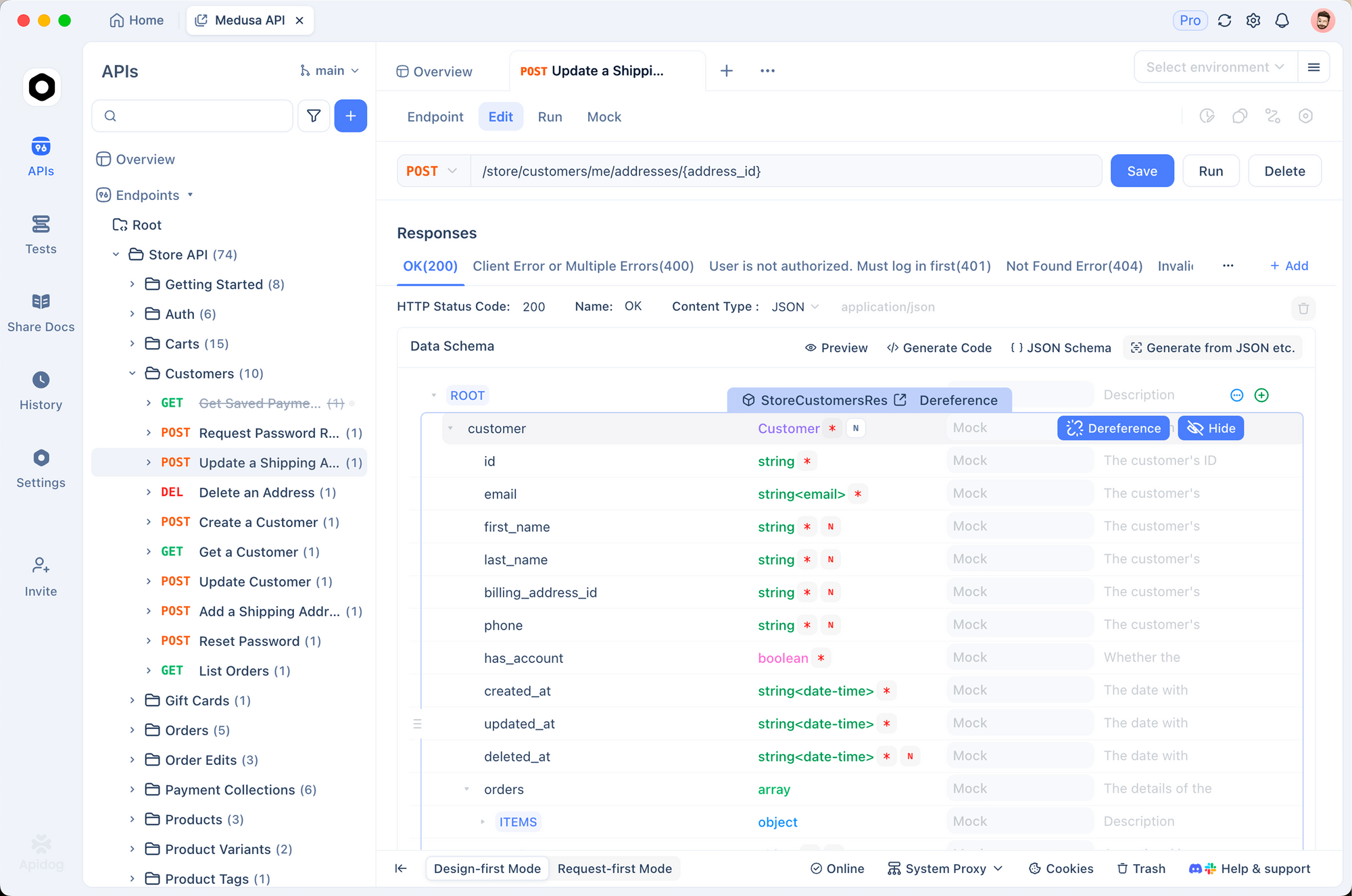
Here's how to combine both:
- Generate OpenAPI specs with Claude - Create your API definition using Claude, then import directly into Apidog via the OpenAPI import feature.
- Auto-generate test cases - Use Claude to generate pytest or Jest test scripts, then run them in Apidog's built-in test runner.
- Documentation workflow - Generate markdown docs with Claude, publish to Apidog's documentation feature, and get instant shareable links.
- Mock data creation - Let Claude generate realistic mock data for your endpoints, then use Apidog's Smart Mock to serve these responses.
Apidog supports importing from Postman, OpenAPI, and curl, making it easy to bring in Claude-generated content. The platform also offers AI-powered test generation natively, so you can compare Claude's output with Apidog's built-in AI features.
Alternative Options
If you don't qualify for Claude for OSS, here are alternatives:
Free Tier Options
| Provider | Free Tier | Limitations |
|---|---|---|
| Anthropic | 5 CPM | 5 requests/minute |
| OpenAI | $5 credit/month | Limited to older models |
| Google Gemini | 15 RPM | Fewer features |
Other OSS Programs
- OpenAI: Offers API credits for qualifying research
- Google Cloud: AI Studio credits for open-source projects
- HuggingFace: Free inference for OSS projects
Conclusion
Anthropic's Claude for OSS program is a fantastic opportunity for open-source maintainers to access powerful AI capabilities without the typical costs. Whether you're building API tools, testing frameworks, or documentation systems, free Claude access can dramatically improve your productivity.
Key Takeaways
- ✅ Apply through Anthropic's official page with proof of OSS contributions
- ✅ Up to 20x free API access for qualifying projects
- ✅ Use for documentation, testing, code generation, and more
- ✅ Batch requests to maximize your credits
- ✅ Start with Claude Sonnet for cost-effective tasks
Next Steps
- Gather documentation of your open-source contributions
- Apply at Anthropic's Claude for OSS page
- Plan your API workflow improvements
- Start integrating Claude into your development process
FAQ
How long does the application take to process?
Most applications are reviewed within 1-2 weeks. Larger projects with clear OSS credentials may get faster approval.
Can I use this for commercial projects?
No, this program is specifically for open-source projects. Commercial projects should apply through Anthropic's standard enterprise pricing.
What if my project is small but still active?
Apply anyway. While larger projects may get priority, Anthropic has shown willingness to support smaller active projects.
Can I transfer unused credits to team members?
No, credits are project-specific and cannot be transferred. Each maintainer must apply separately.
Does this include Claude 4 Opus?
Yes, approved projects typically get access to all Claude models including the latest Opus.
How do I integrate with Apidog?
While this program doesn't directly integrate with Apidog, you can use Claude to generate API specs, test cases, and documentation that you then import into Apidog for execution and management.